
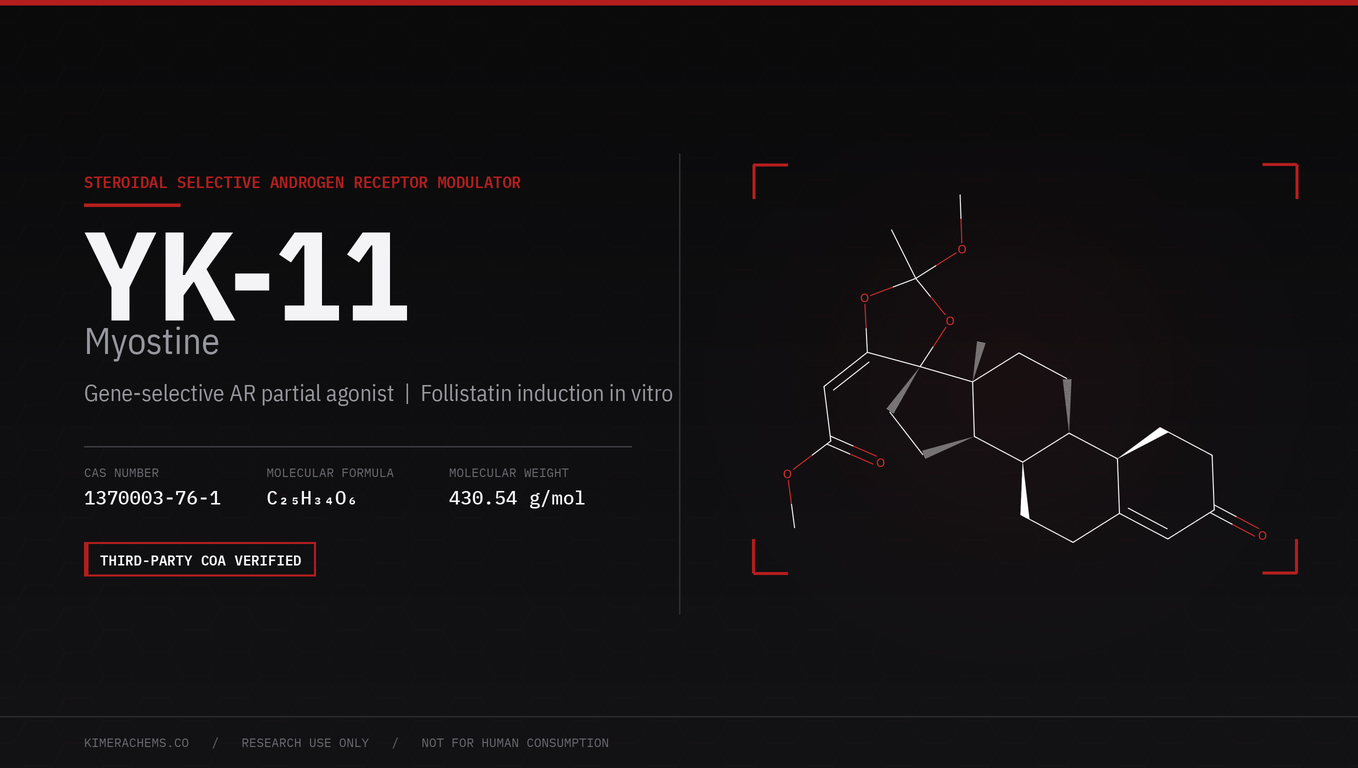
YK-11 occupies an unusual position in the research compound literature. Most compounds sold under a SARM label are non-steroidal molecules built from scratch around the androgen receptor binding pocket. YK-11 is not. It is a synthetic steroid, built on a 19-norpregnadiene scaffold with an unusual orthoester group on the D-ring. That structural difference drives nearly everything interesting about the compound. It also explains why YK-11 is genuinely difficult to analyze.
The compound also carries more marketing mythology than almost any other molecule in this category. It is routinely sold as a “myostatin inhibitor,” a claim that outruns the primary literature by a considerable distance. What follows is the published record, the analytical reality, and a clear line between the two.
Chemical Identity and Verified Identifiers
YK-11 is formally named methyl (17α,20E)-17,20-[(1-methoxyethylidene)bis(oxy)]-3-oxo-19-norpregna-4,20-diene-21-carboxylate. Kanno and colleagues at Toho University first characterized it in 2011.
| Property | Value |
|---|---|
| CAS Number | 1370003-76-1 |
| Molecular Formula | C₂₅H₃₄O₆ |
| Average Molecular Weight | 430.54 g/mol |
| Monoisotopic Mass | 430.2355 Da |
| InChIKey | KCQHQCDHFVGNMK-PQUNLUOYSA-N |
| UNII | Z9748J6B0R |
| PubChem CID | 119058028 |
| Common Synonym | Myostine |
Two structural features matter more than the rest. First, the 19-nor steroid core means YK-11 metabolizes down pathways that overlap with nandrolone-type compounds. Second, the cyclic orthoester at C-17/C-20 is an acid-labile acetal. That single group explains the stability profile, the mass spectrometry behavior, and the purity chromatograms.
The Undefined Stereocentre Most Vendors Miss
Here is a detail that rarely appears on a product page. YK-11 has seven stereocentres, but only six are defined. The acetal carbon of the orthoester is not stereochemically controlled during synthesis.
You can confirm this directly from the published InChI string, where that position is flagged as undefined. Reference suppliers state the consequence plainly on their specification sheets: YK-11 is supplied as a mixture of diastereomers.
The practical implication is significant. A split or shouldered peak in a YK-11 HPLC chromatogram is often the expected diastereomeric pair. It is not, by itself, evidence of contamination. Conversely, an unnaturally clean single peak may indicate a method that simply cannot resolve them. Reading a YK-11 certificate correctly requires knowing which situation you are looking at.
How YK-11 Activates the Androgen Receptor
The 2011 characterization study established the core pharmacology. In an androgen response element luciferase reporter assay, the compound behaved as a partial agonist of the androgen receptor. Transactivation stayed submaximal relative to dihydrotestosterone.
The mechanistic finding was more interesting than the potency. YK-11 accelerated nuclear translocation of the receptor. However, it did not induce the amino/carboxyl-terminal interaction that full androgens require for maximal transactivation. Moreover, it actively prevented DHT from establishing that N/C interaction.
This is what earns the compound its “gene-selective” description. The receptor adopts a different conformation. Consequently, it recruits different cofactors and drives a different subset of target genes. A 2022 follow-up from the same group examined this in MDA-MB-453 breast cancer cells. Differential DNA binding and cofactor recruitment, the authors reported, likely determine which genes respond to the compound versus conventional androgens.
In short, YK-11 is not a weak androgen. It is a structurally distinct one that produces a qualitatively different transcriptional output.
The Follistatin Mechanism — and the Myostatin Claim
This section deserves precision, because the marketing and the evidence diverge here.
Kanno’s 2013 study treated C2C12 mouse myoblasts with YK-11 and observed myogenic differentiation. Induction of the myogenic regulatory factors MyoD, Myf5, and myogenin exceeded what DHT produced. Critically, YK-11 induced follistatin expression while DHT did not. Blocking follistatin with a neutralizing antibody then reversed the differentiation effect.
Follistatin is an endogenous antagonist of myostatin. So the causal chain runs: YK-11 → androgen receptor → follistatin upregulation → reduced myostatin signaling.
That is an indirect mechanism. YK-11 neither binds myostatin nor inhibits it directly. The common “myostatin inhibitor” shorthand compresses a three-step pathway into a claim about direct target engagement. The primary literature does not support that claim.
Some in vivo signal does exist. A 2021 study used mice inoculated with gram-negative bacteria. YK-11 suppressed myostatin protein levels, reduced pro-inflammatory cytokines and organ damage markers, and lowered sepsis mortality. That work is a genuine finding. Even so, it remains a single infection model in mice. It does not establish the compound as a pharmacological myostatin antagonist.
Bone and Non-Genomic Signaling
Muscle is not the only tissue studied. A 2018 report examined MC3T3-E1 mouse osteoblast cells and found that YK-11 accelerated proliferation and mineralization.
Treated cells showed elevated osteoprotegerin and osteocalcin — standard osteoblast differentiation markers — and androgen receptor antagonism attenuated these effects. The study also reported increased Akt phosphorylation. Authors attributed this to rapid non-genomic androgen receptor signaling rather than transcriptional activity alone.
Taken together with the myoblast work, the in vitro picture stays consistent. Androgen-receptor-dependent anabolic signaling appears in both muscle and bone lineages, at nanomolar to sub-micromolar culture concentrations.
The Neurological Findings Nobody Advertises
Two studies from a Brazilian group complicate the picture considerably, and any honest summary has to include them.
A 2023 investigation examined the rat hippocampus and reported that YK-11 increased oxidative stress and produced mitochondrial dysfunction. The authors described the effects as comparable to those of anabolic-androgenic steroids. Notably, exercise alone was neuroprotective in their model. Exercise combined with YK-11 did not prevent the principal neurotoxic outcomes.
A 2024 follow-up combined molecular docking, in vivo work, and ex vivo analysis. Findings included high androgen receptor binding affinity in hippocampal tissue and altered aversive memory consolidation. The authors also reported downregulation of BDNF/TrkB/CREB signaling.
These are rodent studies at supraphysiological exposures, and they should not be over-read. Nevertheless, they are the only published data addressing central nervous system effects, and they point in an unfavorable direction. Vendor copy describing YK-11 as having a benign profile is describing an absence of studies, not an absence of findings.
Metabolism and Detection
The metabolic literature exists almost entirely because doping control laboratories needed it.
Human Metabolism
A 2018 study from the German Sport University Cologne anticipated extensive metabolic conversion. The labile orthoester on the D-ring made that likely. Investigators identified two urinary metabolites and confirmed both structures by independent synthesis and NMR: 5β-19-nor-pregnane-3α,17β,20-triol and 5β-19-nor-pregnane-3α,17β-diol-20-one.
Elimination behavior proved clinically relevant for testing. Unconjugated metabolites disappeared within roughly 24 hours, whereas glucuronidated and sulfated forms remained detectable beyond 48 hours. Both glucuronides were subsequently implemented into routine anabolic agent screening methods.
A 2024 case report from the UCLA Olympic Analytical Laboratory documented detection in an actual doping control sample. The approach works in practice.
Equine Metabolism
A 2023 LGC study characterized the equine picture following oral administration to two Thoroughbred horses. Twelve metabolites were observed overall, with parent YK-11 and seven phase I metabolites detected in plasma.
One methodological result is worth flagging for anyone designing in vitro work. Incubations with equine liver microsomes and S9 fractions generated 79 metabolites. Yet these showed little overlap with what actually appeared in vivo. Microsomal metabolite panels are not a reliable proxy here.
Why YK-11 Breaks Standard Analytical Methods
This is where YK-11 becomes a genuinely hard analyte, and where a certificate either means something or does not.
A 2021 Korean National Institute of Food and Drug Safety Evaluation method development study reported the problem directly. YK-11 hydrolyzes readily — within hours under acidic conditions, confirmed by NMR. More consequentially, the protonated molecular ion [M+H]⁺ at m/z 431 was not detected at all. Identity had to be confirmed through fragmentation patterns and the sodium adduct [M+Na]⁺ at m/z 453.3.
A 2017 mass spectrometry characterization explains the mechanism behind that observation. Under electrospray ionization, YK-11 protonates readily and then undergoes substantial in-source dissociation, eliminating methanol, methyl acetate, and ketene. The molecular ion largely destroys itself before reaching the analyzer.
Three practical consequences follow:
- A quantitative method built around m/z 431 will underreport or miss YK-11 entirely. Sodium adduct or fragment-based transitions are required.
- Sample handling matters more than usual. Acidic mobile phases and aqueous storage degrade the analyte during the analysis itself.
- Orthogonal confirmation is not optional. MS behavior is atypical and the diastereomer pair complicates chromatography. NMR therefore delivers identity confirmation that neither method provides alone.
We cover the complementary strengths of each technique in more detail in HPLC, mass spectrometry, and NMR. YK-11 is close to a textbook case for why single-method characterization fails.
What Independent Testing Actually Finds
The supply chain record for this compound class is poor, and it is documented.
A 2017 analysis published in JAMA examined 44 products sold online as SARMs. Labels and contents diverged substantially. A 2021 UK study reached similar conclusions. Investigators found products with no active ingredient, products containing undeclared prohibited analytes, and concentrations that did not match packaging. The 2021 Korean survey of 60 supplements found YK-11 present in products where it was not declared on the label.
The most recent example comes from the FDA. An adverse event report involving a stroke prompted agency testing of a product named GE Labs Ykarine. Testing confirmed the declared YK-11 was present. It also identified undeclared trendione, an anabolic steroid classified as a Schedule III controlled substance.
That case is instructive because the labeled compound was real. The danger came from what the label omitted.
Every batch in the Kimera catalog is characterized through third-party COA verification. The full COA archive is public and batch-searchable. Given YK-11’s ionization behavior and hydrolytic instability, the methods behind a certificate matter as much as the number printed on it.
Regulatory Status
The position is unambiguous across jurisdictions.
YK-11 has never been approved by any regulatory agency, anywhere, for any indication. No human clinical trial has ever been conducted. The World Anti-Doping Agency prohibits it under Section S1, Anabolic Agents, both in and out of competition.
The FDA has stated repeatedly that SARMs are unapproved drugs rather than dietary supplements. Agency reporting documents liver injury, cardiovascular events, and other serious outcomes tied to this product class. A 2024 review in European Journal of Clinical Pharmacology analyzed suspected adverse event cases. Drug-induced liver injury was the dominant reported presentation.
YK-11 is supplied by Kimera Chems strictly for laboratory research use. It is not for human consumption, nor for medical, veterinary, or household use. Review our Terms and Conditions before ordering.
Laboratory Handling and Stability
Storage behavior follows directly from the chemistry.
The orthoester is acid-labile and hydrolyzes in aqueous media. Consequently, YK-11 should be kept dry, dark and sealed at controlled room temperature. Storage guidance is a house recommendation. Analytical documentation is per-lot release testing.
Solution stability is a different matter. YK-11 dissolves in DMSO and other organic solvents, but aqueous or acidified solutions degrade on a timescale of hours rather than days. Therefore, prepare working dilutions fresh, avoid acidic buffers where possible, and verify concentration analytically if a stock has been held.
Kimera supplies YK-11 in several research formats, including YK-11 (Myostine) as powder, capsule, and solution presentations. Combination solutions support comparative receptor work. Both RAD-140/YK-11 and LGD-4033/YK-11 pair a non-steroidal SARM against the steroidal scaffold in a single system.
What the Evidence Supports
Stripped of promotional framing, the YK-11 record is narrow but real.
Reasonably established: partial agonism at the androgen receptor without the N/C interaction; a distinct transcriptional profile driven by differential cofactor recruitment; follistatin induction in C2C12 myoblasts; osteoblast proliferation and differentiation in MC3T3-E1 cells; well-characterized metabolism in humans and horses.
Preliminary or single-study: myostatin suppression and survival benefit in a murine sepsis model; hippocampal oxidative stress and mitochondrial dysfunction in rats.
Not established: any effect in humans; direct myostatin inhibition; any safety profile whatsoever.
The gap between the last category and how YK-11 is typically marketed is the single most important thing to understand about this compound. Browse additional receptor modulator profiles in our SARMs research library.
Frequently Asked Questions
Is YK-11 a SARM or a steroid?
Both descriptions are defensible. YK-11 is structurally a synthetic steroid built on a 19-norpregnadiene core, which distinguishes it from non-steroidal SARMs such as RAD-140 or LGD-4033. Functionally, it behaves as a selective androgen receptor modulator. It produces gene-selective transactivation rather than full androgenic signaling.
Does YK-11 actually inhibit myostatin?
Not directly. The published mechanism is androgen-receptor-mediated induction of follistatin, which then antagonizes myostatin. One murine sepsis study reported reduced myostatin protein levels in vivo. No study has demonstrated direct binding or inhibition of myostatin by YK-11.
Why does a YK-11 COA sometimes show two peaks?
The orthoester acetal carbon is not stereochemically controlled during synthesis. YK-11 is therefore supplied as a mixture of diastereomers. A resolved pair on a selective HPLC method is expected behavior, not an impurity finding.
Has YK-11 been tested in humans?
No. No clinical trial of YK-11 has ever been registered or conducted. All efficacy data derives from cell culture and animal models.
How is YK-11 detected in anti-doping testing?
Laboratories target the glucuronidated metabolites rather than the parent compound, since unconjugated species clear quickly. The two markers are 5β-19-nor-pregnane-3α,17β,20-triol and 5β-19-nor-pregnane-3α,17β-diol-20-one. These metabolites are integrated into routine anabolic agent screening panels.
References
Primary Pharmacology
- Kanno Y, Hikosaka R, Zhang SY, et al. (17α,20E)-17,20-[(1-Methoxyethylidene)bis(oxy)]-3-oxo-19-norpregna-4,20-diene-21-carboxylic acid methyl ester (YK11) is a partial agonist of the androgen receptor. Biol Pharm Bull. 2011;34(3):318–323. doi:10.1248/bpb.34.318
- Kanno Y, Ota R, Someya K, Kusakabe T, Kato K, Inouye Y. Selective androgen receptor modulator, YK11, regulates myogenic differentiation of C2C12 myoblasts by follistatin expression. Biol Pharm Bull. 2013;36(9):1460–1465. doi:10.1248/bpb.b13-00231
- Yatsu T, Kusakabe T, Kato K, Inouye Y, Nemoto K, Kanno Y. Selective androgen receptor modulator, YK11, up-regulates osteoblastic proliferation and differentiation in MC3T3-E1 cells. Biol Pharm Bull. 2018;41(3):394–398. PMID: 29491216
- Kanno Y, Saito N, Saito R, et al. Differential DNA-binding and cofactor recruitment are possible determinants of the synthetic steroid YK11-dependent gene expression by androgen receptor in breast cancer MDA-MB-453 cells. Exp Cell Res. 2022;419(2):113333. PMID: 36030969
- Lee SJ, Gharbi A, Shin JE, Jung ID, Park YM. Myostatin inhibitor YK11 as a preventative health supplement for bacterial sepsis. Biochem Biophys Res Commun. 2021;543:1–7. PMID: 33588136
Toxicology
- Dahleh MMM, Bortolotto VC, Guerra GP, Boeira SP, Prigol M. YK11 induces oxidative stress and mitochondrial dysfunction in hippocampus: the interplay between a selective androgen receptor modulator (SARM) and exercise. J Steroid Biochem Mol Biol. 2023;233:106364. PMID: 37468001
- Dahleh MMM, Bortolotto VC, Boeira SP, Segat HJ, Guerra GP, Prigol M. From gains to gaps? How selective androgen receptor modulator (SARM) YK11 impacts hippocampal function: in silico, in vivo, and ex vivo perspectives. Chem Biol Interact. 2024;394:110971. PMID: 38521455
- Leciejewska N, Jędrejko K, Gómez-Renaud VM, Manríquez-Núñez J, Muszyńska B, Pokrywka A. Selective androgen receptor modulator use and related adverse events including drug-induced liver injury: analysis of suspected cases. Eur J Clin Pharmacol. 2024;80(2):185–202. doi:10.1007/s00228-023-03592-3
Analytical Chemistry and Metabolism
- Thevis M, Piper T, Dib J, et al. Mass spectrometric characterization of the selective androgen receptor modulator (SARM) YK-11 for doping control purposes. Rapid Commun Mass Spectrom. 2017;31(14):1175–1183. doi:10.1002/rcm.7886
- Piper T, Dib J, Putz M, et al. Studies on the in vivo metabolism of the SARM YK11: identification and characterization of metabolites potentially useful for doping controls. Drug Test Anal. 2018;10(11–12):1646–1656. doi:10.1002/dta.2527
- Harding C, Viljanto M, Habershon-Butcher J, Taylor P, Scarth J. Equine metabolism of the selective androgen receptor modulator YK-11 in urine and plasma following oral administration. Drug Test Anal. 2023;15(4):388–407. PMID: 36519889
- Sobolevsky T, Kucherova Y, Ahrens B. Detection of selective androgen receptor modulator YK-11 in a doping control sample. Drug Test Anal. 2024;16(6):655–660. doi:10.1002/dta.3604
- Lee JH, Han JH, Jung EJ, et al. Development and validation of liquid chromatography-tandem mass spectrometry method for screening six selective androgen receptor modulators in dietary supplements. Food Addit Contam Part A. 2021;38(7):1075–1086. doi:10.1080/19440049.2021.1906954
- Thevis M, Schänzer W. Detection of SARMs in doping control analysis. Mol Cell Endocrinol. 2018;464:34–45. doi:10.1016/j.mce.2017.01.040
Product Quality and Regulatory
- Van Wagoner RM, Eichner A, Bhasin S, Deuster PA, Eichner D. Chemical composition and labeling of substances marketed as selective androgen receptor modulators and sold via the internet. JAMA. 2017;318(20):2004–2010. doi:10.1001/jama.2017.17069
- Leaney AE, Beck P, Biddle S, et al. Analysis of supplements available to UK consumers purporting to contain selective androgen receptor modulators. Drug Test Anal. 2021;13(1):122–127. doi:10.1002/dta.2908
- U.S. Food and Drug Administration. Certain bodybuilding products put consumers at risk for heart attack, stroke, serious liver damage and more. Updated December 2, 2025. FDA.gov
- World Anti-Doping Agency. Prohibited List, Section S1: Anabolic Agents — Selective Androgen Receptor Modulators. wada-ama.org
All compounds referenced are supplied for laboratory research use only. Nothing published here constitutes dosing guidance, a therapeutic claim, or a recommendation for use in humans or animals.