
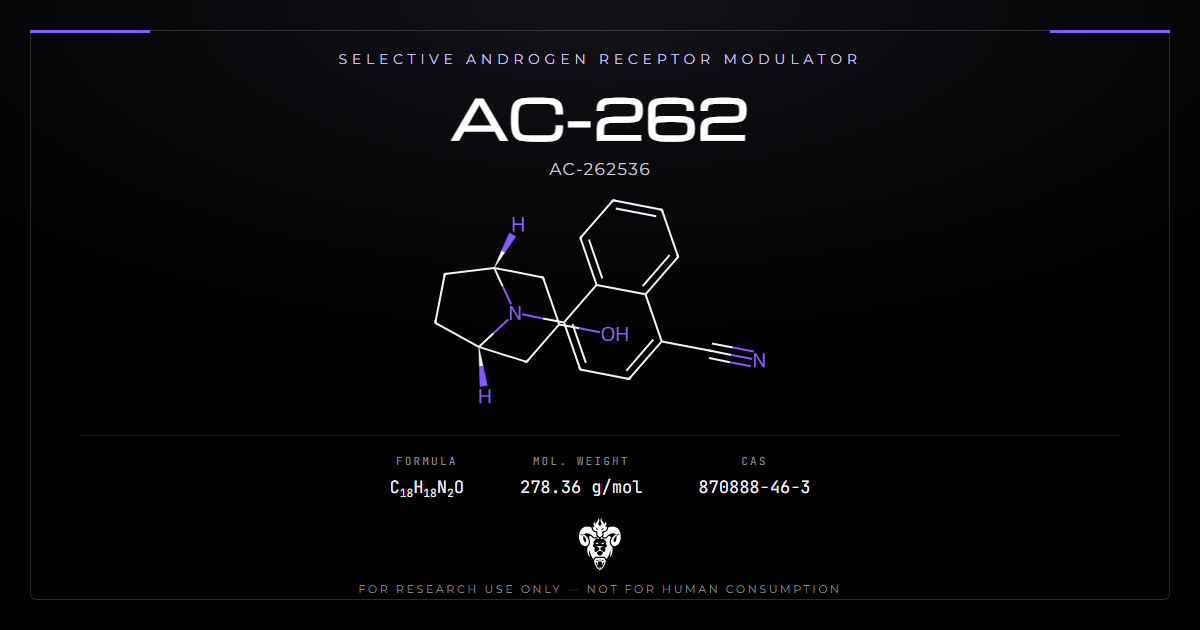
AC-262 occupies an odd position in the research supply space. Vendor copy tends to file it alongside the aryl propionamide SARMs as though it were a minor variation on ostarine. It is not. The scaffold is a tropane. The pharmacology is partial agonism rather than full. And the compound belongs to a chemical class that anti-doping laboratories index separately from every other SARM in circulation.
It also carries a reputation for having almost no literature. That was defensible a decade ago. It no longer is, because a second primary study characterised the compound’s metabolism in detail, and a validated analytical method now covers it explicitly.
What follows covers four things. The receptor biology AC-262 acts on, and what the two primary studies actually measured. Why tissue selectivity in this class remains an unsettled mechanistic question. And how to read a certificate of analysis for a molecule whose defining property no purity figure reports.
Chemical identity: what you are actually handling
AC-262536 is 4-[(1R,5S)-3-hydroxy-8-azabicyclo[3.2.1]octan-8-yl]naphthalene-1-carbonitrile, indexed as PubChem CID 44512434. It is a small non-steroidal molecule with no steroid nucleus and no amide backbone. It bears no relationship to the aryl propionamides beyond a shared receptor.
| Property | Value |
|---|---|
| IUPAC name | 4-[(1R,5S)-3-hydroxy-8-azabicyclo[3.2.1]octan-8-yl]naphthalene-1-carbonitrile |
| Common synonyms | AC-262, AC-262536, AC-262,536 |
| CAS | 870888-46-3 |
| Molecular formula | C18H18N2O |
| Molecular weight | 278.35 g/mol |
| PubChem CID | 44512434 |
| InChIKey | ATKWLNSCJYLXPF-YIONKMFJSA-N |
| Chemical class | Tropanol derivative |
| Molecular target | Androgen receptor (AR) |
| Originator | ACADIA Pharmaceuticals |
The tropane scaffold is unusual for this class
The core is an 8-azabicyclo[3.2.1]octane carrying a hydroxyl at position 3, bridged through its ring nitrogen to a naphthalene bearing a nitrile. That bicyclic amine is the tropane skeleton, the same framework found in atropine and cocaine, though AC-262 carries none of their pharmacology.
This matters for classification rather than trivia. When Italian anti-doping chemists built a method covering nineteen SARMs across nine chemical classes, they placed AC-262536 in its own category, the tropanol derivatives, alongside only ACP-105 [3]. Every other compound most laboratories think of as a SARM sits elsewhere. Ostarine and andarine fall among the aryl propionamides, RAD-140 among the phenyl-oxadiazoles. LGD-4033 sits with the pyrrolidinyl-benzonitriles, LGD-3303 with the quinolinones [3].
A method validated for one class does not automatically transfer to another. The naphthalene chromophore and the bridged amine give AC-262 chromatographic and fragmentation behaviour that the propionamide methods were never designed around.
The androgen receptor, and what selectivity has to mean
Understanding what AC-262 claims to do requires understanding the problem the SARM class was built to solve.
Testosterone and its 5α-reduced metabolite dihydrotestosterone act through a single receptor protein encoded on the X chromosome [10]. One receptor mediates effects in skeletal muscle and effects in prostate tissue alike. A ligand that activates the receptor should therefore act everywhere the receptor is expressed, which is precisely what steroidal androgens do.
The SARM premise is that this need not follow. Suppose a ligand produces receptor activation in muscle and bone while producing less in prostate and seminal vesicle. It then separates two effects that endogenous androgens deliver together [8]. Two decades of medicinal chemistry across aryl propionamide, hydantoin, quinoline, and tetrahydroquinoline scaffolds pursued exactly that separation [15].
Why tissue selectivity needs an explanation
A single receptor producing different outcomes in different tissues is not obvious. Two competing explanations dominate the literature, and neither has fully displaced the other.
The 5α-reductase explanation
Gao and Dalton argued the simplest account is often overlooked [4]. Prostate tissue expresses 5α-reductase at high levels; skeletal muscle expresses it at negligible levels. Testosterone entering prostate tissue is converted to the more potent dihydrotestosterone, amplifying the local signal. Testosterone entering muscle is not.
A non-steroidal ligand cannot undergo 5α-reduction at all. It therefore receives no prostate amplification, and its muscle-to-prostate ratio improves without any special receptor behaviour. Tóth made a parallel argument for nandrolone. It undergoes 5α-reduction to a less potent derivative, and shows myotropic-androgenic dissociation for the same structural reason [9].
On this account, selectivity is a property of tissue enzymology rather than of the ligand.
The coregulator explanation
The competing account starts from ligand shape. Different ligands impose different conformations on the receptor, and those conformations recruit different sets of coregulatory proteins [7].
The evidence here is direct. Furuya and colleagues showed the SARM S-101479 activated the receptor in osteoblastic cells much as dihydrotestosterone did. Yet it stimulated receptor dimerisation at only 34.4 percent of the dihydrotestosterone level [5]. Yeast two-hybrid screening showed dihydrotestosterone recruited a broad cofactor panel: TIF2, SRC1, β-catenin, NCoA3, gelsolin, and PROX1. S-101479 failed to recruit the canonical p160 coactivators. It engaged only gelsolin and PROX1 [5].
Hikichi and colleagues extended this with a 112-cofactor screen comparing TSAA-291 against dihydrotestosterone [6]. Twelve cofactors differed, among them PIAS1, which prostate tissue expresses more highly than skeletal muscle. Forced PIAS1 expression raised receptor transcriptional activity, and silencing it suppressed prostate-specific antigen secretion [6].
That study is worth dwelling on for a further reason. TSAA-291 increased levator ani weight in castrated mice without increasing prostate or seminal vesicle weight [6]. It produced the same result pattern reported for AC-262, through a mechanism the authors could partially attribute to differential cofactor recruitment.
Both explanations are probably operating. Neither has been tested for AC-262 specifically.
What the primary literature on AC-262 established
Two studies characterise this compound directly. They address entirely different questions.
Partial agonism in the functional assay
Piu and colleagues identified AC-262536 in a functional cell-based assay. They characterised it as a potent and selective androgen receptor ligand with partial agonist activity relative to testosterone [1].
Partial agonism is the defining property and it carries a specific consequence. A partial agonist produces a submaximal response even at saturating concentration. In the presence of a full agonist it competes, behaving as a functional antagonist. In an androgen-replete system a partial agonist can therefore lower net receptor output rather than raise it. Study design has to account for background androgen state, which is why the published in vivo work used castrated animals.
The castrated rat study
All in vivo pharmacology comes from a single two-week study in castrated male rats [1]. AC-262536 improved anabolic parameters, measured principally as levator ani muscle growth. It also suppressed elevated luteinising hormone, the expected consequence of receptor engagement at the pituitary in a castrated animal.
Androgenic effects were weak by comparison, measured as prostate and seminal vesicle weights. The authors described this as being in sharp contrast to testosterone [1].
That combination is the entire rationale of the SARM class, demonstrated cleanly in one model.
The metabolism study
The second primary study is more recent and less often cited. Cutler and colleagues characterised AC-262536 metabolism in horses. They worked both in vitro with liver microsomes and in vivo after oral administration to two Thoroughbreds, sampling urine, plasma, and hair [2].
Nine phase I metabolites appeared in vitro. Four of those reached urine and three reached plasma, alongside parent compound in both. Both parent and metabolites circulated primarily as glucuronide conjugates. Parent compound incorporated into hair after oral dosing, while no metabolites did [2].
The finding with the most analytical weight concerns an epimer of the parent compound. It showed the longest detection window in both urine and plasma. The authors proposed it as the preferred target for detecting administration [2].
An epimer differs from the parent only in configuration at one stereocentre. It shares the molecular formula, the accurate mass, and the fragmentation behaviour. A stereochemical variant is therefore the best analytical handle on this compound. That says a great deal about how much of its identity mass spectrometry alone cannot see.
What the record still does not establish
The pharmacology rests on one two-week study, in one species, in one hormonal state. There is no toxicology, no chronic dosing, no second mammalian pharmacology species, and no independent replication of the original findings. Published selectivity figures against other nuclear receptors are absent.
The metabolism work is thorough but equine, conducted for doping-control purposes rather than pharmacological ones [2]. It reports what the horse does to the compound, not what the compound does to the horse.
Nothing in either study supports a claim about behaviour in an intact animal. The partial-agonist classification makes that gap more consequential rather than less.
Reading partial agonism correctly
Three implications follow from the classification, and each changes how an experiment should be built.
The baseline matters. In a castrated or androgen-depleted model, a partial agonist raises signalling. In an intact model it competes with endogenous androgen and can reduce it. The same compound produces opposite-signed results depending on hormonal background.
The ceiling matters. Raising concentration will not produce a testosterone-equivalent response. A dose-response curve plateauing below the full-agonist maximum is the expected result rather than a failed experiment.
The comparator matters. A study without a full-agonist arm cannot demonstrate partial agonism at all. Testosterone or dihydrotestosterone belongs in the design, and its absence makes the central claim untestable.
Where AC-262 sits among SARMs
The class literature is uneven, and AC-262 sits at its thin end. Placing it against better-studied members clarifies what a citation to it can carry.
| Compound | Chemical class | Deepest published evidence |
|---|---|---|
| Enobosarm (ostarine) | Aryl propionamide | Randomised phase 2 in cancer patients [11]; phase 3 programme [12] |
| Andarine (S-4) | Aryl propionamide | Preclinical, extensive doping-control metabolism [17] |
| RAD-140 | Phenyl-oxadiazole | Preclinical, covered by validated assays [3] |
| LGD-4033 | Pyrrolidinyl-benzonitrile | Preclinical and early clinical, frequent doping findings [16] |
| LGD-3303 | Quinolinone | Preclinical only |
| AC-262536 | Tropanol | One pharmacology paper [1]; one equine metabolism study [2] |
The compounds that reached clinical trials
Enobosarm is the reference point. Dobs and colleagues ran a randomised double-blind placebo-controlled phase 2 trial. Patients had cancer and at least two percent weight loss. Total lean body mass rose significantly on dual-energy X-ray absorptiometry, against a placebo group showing no significant change [11]. A phase 3 programme followed. Its designers built it with regulatory input around co-primary endpoints of stair climb power and lean body mass [12].
That is what a developed compound’s evidence base looks like. Reviews of the agent span its phase 1 through phase 3 record [13], and it still holds no marketing approval.
What the class as a whole has not shown
No SARM has been approved in any jurisdiction. Reviews of pharmacotherapy for sarcopenia make the position plain. Few agents developed for muscle wasting have met clinically relevant outcomes for strength and physical performance, and the field still lacks approved treatments [14]. The tissue-selectivity premise remains promising and unproven at the level of clinical benefit [7].
AC-262 is several steps behind even that position. Treating it as a characterised pharmacological agent goes well beyond what two studies support. Using it as a defined partial-agonist comparator is reasonable, and that is the role the literature actually licenses.
Physicochemical properties and handling
The molecule carries a secondary alcohol, a tertiary aryl amine, and an aromatic nitrile. None is strongly labile under ordinary conditions.
The secondary alcohol is the most reactive handle. Under forcing oxidative conditions it converts to the corresponding ketone. That is the degradant worth looking for on a stability-indicating method. Hydrolysis of the nitrile requires strong acid or base. A weakly basic tertiary amine gives the molecule pH-dependent aqueous solubility.
Strong ultraviolet absorbance from the naphthalene makes HPLC-UV detection straightforward and sensitive without derivatisation.
Store the solid sealed, dry, cold, and dark.
Analytical characterisation
Four methods cover this compound, and they answer different questions.
Accurate mass and formula
Accurate mass confirms C18H18N2O at 278.35. Two nitrogens and one oxygen give a distinctive composition. It separates AC-262 cleanly from the aryl propionamides, which carry different elemental signatures. This is the fastest check and the least ambiguous.
Nuclear magnetic resonance
Proton NMR confirms the bicyclic core. The 8-azabicyclo[3.2.1]octane produces a characteristic bridged-ring proton pattern. No other SARM scaffold in circulation reproduces it, so the spectrum settles identity rather than merely supporting it.
Chiral chromatography
Stereochemistry needs its own method. The published compound carries a defined (1R,5S) configuration. A stereoisomer shares formula, accurate mass, and fragmentation. Only a chiral separation reports it. The equine metabolism data make the point concrete, because the epimer is a real detectable species with its own behaviour in vivo [2].
Methods from the anti-doping literature
Doping-control laboratories have developed the most rigorous analytical treatment of these compounds. They must identify them at trace concentrations in complex matrices.
Thevis and Schänzer catalogued electrospray and electron-ionisation fragmentation pathways across the SARM chemical classes. Structural heterogeneity across the class makes detection method development difficult [15]. Stacchini and colleagues validated screening and confirmation procedures covering AC-262536. Detection capability fell in the range of 0.1 to 1.0 ng/mL, with recovery above 80 percent and matrix effects under 35 percent [3].
Where reference standards for metabolites are lacking, groups have synthesised them directly to serve as analytical references [17]. That literature is a useful source of method parameters for anyone developing an assay for this compound.
What a rigorous AC-262 certificate should contain
Most certificates report chromatographic purity and stop. For this molecule that leaves the important questions open.
Chromatographic purity, with the method stated. Straightforward given the naphthalene chromophore, and the least informative of the four items here.
Accurate mass, confirming the molecular formula rather than a nominal value.
Structural confirmation by NMR, establishing the bridged bicyclic amine rather than a propionamide substitute sold under the same name.
Stereochemical purity by a chiral method. The compound’s activity depends on a configuration no mass measurement reports. The metabolism literature confirms the epimer is a real species rather than a theoretical concern [2].
Kimera publishes third-party certificates of analysis for every lot in its COA database. Laboratories source AC-262536 as a reference partial agonist. It is often paired with RAD-140 (Testolone) as a full-agonist comparator, and with LGD-3303 as a quinolinone-class reference. Related receptor chemistry appears in the SARMs category.
Regulatory and compliance status
AC-262536 holds no marketing approval in any jurisdiction and has never entered human clinical trials.
The World Anti-Doping Agency has categorised SARMs as anabolic agents and prohibited them since January 2008 [15]. They sit under section S1.2, prohibited at all times, in and out of competition [16]. Adverse analytical findings attributed to SARMs rose steadily across WADA testing figures through the second half of the 2010s. Ostarine and ligandrol accounted for most of them [16].
That enforcement context has produced a secondary literature worth knowing about. Athletes returning adverse findings have frequently blamed contaminated dietary supplements. Forensic practice now includes testing supplements, hair, and nail clippings to evaluate such claims [16]. Kintz notes that a negative hair result cannot exclude use and cannot overrule a urine result [16].
For a research laboratory the practical reading is straightforward. Material of uncertain provenance carries analytical risk that documentation resolves and assurances do not.
Common misclassifications
Three errors recur in how AC-262 is described.
Suppliers call it an aryl propionamide SARM. It is a tropanol derivative, classified separately in the analytical literature and structurally unrelated to that series [3].
Summaries describe it as having no data beyond one paper. The metabolism study provides in vitro and in vivo characterisation across three matrices [2]. Validated detection methods cover it explicitly [3].
It is compared with other SARMs on potency alone. Potency comparisons across a full agonist and a partial agonist mislead without efficacy reported alongside. Two compounds with identical half-maximal concentrations can differ entirely in maximal response. That difference is the whole point of the classification.
Experimental design considerations
Four points follow from the pharmacology and the analytical record.
Use a gonadectomised model or justify not doing so. Every reported in vivo result comes from castrated rats. A partial agonist behaves differently against an intact androgen background [1].
Include a full-agonist arm. Testosterone or dihydrotestosterone makes the partial classification measurable rather than assumed.
Measure both tissue types. Levator ani mass alone reports anabolic response. Prostate and seminal vesicle weights turn that into a selectivity ratio, and the ratio is the claim [1].
Verify stereochemical identity before starting. The epimer is detectable, distinguishable only by chiral methods, and known to behave differently in vivo [2].
Frequently asked questions
What is AC-262? A non-steroidal androgen receptor partial agonist, CAS 870888-46-3, originated at ACADIA Pharmaceuticals. Kimera supplies it as a laboratory research material.
How does a partial agonist differ from a full agonist? It produces a submaximal response at saturation. Against a full agonist it competes, so in an androgen-replete system it can lower net signalling [1].
What does the animal record show? One two-week study in castrated male rats. Levator ani growth and luteinising hormone suppression, with weak prostate and seminal vesicle effects compared with testosterone [1].
Is there any pharmacokinetic data? Yes, in horses. Nine phase I metabolites in vitro. Four reached urine and three reached plasma, mostly as glucuronide conjugates, with parent compound incorporating into hair [2].
Which name should I record? The CAS, 870888-46-3. Short codes vary between suppliers and AC-262 sits near unrelated alphanumerics.
Does it aromatise? It carries no steroid nucleus, so it is not an aromatase substrate.
Is a chiral method necessary? Yes. The compound has defined stereochemistry, mass spectrometry cannot report it, and an epimer is known to circulate [2].
Is AC-262 approved anywhere? No. It holds no marketing approval and has not entered human trials.
Why do anti-doping laboratories classify it separately? Its tropanol scaffold differs from every other SARM class, and methods validated for aryl propionamides do not transfer automatically [3].
Summary of the evidence
Identity: confirmed by CAS, formula, accurate mass, and a distinctive bridged-ring NMR signature.
Classification: partial agonist at the androgen receptor, established in a functional cell assay [1].
In vivo pharmacology: one two-week study in castrated male rats [1].
Endpoints moved: levator ani mass up, luteinising hormone suppressed. Endpoints spared: prostate and seminal vesicle weights [1].
Metabolism: characterised in horses across urine, plasma, and hair, with an epimer of parent as the longest-lived analytical target [2].
Mechanism of selectivity: unresolved for this compound. Tissue 5α-reductase distribution [4][9] and differential cofactor recruitment [5][6] both remain live explanations for the class.
Gaps: no toxicology, no second mammalian pharmacology species, no replication, no published nuclear receptor selectivity panel.
Status: no approval anywhere, prohibited in sport at all times under WADA section S1.2 [16].
References
- Piu F, Gardell LR, Son T, et al. Pharmacological characterization of AC-262536, a novel selective androgen receptor modulator. J Steroid Biochem Mol Biol. 2008;109(1-2):129-137. PMID 18164613. DOI
- Cutler C, Viljanto M, Taylor P, et al. Equine metabolism of the selective androgen receptor modulator AC-262536 in vitro and in urine, plasma and hair following oral administration. Drug Test Anal. 2021;13(2):369-385. PMID 32959959. DOI
- Stacchini C, Botrè F, Comunità F, et al. Simultaneous detection of different chemical classes of selective androgen receptor modulators in urine by liquid chromatography-mass spectrometry-based techniques. J Pharm Biomed Anal. 2021;195:113849. PMID 33383501. DOI
- Gao W, Dalton JT. Ockham’s razor and selective androgen receptor modulators (SARMs): are we overlooking the role of 5alpha-reductase? Mol Interv. 2007;7(1):10-13. PMID 17339601. DOI
- Furuya K, Yamamoto N, Ohyabu Y, et al. Mechanism of the tissue-specific action of the selective androgen receptor modulator S-101479. Biol Pharm Bull. 2013;36(3):442-451. PMID 23449329. DOI
- Hikichi Y, Yamaoka M, Kusaka M, Hara T. Selective androgen receptor modulator activity of a steroidal antiandrogen TSAA-291 and its cofactor recruitment profile. Eur J Pharmacol. 2015;765:322-331. PMID 26335395. DOI
- Zhang X, Sui Z. Deciphering the selective androgen receptor modulators paradigm. Expert Opin Drug Discov. 2013;8(2):191-218. PMID 23231475. DOI
- Omwancha J, Brown TR. Selective androgen receptor modulators: in pursuit of tissue-selective androgens. Curr Opin Investig Drugs. 2006;7(10):873-881. PMID 17086931
- Tóth M. Myoanabolic steroids and selective androgen receptor modulators: mechanism of action and perspectives. Orv Hetil. 2009;150(45):2051-2059. PMID 19861292. DOI
- McPhaul MJ, Young M. Complexities of androgen action. J Am Acad Dermatol. 2001;45(3 Suppl):S87-S94. PMID 11511858. DOI
- Dobs AS, Boccia RV, Croot CC, et al. Effects of enobosarm on muscle wasting and physical function in patients with cancer: a double-blind, randomised controlled phase 2 trial. Lancet Oncol. 2013;14(4):335-345. PMID 23499390. DOI
- Crawford J, Prado CM, Johnston MA, et al. Study design and rationale for the phase 3 clinical development program of enobosarm, a selective androgen receptor modulator, for the prevention and treatment of muscle wasting in cancer patients (POWER trials). Curr Oncol Rep. 2016;18(6):37. PMID 27138015. DOI
- Srinath R, Dobs A. Enobosarm (GTx-024, S-22): a potential treatment for cachexia. Future Oncol. 2014;10(2):187-194. PMID 24490605. DOI
- Hardee JP, Lynch GS. Current pharmacotherapies for sarcopenia. Expert Opin Pharmacother. 2019;20(13):1645-1657. PMID 31120352. DOI
- Thevis M, Schänzer W. Mass spectrometry of selective androgen receptor modulators. J Mass Spectrom. 2008;43(7):865-876. PMID 18521833. DOI
- Kintz P. The forensic response after an adverse analytical finding (doping) involving a selective androgen receptor modulator (SARM) in human athlete. J Pharm Biomed Anal. 2022;207:114433. PMID 34715583. DOI
- Garg N, Hansson A, Knych HK, et al. Structural elucidation of major selective androgen receptor modulator (SARM) metabolites for doping control. Org Biomol Chem. 2018;16(5):698-702. PMID 29319101. DOI
AC-262536 is sold for laboratory research use only. Not for human consumption, nor medical, veterinary, or household uses.
Literature retrieved from PubMed.