
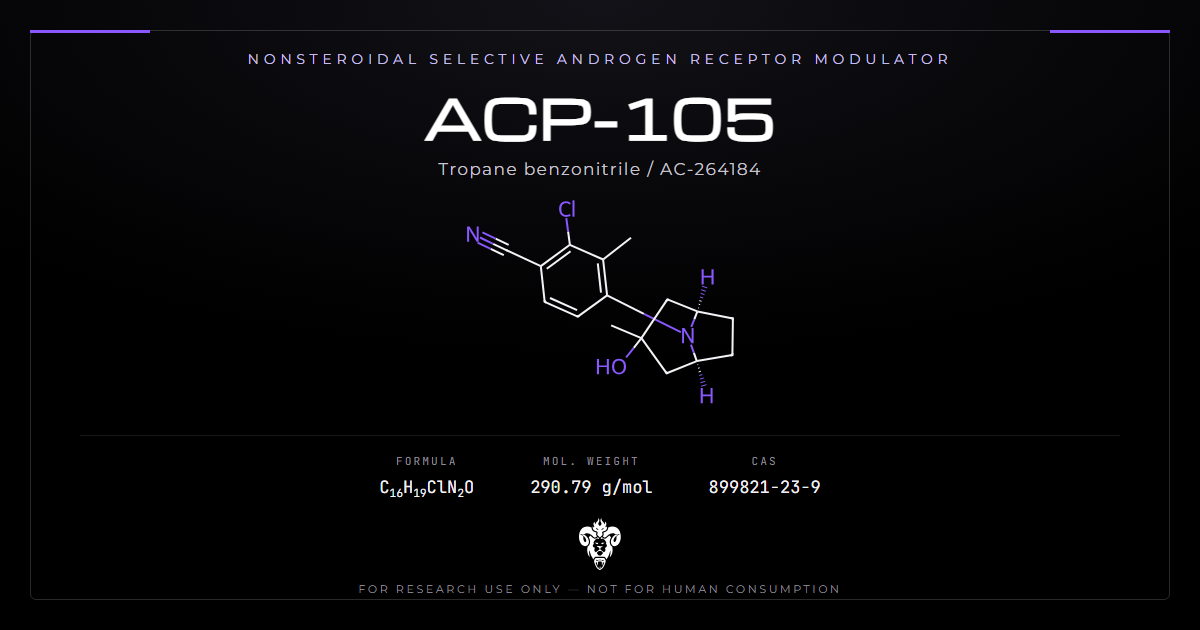
Thirteen indexed papers name this compound. Three of them describe what it does in a living animal. Eight describe how to find it in urine, plasma or hair. Two predict its behaviour with software.
That ratio is the article. ACP-105 is a molecule the doping-control field knows in fine detail and the pharmacology field stopped examining in 2013. Twenty-one metabolites have been mapped in the horse. Nobody has run a second efficacy study.
Three consequences follow, and each one has a section below. The muscle and prostate numbers everyone quotes come from the in-vivo paragraph of a medicinal chemistry paper. The neuroprotection claim rests on a combination treatment rather than on ACP-105 alone. And one person has taken it on the published record. The dose was 100 micrograms and the endpoint was a mass spectrum.
Chemical identity
| Property | Value |
|---|---|
| Common names | ACP-105, AC-264184 |
| Molecular formula | C16H19ClN2O |
| Molecular weight | 290.79 g/mol |
| CAS | 899821-23-9 |
| PubChem CID | 11638442 |
| InChIKey | OUEODVPKPRQETQ-OCZCAGDBSA-N |
| Class | Nonsteroidal tropane benzonitrile |
| Configuration | 3-endo, (1R,5S) |
| Originator | ACADIA Pharmaceuticals |
The catalogue carries it as ACP-105.
Two CAS numbers, one skeleton
Two registry numbers circulate for this molecule and they are not interchangeable. CAS 899821-23-9 resolves to PubChem CID 11638442, InChIKey OUEODVPKPRQETQ-OCZCAGDBSA-N, the 3-endo isomer with its stereochemistry defined. CAS 1048998-11-3 resolves to CID 11507567, InChIKey OUEODVPKPRQETQ-UHFFFAOYSA-N.
Read the second block of those two keys. Same connectivity, different stereochemical hash, and UHFFFAOYSA is the marker for an entry with no stereochemistry assigned. Both 2025 computational papers put the undefined number in their titles [12][13].
That does not by itself invalidate a prediction, since several of those tools work from connectivity anyway. It does mean a certificate quoting one number and a paper quoting the other are describing different database records. The compound also answers to an older internal code, AC-264184, which Dayger and colleagues note in their methods [2].
The tropane ring, and why it returns later
Most of the class shares an arylpropionamide backbone. Ostarine, andarine and S-23 all sit on it. ACP-105 does not. It joins a chlorinated methylbenzonitrile to an 8-azabicyclo[3.2.1]octane, the tropane skeleton, carrying a tertiary alcohol at position 3.
Thevis and colleagues call the pharmacophore an N-substituted tropanol [4]. That alcohol turns out to be the whole metabolic story. Every metabolite paper below reports hydroxylation and water loss around it.
What the literature actually contains
| Type of study | Count | Years |
|---|---|---|
| Pharmacology in a living animal | 3 | 2009 to 2013 |
| Analytical chemistry and metabolism | 8 | 2013 to 2023 |
| Computational prediction | 2 | 2025 |
| Human administration of any kind | 1 | 2023 |
| Clinical trial | 0 | none |
Two searches of this designator also return unrelated work, which is worth a sentence for anyone repeating the search. One paper uses ACP as an abbreviation for acute cor pulmonale. Another tests a powdered coconut water sperm extender that its manufacturer happens to call ACP-105. Neither concerns the androgen receptor.
The discovery paper is the pharmacology
Schlienger and colleagues at ACADIA Pharmaceuticals reported ACP-105 in 2009 [1]. It came out of a high-throughput screen using receptor selection and amplification technology. One paper covers receptor pharmacology, two-species pharmacokinetics and a two-week castrated rat study.
Potency and efficacy at the receptor
Three functional numbers appear, and they do not say the same thing.
| Assay | System | EC50 | Efficacy |
|---|---|---|---|
| MMTV luciferase | Human AR, MDA-KB2 | 0.25 nM | 86% of control |
| R-SAT | Mouse AR, NIH3T3 | 1.0 nM | 81% of DHT |
| R-SAT | AR T877A mutant | 0.40 nM | 37% of DHT |
Sub-nanomolar potency across all three. Efficacy is where ACP-105 declares itself a partial agonist. It reaches roughly four fifths of the dihydrotestosterone response at the wild-type receptor, and under half of that at the mutant.
The castrated rat study
The in-vivo section runs fourteen days with subcutaneous osmotic pumps. At 1 mg/kg/day ACP-105 reversed 67% of the levator ani atrophy caused by orchidectomy. Across 0.3 to 3 mg/kg/day it returned prostate weight by 21%.
Roughly a threefold separation, muscle over prostate, on organ weight recovery. The paper also gave orchidectomised rats testosterone propionate plus 10 mg/kg by mouth. There ACP-105 cut the prostate weight the androgen had driven up. A partial agonist behaves as an antagonist when a full agonist is already present, and selectivity runs on exactly that property.
Pharmacokinetics measured in two species
| Parameter | Rat | Dog |
|---|---|---|
| Half-life, 1 mg/kg IV | 2.5 h | 2.1 h |
| Clearance | 24.4 mL/min/kg | 42 mL/min/kg |
| Volume of distribution at steady state | 3.9 L/kg | 6.1 L/kg |
| Oral bioavailability, 10 mg/kg | 38% | 56% |
Human liver microsomes gave an intrinsic clearance roughly 2.6-fold lower than rat microsomes in the same assay. Human hepatocytes returned a half-life of 5 hours for ACP-105. Hold those numbers. A later section sets them beside what two 2025 papers predicted.
The T877A result, and what a binding number is not
The T877A substitution in the androgen receptor ligand-binding domain is the mutation carried by LNCaP prostate cancer cells. Tan and colleagues showed it converts hydroxyflutamide, an antiandrogen, into an agonist [16]. Activity ran four- to sevenfold above what the same drug produced at the wild-type receptor.
Efficacy falls where potency does not
At that mutant, ACP-105 keeps its potency and loses its ceiling. EC50 moves from 1.0 nM to 0.40 nM while efficacy drops from 81% of the dihydrotestosterone maximum to 37% [1].
Read against the hydroxyflutamide precedent, that is the opposite direction of travel. The same series produced a compound the authors describe as an outright antagonist at T877A. So the scaffold tunes across the agonist-antagonist axis at a mutant receptor, and ACP-105 sits low on it.
Four orders of magnitude between two assays
The same paper reports a T877A binding affinity of 3.16 micromolar, by scintillation counting in hamster DDT cells [1]. The functional EC50 in that mutant is 0.40 nanomolar.
Those differ by close to four orders of magnitude, and both are correct. One measures displacement of a radioligand from receptor protein in one cell background. The other measures a transcriptional output in a different cell line, through an amplification assay that turns fractional occupancy into a large signal. Anyone quoting a single affinity figure for ACP-105 should name which experiment produced it. The two do not convert into each other.
What the compound did in brains, and what it did not
Both animal studies of ACP-105 after 2009 are neuroscience rather than muscle physiology. Roger Olsson, an author on the discovery paper, appears on one of them. ACADIA was a central nervous system company.
Radiation and the rotorod
Dayger and colleagues gave ACP-105 at 1 mg/kg/day by osmotic minipump to female mice, half of them irradiated at 10 Gy [2]. Vehicle-treated irradiated mice fell off the rotorod sooner than sham-irradiated controls. Treated mice showed no such effect of irradiation.
Cued fear conditioning, which does not depend on the hippocampus, improved with treatment in irradiated and sham animals alike. Contextual fear conditioning, which does, moved for neither irradiation nor drug. The authors state plainly that peripheral effects on muscle could contribute to the rotorod result. ACP-105 acts on skeletal muscle, and the rotorod measures a motor task.
The Alzheimer’s model needed a second compound
George and colleagues gave ACP-105 to gonadectomised male triple-transgenic mice [3]. One arm ran it alone, another combined it with AC-186, a selective oestrogen receptor beta agonist.
Alone, it reduced anxiety-like behaviour in the open field and elevated plus maze. The combination raised neprilysin and insulin-degrading enzyme, lowered brain amyloid-beta and improved water maze performance. Brain androgen receptor levels rose only under the combination. Neither dihydrotestosterone nor ACP-105 alone reproduced that.
Vendor copy across this catalogue reads the study as evidence of cognitive preservation. The published result assigns the cognitive and amyloid effects to a two-compound treatment. The hippocampus-dependent endpoints were the ones that did not move in either study.
The only human administration on record
Broberg and colleagues published the single human exposure in the indexed literature [11]. A post-administration urine sample followed one oral dose of 100 micrograms. Seven metabolites came out of it, formed by hydroxylation and glucuronidation.
Note what that experiment was for. The dose is a microdose, chosen to generate detectable metabolites rather than a physiological response. The endpoint was a list of analytical targets for doping control. Nobody sampled blood for parent compound, and no effect of any kind was measured.
So the human record for ACP-105 runs to one person, one urine sample, and a dose three orders of magnitude below the milligram range the class is discussed in. That is a real datum. It answers no pharmacological question.
Metabolism is the deepest part of this literature
Six studies map the metabolism of ACP-105, across four species and five in-vitro systems. All of them converge on the tropanol.
Subhahar and colleagues set out the chemistry most explicitly from equine urine [7]. Oxidation gives mono-, di- and trihydroxylated products. Water loss from position 3 of the tropine moiety then gives a dehydrated version of each. Fragmentation stays constant across parent and metabolites, which is what makes the family tractable.
The counts are a property of the model
| Study | System | Metabolites |
|---|---|---|
| Thevis 2014 [5] | Rat, in vivo urine | 7 phase-I |
| Subhahar 2020 [7] | Horse, in vivo urine | 19 |
| Broberg 2021 [8] | Horse, in vivo | 21 |
| Cutler 2021 [9] | Equine liver microsomes | 12 |
| Broberg 2023 [11] | Human in vitro | 18 |
| Broberg 2023 [11] | Human, in vivo urine | 7 |
Six numbers between 7 and 21, for one molecule. Species accounts for part of that spread and method accounts for the rest. Broberg and colleagues raised the yield of the two main monohydroxylated isomers 24-fold and 10-fold by optimising the incubation before they counted [11]. A metabolite map describes the model as much as the molecule.
Detection windows
Thevis and colleagues followed rat urine for seven days after an oral dose of ACP-105 [5]. Three monohydroxylated and four bishydroxylated species appeared. The mono forms stayed detectable four days and the bis forms six.
Horses cleared faster on the published sampling, with parent and metabolites found up to 72 hours [7]. Broberg’s equine work proposes a dihydroxylated species with a net loss of two hydrogens as the plasma target [8]. For urine it proposes two monohydroxylated forms, read after beta-glucuronidase hydrolysis.
Two 2025 papers predicted what 2009 measured
Fijałkowska and Jurowski published two computational studies of ACP-105. One covers toxicity endpoints [12]. The other is an ADME profile the authors describe as the first of its kind for the compound [13], built from seven independent platforms.
Where prediction and measurement can be compared
| Parameter | Predicted, 2025 [13] | Measured, 2009 [1] |
|---|---|---|
| Half-life | 1.18 h | 2.5 h rat, 2.1 h dog |
| Volume of distribution | 0.18 to 12 L/kg | 3.9 L/kg rat, 6.1 dog |
| Clearance | 7.175 mL/min/kg, or effectively zero | 24.4 rat, 42 dog |
| Oral absorption | High, up to 100% | 38% rat, 56% dog bioavailability |
The predicted values are human-directed and the measured ones are not. So the table is a sanity check rather than a scoring exercise. The measured volume of distribution does sit inside the predicted range, though a range spanning 0.18 to 12 L/kg contains most of pharmacology.
Where the tools disagreed with each other
Plasma protein binding came back at 77% from one platform and 99% from another [13]. Unbound fraction split harder still: 0.7 to 1.6% from two tools, 22.6 to 22.7% from two others. Clearance predictions differed by orders of magnitude. Three platforms called blood-brain barrier penetration likely and the fourth called it unlikely.
One result held across everything. Every platform that returned a value named CYP3A4 as the principal metabolising enzyme for ACP-105, at 82 to 100% confidence. That is a testable prediction, and no published experiment has yet tested it.
Where ACP-105 sits against the rest of the class
The selectivity numbers do not line up
Gao and colleagues put andarine through eight weeks in castrated rats [14]. Muscle mass and strength returned to intact levels. Dihydrotestosterone meanwhile pushed prostate and seminal vesicle above double the control weight, where andarine returned them to 16% and 17%.
Set that beside ACP-105 at 67% levator ani and 21% prostate over fourteen days [1]. Different durations, different comparators, different denominators. Kearbey and colleagues then ran andarine to 210 days with three-point bending of excised femurs [15]. Nothing in this compound’s file approaches a bone strength endpoint.
The catalogue neighbours illustrate the gradient. MK-2866 reached phase 3. S-23 has one preclinical paper. GSK-2881078 and LGD-2226 sit alongside this one in the same equine metabolism study [9].
Why the analytical work outlived the pharmacology
Thevis and Schänzer trace the pattern across the whole class [6]. SARMs joined the prohibited list in 2008, adverse analytical findings followed, and not one member had clinical approval.
That inverts the usual order. Detection methods normally follow a drug into use. Here they precede any approved use entirely, which is why ACP-105 has three pharmacology papers and eight analytical ones. Testing laboratories need targets whether or not anybody finishes the development programme.
Detection, prevalence and the hair panel
Gheddar and colleagues validated a hair method covering nine SARMs, ACP-105 among them [10]. Limits of detection ran 0.1 to 20 pg/mg and limits of quantification 0.5 to 50 pg/mg, from 20 mg of hair.
On a panel is not the same as in a sample
The authors applied the method to a real doping case and segmented the hair into six one-centimetre lengths. They found andarine at 120 to 1,644 pg/mg, ostarine at 1 to 9 and S-23 at 0.6 to 16. ACP-105 was on the panel and absent from the sample [10].
Inclusion in a screening method reflects what a laboratory wants to be able to find, not what it finds. No published case report describes an adverse analytical finding for this specific molecule. The mass spectrometric groundwork for one has existed since 2013 [4].
Verifying research material
Batch documentation sits on the certificates of analysis page. ACP-105 is small, halogenated and stereochemically defined, which makes several independent checks available.
Identity
Formula C16H19ClN2O, molecular weight 290.79, CAS 899821-23-9, InChIKey OUEODVPKPRQETQ-OCZCAGDBSA-N.
The single chlorine gives a diagnostic isotope pattern. The M+2 peak sits near a third the height of the molecular ion. Thevis and colleagues published product ions at m/z 233 and 193 under electrospray, and 231 and 217 under electron ionisation [4]. Those are ordinary bench checks, and they are already in the literature.
Stereochemistry
The OCZCAGDBSA block encodes the 3-endo configuration. The undefined-stereochemistry record answers to a different CAS number and returns UHFFFAOYSA instead.
Mass spectrometry does not resolve that difference and neither does the chlorine isotope check. Chiral chromatography against a characterised standard answers it. A certificate reporting purity by area percentage has not addressed the question at all.
The reference material problem
Metabolite standards are the recurring shortage in this literature. Broberg and colleagues chose their equine urine targets partly because in-vitro models could supply reference material for them [8]. That is a candid statement of the constraint.
Anyone quantifying ACP-105 should establish a response factor against a certified parent standard before quoting concentrations. Treat any long-term detection claim as tied to a specific published method rather than to the molecule.
Common questions about ACP-105
How much research exists? Thirteen indexed papers. Three describe biological effects, eight are analytical chemistry and two are computational [1][2][3][12][13].
Has anyone taken it? One person, one 100 microgram dose, one urine sample, in a study designed to find detection targets [11].
Is it tissue-selective? In castrated rats over fourteen days, ACP-105 recovered 67% of levator ani mass and 21% of prostate weight [1]. That is one study, at one duration, in one species.
Does it protect the brain? The cognitive and amyloid results required a second compound alongside it [3]. Alone, ACP-105 reduced anxiety-like behaviour and improved rotorod performance [2][3].
What is the half-life? Around 2.5 hours in rat and 2.1 in dog after intravenous dosing [1]. No human value exists.
Why two CAS numbers? One record defines the stereochemistry and one does not. Verify on InChIKey.
Summary of the evidence
Strongest evidence is a 2009 medicinal chemistry paper [1]. It reports receptor pharmacology, rat and dog pharmacokinetics and a fourteen-day castrated rat study in one publication. Its numbers are internally consistent, and nobody has repeated them.
Second strongest is the metabolism work, which is genuinely deep across rat, horse and human systems [5][7][8][9][11]. It answers where ACP-105 goes and says nothing about what it does.
Weakest is everything about human effect. No trial, no dose-response, no pharmacokinetics, no case reports. Two 2025 papers predict properties rather than measuring them [12][13], and software filling a gap is a description of the gap.
One reading question transfers to the whole class. When a compound’s analytical literature outgrows its pharmacological one by more than two to one, ask what the field wanted from it. From ACP-105 it wanted a detection target. More of this literature sits in the SARMs category.
Status: supplied for laboratory research use only.
References
- Schlienger N, Lund BW, Pawlas J, Badalassi F, Bertozzi F, Lewinsky R, Fejzic A, Thygesen MB, Tabatabaei A, Bradley SR, Gardell LR, Piu F, Olsson R. Synthesis, structure-activity relationships, and characterization of novel nonsteroidal and selective androgen receptor modulators. J Med Chem. 2009;52(22):7186-7191. PMID 19856921. DOI
- Dayger C, Villasana L, Pfankuch T, Davis M, Raber J. Effects of the SARM ACP-105 on rotorod performance and cued fear conditioning in sham-irradiated and irradiated female mice. Brain Res. 2011;1381:134-140. PMID 21219889. DOI
- George S, Petit GH, Gouras GK, Brundin P, Olsson R. Nonsteroidal selective androgen receptor modulators and selective estrogen receptor beta agonists moderate cognitive deficits and amyloid-beta levels in a mouse model of Alzheimer’s disease. ACS Chem Neurosci. 2013;4(12):1537-1548. PMID 24020966. DOI
- Thevis M, Piper T, Beuck S, Geyer H, Schänzer W. Expanding sports drug testing assays: mass spectrometric characterization of the selective androgen receptor modulator drug candidates RAD140 and ACP-105. Rapid Commun Mass Spectrom. 2013;27(11):1173-1182. PMID 23650030. DOI
- Thevis M, Thomas A, Piper T, Krug O, Delahaut P, Schänzer W. Liquid chromatography-high resolution/high accuracy (tandem) mass spectrometry-based identification of in vivo generated metabolites of the selective androgen receptor modulator ACP-105 for doping control purposes. Eur J Mass Spectrom. 2014;20(1):73-83. PMID 24881457. DOI
- Thevis M, Schänzer W. Detection of SARMs in doping control analysis. Mol Cell Endocrinol. 2017;464:34-45. PMID 28137616. DOI
- Subhahar MB, Karakka Kal AK, Philip M, Karatt TK, Ibrahimwaseem N, Vazhat RA, Ajeebsanu MM. Detection and identification of ACP-105 and its metabolites in equine urine using LC/MS/MS after oral administration. Drug Test Anal. 2021;13(2):299-317. PMID 32852865. DOI
- Broberg MN, Knych H, Bondesson U, Pettersson C, Stanley S, Thevis M, Hedeland M. Investigation of equine in vivo and in vitro derived metabolites of the selective androgen receptor modulator (SARM) ACP-105 for improved doping control. Metabolites. 2021;11(2):85. PMID 33535528. DOI
- Cutler C, Viljanto M, Taylor P, Hincks P, Biddle S, Van Eenoo P. Identification of equine in vitro metabolites of seven non-steroidal selective androgen receptor modulators for doping control purposes. Drug Test Anal. 2022;14(2):349-370. PMID 34714606. DOI
- Gheddar L, Raul JS, Kintz P. Development and validation of SARMs and metabolic modulators screening in hair using UHPLC-MS/MS: application to a doping case and first identification of S23 in authentic human hair. J Chromatogr B. 2021;1187:123048. PMID 34814052. DOI
- Broberg MN, Ohlsson RT, Bondesson U, Pettersson C, Tidstedt B, Thevis M, Hedeland M. A multivariate data analysis approach for the investigation of in vitro derived metabolites of ACP-105 in comparison with human in vivo metabolites. J Chromatogr B. 2023;1231:123927. PMID 37972465. DOI
- Fijałkowska O, Jurowski K. Toxicity of ACP-105: a substance used as doping in sports: application of in silico methods for prediction of selected toxicological endpoints. Arch Toxicol. 2025;99(4):1485-1503. PMID 40064700. DOI
- Fijałkowska O, Jurowski K. First multifaceted ADME profile of ACP-105: a novel non-steroidal selective androgen receptor modulator used as doping in sports. Arch Toxicol. 2025;99(12):5047-5063. PMID 40928534. DOI
- Gao W, Reiser PJ, Coss CC, Phelps MA, Kearbey JD, Miller DD, Dalton JT. Selective androgen receptor modulator treatment improves muscle strength and body composition and prevents bone loss in orchidectomized rats. Endocrinology. 2005;146(11):4887-4897. PMID 16099859. DOI
- Kearbey JD, Gao W, Fisher SJ, Wu D, Miller DD, Dalton JT. Effects of selective androgen receptor modulator (SARM) treatment in osteopenic female rats. Pharm Res. 2009;26(11):2471-2477. PMID 19728047. DOI
- Tan J, Sharief Y, Hamil KG, Gregory CW, Zang DY, Sar M, Gumerlock PH, deVere White RW, Pretlow TG, Harris SE, Wilson EM, Mohler JL, French FS. Dehydroepiandrosterone activates mutant androgen receptors expressed in the androgen-dependent human prostate cancer xenograft CWR22 and LNCaP cells. Mol Endocrinol. 1997;11(4):450-459. PMID 9092797. DOI
ACP-105 is sold for laboratory research use only. Not for human consumption, nor medical, veterinary, or household uses.
Literature retrieved from PubMed.