
Adrafinil is one of the few research compounds whose main historical importance is that it was superseded.
A French company identified it in 1974. It raised motor activity in mice dose-dependently without peripheral sympathomimetic effects. Michel Jouvet began prescribing it to narcoleptic patients as early as 1977, without consistent results [1]. Work on its kinetics then turned up an active metabolite. In 1983 Jouvet and Bastuji gave that metabolite to patients instead, and the results were far better [1].
The metabolite was modafinil, which reached French registration in 1992 and North American trials afterwards [1].
Adrafinil therefore occupies an odd position. It is the parent of a widely studied drug, it converts to that drug in the body, and almost every question about what it does resolves into a question about conversion. What follows covers the chemistry of that conversion, what the compound’s own studies found, how forensic laboratories tell the two apart, and how to verify the material.
Chemical identity: what you are actually handling
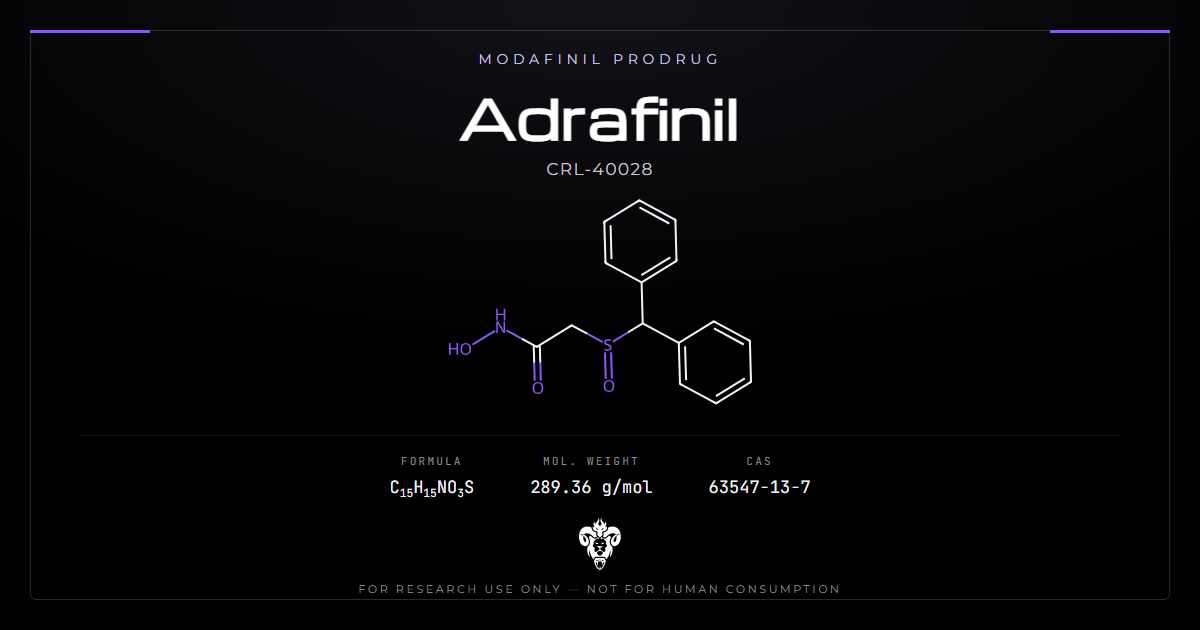
Adrafinil differs from modafinil by a single oxygen atom.
| Property | Value |
|---|---|
| IUPAC name | 2-benzhydrylsulfinyl-N-hydroxyacetamide |
| Development code | CRL-40028 |
| CAS | 63547-13-7 |
| Molecular formula | C15H15NO3S |
| Molecular weight | 289.35 g/mol |
| PubChem CID | 3033226 |
| InChIKey | CGNMLOKEMNBUAI-UHFFFAOYSA-N |
| Active metabolite | Modafinil, C15H15NO2S, 273.35 g/mol |
| Terminal group | Hydroxamic acid |
| Originator | L. Lafon |
Hydroxamic acid against amide
Both molecules share a benzhydrylsulfinyl head and an acetamide tail. Modafinil ends in a simple primary amide. Adrafinil ends in a hydroxamic acid, which is the same amide carrying a hydroxyl on its nitrogen.
That N-hydroxyl is the whole difference, and it accounts for 16 mass units.
Hydroxamic acids behave differently from amides in two ways that matter here. They are appreciably acidic, since the N-hydroxyl ionises near physiological pH where an amide stays neutral. They are also metabolically labile, undergoing reduction to the parent amide. That reduction is exactly the conversion producing modafinil.
The sulfoxide stereocentre
Both compounds carry a stereocentre at the sulfoxide sulfur, and both are usually handled as racemates.
This matters more for modafinil than for the parent, since the two modafinil enantiomers differ in half-life and one of them reached market separately as armodafinil. Racemic material generates racemic modafinil on conversion.
The conversion, and what depends on it
Adrafinil is a prodrug in the strict sense: its activity requires metabolic transformation.
The metabolic route runs adrafinil to modafinil to modafinil acid, and doping-control laboratories treat all three as targets. Lu and colleagues developed and validated a method screening for adrafinil alongside its two major metabolites in human urine, reaching detection limits below the required anti-doping performance threshold [9].
Three practical consequences follow from being a prodrug.
Onset is delayed relative to modafinil, because conversion has to occur before anything happens. The historical record reflects this indirectly. The parent produced inconsistent clinical results where its metabolite did not [1].
Dose does not translate directly. A given mass of adrafinil delivers less than the equivalent mass of modafinil, both because of the 16 g/mol difference and because conversion is neither instantaneous nor complete.
And the conversion imposes a metabolic step that modafinil does not require. Anyone comparing the two compounds is comparing a molecule that must be processed against one that need not be.
What the compound’s own studies found
The pharmacology specific to adrafinil, rather than to modafinil, comes almost entirely from work in aged dogs.
Locomotor activation without stereotypy
Siwak and colleagues gave aged dogs 10, 20, 30 or 40 mg/kg for 14 consecutive days in a crossover design. They recorded spontaneous behaviour in an open field test every fourth day [5].
Locomotor activity rose at the three highest doses. That held at both two and ten hours after dosing, and across both treatment weeks [5]. Directed sniffing increased transiently, and urination frequency fell at the highest dose.
Two details deserve attention. Stereotypical behaviour did not generally accompany the increased locomotion, which distinguishes the profile from classical psychostimulants [5]. And a subpopulation showed no effect or decreased locomotion, with those individual differences tracking serum concentrations at ten hours [5].
That last point is the most useful thing in the paper. Variability in response tracked variability in exposure, which is what a prodrug with variable conversion would predict.
Learning and electroencephalography
A companion report found the effect of a single treatment long-lasting, persisting across repeated treatments. The same work recorded a sustained increase in high-frequency cortical electroencephalographic activity [4].
Milgram and colleagues then trained aged beagles on size or intensity discrimination tasks, two hours after 20 mg/kg or placebo. Training continued until animals reached criterion or failed after 40 sessions [6].
Treatment produced significant improvement in learning, measured as decreased errors and decreased trials to criterion [6]. Response latency did not change significantly. The authors noted that point while acknowledging an effect on motivation might partially account for the findings [6].
They proposed an α1-adrenoceptor mechanism. The improvement might reflect enhanced vigilance through facilitated noradrenergic transmission [6]. That hypothesis sits alongside a broader French literature framing adrafinil and modafinil as centrally acting and specifically noradrenergic agents [8].
Peripheral effects
Earlier work compared the two compounds outside the nervous system. Chariot and colleagues examined pancreatic exocrine secretion in rats. Both compounds inhibited protein output in basal interdigestive secretion, with modafinil the more active of the two [7].
Neither compound behaved like a sympathetic amine. Neither stimulated bicarbonate output, and neither yohimbine nor prazosin blocked the effect [7]. That is a useful negative result, because it argues against a simple adrenergic explanation for at least these peripheral effects.
What modafinil’s mechanism tells you
Because adrafinil acts through modafinil, the mechanism question largely becomes a modafinil question.
Modafinil binds competitively to the cell-membrane dopamine transporter, and its wake-promoting effects depend on catecholaminergic signalling [10]. Wisor characterises it as an exceptionally weak but apparently very selective transporter inhibitor, with a protracted pharmacodynamic response relative to other catecholaminergic agents [10].
The clinical spectrum differs from other agents acting through the same transporter. Modafinil shows relatively low abuse potential and produces wakefulness with an attenuated compensatory sleep rebound. It does not relieve cataplexy in narcolepsy [10].
A separate strand implicates the hypothalamus. Modafinil exhibits only a small degree of dopaminergic action at the transporter. A major part of its effect may instead relate to neuronal activity in the hypothalamus, particularly involving the orexin peptides [12].
The picture is not uniformly reassuring. A preclinical comparison against amphetamine, solriamfetol and pitolisant found modafinil increased central dopamine neurotransmission in part through transporter inhibition, and produced hyperlocomotion, behavioural sensitization and hypophagia, which the authors describe as common features of psychostimulants and of compounds with abuse potential [11]. Pitolisant, acting through histamine H3 receptors instead, produced none of those [11].
Where the eugeroics sit relative to each other
The wake-promoting agents do not form a single pharmacological class, and the differences matter when choosing a comparator.
| Agent | Primary target | Notes |
|---|---|---|
| Amphetamine | Dopamine and noradrenaline release and transport | Full psychostimulant profile [11] |
| Modafinil | Dopamine transporter, weak and selective | Attenuated sleep rebound, low abuse potential [10] |
| Solriamfetol | Dopamine and noradrenaline transporters | Raises striatal dopamine, hyperlocomotion [11] |
| Pitolisant | Histamine H3 receptor, inverse agonist | No striatal dopamine change, no hyperlocomotion [11] |
The pitolisant comparison is the informative one. It promotes wakefulness without touching striatal dopamine, without producing behavioural sensitization, and without hypophagia [11]. Wakefulness therefore does not require dopaminergic action.
That finding places the benzhydrylsulfinyl compounds in a specific position. They are wake-promoting agents that do act on dopamine transport [10][11], which is neither the only route to wakefulness nor a route free of psychostimulant-associated effects. A study using this class as a generic wakefulness tool has chosen a dopaminergic one, and pitolisant exists as the non-dopaminergic control.
The selectivity point deserves emphasis alongside the potency point. Modafinil is described as exceptionally weak at the transporter yet apparently very selective for it, with a protracted pharmacodynamic response compared with other catecholaminergic agents [10]. Weak and selective is a different pharmacological object from potent and promiscuous, and the two produce different experimental signatures even at matched levels of transport blockade.
Conformational constraints on how the molecule engages the transporter appear to underlie those differences, and probably its downstream effects on trace amine receptor signalling as well [10].
Safety observations specific to adrafinil
The indexed safety literature for this compound is thin, and one case report stands out.
Thobois and colleagues described orofacial dyskinesia induced by the compound in an elderly patient [3]. The abnormal movements did not recover spontaneously across a four-month drug-free period. They improved only after introduction of tetrabenazine, a presynaptic dopamine-depleting drug [3].
A single case report establishes little about incidence. It does establish two things worth carrying forward. Someone has documented a movement disorder attributable to this compound. And in that case it persisted well beyond withdrawal, which is not the pattern of a pharmacological effect reversing on clearance.
No controlled human safety study of adrafinil appears in the indexed literature. The compound was withdrawn from the French market, and the clinical development that continued did so with modafinil.
Forensic detection and anti-doping status
The World Anti-Doping Agency banned both adrafinil and modafinil in sport in 2004 [2].
That created a specific analytical problem. Distinguishing use of the prodrug from use of the metabolite is not trivial, because dosing the parent produces both species while dosing modafinil produces only one.
Ameline and colleagues addressed it in hair. In a self-administration study, a single 200 mg oral dose produced detectable parent at 0.8 ng/mg and modafinil at 0.5 ng/mg in beard hair collected ten days later [2].
Applying that to an authentic case proved informative. A hair strand from a woman found in possession of the drug contained modafinil at 6.8 to 13.9 ng/mg, with no detectable parent compound [2]. The authors concluded the pattern matched modafinil use rather than adrafinil use, and that the case was one of trafficking without self-consumption [2].
For a laboratory, the transferable point is that parent compound is detectable after adrafinil dosing, which means the two exposures are distinguishable rather than confounded.
Physicochemical properties and handling
Adrafinil is a crystalline solid carrying a sulfoxide, a hydroxamic acid and two phenyl rings.
The hydroxamic acid is the reactive and distinguishing group. It is weakly acidic, so the compound will form salts with bases rather than acids, and its solubility is pH-dependent in the opposite direction from a basic compound.
Hydroxamic acids also chelate metal ions strongly, particularly iron. That matters for assay design. Trace metals in buffers can complex the compound, and metal-containing enzymes may interact with it.
The sulfoxide can oxidise further to a sulfone under forcing conditions, and can in principle racemise under heat.
Store the solid sealed, dry, cold and dark. Prepare solutions fresh where possible.
The acidity has a practical consequence for solution preparation that catches people out. Most research compounds in this catalogue are neutral or basic, so aqueous solubility improves under acidic conditions. This one behaves in reverse. Its hydroxamic acid deprotonates as pH rises, so solubility improves in mildly basic buffer and worsens in acid. A stock prepared by the habitual method may precipitate where a basic compound would dissolve.
That same acidity affects chromatography. Running the compound on a reversed-phase column without pH control will give variable retention, because the ionised and neutral forms partition differently. Buffering the mobile phase, rather than using unmodified water and organic solvent, produces reproducible retention times.
Analytical characterisation
Four checks cover this compound, and the first is the one that matters most commercially.
Distinguishing it from modafinil
Accurate mass separates the two cleanly. Adrafinil is C15H15NO3S at 289.35; modafinil is C15H15NO2S at 273.35. A 16-unit difference is unambiguous.
Material sold as the parent that assays at 273.35 is modafinil. The two carry different prices and different regulatory treatment across jurisdictions, so this substitution is worth checking rather than assuming.
Proton NMR confirms the hydroxamic acid through its exchangeable N-hydroxyl proton, which has no counterpart in the modafinil spectrum.
The other checks
Chromatographic purity, with method conditions stated. Both phenyl rings give useful ultraviolet absorbance.
Modafinil content, quantified rather than assumed absent, since it is both the plausible synthetic precursor relationship and the plausible substitution.
Sulfone content, as the oxidation product of the sulfoxide.
One further note on the certificate. A purity figure derived from a reversed-phase method run without pH control should be treated with caution for this compound, for the chromatographic reason given above. Ask what buffer the method used, and treat an unbuffered method as a weaker result than the number alone suggests.
Kimera publishes third-party certificates of analysis for every lot in its COA database. Laboratories source Adrafinil as the historical parent of the eugeroic class, often alongside Modafiendz or CE-123, later analogues built on the same benzhydrylsulfinyl head. Related chemistry appears in the nootropics category.
Common misclassifications
Four errors recur.
Adrafinil is described as pharmacologically equivalent to modafinil at a higher dose. Conversion is neither complete nor instantaneous, and the historical record shows the parent produced inconsistent results where the metabolite did not [1].
Sources read its canine data as human data. The controlled behavioural work used aged dogs, and no controlled human study of this compound appears in the indexed literature [4][5][6].
Copy describes it as having no documented adverse effects. A published case reports orofacial dyskinesia persisting more than four months after withdrawal [3].
Summaries overlook its status in sport. Anti-doping authorities have prohibited both compounds since 2004, and validated detection methods cover the parent and both metabolites [2][9].
Experimental design considerations
Measure both compounds. Any study dosing adrafinil is studying a two-species system, and quantifying only the parent or only the metabolite misrepresents exposure [2][9].
Expect inter-individual variability in conversion. The canine work found response differences tracking serum concentration differences at ten hours [5].
Allow for delayed onset. Timepoints designed around modafinil kinetics will sample the wrong window for a prodrug.
Include a modafinil arm. It is the only way to separate effects of the parent from effects of the metabolite.
Watch for metal chelation in vitro. The hydroxamic acid binds iron and other transition metals, which can confound enzyme assays and alter free concentrations in buffer.
Check for stereotypy explicitly. The distinguishing behavioural claim in the canine work is locomotor activation without stereotypy, and that distinction only exists if both are scored [5].
Frequently asked questions
What is Adrafinil? 2-benzhydrylsulfinyl-N-hydroxyacetamide, CAS 63547-13-7, a hydroxamic acid prodrug that converts to modafinil. Kimera supplies it as a laboratory research material.
How does it differ chemically from modafinil? By one oxygen. Adrafinil ends in a hydroxamic acid, modafinil in a plain amide, a difference of 16 mass units.
Is the conversion complete? No. It is a metabolic transformation with inter-individual variability, and both parent and metabolite are detectable after dosing [2][9].
What does the animal literature show? In aged dogs, increased locomotion without stereotypy, increased high-frequency cortical EEG activity, and improved discrimination learning [4][5][6].
Are there documented adverse effects? One published case describes orofacial dyskinesia that persisted beyond four months of withdrawal [3].
Is it prohibited in sport? Yes, along with modafinil, since 2004 [2].
How do I confirm I have adrafinil and not modafinil? Accurate mass at 289.35 rather than 273.35, plus the exchangeable hydroxamic acid proton in the NMR spectrum.
Why does the hydroxamic acid chelate metals? The N-hydroxyl and the adjacent carbonyl oxygen sit in the right geometry to grip a metal ion between them, forming a stable five-membered ring. Iron binds particularly well. This is the same chemistry that makes other hydroxamic acids useful as iron chelators and as inhibitors of metal-dependent enzymes, and it is worth accounting for in any buffer containing trace metals.
Is one enantiomer preferable? No published work separates the enantiomers of this compound. The distinction has been developed for the metabolite instead, where the two forms differ in half-life.
Summary of the evidence
Identity: C15H15NO3S, 289.35 g/mol, hydroxamic acid, one sulfoxide stereocentre.
Relationship to modafinil: prodrug, converting to modafinil and then to modafinil acid [9].
Historical position: identified 1974, prescribed for narcolepsy from 1977 with inconsistent results, superseded by its own metabolite from 1983 [1].
Animal record: locomotor activation without stereotypy, sustained high-frequency cortical EEG changes, and improved discrimination learning in aged dogs [4][5][6], with response variability tracking serum concentration [5].
Proposed mechanism: acts through modafinil, which is a weak but selective dopamine transporter inhibitor with additional hypothalamic involvement [10][12], and shows psychostimulant-like features in preclinical comparison [11].
Human data specific to adrafinil: no controlled study in the indexed literature, and one case report of persistent orofacial dyskinesia [3].
Regulatory position: withdrawn from the French market, prohibited in sport since 2004 [2].
Status: research material, unapproved, with its clinical successor approved in multiple jurisdictions.
References
- Billiard M, Broughton R. Modafinil: its discovery, the early European and North American experience in the treatment of narcolepsy and idiopathic hypersomnia, and its subsequent use in other medical conditions. Sleep Med. 2018;49:69-72. PMID 30174215. DOI
- Ameline A, Gheddar L, Raul JS, Kintz P. Identification of adrafinil and its main metabolite modafinil in human hair. Self-administration study and interpretation of an authentic case. Forensic Sci Res. 2020;5(4):322-326. PMID 33457050. DOI
- Thobois S, Xie J, Mollion H, Benatru I, Broussolle E. Adrafinil-induced orofacial dyskinesia. Mov Disord. 2004;19(8):965-966. PMID 15300665. DOI
- Siwak CT, Callahan H, Milgram NW. Adrafinil: effects on behavior and cognition in aged canines. Prog Neuropsychopharmacol Biol Psychiatry. 2000;24(5):709-726. PMID 11191710. DOI
- Siwak CT, Gruet P, Woehrlé F, et al. Behavioral activating effects of adrafinil in aged canines. Pharmacol Biochem Behav. 2000;66(2):293-300. PMID 10880681. DOI
- Milgram NW, Siwak CT, Gruet P, et al. Oral administration of adrafinil improves discrimination learning in aged beagle dogs. Pharmacol Biochem Behav. 2000;66(2):301-305. PMID 10880682. DOI
- Chariot J, Appia F, Vaille C, Rozé C. Effect of modafinil on pancreatic exocrine secretion in rats. A comparison with adrafinil and related drugs. Fundam Clin Pharmacol. 1987;1(4):243-252. PMID 2893764. DOI
- Jouvet M, Albarede JL, Lubin S, Meyrignac C. Noradrenaline and cerebral aging. Encephale. 1991;17(3):187-195. PMID 1864252
- Lu J, Wang X, Yang S, et al. Doping control analysis for adrafinil and its major metabolites in human urine. Rapid Commun Mass Spectrom. 2009;23(11):1592-1600. PMID 19399790. DOI
- Wisor J. Modafinil as a catecholaminergic agent: empirical evidence and unanswered questions. Front Neurol. 2013;4:139. PMID 24109471. DOI
- Krief S, Berrebi-Bertrand I, Nagmar I, et al. Pitolisant, a wake-promoting agent devoid of psychostimulant properties: preclinical comparison with amphetamine, modafinil, and solriamfetol. Pharmacol Res Perspect. 2021;9(5):e00855. PMID 34423920. DOI
- Swanson JM. Role of executive function in ADHD. J Clin Psychiatry. 2003;64 Suppl 14:35-39. PMID 14658934
Adrafinil is sold for laboratory research use only. Not for human consumption, nor medical, veterinary, or household uses.
Literature retrieved from PubMed.