
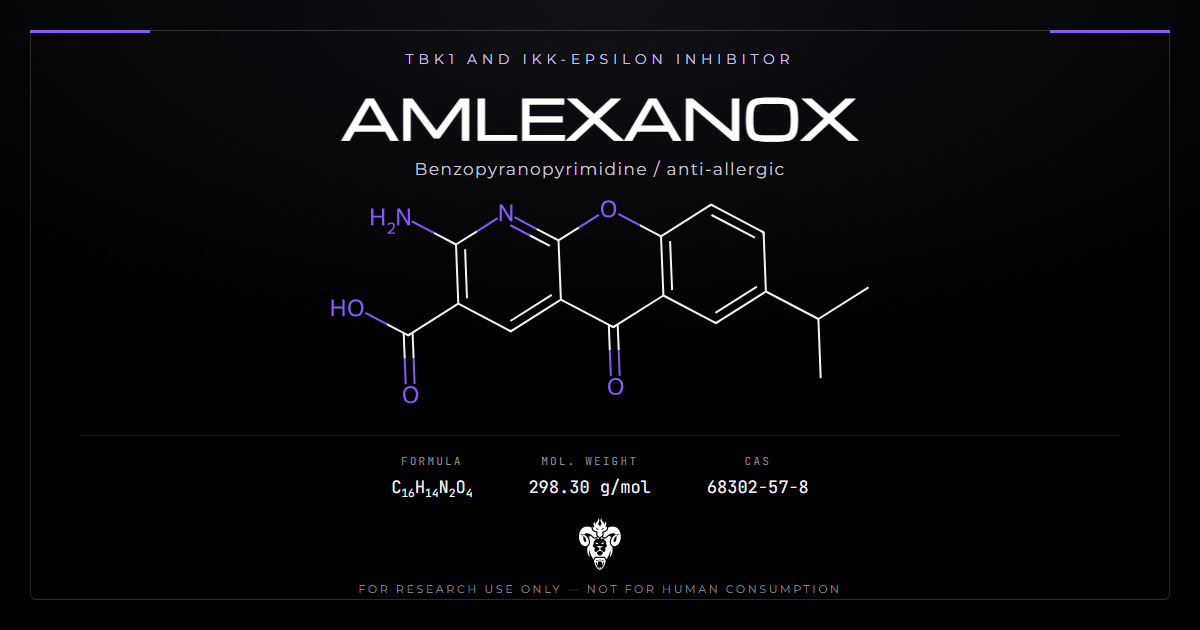
Amlexanox is a small-molecule kinase inhibitor with an unusual history. It was developed in the 1980s as an antiallergic agent, approved decades ago for a narrow clinical indication, and then — long after anyone expected anything further from it — identified as an inhibitor of two kinases sitting at the intersection of inflammation and energy metabolism. That second finding is why it appears in metabolic research literature today.
This page summarizes what the published work actually reports, what it does not, and what the compound is at the chemical level.
What Amlexanox Is
| CAS | 68302-57-8 |
| Molecular formula | C₁₆H₁₄N₂O₄ |
| Molecular weight | 298.29 g/mol |
| Class | Tricyclic heteroaromatic small molecule |
| Core scaffold | 5-oxo-5H-chromeno[2,3-b]pyridine (benzopyranopyridine) |
| Substituents | 2-amino, 3-carboxylic acid, 7-isopropyl |
Amlexanox came out of a Japanese antianaphylactic program in the mid-1980s, described in a synthetic series paper on antiallergic 5-oxo-5H-[1]benzopyrano[2,3-b]pyridines (Nohara et al., 1985).
Is Amlexanox a Peptide?
No — and it is worth stating plainly, because the compound is routinely miscategorized as one across research-supply listings.
Amlexanox contains no amino acid residues and no peptide bonds. It is a tricyclic heteroaromatic small molecule of roughly 298 Da. For scale, BPC-157 is a 15-residue peptide of approximately 1,419 Da. The two compounds are not in the same structural class and do not share a single relevant property.
The distinction is not pedantry. It determines:
- Solubility behavior. Amlexanox has poor aqueous solubility — a limitation the primary literature discusses openly. It is not reconstituted like a lyophilized peptide.
- Storage and degradation. It is not subject to peptide degradation pathways (deamidation, oxidation of Met/Trp, aggregation).
- Analytical method selection. Identity and purity are established by HPLC-UV with MS confirmation against a small-molecule reference standard — not by peptide mapping, amino acid analysis, or the assay/content methods used for peptide fills.
A supplier that files amlexanox under “peptides” is telling you something about how carefully its catalog was assembled.
Molecular Targets
Two distinct pharmacologies appear in the literature.
1. Mast cell / antiallergic activity. The original program characterized amlexanox as an inhibitor of mediator release from mast cells. This is the basis of its historical clinical use.
2. TBK1 and IKKε inhibition. In 2013, Reilly and colleagues identified amlexanox as an inhibitor of TANK-binding kinase 1 (TBK1) and IκB kinase epsilon (IKKε) — the two noncanonical IκB kinases. Selectivity is relative rather than absolute, and potency is moderate; the primary literature is direct about both points.
What the Published Literature Reports
Rodent models
Reilly et al. (Nature Medicine, 2013) reported that in diet-induced and genetically obese mice, administration of amlexanox increased energy expenditure through thermogenesis and was associated with weight loss, improved insulin sensitivity, and reduced hepatic steatosis. The authors proposed that TBK1 and IKKε are induced in liver and adipose tissue under high-fat-diet conditions and suppress adrenergic signaling, and that inhibiting them relieves that suppression.
One detail from this work is frequently dropped in secondary summaries and is mechanistically important: the reported effects were observed in obese animals, not lean controls. This is consistent with the proposed mechanism, in which the kinase targets are upregulated as a consequence of adipose tissue inflammation and are not meaningfully present as targets in its absence.
Human proof-of-concept data
Oral et al. (Cell Metabolism, 2017) conducted a randomized, double-blind, placebo-controlled study in 42 subjects with type 2 diabetes and non-alcoholic fatty liver disease. The study reported a statistically significant reduction in hemoglobin A1c and fructosamine.
The findings require three qualifications that the paper itself makes:
- The effect was confined to a responder subset. Non-responders showed no significant change.
- Responders were characterized by higher baseline adipose tissue inflammation, consistent with the rodent mechanism.
- n = 42 is a proof-of-concept sample reporting a surrogate endpoint, not a phase 3 trial reporting clinical outcomes.
Structure–activity work
Subsequent medicinal chemistry has produced carboxylic acid derivatives with improved potency toward TBK1 and IKKε, supported by crystal structures of TBK1 in complex with amlexanox and its analogs. That literature is explicit that the parent compound’s limited solubility — it was originally formulated as a topical paste — and moderate potency are the principal obstacles to further development.
Regulatory Status
Amlexanox is an approved drug substance in certain formulations and jurisdictions. Aphthasol, a 5% oral paste, was approved in the United States for aphthous ulcers, and amlexanox has been marketed in Japan for allergic indications.
It has not been approved by FDA for any metabolic indication, and no oral systemic formulation is approved in the United States.
Material supplied by Kimera Chems is a research reference material. It is not the approved paste formulation, is not supplied in any therapeutic dosage form, and is not supplied for any therapeutic purpose.
What the Evidence Supports — and What It Does Not
Supported by the published record:
- Amlexanox binds and inhibits TBK1 and IKKε, with a crystallographically resolved binding mode.
- In obese rodent models, the metabolic phenotype described by Reilly et al. has been reported across multiple groups.
- A small controlled human study reported a change in a glycemic surrogate marker within an inflammation-defined subgroup.
Not supported:
- Any claim that amlexanox treats, cures, reverses, or manages obesity, type 2 diabetes, fatty liver disease, asthma, autoimmune disease, or any psychiatric condition in humans.
- Any claim of general efficacy. The human signal was subgroup-restricted, and the mechanism predicts no effect in the absence of adipose inflammation.
Open questions:
- Whether the responder phenotype can be identified prospectively rather than retrospectively.
- Whether the parent compound’s solubility and potency limitations are surmountable, or whether the pharmacology only advances through analogs.
- Long-term human safety at systemic exposure, for which there is essentially no dataset. The historical safety record belongs to a topical paste, not to chronic oral administration.
Handling and Analytical Notes
- Small molecule; not subject to peptide degradation pathways.
- Poor aqueous solubility. DMSO stock solutions are standard for in-vitro work.
- Store per the conditions specified on the lot certificate of analysis.
- Kimera lots are characterized by HPLC-UV with MS confirmation. A lot-specific COA is available for every unit sold.
References
- Nohara A, Ishiguro T, Ukawa K, et al. Studies on antianaphylactic agents. 7. Synthesis of antiallergic 5-oxo-5H-[1]benzopyrano[2,3-b]pyridines. J Med Chem. 1985;28(5):559–568.
- Reilly SM, Chiang S-H, Decker SJ, et al. An inhibitor of the protein kinases TBK1 and IKK-ε improves obesity-related metabolic dysfunctions in mice. Nat Med. 2013;19(3):313–321.
- Oral EA, Reilly SM, Gomez AV, et al. Inhibition of IKKε and TBK1 improves glucose control in a subset of patients with type 2 diabetes. Cell Metab. 2017;26(1):157–170.e7.
- Carboxylic acid derivatives of amlexanox display enhanced potency toward TBK1 and IKKε and reveal mechanisms for selective inhibition. Mol Pharmacol. 2018.
Research use only. This material is sold as a research reference compound for in-vitro and analytical laboratory use. It is not a drug, food, cosmetic, or dietary supplement. It is not for use in humans or animals, and no dosing information is provided or implied. Research supplies are not included.