
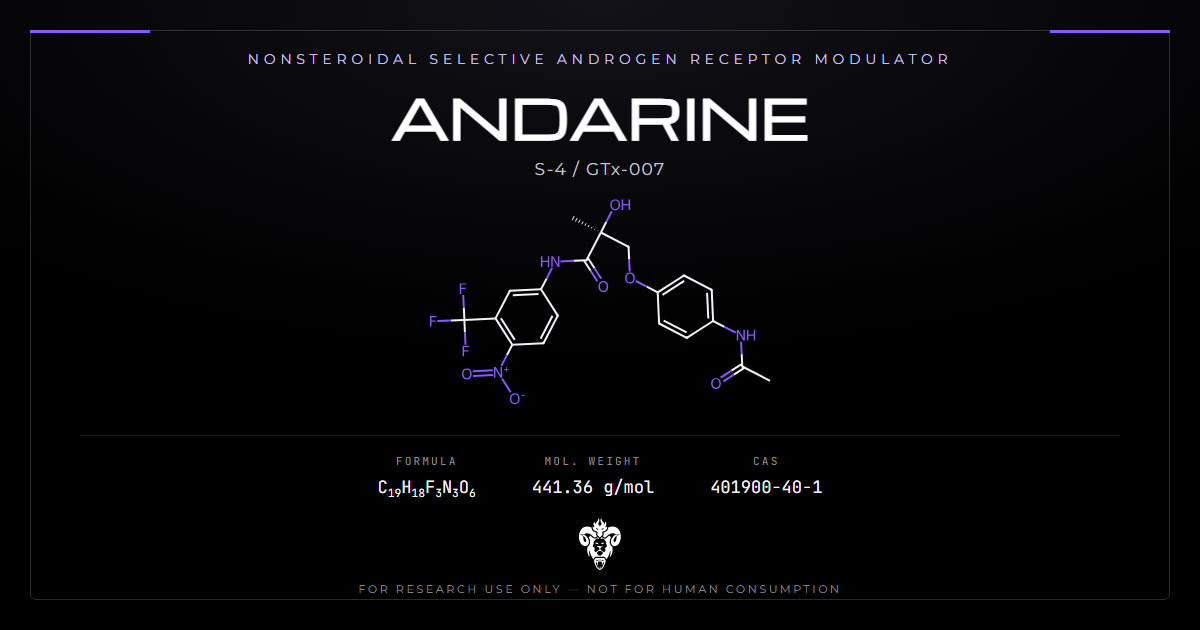
Andarine produced the cleanest demonstration that a selective androgen receptor modulator could work as advertised. In castrated rats it restored muscle mass and strength to intact levels. The prostate stayed at a sixth of normal [2].
The group that produced that result went on to develop ostarine instead. Andarine never entered a published clinical trial, and it never received a name beyond its codes.
Three things make the file worth reading. It has bone strength data that the rest of the class lacks. It suppressed gonadotropins in the same study that proved its selectivity. And it was the first compound in the class found both on the black market and in a doping control sample.
Chemical identity
| Property | Value |
|---|---|
| Common names | Andarine, S-4, GTx-007 |
| Molecular formula | C19H18F3N3O6 |
| Molecular weight | 441.36 g/mol |
| CAS | 401900-40-1 |
| PubChem CID | 9824562 |
| InChIKey | YVXVTLGIDOACBJ-SFHVURJKSA-N |
| Class | Nonsteroidal arylpropionamide |
| Configuration | (2S) |
| AR binding | Ki near 4 nM |
The catalogue carries it as S-4 Andarine.
Reading the structure
Two aromatic rings sit either side of a hydroxylated propanamide. The A-ring carries a nitro group and a trifluoromethyl group. The B-ring carries an acetamide, linked through an ether.
That nitro group is the feature to track. It is unusual in a drug candidate and it dominates the molecule’s colour and ultraviolet absorbance. Both species studied reduce it during metabolism [3].
How it compares with ostarine
Andarine and ostarine share the arylpropionamide skeleton and the trifluoromethyl-bearing A-ring. The difference sits at two positions. Ostarine carries a nitrile where andarine carries a nitro group, and a nitrile again where andarine carries the acetamide-bearing B-ring.
Two nitriles against a nitro and an acetamide. The successor compound removed the nitro group entirely, which is worth noting given what is claimed about it.
What the preclinical work established
| Study | Model | Key result |
|---|---|---|
| Kearbey 2004 [1] | Rat pharmacokinetics | Half-life 2.6 to 5.3 h, complete oral bioavailability at low doses |
| Gao 2005 [2] | Castrated male rats, 8 weeks | Muscle restored to intact levels, prostate at 16% of control |
| Perera 2006 [3] | Dog and rat metabolism | Oral bioavailability 91% in dogs, species-specific pathways |
| Kearbey 2007 [4] | Ovariectomised rats, 120 days | Bone density maintained, bone strength increased, fat reduced |
The tissue-selectivity demonstration
Gao and colleagues castrated male rats and waited twelve weeks [2]. Treatment then ran eight weeks with andarine at 3 or 10 mg/kg, dihydrotestosterone at 3 mg/kg, or vehicle.
Both andarine doses restored soleus muscle mass and strength to the levels seen in intact animals. Levator ani mass recovered too, and dihydrotestosterone did the same.
The prostate is where they separate. Dihydrotestosterone at 3 mg/kg stimulated prostate and seminal vesicle weights to more than double intact control levels. Andarine at the same dose returned those organs to 16% and 17% of control.
That is the class thesis demonstrated in one experiment. Full anabolic effect appeared in muscle and almost none in the androgenic organs. Andarine also raised total body bone mineral density more than dihydrotestosterone did.
The finding usually left out
The same study reports something that complicates the selectivity story. Andarine showed agonist activity in the pituitary. Plasma luteinising hormone and follicle-stimulating hormone fell dose-dependently in castrated animals [2].
Tissue selectivity between muscle and prostate is real. Selectivity between muscle and the hypothalamic-pituitary axis was never part of the claim. The same paper that established the first documented the second.
Bone strength, not just density
Kearbey and colleagues ran a 120-day study in 120 ovariectomised rats, a model of accelerated bone loss [4]. Whole body and lumbar bone mineral density came from dual energy x-ray absorptiometry. Excised femurs then went through peripheral quantitative computed tomography and biomechanical strength testing.
Andarine maintained whole body and trabecular density and cortical content, increased bone strength, and decreased body fat.
That biomechanical result distinguishes this compound within its own class. Ligandrol improved trabecular structure in the same model while leaving biomechanics unchanged. Ostarine’s phase 3 programme never reached a bone endpoint at all. Andarine is the member with a strength result behind it, and that result is in rats.
The authors draw a practical inference. A compound acting directly on bone while increasing muscle strength could reduce fractures by two routes, one structural and one through fewer falls.
Pharmacokinetics across three species
Kearbey and colleagues characterised rat pharmacokinetics across intravenous and oral dosing from 0.5 to 30 mg/kg [1]. Clearance ran 1.0 to 2.1 mL/min/kg and varied with dose. Volume of distribution stayed near 0.448 L/kg. Half-life fell between 2.6 and 5.3 hours. Oral bioavailability was complete at the lower doses.
Perera and colleagues extended that to dogs [3]. Clearance averaged 4.6 mL/min/kg, half-life about 200 minutes, and oral bioavailability reached 91% at pharmacologically relevant doses.
The species difference in metabolism
The metabolism findings are more interesting than the numbers. In dogs, the major pathway runs through deacetylation of the B-ring acetamide, followed by reduction of the A-ring nitro group. In rats it runs through hydrolysis of the amide bond, again with nitro reduction [3].
Two species, two different primary routes, one shared step. Both reduce the nitro group. Oxidative and phase II metabolites appear in both, and elimination is largely hepatic.
That shared step matters for anyone reading metabolite lists. A reduced nitro group becomes an amine, which changes the molecule’s polarity and its detectability.
What carried forward, and what did not
The people who produced the andarine data are the people who produced ostarine, and following the authorship makes the class history legible.
One laboratory, two compounds
Dalton and Miller appear on the andarine pharmacokinetics, the castrated rat study, the metabolism work and the ovariectomised rat study [1][2][3][4]. Kearbey and Gao appear on three of the four. The same names then appear on the ostarine clinical programme.
So the compound that entered trials and the compound that did not came from one group working on one scaffold. Whatever separated them, it was not a difference in who was looking.
The published record does not say why
No paper in the indexed literature explains the decision to advance ostarine rather than andarine. Inventing a reason is easy and unsupported, so this article does not offer one.
What the record does show is a substitution pattern in the chemistry. The successor removed the nitro group and replaced the acetamide-bearing B-ring with a nitrile. Two of the three features that define andarine were changed, and the trifluoromethyl A-ring was kept.
What the preclinical package was strong on
Read as a development file rather than as a set of individual papers, the andarine work covers ground the class rarely covers. Pharmacokinetics exist in two species with oral bioavailability measured in both [1][3]. Efficacy covers muscle mass, muscle strength, bone density, bone strength and body fat [2][4]. Metabolism is mapped, and the mapping agreed with human urinary findings years later [3][6].
That is a more complete preclinical picture than ligandrol has, and ligandrol reached a human trial while this compound did not. Depth of animal data does not determine which molecules advance.
The visual effect, and what the literature says
Andarine is best known outside the laboratory for a reported yellow tint to vision. It is the single most frequently described effect in non-clinical accounts of the compound.
No indexed study documents it. Searches of the biomedical literature for visual disturbance, colour perception or ocular effects associated with this compound return nothing. That describes what is reachable through the databases searched. It is not a claim that no such effect exists, nor that no unpublished data describe it.
Two things can be said with sourcing. The molecule carries a nitroaromatic group, which is a strong chromophore. Both dog and rat metabolism reduce it [3]. Whether that chemistry relates to the reported visual effect is unestablished, and treating the association as mechanism would invent a link the literature does not make.
The honest position is that a widely reported effect has no published characterisation. No dose relationship, no duration data and no reversibility data exist. For a compound with no clinical trials that gap is unsurprising, and it is still a gap.
First on the black market, first in doping control
Andarine holds an unusual double distinction, and both halves are documented.
Sold as face moisturiser
Thevis and colleagues analysed products advertised and sold online [5]. They report the first confirmed detection of a SARM distributed for misuse. The oily liquids were declared as green tea extract and face moisturiser, and contained andarine at approximately 150 mg/mL.
The purity finding is the part to keep. Poor purification left an impurity accounting for roughly 10% of the andarine content, identified as 2-hydroxy-2-methyl-N-(4-nitro-3-trifluoromethyl-phenyl)-3-(4-nitro-3-trifluoromethyl-phenylamino)-propionamide.
That is a named, quantified contaminant in a consumer product. Such specifics are rarer in this literature than the general warnings about supply chains. A tenth of what a buyer received was a different molecule.
Kohler and colleagues reported similar findings from the Cologne laboratory’s 2009 confiscations [7]. Ampoules containing andarine sat alongside mislabelled growth hormone vials and unpurified IGF-1.
The first case in sport
Grata and colleagues describe the Swiss laboratory’s 2010 report of the first case of SARM misuse detected during in-competition testing [8]. The compound was andarine. Their paper walks through screening and confirmation by liquid chromatography tandem mass spectrometry.
Further findings followed. Starcevic and colleagues reported andarine in a doping control sample from the UCLA laboratory [9], and Cawley and colleagues found it in a routine equine blood sample in Australia [10].
SARMs joined the prohibited list in 2008. A competition sample returned andarine within two years, and the compound had never completed a published clinical trial.
How the analytical methods developed
Thevis and colleagues characterised the urinary metabolites for routine testing [6]. The confirmed targets include glucuronide conjugates of the parent drug, of the monohydroxylated and deacetylated products, and of the hydrolysis product formed by removing the B-ring, plus sulfates of the monohydroxylated and deacetylated metabolites.
That list maps onto the animal metabolism directly. Deacetylation and hydrolysis are the same routes the dog and rat studies identified [3]. Cross-species agreement of that quality is better than these comparisons usually deliver.
Temerdashev and colleagues later published a quantification method covering andarine and ostarine together [11]. It uses dispersive liquid-liquid microextraction into methanol and chloroform before ultra-high-pressure chromatography. Detection limits reached 0.05 ng/mL with linearity from 0.25 to 50 ng/mL.
Kintz and colleagues added hair analysis across three SARMs [12]. Andarine appeared at 0.1 to 0.7 pg/mg, against 3 to 21 for ostarine and 14 to 42 for ligandrol.
Andarine is therefore an order of magnitude harder to find in hair than its relatives. Incorporation depends on physicochemistry rather than on dose alone. A negative hair result consequently carries less weight for this compound than for the others.
What the ovariectomised model was actually testing
The 120-day bone study deserves reading on its own terms, because the model it used answers a different question from the muscle work.
Why ovariectomy rather than castration
Removing the ovaries produces accelerated bone loss driven by oestrogen withdrawal, which is the standard rodent stand-in for postmenopausal osteoporosis. The male castration model in the muscle study removes androgen instead [2].
So the two headline studies from this programme test two different deficiency states in two different sexes. A compound that works in both is making a broader claim than one tested only in orchidectomised males, and this scaffold was put through both [2][4].
The fat result is easy to miss
Alongside the skeletal findings, treatment decreased body fat in those animals [4]. That endpoint rarely survives into summaries of the class, which tend to report lean mass and stop.
Body composition has two halves and a compound can move them independently. The five-week human case report on ligandrol found lean mass up 3.1% and total fat mass up 15.4%, which is the opposite pattern in the opposite direction. One is a 120-day rodent study and the other is a single person taking two compounds, so they are not comparable, and the contrast is worth holding when reading claims about recomposition.
What a strength endpoint costs
Biomechanical testing requires excising the bone and breaking it, so it cannot be done in a living participant. Every measurement of bone strength in this literature therefore comes from an animal, and human work is limited to density and to fracture counts in trials large enough to accumulate them.
That constraint explains the shape of the whole field. Density is measurable in people and strength is not, so the endpoint that matters clinically is the one the rodent studies own. Reading a rodent strength result as a human strength claim skips a gap that no design can currently close.
How to read an andarine study
Five questions separate what this record supports from what circulates.
Rat, dog or human?
Every efficacy result for andarine is preclinical [1][2][3][4]. No published clinical trial exists. Statements about what it does in people are extrapolation from castrated rodents.
Which endpoint in bone?
Density and strength are different measurements. Andarine has both [4], which is unusual, and only the density half has parallels elsewhere in the class.
Was the axis measured?
Gonadotropin suppression appeared in the same study that established selectivity [2]. A summary reporting the prostate result without the pituitary result has taken half the finding.
Is the visual claim sourced?
It is not. Any citation offered for the yellow-vision effect should be checked, because searches of the indexed literature return no characterisation of it.
Was the material assayed?
Products sold as andarine have carried a 10% impurity of a related nitroaromatic [5]. A stated concentration on a label has been wrong by that margin in a documented case.
Verifying research material
The compound is a defined single stereoisomer with strong chromophores, which makes verification unusually tractable. Batch documentation sits on the certificates of analysis page.
Identity
Formula C19H18F3N3O6, molecular weight 441.36, CAS 401900-40-1, InChIKey YVXVTLGIDOACBJ-SFHVURJKSA-N. The nitroaromatic gives a strong ultraviolet absorbance, so chromatography with diode-array detection reads this compound easily.
Purity and the documented impurity
The known contaminant is a close structural relative [5]. A second nitro-trifluoromethyl-phenylamino group replaces the B-ring acetamidophenoxy. It is more lipophilic than the parent and separates chromatographically, so a resolving method exists and a certificate should show it.
Both compounds are nitroaromatics with similar absorbance, so area percent by ultraviolet detection understates neither. A purity figure that does not name the remaining percent has not answered the question this compound raises.
Stereochemistry and handling
The SFHVURJKSA block of the InChIKey encodes the (2S) configuration, and chiral chromatography confirms it. Store protected from light, since nitroaromatics are photolabile. The group defining this molecule is the one most at risk.
Common questions about andarine
Has andarine been tested in humans? No published clinical trial exists. The efficacy record is rats and dogs [1][2][3][4].
Does it really cause yellow vision? It is the most commonly reported effect in non-clinical accounts, and no indexed study documents or characterises it.
Is it selective? In castrated rats, strikingly so between muscle and prostate [2]. Not between muscle and the pituitary, where it suppressed both gonadotropins in the same experiment.
How does it compare with ostarine? Same scaffold, different substituents, and ostarine is the compound its developers took forward. Ostarine has trials [see the Ostarine article]; andarine has bone strength data.
Why is it hard to detect in hair? Concentrations run 0.1 to 0.7 pg/mg, roughly an order of magnitude below ostarine and two below ligandrol [12].
What else does the catalogue carry? LGD-4033 and RAD-140 sit alongside it for comparative work.
Summary of the evidence
Strongest evidence sits in four places. A castrated rat study separated muscle from prostate with quantified organ weights [2]. A 120-day ovariectomised rat study added biomechanical bone strength testing [4]. Pharmacokinetics are complete in two species [1][3], and one black market analysis names and quantifies an impurity [5].
Weakest evidence: anything about humans. There is no clinical trial, no dose-response in people, and the compound’s most discussed effect has no published characterisation at all.
Read plainly, andarine is the compound that proved the class thesis in rodents and was then set aside by the people who proved it. More of this literature sits in the SARMs category.
Status: supplied for laboratory research use only.
References
- Kearbey JD, Wu D, Gao W, Miller DD, Dalton JT. Pharmacokinetics of S-3-(4-acetylamino-phenoxy)-2-hydroxy-2-methyl-N-(4-nitro-3-trifluoromethyl-phenyl)-propionamide in rats, a non-steroidal selective androgen receptor modulator. Xenobiotica. 2004;34(3):273-280. PMID 15204699. DOI
- Gao W, Reiser PJ, Coss CC, Phelps MA, Kearbey JD, Miller DD, Dalton JT. Selective androgen receptor modulator treatment improves muscle strength and body composition and prevents bone loss in orchidectomized rats. Endocrinology. 2005;146(11):4887-4897. PMID 16099859. DOI
- Perera MA, Yin D, Wu D, Chan KK, Miller DD, Dalton J. In vivo metabolism and final disposition of a novel nonsteroidal androgen in rats and dogs. Drug Metab Dispos. 2006;34(10):1713-1721. PMID 16815963. DOI
- Kearbey JD, Gao W, Narayanan R, Fisher SJ, Wu D, Miller DD, Dalton JT. Selective androgen receptor modulator (SARM) treatment prevents bone loss and reduces body fat in ovariectomized rats. Pharm Res. 2007;24(2):328-335. PMID 17063395. DOI
- Thevis M, Geyer H, Kamber M, Schänzer W. Detection of the arylpropionamide-derived selective androgen receptor modulator (SARM) S-4 (andarine) in a black-market product. Drug Test Anal. 2009;1(8):387-392. PMID 20355219. DOI
- Thevis M, Thomas A, Fusshöller G, Beuck S, Geyer H, Schänzer W. Mass spectrometric characterization of urinary metabolites of the selective androgen receptor modulator andarine (S-4) for routine doping control purposes. Rapid Commun Mass Spectrom. 2010;24(15):2245-2254. PMID 20623476. DOI
- Kohler M, Thomas A, Geyer H, Petrou M, Schänzer W, Thevis M. Confiscated black market products and nutritional supplements with non-approved ingredients analyzed in the Cologne Doping Control Laboratory 2009. Drug Test Anal. 2010;2(11-12):533-537. PMID 21204286. DOI
- Grata E, Perrenoud L, Saugy M, Baume N. SARM-S4 and metabolites detection in sports drug testing: a case report. Forensic Sci Int. 2011;213(1-3):104-108. PMID 21816554. DOI
- Starcevic B, Ahrens BD, Butch AW. Detection of the selective androgen receptor modulator S-4 (andarine) in a doping control sample. Drug Test Anal. 2013;5(5):377-379. PMID 23427117. DOI
- Cawley AT, Smart C, Greer C, Liu Lau M, Keledjian J. Detection of the selective androgen receptor modulator andarine (S-4) in a routine equine blood doping control sample. Drug Test Anal. 2016;8(2):257-261. PMID 26456227. DOI
- Temerdashev A, Dmitrieva E, Azaryan A, Gashimova E. A novel approach to the quantification of urinary aryl-propionamide-derived SARMs by UHPLC-MS/MS. Biomed Chromatogr. 2020;34(1):e4700. PMID 31734960. DOI
- Kintz P, Gheddar L, Ameline A, Raul JS. Perspectives in evaluating selective androgen receptor modulators in human hair: a short communication. Ther Drug Monit. 2021;43(2):298-300. PMID 33337588. DOI
Andarine is sold for laboratory research use only. Not for human consumption, nor medical, veterinary, or household uses.
Literature retrieved from PubMed.