
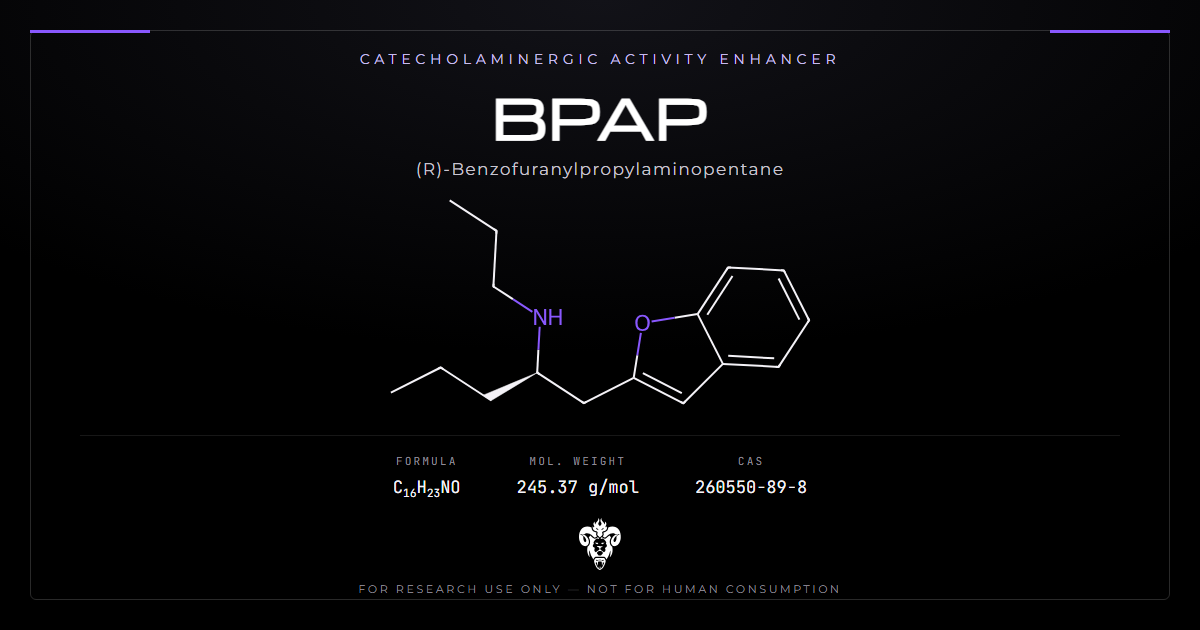
Most research compounds are variations on a mechanism that already has a textbook chapter. BPAP is not. It was designed as the cleanest available chemical probe for a proposed mechanism — “enhancer regulation” — that has never made it into mainstream pharmacology, and whose strongest advocate spent forty years arguing for it largely alone.
That history explains almost everything strange about BPAP. It explains why the compound is active at doses three to four orders of magnitude below what a stimulant needs. It explains why raising the dose makes it work less, not more. And it explains why a literature that looks substantial at a glance turns out, on inspection, to originate overwhelmingly from two collaborating laboratories — a limitation that only became visible when an independent group finally ran the experiment in 2024.
This article covers the chemistry, the proposed mechanism, the preclinical record, the pharmacokinetics, the near-total absence of human data, and the analytical problem that makes BPAP harder to verify than almost anything else in a research catalog.
Naming: BPAP Is Not BiPAP
One point of housekeeping, because it causes real confusion. BPAP in this article refers to benzofuranylpropylaminopentane, a small-molecule research compound. It is unrelated to BiPAP (bilevel positive airway pressure), a respiratory ventilation modality. The acronyms differ by a single letter and share no subject matter. If you arrived here looking for ventilator settings, this is the wrong page.
Chemical Identity
BPAP is a chiral secondary amine built on a benzofuran scaffold. The active substance is the R-(−) enantiomer, and essentially all published pharmacology refers to it specifically.
| Field | Value |
|---|---|
| Common name | BPAP; (−)-BPAP; R-(−)-BPAP |
| Development code | FPFS-1169 |
| IUPAC name | (2R)-1-(1-benzofuran-2-yl)-N-propylpentan-2-amine |
| CAS (free base) | 260550-89-8 |
| CAS (hydrochloride) | 265130-22-1 |
| Molecular formula (free base) | C₁₆H₂₃NO |
| Molecular weight (free base) | 245.37 g/mol |
| Monoisotopic mass | 245.1780 Da |
| Molecular formula (HCl salt) | C₁₆H₂₄ClNO |
| Molecular weight (HCl salt) | 281.83 g/mol |
| SMILES | CCCC@@HCC1=CC2=C(C=CC=C2)O1 |
| InChIKey | LJHIBIVAYHQPBT-CQSZACIVSA-N |
| PubChem CID | 9859674 |
| Compound class | Monoaminergic activity enhancer (MAE) |
Two identity details matter more here than they do for most compounds, and both are covered in the analytical section below: the material is usually supplied as the hydrochloride salt, and it has one stereocenter whose configuration determines the pharmacology.
Where BPAP Came From: The Enhancer Concept
To understand BPAP you have to understand the problem its designers were trying to solve.
Joseph Knoll — the Hungarian pharmacologist who developed selegiline — proposed that catecholaminergic and serotonergic neurons in the brainstem operate under a regulatory layer distinct from receptor binding, reuptake, and enzymatic degradation. In his framing, certain endogenous trace amines, specifically β-phenylethylamine (PEA), tyramine, and tryptamine, act as enhancers: they increase the amount of neurotransmitter released per nerve impulse without triggering release on their own. He termed these catecholaminergic and serotonergic activity enhancer (CAE/SAE) substances.
The problem with testing that idea was that the only clinically available enhancer, (−)-deprenyl (selegiline), is also a potent selective MAO-B inhibitor. Any effect you observe could plausibly be attributed to enzyme inhibition rather than to the proposed enhancer mechanism. The confound is structural, not experimental — you cannot dose your way around it.
Knoll’s group therefore built compounds that stripped the confound out. First came PPAP (1-phenyl-2-propylaminopentane), a deprenyl analog lacking the propargyl group responsible for MAO inhibition. Then, in a structure–activity campaign at Fujimoto Pharmaceutical Corporation in Osaka, a series of 1-aryl-2-alkylaminoalkanes was screened, and the benzofuran-2-yl analog emerged as the lead (Yoneda et al., 2001).
BPAP differs from its predecessors in two ways worth noting. It is tryptamine-derived rather than PEA-derived, with the benzofuran ring standing in for indole. And unlike PPAP, which enhances catecholamines only, BPAP enhances serotonin as well (Knoll et al., 1999).
The headline potency figure comes from a tetrabenazine-antagonism shuttle box assay in rats, in which BPAP was reported to be roughly 130 times more potent than (−)-deprenyl (Knoll et al., 1999). That number is quoted constantly in secondary sources, usually without the assay attached. It is a behavioral potency ratio from one specific paradigm, not a binding affinity and not a general statement about relative effect size.
Mechanism: Enhancer Versus Releaser
The central pharmacological claim about BPAP is a negative one. It is proposed to increase impulse-propagation-mediated (exocytotic, vesicular) transmitter release while not producing the carrier-mediated efflux characteristic of amphetamines. In plain terms: it is claimed to raise the volume on signaling that the neuron was already going to do, rather than forcing release independent of firing.
That distinction stayed hypothetical for two decades. The most direct mechanistic evidence arrived when Harsing and colleagues examined BPAP against trace amine-associated receptor 1 (TAAR1) in rat striatal slices. Their finding was a clean dissociation: methamphetamine evoked non-vesicular [³H]dopamine release in a TAAR1-dependent manner, while BPAP potentiated [³H]dopamine release of vesicular origin, also via TAAR1, and did not induce non-vesicular release at all (Harsing et al., 2022).
The same work proposed a two-site model — one binding site on TAAR1 for releasers, another for enhancers — with the two triggering different PKC-mediated phosphorylation cascades. BPAP was additionally reported to increase VMAT2 activity, driving vesicular dopamine accumulation (Harsing et al., 2022).
Supporting evidence for a distinct binding site comes from an unusual place. 3-F-BPAP, a trifluoropropyl analog with weak intrinsic activity, antagonizes the enhancer effect of BPAP while leaving the effects of deprenyl and PPAP unchanged (Shimazu & Miklya, 2004). If the mechanism were a single shared site, that selectivity would not be expected.
A follow-up study extended the model to striatal GABAergic output and to the bell-shaped dose curves discussed below (Harsing et al., 2025).
A caveat worth stating plainly: TAAR1 involvement is a well-argued hypothesis supported primarily by one research group. It is not settled receptor pharmacology, and BPAP has not been characterized against TAAR1 with the binding and functional panel you would expect for an established ligand.
The Dose Paradox
This is the single most important thing to understand about BPAP, and the thing most often lost in summary coverage.
The enhancer effect is bimodal, and the specific window is extraordinarily narrow and extraordinarily low. In rats, statistically significant enhancement of catecholaminergic and serotonergic neuronal activity was reported 30 minutes after a single subcutaneous dose of 0.1 µg/kg — 0.0001 mg/kg, or about 0.36 nmol/kg (Knoll et al., 1999). A second, mechanistically distinct peak appears roughly 500-fold higher, around 0.05 mg/kg, and Knoll’s group labeled this the non-specific enhancer dose.
In tissue, the pattern is the same. Concentration–effect curves in striatal slices are bell-shaped, with the effect on dopamine and GABA release appearing in the 10⁻¹³ to 10⁻¹¹ mol/L range and declining above it. Harsing’s group attributed the rising phase to TAAR1 agonism and the falling phase to TAAR1 heterodimerization with dopamine D2 receptors, which would switch off TAAR1 signaling and hand transduction to D2 (Harsing et al., 2025).
Three consequences follow, and they are not intuitive:
- More is not more. Above the specific window, the enhancer effect diminishes rather than saturating.
- A negative result is uninterpretable without dose verification. An experiment run above the window has not tested the enhancer mechanism at all.
- Two different pharmacologies wear the same name. Published BPAP effects come from at least two distinct dose regimes, and papers frequently do not make clear which one is in play.
These figures are rodent subcutaneous experimental parameters cited to explain the shape of the dose–response relationship. They are not dosing guidance, and interspecies scaling from picomolar-range rodent s.c. data is not meaningful.
What BPAP Does Outside the Enhancer Window
“Selective enhancer, not a releaser” is the framing BPAP is usually sold with. It holds — inside the narrow window. Outside it, the compound is considerably less tidy, and the primary literature says so.
Shimazu and colleagues reported that BPAP potentiates locomotor activity in normal rats through a mechanism attributable to dopamine release (Shimazu et al., 2001). Separately, the same group concluded that BPAP is not only a CAE/SAE substance but also a norepinephrine and dopamine uptake inhibitor and a weak serotonin uptake inhibitor.
Two nuances from that work cut in BPAP’s favor. It does not show tyramine-like releasing action, and it actually inhibits tyramine-induced norepinephrine release — relevant to the classic hypertensive-crisis liability of older monoamine drugs.
The honest summary: BPAP is a multi-mechanism compound whose behavior depends heavily on concentration. Descriptions that present it as a single clean mechanism are describing one slice of the dose range.
The Preclinical Record
Parkinson’s disease models. BPAP attenuated hypolocomotion in reserpine-treated rats (Shimazu et al., 2001) and showed an L-DOPA-sparing effect in the same model (Shimazu et al., 2003). This was the lead indication throughout development.
Mood models. In the most thorough behavioral characterization, acute BPAP reduced immobility in the mouse forced swim test while chronic dosing improved social interaction deficits following forced swimming — an acute/chronic dissociation. In olfactory-bulbectomized rats, chronic BPAP improved social interaction, prepulse inhibition, and tone-cue fear learning without altering locomotor activity or circadian pattern. The social interaction effect was blocked by dopamine receptor antagonists (Tsunekawa et al., 2008).
Neuroprotection and neurotrophins. BPAP up-regulated neurotrophic factor synthesis in mouse astrocytes (Ohta et al., 2002) and altered neurotrophin and receptor expression in mesencephalic slices (Hirami et al., 2005). In SH-SY5Y cells, BPAP and analogs reduced apoptosis induced by the endogenous neurotoxin N-methyl(R)salsolinol via direct stabilization of mitochondrial membrane potential and Bcl-2 induction (Maruyama et al., 2004).
That last paper contains a detail worth flagging. The stereochemical requirement inverts: dextrorotatory compounds prevented mitochondrial permeability transition, while levorotatory ones did not. The neuroprotective activity and the enhancer activity therefore track opposite enantiomers and are mechanistically separable — which means neuroprotection claims cannot be carried over to (−)-BPAP by association.
Addiction models. BPAP attenuated cue-induced and priming-induced reinstatement of methamphetamine-seeking in rats without reinstating the behavior itself or altering self-administration. Notably, D1 and D2 antagonists did not block the effect (Hiranita et al., 2010).
Longevity and tumor incidence. A long-term rat study reported reduced fibromyxosarcoma manifestation: 20/40 in saline controls versus 8/40 at 0.0001 mg/kg BPAP and 7/40 at 0.05 mg/kg. BPAP showed no direct cytotoxicity against human medulloblastoma cell lines, leading the authors to propose an indirect, brain-mediated mechanism (Knoll et al., 2017).
The Replication Gap
Nearly all of the above traces to Knoll’s Budapest group, Fujimoto in Osaka, or their direct collaborators. In 2024, an independent team at Semmelweis University published the first rigorous outside test of the anti-aging claim.
The design was unusually good. Aged, behaviorally experienced male Long-Evans rats were dosed subcutaneously five days a week and tracked across a battery of cognitive tasks through the end of life. The starting dose of 0.0002 mg/kg was raised to 0.001 mg/kg after seven weeks because no effects were observed. Mean lifespan of the colony was 36 months.
The result was null on both endpoints. BPAP neither improved cognitive performance nor extended lifespan (Ernyey et al., 2024).
The authors offered a reasonable alternative explanation — their animals were on dietary restriction and lifelong cognitive engagement, both of which independently protect against age-related decline and could impose a ceiling that leaves no headroom for a drug effect. That is a fair caveat, and it is not a dismissal of the study.
But the study stands as the most methodologically rigorous long-term evaluation of BPAP published to date, it was conducted by a group with no stake in the outcome (with Miklya, a longtime Knoll collaborator, as a co-author), and it did not reproduce the central longevity claim. Anyone citing BPAP as an anti-aging compound needs to engage with this paper.
Pharmacokinetics
The only substantive pharmacokinetic dataset is a rat radiolabel study using ¹⁴C-BPAP (Magyar et al., 2002):
- Absorption was good by intraperitoneal, subcutaneous, and oral routes.
- Cmax was reached at 30–60 minutes; peak brain levels at 30 minutes after subcutaneous dosing.
- A second peak at 4 hours indicated enterohepatic recirculation.
- Elimination half-life (t½β) was 5.5–5.8 hours; >90% recovered in excreta within 72 hours, primarily urine.
- Distribution across nine brain regions was broadly uniform, confirming CNS penetration.
No human pharmacokinetic data has been published. Metabolite identification is likewise absent from the public literature — the study above measured total radioactivity, not specific metabolites.
Human Data: What Actually Exists
Very little, and this deserves a direct statement because secondary sources routinely imply otherwise.
There is no published, peer-reviewed clinical trial of BPAP. The frequently cited paper by Gaszner and Miklya on enhancer substances in major depression is a mechanistic argument for why BPAP should be investigated, not a report of a controlled trial (Gaszner & Miklya, 2006).
A Phase 2 proof-of-concept study of subcutaneous FPFS-1169 in Parkinson’s disease patients does appear in the European clinical trials register (EudraCT 2006-000361-11), listed as completed. No results from it have been published in the peer-reviewed literature, and no subsequent development program is on record. Given that the compound has not advanced in the twenty years since, the most parsimonious reading is that the study did not produce a result worth building on — but that is inference, not evidence.
BPAP is not approved as a drug in any jurisdiction.
Analytical Verification: The Enantiomer Problem
This is where BPAP diverges from most catalog compounds, and it is the part worth reading carefully.
Chirality is the identity question. BPAP has one stereocenter. The R-(−) enantiomer is the enhancer; the S-(+) enantiomer has a materially different profile, including the inverted mitochondrial-stabilization SAR noted above. Racemic material would be half something else.
The problem is that the standard verification stack cannot see this:
- HPLC on an achiral column — enantiomers co-elute. A 99% purity figure on an achiral method is fully compatible with a 50:50 racemate.
- Mass spectrometry — enantiomers are isobaric and fragment identically. MS confirms C₁₆H₂₃NO; it cannot confirm which C₁₆H₂₃NO.
- Standard ¹H/¹³C NMR — enantiomers give identical spectra in an achiral environment.
Establishing enantiomeric identity requires a chiral stationary phase HPLC method, chiral derivatization, a chiral shift reagent in NMR, or polarimetry with a reliable reference rotation. If a certificate of analysis for BPAP does not indicate which was used, it has not established the thing that matters most. We cover the general limits of each technique in HPLC, Mass Spectrometry, and NMR.
Salt form changes the mass basis. BPAP is typically supplied as the hydrochloride. Free base MW is 245.37; the HCl salt is 281.83. The free base fraction is 87.1%, so 1.00 mg of BPAP HCl contains 0.871 mg of BPAP free base. Whether a stated quantity refers to salt or free base is a labeling question that changes the number by roughly 13%.
Microgram-scale handling is its own problem. BPAP is studied at doses several orders of magnitude below typical research compounds. At that scale, content uniformity in blended or solubilized preparations becomes the dominant analytical risk — not purity. A homogeneity failure at microgram loading is invisible on a bulk assay and can swamp any pharmacological signal.
Structural isomer risk. The benzofuran-2-yl substitution pattern must be confirmed; the 3-yl positional isomer has the same formula and mass. This is an NMR question, not an MS question.
Every batch we supply is characterized through independent third-party analysis, and the full COA archive is public. Our BPAP listing links directly to the current batch record.
Where BPAP Sits Among Related Compounds
BPAP is not a stimulant in the conventional sense, and it does not fit the racetam, cholinergic, or ampakine categories either. Its closest conceptual relatives are compounds that modulate dopaminergic tone through indirect or upstream mechanisms rather than direct receptor agonism — bromantane, for instance, which acts on dopamine synthesis enzyme expression rather than on release or reuptake. Both sit outside the standard monoamine pharmacology framework, which is precisely why both are interesting as probes and difficult to characterize. Additional mechanism profiles are collected in our nootropics research section.
Summary
BPAP is the most potent available chemical probe for enhancer regulation, a mechanism that remains outside pharmacological consensus. The proposed mechanism — TAAR1-mediated potentiation of vesicular, impulse-coupled monoamine release, distinct from carrier-mediated efflux — has real supporting data, but that data comes overwhelmingly from a small network of collaborating labs. The dose–response is bimodal and bell-shaped, with the specific window at picomolar-to-femtomolar tissue concentrations, meaning the compound has two distinct pharmacologies depending on exposure. Outside the enhancer window it behaves as a monoamine uptake inhibitor and produces dopamine release. The preclinical record across Parkinson’s, mood, addiction, and neuroprotection models is broad but shallow in independent replication, and the one rigorous outside long-term study returned a null result on both cognition and lifespan. Human data is effectively nonexistent: one unreported Phase 2 registry entry from 2006 and nothing since.
For laboratory work, the governing practical constraints are enantiomeric verification — which routine HPLC and MS cannot provide — salt-form mass basis, and content uniformity at microgram scale.
References
1.European Union Clinical Trials Register. A proof of concept study to determine the minimum effective dose and to assess the efficacy and safety of subcutaneous injections of FPFS-1169 in Parkinson’s disease patients. EudraCT 2006-000361-11.
2.Knoll J, Yoneda F, Knoll B, Ohde H, Miklya I. (−)1-(Benzofuran-2-yl)-2-propylaminopentane, [(−)BPAP], a selective enhancer of the impulse propagation mediated release of catecholamines and serotonin in the brain. Br J Pharmacol. 1999;128(8):1723–1732. https://doi.org/10.1038/sj.bjp.0702995
3.Yoneda F, Moto T, Sakae M, Ohde H, Knoll B, Miklya I, Knoll J. Structure-activity studies leading to (−)1-(benzofuran-2-yl)-2-propylaminopentane, ((−)BPAP), a highly potent, selective enhancer of the impulse propagation mediated release of catecholamines and serotonin in the brain. Bioorg Med Chem. 2001;9(5):1197–1212. https://doi.org/10.1016/s0968-0896(01)00002-5
4.Knoll J. Antiaging compounds: (−)deprenyl (selegiline) and (−)1-(benzofuran-2-yl)-2-propylaminopentane, [(−)BPAP], a selective highly potent enhancer of the impulse propagation mediated release of catecholamine and serotonin in the brain. CNS Drug Rev. 2001;7(3):317–345. https://doi.org/10.1111/j.1527-3458.2001.tb00202.x
5.Shimazu S, Takahata K, Katsuki H, Tsunekawa H, Tanigawa A, Yoneda F, Knoll J, Akaike A. (−)-1-(Benzofuran-2-yl)-2-propylaminopentane enhances locomotor activity in rats due to its ability to induce dopamine release. Eur J Pharmacol. 2001;421(3):181–189. https://doi.org/10.1016/s0014-2999(01)01040-8
6.Ohta K, Ohta M, Mizuta I, Fujinami A, Shimazu S, Sato N, Yoneda F, Hayashi K, Kuno S. The novel catecholaminergic and serotoninergic activity enhancer R-(−)-1-(benzofuran-2-yl)-2-propylaminopentane up-regulates neurotrophic factor synthesis in mouse astrocytes. Neurosci Lett. 2002;328(3):205–208. https://doi.org/10.1016/s0304-3940(02)00461-5
7.Magyar K, Lengyel J, Bolehovszky A, Knoll B, Miklya I, Knoll J. The fate of (−)1-(benzofuran-2-yl)-2-propylaminopentane · HCl, (−)-BPAP, in rats, a potent enhancer of the impulse-evoked release of catecholamines and serotonin in the brain. Eur J Drug Metab Pharmacokinet. 2002;27(3):157–161. https://doi.org/10.1007/BF03190451
8.Knoll J, Miklya I, Knoll B. Stimulation of the catecholaminergic and serotoninergic neurons in the rat brain by R-(−)-1-(benzofuran-2-yl)-2-propylaminopentane, (−)-BPAP. Life Sci. 2002;71(18):2137–2144. https://doi.org/10.1016/s0024-3205(02)01969-0
9.Shimazu S, Tamashiro A, Yoneda F, Knoll J. The L-DOPA-sparing effect of R-(−)-1-(benzofuran-2-yl)-2-propylaminopentane hydrochloride [(−)-BPAP] in reserpine-pretreated rats. Life Sci. 2003;72(12):1413–1419. https://doi.org/10.1016/s0024-3205(02)02411-6
10.Knoll J, Miklya I. Analysis of the effect of (−)-BPAP, a selective enhancer of the impulse propagation mediated release of catecholamines and serotonin in the brain. Life Sci. 2003. https://www.sciencedirect.com/science/article/abs/pii/S0024320503001978
11.Maruyama W, Yi H, Takahashi T, Shimazu S, Ohde H, Yoneda F, Iwasa K, Naoi M. Neuroprotective function of R-(−)-1-(benzofuran-2-yl)-2-propylaminopentane, [R-(−)-BPAP], against apoptosis induced by N-methyl(R)salsolinol, an endogenous dopaminergic neurotoxin, in human dopaminergic neuroblastoma SH-SY5Y cells. Life Sci. 2004;75(1):107–117. https://pubmed.ncbi.nlm.nih.gov/15102525/
12.Shimazu S, Miklya I. Pharmacological studies with endogenous enhancer substances: β-phenylethylamine, tryptamine, and their synthetic derivatives. Prog Neuropsychopharmacol Biol Psychiatry. 2004;28(3):421–427. https://pubmed.ncbi.nlm.nih.gov/15093950/
13.Hirami C, Takahata K, Shimazu S, Yoneda F, Hayashi K, Katsuki H, Akaike A. Effects of R-(−)-BPAP on the expressions of neurotrophins and their receptors in mesencephalic slices. Biol Pharm Bull. 2005;28(8):1524–1526. https://pubmed.ncbi.nlm.nih.gov/16079507/
14.Gaszner P, Miklya I. Major depression and the synthetic enhancer substances, (−)-deprenyl and R-(−)-1-(benzofuran-2-yl)-2-propylaminopentane. Prog Neuropsychopharmacol Biol Psychiatry. 2006;30(1):5–14. https://pubmed.ncbi.nlm.nih.gov/16023777/
15.Tsunekawa H, Noda Y, Miyazaki M, Yoneda F, Nabeshima T, Wang D. Effects of (R)-(−)-1-(benzofuran-2-yl)-2-propylaminopentane hydrochloride [(−)-BPAP] in animal models of mood disorders. Behav Brain Res. 2008;189(1):107–116. https://doi.org/10.1016/j.bbr.2007.12.016
16.Hiranita T, Yamamoto T, Nawata Y. A tryptamine-derived catecholaminergic enhancer, (−)-1-(benzofuran-2-yl)-2-propylaminopentane [(−)-BPAP], attenuates reinstatement of methamphetamine-seeking behavior in rats. Neuroscience. 2010;165(2):300–312. https://doi.org/10.1016/j.neuroscience.2009.10.055
17.Knoll J, Baghy K, Eckhardt S, Ferdinandy P, Garami M, Harsing LG Jr, Hauser P, Mervai Z, Pocza T, Schaff Z, Schuler D, Miklya I. A longevity study with enhancer substances (selegiline, BPAP) detected an unknown tumor-manifestation-suppressing regulation in rat brain. Life Sci. 2017. https://www.sciencedirect.com/science/article/abs/pii/S0024320517302965
18.Harsing LG Jr, Knoll J, Miklya I. Enhancer regulation of dopaminergic neurochemical transmission in the striatum. Int J Mol Sci. 2022;23(15):8543. https://doi.org/10.3390/ijms23158543
19.Ernyey AJ, Kassai F, Kozma K, Plangár I, Somfai Z, Miklya I, Gyertyán I. Age-related decline of various cognitive functions in well-experienced male rats treated with the putative anti-aging compound (2R)-1-(1-benzofuran-2-yl)-N-propylpentane-2-amine ((−)BPAP). GeroScience. 2024;46(1):417–429. https://doi.org/10.1007/s11357-023-00821-6
20.Harsing LG Jr, Szénási G, Fehér B, Miklya I. Regulation by trace amine-associated receptor 1 (TAAR1) of dopaminergic-GABAergic interaction in the striatum: effects of the enhancer drug (−)BPAP. Neurochem Res. 2025;50(2):94. https://doi.org/10.1007/s11064-025-04337-7