
Most research compounds are optimised for potency. CE-123 was not, and understanding why is the key to reading its literature correctly.
Its half-maximal inhibitory concentration at the dopamine transporter sits in the low micromolar range. That looks unimpressive next to the nanomolar figures quoted for cocaine-like inhibitors. The figure is not a shortcoming of the programme.
The Vienna group that built the compound titled one of its own papers around the point. They describe low-affinity, high-selectivity dopamine transport inhibition as sufficient to rescue cognitive function in aging rats [9].
Selectivity was the objective. Existing transporter inhibitors block noradrenaline and serotonin transport alongside dopamine. The resulting pharmacology resists attribution to any single system [2]. A compound that engages only one transporter is a cleaner instrument, even if it engages it weakly.
What follows covers five things. The chemistry, and the transporter biology the compound targets. The substantial behavioural record it has accumulated across six countries. Its pharmacokinetics. And the stereochemical question a certificate of analysis for this compound must answer.
Chemical identity: what you are actually handling
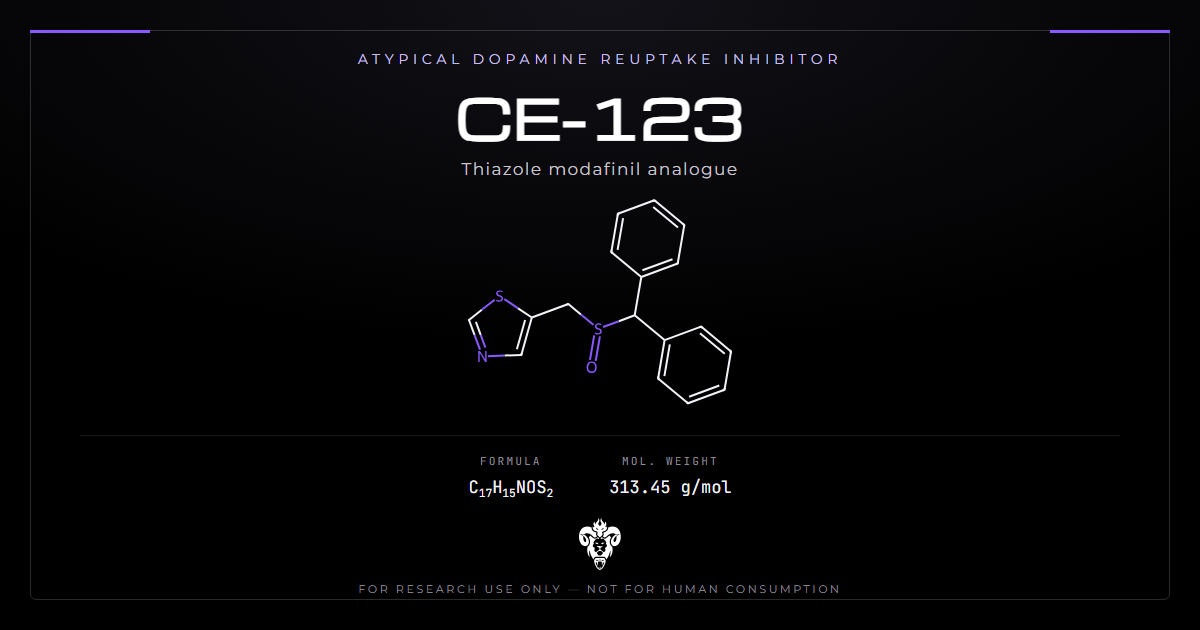
CE-123 is 5-(benzhydrylsulfinylmethyl)-1,3-thiazole, a sulfoxide bearing a thiazole ring.
| Property | Value |
|---|---|
| IUPAC name | 5-[(benzhydrylsulfinyl)methyl]-1,3-thiazole |
| Common synonyms | CE-123, S-CE-123, (S)-CE-123 |
| Molecular formula | C17H15NOS2 |
| Molecular weight | 313.44 g/mol |
| PubChem CID | 118871455 |
| Parent scaffold | Benzhydrylsulfinyl (modafinil-type) |
| Stereocentre | One, at sulfur |
| Molecular target | Dopamine transporter (DAT) |
| Originator | University of Vienna |
The relationship to modafinil
The structural link is direct and worth stating precisely. Modafinil is a benzhydrylsulfinyl acetamide. CE-123 keeps the benzhydrylsulfinyl head and swaps the acetamide tail for a thiazole ring.
That single substitution changes three things. It removes the amide, which was a metabolic liability and a hydrogen-bond donor. It introduces a second sulfur atom and a basic ring nitrogen. And it replaces a flexible tail with a flat aromatic heterocycle. That change alters how the molecule sits in the transporter binding site.
The stereocentre is at sulfur, not carbon
Sulfoxides are chiral. The sulfur carries an oxygen, a lone pair, and two different carbon substituents. That arrangement makes it a stereocentre, exactly as a carbon with four different groups would be.
This is the single most consequential fact about handling CE-123, and the section on enantiomers below explains why. Most published work uses the S enantiomer, written as S-CE-123 or (S)-CE-123. Material described only as “CE-123” may be racemic, and racemic material is not what most of the literature studied.
The dopamine transporter and what “atypical” means
The dopamine transporter clears dopamine from the synaptic cleft back into the presynaptic neuron. Blocking it raises extracellular dopamine, which is the shared mechanism behind cocaine, methylphenidate, and modafinil alike.
Typical against atypical inhibition
Compounds blocking this transporter do not all behave the same way, and conformational preference explains much of the difference.
Cocaine-like inhibitors stabilise the transporter in an outward-facing conformation. Atypical inhibitors prefer a different conformational state, and that group includes modafinil and its analogues.
The behavioural consequence is substantial. Atypical inhibitors generally produce weaker stimulant and reinforcing effects than typical ones, at comparable levels of transport blockade.
That difference explains the interest in this chemical series. It became a starting point for cognitive and motivational work rather than a stimulant series [4].
The selectivity problem the programme addressed
Drugs targeting the dopamine transporter see wide use for their potential effects on cognitive performance. The commercially available ones show limited specificity, blocking noradrenaline and serotonin transporters as well [2].
Off-target transport blockade complicates interpretation. It also produces effects unrelated to the dopamine hypothesis under test.
CE-123 emerged from a sustained effort against that problem. The goal was a modafinil analogue with higher inhibitory activity and better selectivity toward the dopamine transporter [3].
CE-123 transporter pharmacology
Kristofova and colleagues characterised the compound in cells expressing human transporters. CE-123 blocked tritiated dopamine uptake with a half-maximal inhibitory concentration of 4.606 μM. Effects at the serotonin and noradrenaline transporters proved negligible [1].
How to read that number
A micromolar figure in a field that quotes nanomolar values invites dismissal. Two considerations argue against dismissing it.
The ratio matters more than the absolute value. Consider a compound with modest dopamine transporter affinity and no measurable activity at the other two. It is more interpretable than a nanomolar compound hitting all three, because attributing an observed effect to dopamine becomes defensible rather than assumed.
The compound reaches its target. Brain penetration determines whether an in vitro concentration is achievable in tissue. The pharmacokinetic work below shows CE-123 crossing into brain more efficiently than modafinil [13].
Lubec and colleagues made the design philosophy explicit. They frame low-affinity, high-selectivity transport inhibition as sufficient for the cognitive effects they pursued [9].
The thiazole series
CE-123 did not arrive alone. It belongs to a structure-activity series, and knowing the siblings helps avoid ordering errors.
Kalaba and colleagues described the synthesis and activity of thiazole-based modafinil analogues acting at monoamine transporters. The work identified CE-103, CE-111, CE-123 and CE-125 as promising members. It then extended the series to probe structure-activity relationships and yielded further selective inhibitors [3].
A related analogue, (S,S)-CE-158, has its own behavioural and transporter binding characterisation [5]. Rotolo and colleagues examined its effects on tetrabenazine-induced motivational deficits and progressive ratio responding. They followed the same experimental template applied to CE-123 [5].
The codes differ by one or two digits and the compounds differ in selectivity profile. Ordering against a code alone is risky in this series, and molecular formula plus accurate mass is the safer identifier.
The behavioural record
CE-123 has accumulated an unusually broad in vivo literature for a compound at this stage. Laboratories in Austria, Poland, Italy, Hungary, Spain and Russia have all published on it.
Cognitive flexibility
Nikiforuk and colleagues tested CE-123 in healthy male rats using the attentional set-shifting task. That task measures the ability to abandon a learned rule when the relevant category changes [2].
The compound improved cognitive flexibility while maintaining impulsivity. It did not produce the impulsive responding that stimulant transporter blockers tend to introduce [2]. That dissociation is the practical argument for the atypical binding profile.
Memory acquisition and retrieval
Kristofova and colleagues examined memory performance after daily single doses. They reported improvement in both acquisition and retrieval in a rat model [1]. Separating those two processes matters, because a compound affecting only encoding has different implications from one affecting recall.
Effort-based choice and motivation
The most thoroughly developed line of work uses tetrabenazine. That vesicular monoamine transport blocker depletes dopamine storage and shifts animals toward low-effort options in choice tasks.
Rotolo and colleagues reported that CE-123 partially reversed the effort-related effects of tetrabenazine and increased progressive ratio responding [4]. The model represents motivational dysfunction rather than mood. Its endpoints measure behavioural output under increasing work requirements.
Savchenko and colleagues later used the same paradigm to compare dopaminergic and non-dopaminergic approaches. They evaluated CE-123 alongside the NMDA receptor antagonist MK-801 [15]. Their analysis attributed the tetrabenazine effect to reduced tolerance for high effort demands, rather than to reduced reinforcer value or locomotor impairment [15].
Aging
Gyertyán and colleagues profiled S-CE-123 in twenty-seven male Lister Hooded rats aged twenty-six months. Every animal had already learned several cognitive tasks. Treatment ran subchronically in a randomised blind design, followed by label-free quantitative proteomics on collected tissue [8].
Lubec and colleagues pursued the same question with a fuller preclinical package. It covered binding against all three monoamine transporters, G-protein coupled receptor and kinome screening, pharmacokinetics, and basic neurotoxic screening. Behavioural testing in aging animals followed [9].
Developmental and stress models
Several groups have tested the compound in models of early-life insult.
Gibula-Tarlowska and colleagues assessed it in a rat model of fetal alcohol spectrum disorders. They reported attenuated locomotor hyperactivity and improved cognitive function after neonatal ethanol exposure [11].
Socha and colleagues extended that work to social behaviour. They found sex- and age-dependent deficits in social novelty discrimination, and chronic CE-123 treatment prevented their appearance. Hippocampal BDNF and TrkB receptor expression shifted alongside [12].
Grochecki and colleagues examined maternal separation. They reported effects on spatial learning deficits, analysed sex differences explicitly, and measured dopamine D1 receptor, transporter and RIT2 expression [10].
A 2025 study looked outside the nervous system entirely. It examined bone biomechanics in a rat post-traumatic stress model. CE-123 mitigated some stress-induced changes, yet in healthy animals it affected bone length and growth plate dimensions [16].
That last observation carries a warning. A selective transporter inhibitor is not an inert probe.
Electrophysiology and dopamine system effects
Sagheddu and colleagues examined effects on the mesocorticolimbic dopamine system directly. They used in vivo single-unit recordings in anaesthetised adult male rats alongside neurochemical measurements [7].
The study compared the S enantiomer of CE-123 against R-modafinil in cognition- and reward-related brain areas. It reported effects for the former that the latter did not produce [7]. Electrophysiological confirmation matters here, because it connects a transporter measurement made in cells to neuronal firing in an intact circuit.
Pharmacokinetics and brain penetration
Spreitzer and colleagues conducted the dedicated pharmacokinetic comparison. They developed a liquid chromatography high-resolution mass spectrometry method, then applied the Combinatory Mapping Approach to assess neuropharmacokinetic parameters [13].
Three findings stand out, and one corrects a common assumption.
Brain penetration favours CE-123 substantially. The unbound brain-to-plasma concentration ratio reached 0.5 for S-CE-123 against 0.1 for R-modafinil. A similar pattern held across the blood-spinal cord barrier [13].
Subcellular distribution differs. S-CE-123 localises primarily to the brain interstitial space. R-modafinil distributes more evenly across both sides of the plasma membrane in brain parenchymal cells [13].
Metabolic stability is lower, not higher. S-CE-123 showed 9.3-fold faster hepatic metabolism than R-modafinil [13]. Sources calling CE-123 the more metabolically stable of the two have it backwards, and the consequence is a shorter expected exposure window.
| Parameter | S-CE-123 | R-modafinil |
|---|---|---|
| Unbound brain-to-plasma ratio | 0.5 | 0.1 |
| Blood-spinal cord barrier transport | Higher | Lower |
| Primary brain localisation | Interstitial space | Across parenchymal cell membrane |
| Relative hepatic metabolism rate | 9.3x faster | Reference |
| Dopamine transporter affinity | Higher | Lower |
The enantiomers are not interchangeable
Because the stereocentre sits at sulfur, CE-123 exists as two enantiomers, and the published evidence shows they do different things.
Camats-Perna and colleagues tested both against interference with long-term social recognition memory in mice. Administration before learning blocked experimentally induced retroactive interference. The two enantiomers blocked it at different post-learning intervals, three hours against six hours. One enantiomer failed to affect proactive interference at either timepoint [6].
Both share a molecular formula. Both share an accurate mass. Neither is distinguishable by nominal purity on a standard chromatographic method. Their behavioural results diverge.
That is the strongest possible argument for treating enantiomeric excess as a required certificate parameter rather than an optional one.
Manufacturing and enantiomeric excess
The process chemistry literature makes the stereochemical problem concrete.
Perez Gonzalez and colleagues published the scale-up of (S)-CE-123 to a one kilogram preclinical batch. They applied the Kagan protocol for asymmetric oxidation of sulfide to sulfoxide within a four-step synthesis [14].
The reported difficulty is instructive. Scaling required workup optimisation, simplified chromatographic purification, and modified elution. Two additional washing steps went in specifically to improve yield and enantiomeric excess [14]. The final batch reached purity above 99 percent with an enantiomeric excess of 95 percent [14].
Read that pairing carefully. Purity above 99 percent and enantiomeric excess of 95 percent describe the same material. Chemical purity and stereochemical purity are separate measurements. A certificate reporting only the first tells you nothing about the second.
Physicochemical properties and handling
The molecule is a neutral, moderately lipophilic solid with no ionisable group of consequence. The thiazole nitrogen is weakly basic, far less so than an aliphatic amine, so aqueous solubility stays limited across the ordinary pH range. Dimethyl sulfoxide is the usual stock solvent.
Two stability considerations follow from the sulfoxide.
Further oxidation is the main chemical risk. A sulfoxide sits at an intermediate oxidation state between sulfide and sulfone, so oxidising conditions push it onward to the sulfone. Storing the solid cold, dry, dark and sealed under an inert headspace addresses this.
Stereochemical integrity is the second concern. Sulfoxides can racemise under heat, and thermal stress during shipping or drying is the plausible route. Material stored correctly holds its configuration, but a certificate dated long before receipt says less about current enantiomeric excess than a recent one does.
Analytical characterisation
Four checks cover this compound, and they are not equally informative.
Accurate mass confirms C17H15NOS2 at 313.44. Two sulfur atoms produce a recognisable isotope contribution. Sulfur-34 adds an M+2 component more visible than a single-sulfur compound would show.
Proton NMR confirms the benzhydryl methine and the thiazole ring protons. The benzhydryl proton appears as a distinctive singlet, and thiazole ring protons sit well downfield.
Chiral chromatography reports enantiomeric excess. Mass methods cannot separate the enantiomers. Neither can a standard reversed-phase purity method, nor an NMR experiment run without a chiral shift reagent.
Sulfoxide oxidation state deserves confirmation. Sulfoxides oxidise further to sulfones. A sulfone impurity differs by 16 mass units, and it is a plausible degradant or process residue.
Kimera publishes third-party certificates of analysis for every lot in its COA database. Laboratories source CE-123 as a reference atypical transport inhibitor, often alongside Modafiendz and Adrafinil from the same structural family. Related compounds appear in the nootropics category.
What a rigorous certificate should contain
Enantiomeric excess, by a chiral method, with the value stated. This is the item that determines whether the material matches the published compound.
Chromatographic purity, with column and detection conditions given.
Accurate mass confirming the molecular formula, including both sulfurs.
Structural confirmation by NMR, establishing the thiazole rather than another heterocycle from the same series.
Sulfone content, or a statement that the method would resolve it.
A certificate reporting purity alone leaves the defining stereochemical question unanswered.
Common misclassifications
Four errors recur.
CE-123 is described as a stimulant. It is an atypical transport inhibitor. The published behavioural work reports improved cognitive flexibility while maintaining rather than raising impulsivity [2].
Its micromolar potency is treated as a failure. Low affinity paired with high selectivity was the design target, stated as such by the originating group [9].
It is called more metabolically stable than modafinil. Dedicated pharmacokinetic work reports 9.3-fold faster hepatic metabolism [13].
Racemic material is treated as equivalent to the published compound. Most in vivo work used the S enantiomer, and the two enantiomers produce different results in a direct comparison [6].
Experimental design considerations
Specify the enantiomer in the methods section. A study reporting only “CE-123” has not defined its tool compound. The literature it will be compared against used S-CE-123.
Account for fast clearance. Faster hepatic metabolism than modafinil means dosing intervals derived from modafinil work will not transfer [13].
Include a typical inhibitor comparator if the atypical claim is the point. The behavioural distinction between conformational classes only becomes measurable with both present.
Measure impulsivity alongside performance. The reported dissociation between improved flexibility and unchanged impulsivity is a central claim, and it requires both endpoints [2].
Do not assume neurological specificity. Effects on bone growth plates in healthy animals have been reported [16].
Frequently asked questions
What is CE-123? 5-(benzhydrylsulfinylmethyl)-1,3-thiazole, an atypical dopamine transporter inhibitor developed at the University of Vienna. Kimera supplies it as a laboratory research material.
How selective is it? It blocked dopamine uptake at a half-maximal concentration of 4.606 μM with negligible effects at serotonin and noradrenaline transporters [1].
Why is low potency acceptable? Selectivity was the design goal. The originating group published a paper arguing low-affinity, high-selectivity inhibition suffices for the cognitive effects studied [9].
Does it cross the blood-brain barrier? Yes, more efficiently than modafinil. The unbound brain-to-plasma ratio was 0.5 against 0.1 for R-modafinil [13].
Do the enantiomers differ? Yes. They blocked retroactive interference with social memory at different post-learning intervals [6].
What is CE-158? A related analogue from the same series with its own behavioural and binding characterisation [5].
Is it approved anywhere? No. It remains a preclinical compound with no marketing approval and no published human trial.
Summary of the evidence
Identity: C17H15NOS2, 313.44 g/mol, one stereocentre at sulfur.
Design premise: high selectivity for the dopamine transporter accepted at the cost of affinity [9].
Transporter pharmacology: 4.606 μM at dopamine transport, negligible at serotonin and noradrenaline transport [1].
Brain penetration: fivefold better than R-modafinil by unbound brain-to-plasma ratio [13].
Metabolism: 9.3-fold faster hepatically than R-modafinil [13].
Behavioural record: cognitive flexibility without added impulsivity [2], and memory acquisition and retrieval [1]. Reversal of tetrabenazine-induced effort deficits [4][15]. Effects in aging [8][9] and developmental models [10][11][12].
Stereochemistry: enantiomers differ behaviourally [6], and kilogram-scale synthesis reports 95 percent enantiomeric excess against 99 percent chemical purity [14].
Status: preclinical, no approval, no published human study.
References
- Kristofova M, Aher YD, Ilic M, et al. A daily single dose of a novel modafinil analogue CE-123 improves memory acquisition and memory retrieval. Behav Brain Res. 2018;343:83-94. PMID 29410048. DOI
- Nikiforuk A, Kalaba P, Ilic M, et al. A novel dopamine transporter inhibitor CE-123 improves cognitive flexibility and maintains impulsivity in healthy male rats. Front Behav Neurosci. 2017;11:222. PMID 29230168. DOI
- Kalaba P, Ilic M, Aher NY, et al. Structure-activity relationships of novel thiazole-based modafinil analogues acting at monoamine transporters. J Med Chem. 2020;63(1):391-417. PMID 31841637. DOI
- Rotolo RA, Dragacevic V, Kalaba P, et al. The novel atypical dopamine uptake inhibitor CE-123 partially reverses the effort-related effects of the dopamine depleting agent tetrabenazine and increases progressive ratio responding. Front Pharmacol. 2019;10:682. PMID 31316379. DOI
- Rotolo RA, Kalaba P, Dragacevic V, et al. Behavioral and dopamine transporter binding properties of the modafinil analog (S,S)-CE-158: reversal of the motivational effects of tetrabenazine and enhancement of progressive ratio responding. Psychopharmacology (Berl). 2020;237(12):3459-3470. PMID 32770257. DOI
- Camats-Perna J, Kalaba P, Ebner K, et al. Differential effects of novel dopamine reuptake inhibitors on interference with long-term social memory in mice. Front Behav Neurosci. 2019;13:63. PMID 31031603. DOI
- Sagheddu C, Pintori N, Kalaba P, et al. Neurophysiological and neurochemical effects of the putative cognitive enhancer (S)-CE-123 on mesocorticolimbic dopamine system. Biomolecules. 2020;10(5):779. PMID 32443397. DOI
- Gyertyán I, Lubec J, Ahmed M, et al. Cognitive profiling and proteomic analysis of the modafinil analogue S-CE-123 in experienced aged rats. Sci Rep. 2021;11(1):23962. PMID 34907284. DOI
- Lubec J, Kalaba P, Hussein AM, et al. Low-affinity/high-selectivity dopamine transport inhibition sufficient to rescue cognitive functions in the aging rat. Biomolecules. 2023;13(3):467. PMID 36979402. DOI
- Grochecki P, Smaga I, Marszalek-Grabska M, et al. Novel dopamine transporter inhibitor, CE-123, ameliorates spatial memory deficits induced by maternal separation in adolescent rats: impact of sex. Int J Mol Sci. 2022;23(18):10718. PMID 36142621. DOI
- Gibula-Tarlowska E, Korz V, Lopatynska-Mazurek M, et al. CE-123, a novel dopamine transporter inhibitor, attenuates locomotor hyperactivity and improves cognitive functions in rat model of fetal alcohol spectrum disorders. Behav Brain Res. 2021;410:113326. PMID 33940050. DOI
- Socha J, Grochecki P, Smaga I, et al. Social interaction in adolescent rats with neonatal ethanol exposure: impact of sex and CE-123, a selective dopamine reuptake inhibitor. Int J Mol Sci. 2024;25(2):1041. PMID 38256113. DOI
- Spreitzer I, Keife J, Strasser T, et al. Pharmacokinetics of novel dopamine transporter inhibitor CE-123 and modafinil with a focus on central nervous system distribution. Int J Mol Sci. 2023;24(23):16956. PMID 38069277. DOI
- Perez Gonzalez ER, Reck B, Kalaba P, et al. Process development and scale-up of a novel atypical DAT inhibitor (S)-CE-123. ACS Omega. 2024;9(11):12976-12983. PMID 38524446. DOI
- Savchenko A, Tarchokov S, Dravolina O, et al. Reversal of the motivational effects of tetrabenazine by NMDA receptor blockade. Neuropharmacology. 2025;266:110277. PMID 39710336. DOI
- Osiak-Wicha C, Kras K, Tomaszewska E, et al. Evaluation of PTSD-induced alterations in bone biomechanics and the protective potential of CE-123 in a Wistar rat model. J Clin Med. 2025;14(7):2427. PMID 40217875. DOI
CE-123 is sold for laboratory research use only. Not for human consumption, nor medical, veterinary, or household uses.
Literature retrieved from PubMed.