
Give a rat clenbuterol for three weeks and its muscles grow. Absolute maximal tetanic force rises by 89%. That much is settled.
Measure force per unit of muscle instead, and the picture changes. Specific maximal tetanic force was unchanged in fast muscle and depressed in slow muscle. Contraction and relaxation both slowed [1].
More muscle, and no more force for the muscle you have. That result is the most useful thing in this literature and it rarely gets quoted.
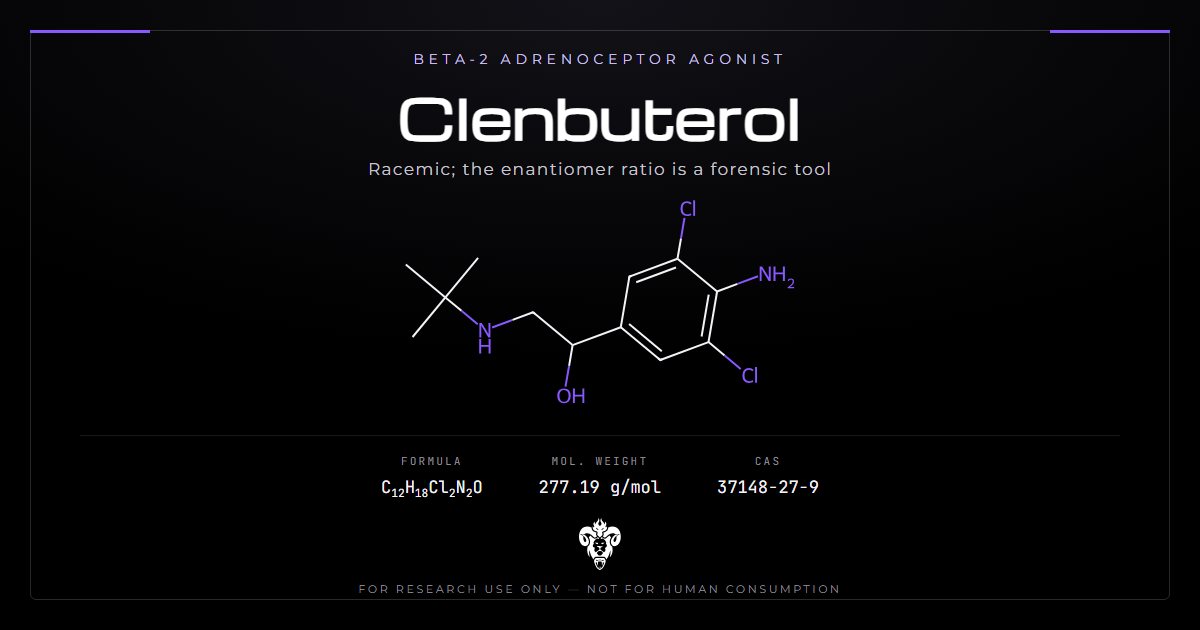
Chemical identity
A small molecule with one stereocentre, and the stereochemistry turns out to matter more than usual.
| Property | Value |
|---|---|
| Systematic name | 4-amino-3,5-dichloro-alpha-[(tert-butylamino)methyl]benzyl alcohol |
| Molecular formula | C12H18Cl2N2O |
| Molecular weight | 277.19 (free base) |
| CAS | 37148-27-9 (free base), 21898-19-1 (hydrochloride) |
| PubChem CID | 2783 |
| InChIKey | STJMRWALKKWQGH-UHFFFAOYSA-N |
| Class | Beta-2 adrenoceptor agonist |
The InChIKey tells you it is a racemate
That key ends in -UHFFFAOYSA-N, the signature of a record with no stereochemistry defined. Clenbuterol carries one stereocentre at the carbinol carbon, and pharmaceutical material is racemic: equal parts R and S.
Hold onto that. It becomes the basis of a forensic method later in this article. This is the one place in the catalogue where an identity detail carries consequences for the people getting tested.
What the force study actually did
Forty-three male Wistar rats received subcutaneous clenbuterol at 4 mg/kg/day or saline, for 9, 14 or 21 days [1].
Hypertrophy appeared, as expected. Absolute maximal tetanic force rose 89%. Then the authors normalised force to muscle size and the effect disappeared. Specific maximal tetanic force came out unchanged, or depressed in the slow twitch muscle.
The kinetics moved too
Fitting the contraction and relaxation curves showed clenbuterol slowing the machinery. The rate constant of force development fell. In extensor digitorum longus, so did the slow and fast relaxation rate constants. In soleus, the fast relaxation rate constant fell [1].
Larger, no stronger per unit, and slower in both directions. That is a specific and slightly unwelcome description. Companion work from the same group examined contractile properties and calcium handling [2]. Earlier work tracked calpain activity and autolysis through the treatment [3].
Why absolute and specific force differ
Absolute force is what the whole muscle produces. Specific force divides that by cross-sectional area, so it measures quality rather than quantity.
A compound that adds tissue raises the first number automatically. Only the second says whether the added tissue works as well as what was there before. Reporting the 89% without the normalisation is technically true and tells you almost nothing.
The rodent dose is not the human dose
Here is the arithmetic that reframes the whole rodent literature, and both halves come from the papers themselves.
| Study | Species | Dose |
|---|---|---|
| Force study [1] | Rat | 4 mg/kg/day, subcutaneous, up to 21 days |
| Human metabolic study [4] | Human | 80 micrograms, single oral dose |
Eighty micrograms in a 75 kg adult is 0.0011 mg/kg. The rat received 4 mg/kg. That comes to roughly 3,700 times more per kilogram. Applying the usual allometric correction between rats and humans still leaves a gap near 600-fold.
The human researchers say this themselves
A Copenhagen group ran four weeks of daily inhaled beta-2 agonist in 21 healthy men, randomised and placebo-controlled [5]. Doses resembled those used in respiratory disease. Their own framing states that rodent doses are not comparable with the therapeutic doses used in humans.
That caveat is the field’s own, printed in a physiology journal. It belongs in front of any rodent result quoted about this compound.
What a single human dose did
The same Copenhagen group gave six young men 80 micrograms and measured them before and 140 minutes after [4].
Resting energy expenditure rose 21%. Fat oxidation rose 39%, with carbohydrate oxidation unchanged. In vastus lateralis biopsies, phosphorylation of mTOR at Ser2448 rose 121% and PKA substrate phosphorylation rose 35%.
What that does and does not show
Six men, one dose, one time point. The metabolic effects are real and measured, and the signalling changes show the pathway responding at a human dose.
None of it measures muscle mass, force, or anything over time. A 140-minute mTOR reading is a mechanism observation rather than an outcome. What the field still lacks is a controlled human trial of chronic clenbuterol on muscle mass and function, and the dose gap above explains a good part of why.
The cardiac question, stated fairly
Clenbuterol is not approved for human use in most countries, and concern about cardiac effects is the stated reason [4]. The published picture is more specific than that summary suggests, and it does not all run one way.
- A comparison against fenoterol and isoprenaline in rats found fenoterol’s cardiotoxicity greater than clenbuterol’s. Clenbuterol lowered diastolic and systolic blood pressure and raised heart rate at higher doses [6].
- Work on cardiac myocytes described hypertrophic growth with elevated ANP and BNP, but without induction of alpha-skeletal muscle actin, a marker of pathological hypertrophy [7]. Those authors characterise the in vivo response as mild physiological hypertrophy with normal contractile function.
- Chronic administration has been examined against adult rat cardiac function and metabolism directly [8].
Physiological and pathological hypertrophy are different claims
That distinction is real: hearts enlarge in athletes without disease, and enlarge in heart failure with it. Marker profiles separate the two.
That work put clenbuterol’s cardiac hypertrophy on the physiological side. It is a meaningful finding, and it is why the compound entered trials in muscle wasting and heart failure [7]. None of that cancels the regulatory position, which rests on a wider set of concerns. Both facts belong in the same paragraph.
Contaminated meat is a documented problem
Clenbuterol occupies an unusual position among research compounds. Farmers have used it illegally as a growth promoter, and its disposition in edible tissue is characterised well enough to have produced its own clinical entity. Proposed guidelines for clenbuterol food poisoning appeared in a general medical journal [9].
The case that forced the issue
Five adverse analytical findings appeared among the Mexican national soccer team in out-of-competition controls in May 2011. FIFA opened an inquest into food contamination in Mexico, host of that year’s U-17 World Cup. A further 208 doping control samples went through highly sensitive testing [10].
Investigators have since examined regional food contamination as a source of inadvertent doping [11]. Broader work covers protecting athletes from inadvertent findings [12], and supplement and food contamination generally [13].
The enantiomer ratio is a forensic tool
This is where the racemate detail pays off.
Pharmaceutical clenbuterol is a 50:50 mixture of R and S. Cattle metabolism does not treat the two equally, so residues in meat carry a shifted ratio. Chiral chromatography with tandem mass spectrometry measures that shift. The signature then survives into human urine after somebody eats the meat [14].
So an altered enantiomeric composition can support an athlete’s claim that a positive test came from food rather than a vial. One national anti-doping laboratory has built and applied the method [15].
The limitation the authors state
The same study reporting the method reports its weakness: enantiomeric composition in meat is highly variable [14]. A tool that depends on a shifted ratio works less well when the shift itself varies from animal to animal.
Worth knowing as a general pattern. A forensic method carrying a stated variability problem earns more trust than one presented without limits, and here the limitation sits in the abstract rather than buried.
The receptor falls while the muscle grows
A beta-2 agonist acts on the beta-2 adrenoceptor, and chronic agonism reduces how much receptor is there to act on. Two studies measured that in the same tissue this article has been discussing.
Female Sprague-Dawley rats received clenbuterol at 4 mg/kg for 12 days, the same dose as the force study [17]. Total beta-adrenoceptor density fell 45% in soleus and 40% in medial gastrocnemius. Gastrocnemius hypertrophied; soleus did not.
A separate group looked at the message rather than the protein, dosing 1.0 mg/kg/day for 10 days [18]. Beta-2 adrenoceptor mRNA fell in fast-twitch muscle without changing in slow-twitch muscle.
The two results do not line up, and that is worth stating
One study reports receptor protein falling in both muscle types. The other reports mRNA falling only in fast muscle. Different measures, different doses, different sexes of animal. Nobody has reconciled them.
What both agree on is direction: the target is downregulating within days to weeks of continuous exposure.
The muscle-type split appears twice
The receptor study found hypertrophy in gastrocnemius and none in soleus [17]. The force study found specific force depressed in slow muscle [1]. Two independent groups at the same 4 mg/kg dose, both finding slow muscle behaving differently from fast muscle, and not in slow muscle’s favour.
That pattern is the most reproducible thing in this literature after the hypertrophy itself.
What the studies actually used
Amounts across this literature span four orders of magnitude, which is the single most useful thing to see in one place.
| Study | Species | Route and amount |
|---|---|---|
| Force study [1] | Rat, n=43 | Subcutaneous, 4 mg/kg/day, 9 to 21 days |
| Receptor density [17] | Rat, female | 4 mg/kg, 12 days |
| Receptor mRNA [18] | Rat | Subcutaneous, 1.0 mg/kg/day, 10 days |
| Comparative cardiac [6] | Rat | Heart rate rose at doses above 0.3 mmol/kg |
| Single human dose [4] | Human, n=6 | Oral, 80 micrograms once |
| Four-week human [5] | Human, n=21 | Inhaled daily, respiratory therapeutic doses |
Reading the table
Every rodent entry uses milligrams per kilogram. Both human entries use micrograms in total. Nothing in the middle exists, so no study bridges the two.
That gap is not an oversight by the researchers. Rodent work uses doses that produce a measurable phenotype quickly, and human work uses doses a regulator has already accepted somewhere. Both are reasonable choices, and together they leave the interesting range unstudied.
Two experiments that would settle the interpretation
Neither is a recommendation. They are the gaps a reader should notice.
Report the contractile measurement that was already taken
The single-dose human study lists contractile function of the quadriceps among its measurements [4]. The abstract reports the metabolic and signalling findings and does not state what the contractile measurement showed.
That may simply be a matter of what fits in an abstract, and the full text may carry it. But the one human dataset that measured force is also the one whose force result is not in the summary everybody reads. Anyone building a picture from abstracts alone should know that.
Run the rodent design at a rodent-relevant human dose, or say why not
The force finding is specific and reproducible-looking, and it exists only at 4 mg/kg in rats. Either a human-relevant dose produces the same divergence between mass and specific force, or it does not, and nobody has looked. Until somebody does, the most quoted rodent result and the only human doses studied describe different experiments.
How to read a clenbuterol study
Four questions, and the first two carry most of the weight.
Absolute force or specific force?
Absolute force rises whenever tissue is added. Specific force asks whether the tissue is any good. A paper reporting only the first has reported the easy half [1].
What dose, in what species?
Rodent work commonly uses milligrams per kilogram. Human work uses tens of micrograms total. Those are different experiments about the same molecule, and the human researchers say so [5].
Skeletal or cardiac, and which marker set?
Cardiac hypertrophy splits into physiological and pathological, and the marker profile separates them [7]. A study reporting heart enlargement without that panel has not told you which one it saw.
Was the receptor still there?
Chronic agonism downregulates the beta-2 adrenoceptor by around 40% within two weeks in rat muscle [17]. A study running longer than that is measuring a different receptor population from the one it started with, and few report the density they ended up with.
Administered or ingested?
For any positive analytical finding, the food contamination route is documented and the enantiomer ratio is the discriminator [10][14][15].
Verifying research material
Two checks, and the first is the one people miss.
Free base or hydrochloride
The free base is 277.19 with CAS 37148-27-9. The hydrochloride carries a different CAS, 21898-19-1, and a different mass. Material sold as clenbuterol is commonly the hydrochloride salt. Confirm which form a certificate describes before comparing a mass figure against a reference.
Racemic or resolved
Standard material is racemic, and the PubChem record carries no stereochemistry for that reason. Methods exist to resolve the enantiomers in pharmaceutical preparations [14][15]. A supplier claiming a single enantiomer is making an extraordinary claim that needs chiral chromatography behind it. An ordinary certificate will not address the question at all.
Every batch we supply carries a certificate of analysis recording the identity and purity data behind it.
Handling
The hydrochloride is a stable crystalline solid with no ester and no obvious hydrolytic route, so it tolerates ordinary storage. Keep it dry and dark. A long elimination half-life in vivo is a detection property rather than a storage one, and it is why trace-level urine methods matter in this field [16].
Common questions about clenbuterol
Mechanism and effects
What does clenbuterol act on? The beta-2 adrenoceptor, as an agonist.
Does it build muscle? In rodents, at high doses, muscles enlarge. Force per unit area did not improve in the study that measured it, and fell in slow muscle [1].
What did a human dose do? A single 80 microgram dose raised resting energy expenditure 21% and fat oxidation 39% over 140 minutes. It also raised mTOR and PKA signalling in muscle [4].
Evidence
Is there a chronic human trial? Not on muscle mass and function. The available human work is short, small, or uses inhaled therapeutic doses for other endpoints [4][5].
Is it cardiotoxic? The picture is more specific than that. A direct rat comparison put it below fenoterol [6], and its cardiac hypertrophy carried physiological rather than pathological markers [7]. It remains unapproved for human use in most countries [4].
Why does food contamination come up so often? Illegal use as a livestock growth promoter is documented, and residues reach consumers [9][10][11].
Verification
Which CAS should a certificate show? 37148-27-9 for the free base, 21898-19-1 for the hydrochloride. Check which one before comparing masses.
Why does the salt form matter for a mass check? Because the hydrochloride carries an extra HCl, so a certificate reporting the salt and a reference quoting the free base will disagree by design rather than by error. Establish which one each figure describes before calling a mismatch.
Does the effect persist with continuous use? Nobody has shown that it does. Receptor density fell 40% to 45% in rat muscle over 12 days at the dose used in the hypertrophy work [17], which is the mechanism by which a beta-agonist effect would be expected to fade.
Can a test tell meat from a vial? The enantiomer ratio supports the distinction, with one caveat: the ratio in meat varies [14][15].
Summary of the evidence
Clenbuterol enlarges rodent skeletal muscle. The one study that normalised for size found no improvement in force per unit area, a depression in slow muscle, and slower contraction and relaxation. Rodent doses producing those effects sit roughly 3,700 times above the studied human doses per kilogram, and the researchers running the human work state that gap themselves.
Human data amounts to short studies with metabolic and signalling endpoints. The cardiac position carries more nuance than the regulatory summary implies. None of that nuance changes the fact that most countries do not approve it for human use. Its most distinctive feature among research compounds is the documented food route, and analysts use the enantiomer ratio of a racemic molecule to tell one route from the other.
Kimera Chems supplies Clenbuterol alongside related metabolic research compounds including GW-501516 and Tesofensine, with full analytical documentation. Our metabolic research library covers more compounds in this class.
Research use only. Not for human or veterinary use. Nothing here describes a therapy or a dosing protocol.
References
- Py G, Ramonatxo C, Sirvent P, Sanchez AM, Philippe AG, Douillard A, Galbès O, Lionne C, et al. Chronic clenbuterol treatment compromises force production without directly altering skeletal muscle contractile machinery. J Physiol. 2015;593(8):2071-84. PMID 25656230. DOI
- Sirvent P, Douillard A, Galbes O, Ramonatxo C, Py G, Candau R, Lacampagne A. Effects of chronic administration of clenbuterol on contractile properties and calcium homeostasis in rat extensor digitorum longus muscle. PLoS One. 2014;9(6):e100281. PMID 24971566. DOI
- Douillard A, Galbes O, Rossano B, Vernus B, Bonnieu A, Candau R, Py G. Time course in calpain activity and autolysis in slow and fast skeletal muscle during clenbuterol treatment. Can J Physiol Pharmacol. 2011;89(2):117-25. PMID 21326343. DOI
- Jessen S, Solheim SA, Jacobson GA, Eibye K, Bangsbo J, Nordsborg NB, Hostrup M. Beta(2) -adrenergic agonist clenbuterol increases energy expenditure and fat oxidation, and induces mTOR phosphorylation in skeletal muscle of young healthy men. Drug Test Anal. 2020;12(5):610-618. PMID 31887249. DOI
- Jessen S, Baasch-Skytte T, Onslev J, Eibye K, Backer V, Bangsbo J, Hostrup M. Muscle hypertrophic effect of inhaled beta(2) -agonist is associated with augmented insulin-stimulated whole-body glucose disposal in young men. J Physiol. 2022;600(10):2345-2357. PMID 35218559. DOI
- Burniston JG, Tan LB, Goldspink DF. Relative myotoxic and haemodynamic effects of the beta-agonists fenoterol and clenbuterol measured in conscious unrestrained rats. Exp Physiol. 2006;91(6):1041-9. PMID 16973691. DOI
- Bhavsar PK, Brand NJ, Felkin LE, Luther PK, Cullen ME, Yacoub MH, Barton PJ. Clenbuterol induces cardiac myocyte hypertrophy via paracrine signalling and fibroblast-derived IGF-1. J Cardiovasc Transl Res. 2010;3(6):688-95. PMID 20577844. DOI
- Soppa GK, Smolenski RT, Latif N, Yuen AH, Malik A, Karbowska J, Kochan Z, Terracciano CM, et al. Effects of chronic administration of clenbuterol on function and metabolism of adult rat cardiac muscle. Am J Physiol Heart Circ Physiol. 2005;288(3):H1468-76. PMID 15528231. DOI
- Ramos F, Silveira I, Silva JM, Barbosa J, Cruz C, Martins J, Neves C, Alves C. Proposed guidelines for clenbuterol food poisoning. Am J Med. 2004;117(5):362. PMID 15336588. DOI
- Thevis M, Geyer L, Geyer H, Guddat S, Dvorak J, Butch A, Sterk SS, Schänzer W. Adverse analytical findings with clenbuterol among U-17 soccer players attributed to food contamination issues. Drug Test Anal. 2013;5(5):372-6. PMID 23559541. DOI
- Guddat S, Fußhöller G, Geyer H, Thomas A, Braun H, Haenelt N, Schwenke A, Klose C, et al. Clenbuterol – regional food contamination a possible source for inadvertent doping in sports. Drug Test Anal. 2012;4(6):534-8. PMID 22447758. DOI
- Geyer H, Schänzer W, Thevis M. Anabolic agents: recent strategies for their detection and protection from inadvertent doping. Br J Sports Med. 2014;48(10):820-6. PMID 24632537. DOI
- Walpurgis K, Thomas A, Geyer H, Mareck U, Thevis M. Dietary Supplement and Food Contaminations and Their Implications for Doping Controls. Foods. 2020;9(8). PMID 32727139. DOI
- Parr MK, Blokland MH, Liebetrau F, Schmidt AH, Meijer T, Stanic M, Kwiatkowska D, Waraksa E, et al. Distinction of clenbuterol intake from drug or contaminated food of animal origin in a controlled administration trial – the potential of enantiomeric separation for doping control analysis. Food Addit Contam Part A Chem Anal Control Expo Risk Assess. 2017;34(4):525-535. PMID 27690842. DOI
- He G, Sheng L, Zhang J, Wu Y, Zhao X, Xu Y, Lu J. Enantiomeric analysis of clenbuterol in Chinese people by LC-MS/MS to distinguish doping abuse from meat contamination. Bioanalysis. 2020;12(11):783-790. PMID 32441534. DOI
- Nicoli R, Petrou M, Badoud F, Dvorak J, Saugy M, Baume N. Quantification of clenbuterol at trace level in human urine by ultra-high pressure liquid chromatography-tandem mass spectrometry. J Chromatogr A. 2013;1292:142-50. PMID 23294994. DOI
- Lavoie JL, Calderone A, Béliveau L. A farnesyltransferase inhibitor attenuated beta-adrenergic receptor downregulation in rat skeletal muscle. Am J Physiol Regul Integr Comp Physiol. 2002;282(1):R317-22. PMID 11742854. DOI
- Sato S, Nomura S, Kawano F, Tanihata J, Tachiyashiki K, Imaizumi K. Adaptive effects of the beta2-agonist clenbuterol on expression of beta2-adrenoceptor mRNA in rat fast-twitch fiber-rich muscles. J Physiol Sci. 2010;60(2):119-27. PMID 20033361. DOI
Research use only. Not for human or veterinary use. Nothing here describes a therapy or a dosing protocol.