
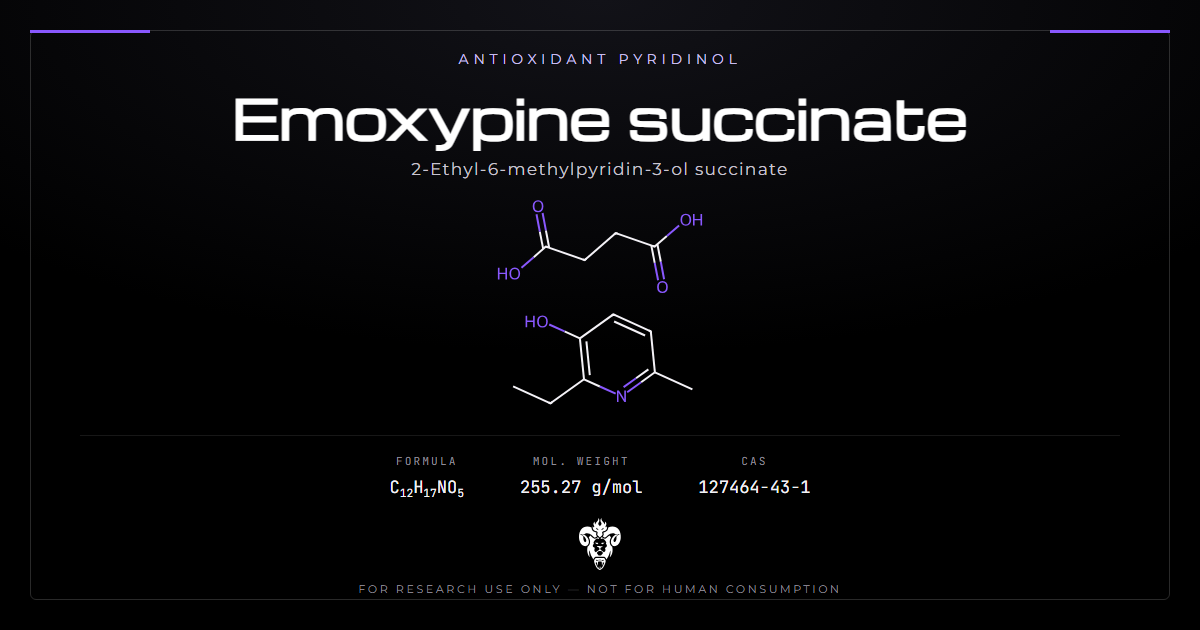
Most salts have a passenger. Chemists formulate a drug as a hydrochloride or a citrate because the salt crystallises better, dissolves faster, or stores longer. Nobody expects the counterion to do anything pharmacological.
Emoxypine succinate breaks that assumption, and the break is the most interesting thing about the compound.
Succinate is a Krebs cycle intermediate. It also acts as a signalling molecule through its own G-protein coupled receptor. Over the past two decades, work on that receptor has tied it to angiogenesis in the retina, macrophage polarisation, adipose leptin expression, and immune sensing in the gut. A salt delivering succinate delivers a ligand, not packaging.
Whether that matters at the doses used is a separate question, and the published record answers it only partially. This article covers the chemistry of both halves of Emoxypine succinate, what succinate signalling actually does, the proposed mechanism, the animal and clinical evidence, and the unusual shape of that evidence base.
Chemical identity: what you are actually handling
Emoxypine succinate is a two-component salt rather than a single molecule.
| Property | Value |
|---|---|
| IUPAC name | butanedioic acid;2-ethyl-6-methylpyridin-3-ol |
| Russian designation | ethylmethylhydroxypyridine succinate |
| Trade name | Mexidol |
| CAS | 127464-43-1 |
| Combined formula | C12H17NO5 |
| Formula weight | 255.27 g/mol |
| PubChem CID | 122298 |
| InChIKey | IKMNOGHPKNFPTK-UHFFFAOYSA-N |
| Base component | Emoxypine, C8H11NO, 137.18 g/mol |
| Acid component | Succinic acid, C4H6O4, 118.09 g/mol |
The pyridinol component
Emoxypine is a 3-hydroxypyridine. The ring carries a hydroxyl at position 3, an ethyl at position 2, and a methyl at position 6.
That hydroxyl on an electron-rich aromatic ring is the antioxidant pharmacophore. A phenolic or pyridinolic hydroxyl donates a hydrogen atom to a radical. Delocalisation into the ring then stabilises the resulting aryloxy radical. The arrangement resembles the pyridinol of vitamin B6, and it resembles the chromanol of vitamin E in function if not in structure.
The succinate component
Succinic acid is a four-carbon dicarboxylic acid and the substrate of succinate dehydrogenase, which sits at the junction of the Krebs cycle and the electron transport chain as complex II.
Russian sources name Emoxypine succinate as ethylmethylhydroxypyridine succinate. They present the succinate as contributing to the effect rather than serving only as a counterion [1]. That claim is testable, and the sections below examine what supports it.
Why the counterion is not inert
Two distinct arguments say succinate does something. They operate at different levels, and conflating them muddles both.
Succinate as a metabolic substrate
The first argument is bioenergetic. Under oxygen deficiency the Krebs cycle stalls, and succinate oxidation through complex II offers a route that can continue when others cannot. Shchulkin frames the antihypoxic action in exactly these terms. Succinic acid in Emoxypine succinate supports succinate oxidase activity under oxygen shortage [1].
Succinate as a receptor ligand
The second argument is pharmacological, and it is the stronger one because the receptor is well characterised.
Succinate activates SUCNR1, also called GPR91. That G-protein coupled receptor senses extracellular succinate as a metabolic stress signal [10]. Shchulkin cites it directly as part of the proposed antihypoxic mechanism [1].
Structural work has since clarified how the interaction works. Trauelsen and colleagues established that the receptor prefers the cis conformation of the succinate backbone. They modelled the binding pocket against the closely related P2Y1 receptor structure, and found succinate binding in a mode quite different from the prevailing assumption [10]. They also identified an empty side-pocket adjacent to the succinate site. Using that insight, they screened a small virtual library and recovered sub-micromolar selective agonists [10].
Signalling assignment took longer to settle. Early work described the receptor as mainly Gi-coupled. Later experiments in G-protein-depleted cells, with BRET monitoring, identified Gq rather than Gi behind the transcriptional effects [11].
What succinate signalling controls
The breadth of this receptor’s biology is the reason the counterion question deserves attention.
Retinal angiogenesis
The finding that established succinate as a signalling molecule came from the eye. Sapieha and colleagues showed succinate accumulating in the hypoxic rodent retina. Acting through GPR91 on retinal ganglion neurons, it drove vessel growth in both normal retinal development and proliferative ischaemic retinopathy [9].
The mechanism runs through the neurons rather than the endothelium. Retinal ganglion cells responded to raised succinate by regulating production of angiogenic factors, vascular endothelial growth factor among them. In rats lacking those cells, succinate had no proangiogenic effect [9].
Macrophage polarisation
Immunological work has produced a more nuanced picture than the early framing suggested.
Earlier work had tied intracellular succinate accumulation in macrophages to a pro-inflammatory programme. Keiran and colleagues showed that receptor-mediated sensing of extracellular succinate does something different. It promotes an anti-inflammatory phenotype and boosts responses to type 2 cytokines [12]. Myeloid-specific receptor deficiency disrupted glucose homeostasis in mice on normal chow. It also worsened the metabolic consequences of diet-induced obesity [12].
Trauelsen and colleagues reached a compatible conclusion in primary human M2 macrophages, which express the receptor highly. Physiological concentrations of extracellular succinate regulated immune gene transcription through Gq signalling, reinforcing the M2 phenotype [11].
Adipose tissue and the gut
Two further systems extend the picture.
In adipocytes, succinate controls leptin expression through the receptor. It acts via the circadian clock in an AMPK and JNK dependent manner. Oral succinate mimicked nutrient-related leptin dynamics in mice [14].
In the small intestine, tuft cells express the receptor and use it to detect microbial succinate. That detection triggers a type 2 innate immune circuit. Succinate in drinking water alone induced the response [13].
That last detail is worth pausing on. Oral succinate at achievable concentrations produced a measurable immunological outcome in a mammal. Treating the succinate half of this salt as pharmacologically silent assumes something the literature does not support.
The proposed mechanism of Emoxypine succinate
Shchulkin sets out the mechanism claimed for the compound across both components [1].
The direct antioxidant action covers two things. Emoxypine succinate inactivates free radicals, and it raises activity of glutathione peroxidase and superoxide dismutase in vitro [1].
An indirect antioxidant action runs through Nrf2, the transcription factor governing cellular resistance to oxidative stress. Expression of Nrf2 rose under ischaemia with Emoxypine succinate present [1].
The antihypoxic action belongs to the succinate component, through the two routes described above. Those are support of succinate oxidase activity under oxygen deficiency, and receptor-mediated signalling through SUCNR1 [1].
That is a coherent proposal. It also rests largely on studies published within one journal system, a point the section on evidence quality returns to.
What the animal data show
Three lines of rodent work bear on the mechanism, and one directly tests whether the succinate reaches tissue.
Succinate distribution after dosing
The most useful study for anyone handling this material measured where the succinate goes.
Shchulkin and colleagues gave Wistar rats a single intravenous dose of 100 mg/kg. They measured succinate by liquid chromatography with tandem mass spectrometry. Sampling covered plasma alongside cytoplasmic and mitochondrial fractions from cerebral cortex, left-ventricular myocardium and liver [2].
Succinate distributed evenly across organs and cleared quickly, following two-compartment kinetics [2]. Levels rose in the cytoplasmic fraction of liver, myocardium and cortex, with only a minor rise in the mitochondrial fraction. Liver showed the largest cytoplasmic increase. Cortex and myocardium showed smaller, statistically indistinguishable increases [2].
The cytoplasmic-versus-mitochondrial split matters. The bioenergetic argument needs succinate inside mitochondria to feed complex II. A predominantly cytoplasmic rise fits that requirement poorly. A cytoplasmic and extracellular rise fits receptor-mediated signalling more comfortably.
A conditional effect on hypoxia signalling
Yakusheva and colleagues examined hypoxia-inducible factor 1α in rat frontal cortex across 64 animals, using immunohistochemistry [3].
The result is notable for what did not happen. Single intraperitoneal dosing at 120 mg/kg changed nothing under normal conditions. Neither did oral dosing at 100 mg/kg three times daily for 14 days [3]. After unilateral common carotid artery occlusion, expression rose at four hours. Oral dosing before and after ischaemia raised it further at four and twelve hours against normal animals, and at day five against occlusion controls [3].
Emoxypine succinate therefore behaves as a conditional agent, changing nothing at baseline and acting only under ischaemic stress. That profile is harder to detect in a healthy-animal screen, and easier to over-interpret in a damaged one.
Cardiac apoptosis markers
Azova and colleagues examined apoptosis regulators in left-ventricular cardiomyocytes of spontaneously hypertensive rats, comparing the compound against phosphocreatine [6].
Neither agent affected Bcl-2 expression. Both significantly reduced Bax protein, with phosphocreatine producing the larger effect [6]. Both authors read that result as evidence for roles of energy deficit and oxidative stress in cardiomyocyte apoptosis under genetically determined hypertension [6].
The clinical record
The human literature for Emoxypine succinate is large by the standards of this catalogue, and it needs reading with its provenance in view.
The MEMO trial
The most rigorous study in the public record is an international multicentre randomised double-blind placebo-controlled trial of sequential therapy in chronic brain ischaemia, reported as the MEMO study [4].
It enrolled 318 patients aged 40 to 90, median age 60. The primary endpoint measured change in total score on a cognitive screening scale at day 75. Secondary endpoints covered a digit symbol substitution test, a general health survey, an asthenia scale, an anxiety scale, and a balance and gait scale [4].
The reported result deserves careful phrasing. Both the treatment group and the placebo group improved across cognitive, emotional and motor measures over 75 days. The treatment group changed more, with significantly higher median absolute differences [4].
A placebo group that improves substantially is the expected pattern in this setting, and it is the reason a controlled design was necessary.
Other reported indications
Investigators have examined Emoxypine succinate across a wide range of conditions, which is itself informative.
Prakhova and colleagues studied 52 patients with multiple sclerosis alongside 24 healthy controls, using diffusion tensor imaging with tractography. They concluded that further clinical trials would be needed to confirm what they observed [5].
Review literature covers proposed use in schizophrenia spectrum disorders, antipsychotic-associated symptoms, insomnia within borderline mental disorders, and addiction medicine [7]. A clinical study in chronic pancreatitis reported changes in quality-of-life scores and lipid parameters [8].
The single-country evidence problem
The breadth just described is a caution rather than a recommendation.
Reports of efficacy span cerebrovascular disease, multiple sclerosis, schizophrenia, insomnia, addiction and pancreatitis. Emoxypine succinate is therefore either a very general cytoprotectant, or a compound whose trial literature has never faced independent replication. Distinguishing those two possibilities requires evidence from outside the originating research community, and for this compound that evidence is largely absent.
Most of the clinical record appears in Russian-language journals, much of it in a single publication. Emoxypine succinate holds no marketing approval outside its region of origin. No regulator in the European Union or United States has evaluated it.
None of that makes the findings wrong. It does mean a laboratory citing them draws on a literature that independent groups have not reproduced, and the honest framing says so.
Physicochemical properties and handling
Emoxypine succinate is a crystalline solid with good water solubility. That solubility is one reason the succinate salt exists rather than the free base.
The pyridinol hydroxyl is the reactive centre and the stability liability. Electron-rich phenolic and pyridinolic compounds oxidise on exposure to air and light. Their oxidation products usually carry colour. Discoloration of a white or off-white solid toward yellow or brown is the visible sign of degradation.
Store the solid sealed, dry, cold and dark, ideally under inert headspace. Prepare aqueous solutions fresh, since oxidation proceeds faster in solution than in the solid state.
Stoichiometry is not optional
This is where most quantitative errors with this compound arise.
Emoxypine succinate has a formula weight of 255.27 g/mol. Its emoxypine component contributes 137.18 g/mol, or 53.7 percent of the total. Succinic acid contributes the remaining 118.09 g/mol, or 46.3 percent.
Weighing 100 mg of Emoxypine succinate therefore delivers roughly 54 mg of emoxypine and roughly 46 mg of succinic acid. A protocol specifying an emoxypine concentration, then weighing the salt without correction, will run low by nearly half.
Confirm the stoichiometry on the certificate as well. A 1:1 salt is the standard form. Hemisuccinate and other ratios remain chemically possible, and the molar correction changes accordingly.
Analytical characterisation
Four checks cover this material, and the first two are the ones a single-molecule mindset tends to skip.
Stoichiometric ratio, established by proton NMR integration. The succinate methylene signal integrates against the pyridine ring protons, and the ratio confirms a 1:1 salt directly.
Content of both components, quantified separately. Ion chromatography or a dedicated organic acid method quantifies succinate. Reversed-phase HPLC with ultraviolet detection quantifies emoxypine, which absorbs well.
Accurate mass on the base component. Electrospray ionisation usually shows the emoxypine ion at 138 in positive mode, because the salt dissociates in solution. The combined formula weight of 255.27 is a formula weight rather than a molecular ion to look for.
Oxidation products, by a stability-indicating method. Given the pyridinol, this is the impurity class that matters.
One point of interpretation follows from the salt structure. A purity figure of 99 percent for Emoxypine succinate describes the salt as a whole. It says nothing about whether the stoichiometry is correct, because a preparation carrying excess free succinic acid can still assay as chemically pure. Only the ratio measurement catches that error, which is why it belongs on the certificate alongside purity.
Kimera publishes third-party certificates of analysis for every lot in its COA database. Laboratories source Emoxypine Succinate as a hydroxypyridine antioxidant reference, sometimes alongside Bromantane or Noopept from the same research tradition. Related compounds appear in the nootropics category.
Common misclassifications
Four errors recur with this compound.
Suppliers describe the succinate as an inert counterion. It is a receptor ligand with characterised structural pharmacology [10][11]. Documented effects span angiogenesis [9], macrophage phenotype [12], gut immunity [13] and leptin expression [14].
Summaries treat Emoxypine succinate as interchangeable with emoxypine hydrochloride. Chloride is inert and succinate is not, so the two salts differ as preparations even at matched emoxypine content.
Protocols treat salt mass as base mass. Roughly 46 percent of the weighed material is succinic acid.
Sources cite the Russian clinical literature as though independent groups had replicated it. That literature is extensive and largely single-country, and groups outside the originating community have not reproduced it.
Experimental design considerations
Correct for salt mass before anything else. Multiply by 0.537 to obtain emoxypine content from weighed salt.
Include a succinate-only control arm. Without one, nothing observed with Emoxypine succinate distinguishes the pyridinol from the counterion. Given what the receptor literature shows, this is the single most valuable control available for this compound.
Consider a sodium succinate comparator at matched molar succinate. That isolates the contribution of the antioxidant component directly.
Design for conditional effects. The hypoxia-inducible factor result appeared only under ischaemia and not at baseline [3], so a healthy-animal design may show nothing.
Prepare solutions fresh and protect from light. The pyridinol oxidises.
Frequently asked questions
What is Emoxypine succinate? A 1:1 salt of 2-ethyl-6-methylpyridin-3-ol with succinic acid, CAS 127464-43-1, marketed in Russia as Mexidol. Kimera supplies it as a laboratory research material.
Is the succinate just a counterion? No. Succinate activates SUCNR1, a characterised G-protein coupled receptor with documented roles across several tissues [9][10][11][12][13][14].
How much emoxypine is in the salt? About 53.7 percent by mass. The remainder is succinic acid.
Is it the same as emoxypine hydrochloride? No. The counterions differ in pharmacological activity, so the two preparations are not equivalent.
What does the strongest clinical study show? In a placebo-controlled trial of 318 patients with chronic brain ischaemia, both groups improved over 75 days, with more pronounced changes in the treatment group [4].
Is it approved outside Russia? No. It holds no marketing approval in the European Union or the United States.
What is the main stability concern? Oxidation of the pyridinol hydroxyl, visible as yellowing or browning of the solid.
Summary of the evidence
Identity: a 1:1 salt, C12H17NO5, 255.27 g/mol, comprising a 3-hydroxypyridine antioxidant and succinic acid.
Composition: 53.7 percent emoxypine and 46.3 percent succinic acid by mass.
Counterion status: pharmacologically active. Succinate is an established extracellular signalling molecule acting through SUCNR1 [10][11].
Proposed mechanism: direct radical scavenging with raised glutathione peroxidase and superoxide dismutase activity, indirect action through Nrf2, and antihypoxic action attributed to succinate [1].
Distribution: succinate rises mainly in the cytoplasmic fraction after dosing, with only a minor mitochondrial rise [2].
Conditional pharmacology: hypoxia-inducible factor expression changed only under ischaemia, not at baseline [3].
Clinical record: a 318-patient placebo-controlled trial in chronic brain ischaemia showing improvement in both arms, larger with treatment [4], alongside reports across multiple sclerosis [5], psychiatric indications [7] and gastroenterology [8].
Principal limitation: the clinical literature is extensive, largely single-country, and not independently replicated.
Status: approved in its region of origin, unapproved elsewhere, supplied here for laboratory research use only.
References
- Shchulkin AV. A modern concept of antihypoxic and antioxidant effects of mexidol. Zh Nevrol Psikhiatr Im S S Korsakova. 2018;118(12 Pt 2):87-93. PMID 30830123. DOI
- Shchulkin AV, Mylnikov PY, Chernykh IV, Esenina AS, Yakusheva EN. Pharmacokinetics of succinate in rats after intravenous administration of Mexidol. Bull Exp Biol Med. 2023;175(1):54-58. PMID 37338763. DOI
- Yakusheva EN, Mylnikov PY, Chernykh IV, Shchulkin AV. Mexidol effect on the factor induced by hypoxia HIF-1α expression in the rat cerebral cortex in ischemia. Zh Nevrol Psikhiatr Im S S Korsakova. 2017;117(10):87-91. PMID 29171495. DOI
- Zakharov VV, Tkacheva ON, Mkhitaryan EA, Fedin AI. Efficacy of Mexidol in patients with chronic brain ischemia and cognitive impairment of different age groups: results of sub-analysis of the MEMO study. Zh Nevrol Psikhiatr Im S S Korsakova. 2022;122(11 Pt 2):73-80. PMID 36412160. DOI
- Prakhova LN, Ilves AG, Savintceva ZI, et al. Neuroprotection therapy of multiple sclerosis with high doses of ethylmethylhydroxypyridine succinate. Zh Nevrol Psikhiatr Im S S Korsakova. 2016;116(10 Pt 2):73-78. PMID 28139615. DOI
- Azova MM, Blagonravov ML, Frolov VA. Effect of phosphocreatine and ethylmethylhydroxypyridine succinate on the expression of Bax and Bcl-2 proteins in left-ventricular cardiomyocytes of spontaneously hypertensive rats. Bull Exp Biol Med. 2015;158(3):313-314. PMID 25573357. DOI
- Shamrey VK, Kurasov ES, Nechiporenko VV, Kolchev AI, Tsygan NV. Possibilities of using Mexidol in the complex therapy of mental disorders. Zh Nevrol Psikhiatr Im S S Korsakova. 2020;120(5):160-164. PMID 32621483. DOI
- Samarin AG, Pimenov LT. Chronic pancreatitis: quality of life and possibilities of pharmacological correction by ethylmethylhydroxypyridine succinate. Eksp Klin Gastroenterol. 2010;(6):77-81. PMID 20734491
- Sapieha P, Sirinyan M, Hamel D, et al. The succinate receptor GPR91 in neurons has a major role in retinal angiogenesis. Nat Med. 2008;14(10):1067-1076. PMID 18836459. DOI
- Trauelsen M, Rexen Ulven E, Hjorth SA, et al. Receptor structure-based discovery of non-metabolite agonists for the succinate receptor GPR91. Mol Metab. 2017;6(12):1585-1596. PMID 29157600. DOI
- Trauelsen M, Hiron TK, Lin D, et al. Extracellular succinate hyperpolarizes M2 macrophages through SUCNR1/GPR91-mediated Gq signaling. Cell Rep. 2021;35(11):109246. PMID 34133934. DOI
- Keiran N, Ceperuelo-Mallafré V, Calvo E, et al. SUCNR1 controls an anti-inflammatory program in macrophages to regulate the metabolic response to obesity. Nat Immunol. 2019;20(5):581-592. PMID 30962591. DOI
- Nadjsombati MS, McGinty JW, Lyons-Cohen MR, et al. Detection of succinate by intestinal tuft cells triggers a type 2 innate immune circuit. Immunity. 2018;49(1):33-41.e7. PMID 30021144. DOI
- Villanueva-Carmona T, Cedó L, Madeira A, et al. SUCNR1 signaling in adipocytes controls energy metabolism by modulating circadian clock and leptin expression. Cell Metab. 2023;35(4):601-619.e10. PMID 36977414. DOI
Emoxypine succinate is sold for laboratory research use only. Not for human consumption, nor medical, veterinary, or household uses.
Literature retrieved from PubMed.