
In October 2017 the British Journal of Clinical Pharmacology carried two things in one issue. One was the first-in-human report for GSK-2881078 [1]. The other was a commentary by James Dalton, who developed ostarine, titled “The long and winding road for selective androgen receptor modulators” [2].
Dalton’s argument was precise. Plenty of these compounds are well tolerated and reliably add lean body mass in people. What nobody had shown was the link from that lean mass to physical function, in a real patient population.
Five years later this compound ran that experiment. A randomised trial in patients with chronic obstructive pulmonary disease measured leg strength, lean mass and how patients said they felt [3]. Lean mass rose. Leg strength moved on one of its two expressions and not the other. The patient-reported outcomes did not change at all. That result, and how to read it, is what this article is about.
Chemical identity
| Property | Value |
|---|---|
| Common names | GSK-2881078, GSK2881078 |
| Molecular formula | C14H13F3N2O2S |
| Molecular weight | 330.33 g/mol |
| CAS | 1539314-06-1 |
| PubChem CID | 86709174 |
| InChIKey | SKDVMPZQJMZEAC-SECBINFHSA-N |
| Class | Nonsteroidal indole-5-carbonitrile |
| Configuration | (2R) |
| Originator | GlaxoSmithKline |
The catalogue carries it as GSK-2881078.
An indole, not an arylpropionamide
Most of this shelf shares one backbone. Ostarine, andarine and S-23 are arylpropionamides. This compound is not related to them at all.
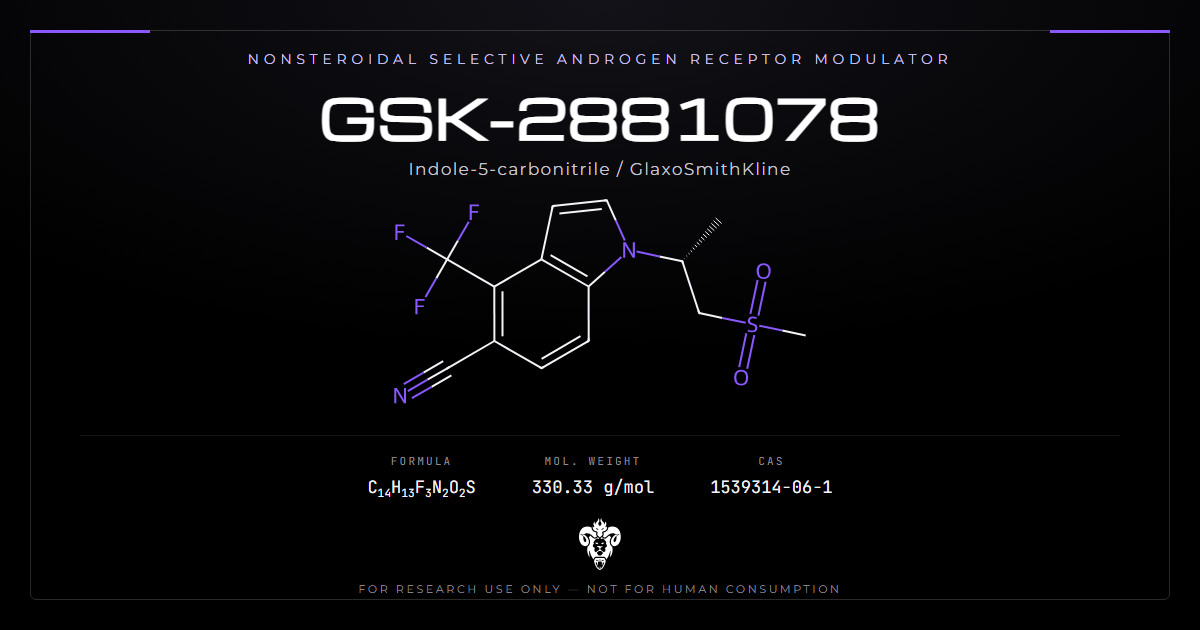
It is an indole carrying a carbonitrile at position 5 and a trifluoromethyl at position 4, with a methylsulfonyl propyl group on the indole nitrogen. The single stereocentre sits on that side chain in the (2R) configuration.
What defines the class is receptor behaviour, not a shared scaffold. GSK-2881078 is a useful reminder of that. Anyone reasoning from arylpropionamide metabolism or arylpropionamide detection methods to this compound is reasoning across a genuine chemical gap.
Doses in micrograms
The first-in-human study gave single doses of 0.05, 0.1 and 0.2 mg [1]. Repeat dosing in men ran from 0.05 to 0.75 mg, and in women 0.24 and 0.35 mg.
Put that beside the rest of the catalogue. Ostarine’s phase 3 used 3 mg, ligandrol’s trial topped out at 1 mg, and RAD-140’s phase 1 reached 150 mg. GSK-2881078 is active at doses an order of magnitude below most of the class, which matters for anyone handling it and for anyone reading a concentration.
First in human
Clark and colleagues ran the opening study in healthy young men and postmenopausal women [1]. Part A was single-dose in 10 men. Part B repeated dosing in 65 men and 24 women, over 7 to 14 days.
Half-life over 100 hours
Exposure rose in proportion to dose, and the terminal half-life exceeded 100 hours [1]. That is long for a small molecule and it shapes everything downstream.
A half-life that long means accumulation over repeated daily dosing, a slow approach to steady state, and a slow washout. The trial design shows the developers knew it: dosing in the later study started twice daily for three days, then dropped to once daily [4].
What moved, and what did not
Vital signs, electrocardiograms, cardiac telemetry and routine laboratory panels showed no significant effects [1]. Two markers did move, both dose-dependently, and both downward: high-density lipoprotein cholesterol and sex hormone binding globulin.
In women at 0.35 mg the differences from placebo were HDL cholesterol −0.518 mmol/L (95% CI −0.703 to −0.334) and SHBG −39.1 nmol/L (−48.5 to −29.7). Falling SHBG is a straightforward marker of androgen receptor engagement. Falling HDL is the finding that recurs in every trial of this compound.
The two men with raised creatine kinase
One woman developed a drug rash and left the study. Two men had elevated creatine phosphokinase after physical exertion during follow-up. The one serious adverse event in the trial occurred in a subject taking placebo [1].
Hold that creatine kinase sentence. A later systematic review reads the same events differently, and the section below returns to it.
Dose-ranging in older adults
Neil and colleagues took the compound into healthy older men and postmenopausal women [4]. Three cohorts of each sex received twice-daily dosing for three days, then once daily for up to 53 days.
Measurement was unusually thorough for a phase 1b. Repeated dual-energy X-ray absorptiometry tracked whole-body composition, and MRI cross-sectional thigh scans looked directly at the muscle the compound is supposed to act on.
Every dose level of GSK-2881078 produced greater lean mass accrual than placebo. Alanine aminotransferase rose transiently.
A separate cohort tested CYP3A4 inhibition. The effect on exposure was unlikely to matter clinically [4], which is a useful negative for a compound with a 100-hour half-life. Long half-lives and enzyme inhibition compound each other, so a drug that avoids that interaction is easier to dose safely.
Note what the MRI adds. Dual-energy X-ray absorptiometry reports whole-body lean mass, a compartment that includes water. Cross-sectional thigh imaging measures the muscle itself. Running both in the same subjects separates tissue from fluid. Few compounds in this catalogue have had that scrutiny.
Women respond at lower doses, and the protocol changed
The signal appears twice
Clark’s study reported women more sensitive than men on both HDL and SHBG, at lower doses [1]. Neil’s study reported the same pattern on lean mass: greater response in women, at lower doses [4].
Two studies, two different endpoint sets, one consistent direction. That is about as much replication as any sex-difference finding in this catalogue has.
What the COPD trial did with it
Most compounds here report a sex difference and then dose everyone identically. This one did not. The phase 2A trial gave women 1.0 mg and men 2.0 mg [3].
A protocol that changes with the finding is worth noticing. It also complicates the reading of that trial. The sexes did not share a dose, and the paper reports them separately rather than pooling them.
The COPD trial
Mohan and colleagues published the phase 2A in Thorax [3]. It enrolled 47 postmenopausal women and 50 men with COPD, forced expiratory volume in one second between 30% and 65% predicted, and short physical performance battery scores of 3 to 11.
Design
Randomisation was 1:1 to placebo or active for 13 weeks, double-blind, alongside a home exercise programme of strength training and physical activity. Everyone exercised, so the comparison is drug plus exercise against exercise alone.
Co-primary endpoints were change in leg strength at 90 days by one-repetition maximum, reported two ways, and a set of safety outcomes.
That design decision deserves a sentence of its own. Comparing GSK-2881078 plus exercise against exercise alone sets a harder bar than comparing drug against nothing. It also matches real use, since nobody proposes treating muscle weakness without training. The cost is that any drug effect has to show up on top of a real training response.
The strength result, read carefully
Here are the four numbers, and they do not all say the same thing.
| Group | Absolute change vs placebo | Relative change vs placebo |
|---|---|---|
| Women | 8.0 kg (90% CI −2.5 to 18.4) | 5.2% (90% CI −4.7 to 15.0) |
| Men | 11.8 kg (90% CI −0.5 to 24.0) | 7.0% (90% CI 0.5 to 13.6) |
One of those four intervals excludes zero. It is the relative change in men. The absolute change in the same men, in the same trial, on the same measurement, does not.
Two further things belong with that table. These are 90% confidence intervals, a phase 2A convention that is wider-tolerance than the 95% intervals most readers assume. The authors word their own conclusion carefully: strength increased “when expressed as per cent predicted, in men”. The published claim is narrower than the headline usually reported.
What did not move
Lean body mass increased, consistent with every earlier study. The patient-reported outcomes did not change [3].
That sentence is the answer to Dalton’s 2017 question, and it is not the answer the field wanted. GSK-2881078 did the thing SARMs reliably do. Whether patients noticed is where the trial went quiet.
One qualifier belongs here in fairness. Lean mass, physical function and the patient-reported outcomes were all secondary endpoints; only leg strength and safety were co-primary [3]. A trial sized to detect a strength difference is not thereby sized to detect a change in how patients feel, and a null result on a secondary endpoint carries less weight than a null on a primary one. It is still the only such measurement anyone has published for this class in a disease population.
Two accounts of how patients felt
The story does not end there, and the honest version needs both halves.
Tabberer and colleagues interviewed patients from that same trial [5]. Thirty-two gave 60-minute in-depth interviews on exit and 35 gave shorter confirmatory ones. Most described improvements in muscle strength and in functional limitations.
So the structured instruments recorded nothing and the open interviews recorded something. Both sit in the published record, from one trial, about one group of patients.
The same paper offers a partial explanation. Only 19.4% of participants found the physical assessments easy to complete, and 71% reported technical issues with the equipment. An assessment that patients struggle to perform is a noisy instrument, and noise hides small effects. Interviews are also unblinded, uncontrolled and prone to courtesy bias, which cuts the other way.
The transferable point is not that one method beat the other. A trial can measure the right construct with the wrong instrument. The interview data are evidence that this is worth checking, rather than proof of an effect.
How the safety record reads
In the trials
The findings repeat across all three studies: transient rises in hepatic transaminases, and reductions in HDL cholesterol that reversed [1][3][4]. Nothing in the trials produced a serious drug-related event.
The reclassification
Vignali and colleagues reviewed safety across 33 studies, 2,136 patients and 1,447 SARM exposures [6]. Across trials, ALT elevation averaged 7.1% of exposed patients. The case report literature contributed 15 drug-induced liver injuries, one Achilles tendon rupture and one rhabdomyolysis.
Then this line: two individuals exposed to GSK-2881078 in a clinical trial are recorded as having rhabdomyolysis. Read it against the first-in-human paper, which describes two men with raised creatine phosphokinase after physical exertion during follow-up [1].
Those are almost certainly the same two people. One paper reports a laboratory value with an exertional explanation; the other counts a named condition in a safety tally. The same events carry different weight depending on which paper you read, and neither account is wrong. Anyone citing a safety record for this compound should say which framing they are using.
Detection
Forty-two days from 760 micrograms
Rading and colleagues gave a single oral dose and followed it out [8]. Urine peaked near 920 pg/mL at eight hours after 760 micrograms, and stayed above the 2 pg/mL detection limit until day 42.
Six weeks of detectability from a sub-milligram dose follows directly from that 100-hour half-life. It also puts this compound alongside ostarine and roxadustat in the group where trace exposure produces month-scale windows.
Hair works only if the segment covers the dose
Rading’s group also shaved scalp hair at weeks 0, 1, 3, 5 and 9 after a single 1.5 mg dose. Intact GSK-2881078 peaked at 1.7 pg/mg in the week 3 segment. It then fell to 0.7 at week 5 and 0.2 at week 9.
Their conclusion is the practical one. Hair analysis is feasible, and only if the segment analysed covers the period of ingestion. At those concentrations a mis-segmented sample returns nothing.
Karatt and colleagues mapped the metabolism in the horse, finding five in vivo and six in vitro metabolites, mostly hydroxylated [9]. They observed no glucuronide and no sulfate conjugates, which is unusual in this class and means the usual hydrolysis step adds nothing here.
Human in vitro work and multi-class urine methods cover GSK-2881078 as well [10][11][13], and it appears among the compounds the class detection reviews name [16]. Thevis and Volmer characterised its behaviour under both electron and electrospray ionisation in 2017 [12].
Where GSK-2881078 sits in the class
Wen and colleagues pooled nine randomised trials across six SARMs, 970 patients, mean follow-up 80 days [7]. Mean lean body mass rose from 49.46 to 50.86 kg and mean leg press from 1,822.77 to 2,191.27 N.
Mean stair climbing power went the other way, from 352.24 to 315.16 W. Those are averages of pre and post values across heterogeneous studies rather than pooled effect estimates, so they carry little weight individually. They do show that the performance measures in this field disagree with each other.
Against that background, MK-2866 is the only class member with completed phase 3 trials. S-23 has one preclinical paper, and LGD-2226 and OTR-AC appear mainly in analytical work.
GSK-2881078 has the most complete clinical arc of any of them: first-in-human, dose-ranging in older adults, then a randomised trial in a disease population. No phase 3 is indexed, and the published record gives no reason why. This article does not supply one.
The reviews still name it
Two 2025 reviews are worth reading for what they reveal about the field’s own account of itself. Borecki and colleagues survey SARMs as candidates for cachexia and frailty [14]. Jeyaraman and colleagues place them among emerging sarcopenia therapies, naming enobosarm and GSK-2881078 as showing dose-dependent gains in appendicular lean mass with preliminary functional benefit [15].
Both frame the class as promising and near. Neither cites a completed phase 3 for any member, because there is not one to cite. A compound can stay in the review literature long after it has stopped moving through development, and a reader who meets GSK-2881078 in a 2025 review would not learn that its last trial was published in 2022.
Verifying research material
Batch documentation sits on the certificates of analysis page.
Identity
Formula C14H13F3N2O2S, molecular weight 330.33, CAS 1539314-06-1, InChIKey SKDVMPZQJMZEAC-SECBINFHSA-N.
GSK-2881078 carries no chlorine or bromine, so there is no convenient halogen isotope pattern to check. Its trifluoromethyl and methylsulfonyl groups both give characteristic losses, and published mass spectrometric characterisation exists for the class [12].
Stereochemistry
The SECBINFHSA block encodes the (2R) configuration at the side-chain carbon. There is one stereocentre, so a racemic preparation would contain 50% of the wrong enantiomer while matching formula, mass and every achiral spectrum.
Chiral chromatography against a characterised standard is the check. A certificate reporting purity by area percentage on an achiral column has not addressed configuration.
Reading a concentration
This is the compound in the catalogue where a decimal place matters most. Human studies used 0.05 to 2 mg, and the detection study worked from 760 micrograms.
Anyone reproducing a published exposure should convert on a molar basis and check the units twice. A tenfold error here lands outside every dose ever given to a person.
Common questions about GSK-2881078
Did it reach clinical trials? Yes. First-in-human, a phase 1b in older adults, and a randomised phase 2A in COPD [1][3][4].
Did it work? It increased lean mass in every study. Leg strength in the COPD trial improved on the relative measure in men only, and patient-reported outcomes did not change [3].
Why do men and women get different doses? Women responded at lower doses in two separate studies, so the COPD trial dosed women 1.0 mg and men 2.0 mg [1][3][4].
What is the half-life? Over 100 hours [1].
How long is it detectable? Up to 42 days in urine after a single 760 microgram dose [8].
What are the safety findings? Transient transaminase elevations and reversible HDL reductions across the trials, plus two trial subjects recorded as rhabdomyolysis in a later review [1][3][6].
Summary of the evidence
Strongest evidence is a genuine clinical programme: three published trials in sequence, with dual-energy X-ray absorptiometry, MRI thigh scans and a disease population [1][3][4]. Very little else in this catalogue comes close.
The result is the interesting part. Lean mass rose in every study that looked. Strength moved on one of two expressions of one endpoint in one sex. The instruments that asked patients how they felt recorded nothing, while interviews with the same patients recorded improvement [3][5].
Weakest is everything after 2022. No phase 3 appears in the indexed literature, and the record offers no explanation, so this article does not invent one.
The standing lesson belongs to Dalton’s commentary [2]. Lean body mass is easy to move and physical function is hard, and a compound that does the first is not thereby doing the second. Six years and one randomised trial later, that gap is still the one that matters. More of this literature sits in the SARMs category.
Status: supplied for laboratory research use only.
References
- Clark RV, Walker AC, Andrews S, Turnbull P, Wald JA, Magee MH. Safety, pharmacokinetics and pharmacological effects of the selective androgen receptor modulator, GSK2881078, in healthy men and postmenopausal women. Br J Clin Pharmacol. 2017;83(10):2179-2194. PMID 28449232. DOI
- Dalton JT. The long and winding road for selective androgen receptor modulators. Br J Clin Pharmacol. 2017;83(10):2131-2133. PMID 28621446. DOI
- Mohan D, Rossiter H, Watz H, Fogarty C, Evans RA, Man W, et al. Selective androgen receptor modulation for muscle weakness in chronic obstructive pulmonary disease: a randomised control trial. Thorax. 2022;78(3):258-266. PMID 36283827. DOI
- Neil D, Clark RV, Magee M, Billiard J, Chan A, Xue Z, et al. GSK2881078, a SARM, produces dose-dependent increases in lean mass in healthy older men and women. J Clin Endocrinol Metab. 2018;103(9):3215-3224. PMID 29982690. DOI
- Tabberer M, Williamson N, Tatlock S, Gater A, Grimes R, Akinseye C, et al. Qualitative interviews of patients with COPD and muscle weakness enrolled in a clinical trial evaluating a new anabolic treatment. J Patient Rep Outcomes. 2024;8(1):45. PMID 38641716. DOI
- Vignali JD, Pak KC, Beverley HR, DeLuca JP, Downs JW, Kress AT, et al. Systematic review of safety of selective androgen receptor modulators in healthy adults: implications for recreational users. J Xenobiot. 2023;13(2):218-236. PMID 37218811. DOI
- Wen J, Syed B, Leapart J, Shehabat M, Ansari U, Akhtar M, et al. Selective androgen receptor modulators (SARMs) effects on physical performance: a systematic review of randomized control trials. Clin Endocrinol (Oxf). 2024;102(1):3-27. PMID 39285652. DOI
- Rading A, Anielski P, Thieme D, Keiler AM. Detection of the selective androgen receptor modulator GSK2881078 and metabolites in urine and hair after single oral administration. Drug Test Anal. 2020;13(1):217-222. PMID 33037775. DOI
- Karatt TK, Sathiq MA, Laya S, Kal AKK, Subhahar MB, Muhammed Ajeebsanu MP, et al. In-depth metabolic study of nonsteroidal selective androgen receptor modulator GSK2881078 in thoroughbred horses and horse liver microsomes for doping control. Drug Test Anal. 2023;15(7):757-768. PMID 36922727. DOI
- Kowalczyk K, Torres-Elguera JC, Jarek A, Konopka A, Kwiatkowska D, Bulska E. In vitro metabolic studies of novel selective androgen receptor modulators and their use for doping control analysis. Drug Test Anal. 2021;14(1):122-136. PMID 34414676. DOI
- Stacchini C, Botrè F, Comunità F, de la Torre X, Dima AP, Ricci M, et al. Simultaneous detection of different chemical classes of selective androgen receptor modulators in urine by liquid chromatography-mass spectrometry-based techniques. J Pharm Biomed Anal. 2020;195:113849. PMID 33383501. DOI
- Thevis M, Volmer DA. Mass spectrometric studies on selective androgen receptor modulators (SARMs) using electron ionization and electrospray ionization/collision-induced dissociation. Eur J Mass Spectrom (Chichester). 2017;24(1):145-156. PMID 29232975. DOI
- Cutler C, Viljanto M, Taylor P, Hincks P, Biddle S, Van Eenoo P. Identification of equine in vitro metabolites of seven non-steroidal selective androgen receptor modulators for doping control purposes. Drug Test Anal. 2022;14(2):349-370. PMID 34714606. DOI
- Borecki R, Byczkiewicz P, Słowikowska-Hilczer J. Selective androgen receptor modulators (SARMs): potential anabolic drugs for the treatment of cachexia and frailty syndrome. Endokrynol Pol. 2025;76(3):248-256. PMID 40586402. DOI
- Jeyaraman M, Jeyaraman N, Nallakumarasamy A, Ramasubramanian S, Muthu S, Murugan S, et al. Sarcopenia in aging: pathogenesis, diagnosis, and emerging therapeutic frontiers. Mol Imaging Biol. 2025;28(1):1-22. PMID 41296190. DOI
- Thevis M, Schänzer W. Detection of SARMs in doping control analysis. Mol Cell Endocrinol. 2017;464:34-45. PMID 28137616. DOI
GSK-2881078 is sold for laboratory research use only. Not for human consumption, nor medical, veterinary, or household uses.
Literature retrieved from PubMed.