
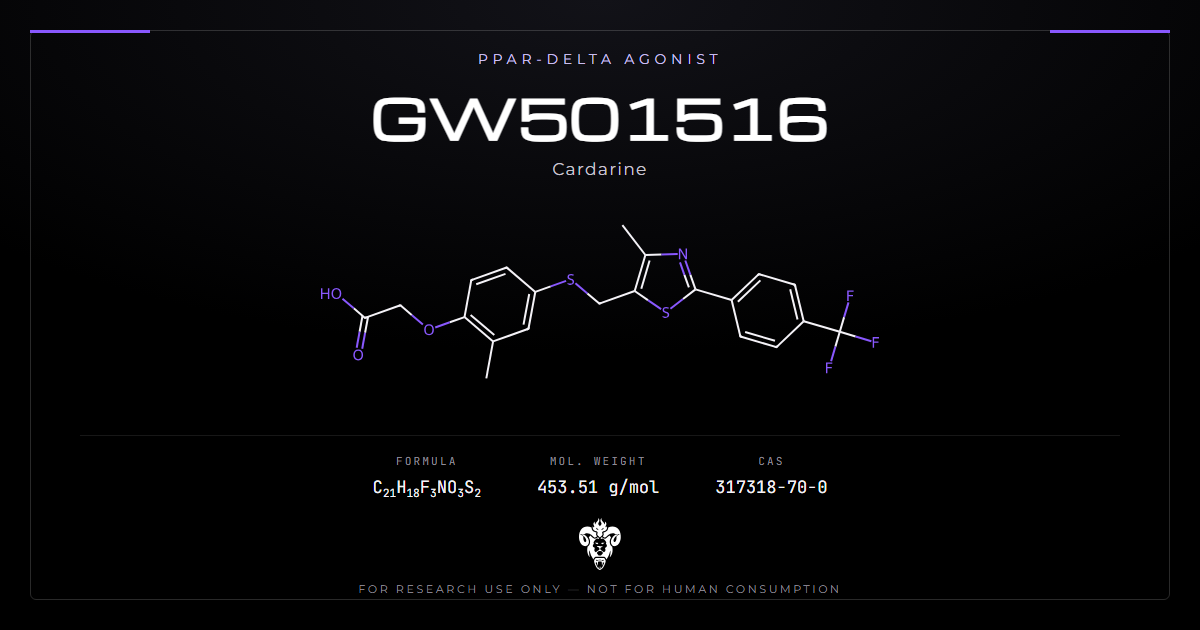
GW-501516 is a selective agonist of peroxisome proliferator-activated receptor delta, developed by GlaxoSmithKline and abandoned before approval. Laboratories source GW-501516 as a reference PPARδ agonist for transcriptional and metabolic work. The compound has an unusually complete literature for a discontinued molecule. It covers mechanism, rodent metabolic phenotype, tumour promotion, and analytical detection. The tumour findings are the reason it never reached market, and they belong in the same summary as the metabolic data.
What is GW-501516?
GW-501516 is 2-[2-methyl-4-[[4-methyl-2-[4-(trifluoromethyl)phenyl]-1,3-thiazol-5-yl]methylsulfanyl]phenoxy]acetic acid, CAS 317318-70-0. The molecular formula is C21H18F3NO3S2 and the molecular weight is 453.5 g/mol. Databases index it as PubChem CID 9803963.
Other names in the literature include GW1516, GSK-516, and Endurobol. The structure is a phenoxyacetic acid joined through a thioether to a trifluoromethylphenyl-substituted thiazole. That thioether sulfur governs the compound’s metabolism and its analytical behaviour, covered below.
Mechanism of action
PPARδ is a ligand-activated nuclear receptor. It heterodimerises with RXR and binds peroxisome proliferator response elements in target promoters. Skeletal muscle expresses it strongly. Agonist binding shifts the transcriptional programme toward fatty acid catabolism.
Three PPAR isoforms divide the work. PPARα drives lipid catabolism, mostly in liver. PPARγ drives lipid storage and adipocyte differentiation. PPARδ was the least characterised of the three when GW-501516 arrived. The compound became the tool that defined its role.
Dressel and colleagues profiled the response in skeletal muscle cells. GW-501516 induced genes for preferential lipid utilisation, β-oxidation, cholesterol efflux, and energy uncoupling. Treatment increased apolipoprotein-A1-specific efflux of intracellular cholesterol. The muscle carnitine palmitoyltransferase-1 promoter reporter proved directly PPARβ/δ-regulated in a PGC-1-dependent manner [2].
The effect is specific to lipid handling rather than glucose. Dimopoulos and colleagues showed that in rat L6 myotubes GW-501516 raised PGC-1α and CPT-1 expression and stimulated fatty acid oxidation. It failed to enhance insulin sensitivity, AMPK activity, or glucose uptake and storage [4]. That result excluded sarcolemmal glucose transport as the therapeutic target in muscle.
The receptor family, and why the isoform matters
Peroxisome proliferator-activated receptors are ligand-inducible transcription factors with three isoforms, and they do markedly different things.
| Isoform | Principal tissues | Broad role | Clinical agonists |
|---|---|---|---|
| PPARα | Liver, heart | Fatty acid oxidation, lipid lowering | Fibrates |
| PPARγ | Adipose tissue | Adipocyte differentiation, insulin sensitisation | Thiazolidinediones |
| PPARδ (β/δ) | Skeletal muscle, widely expressed | Fatty acid oxidation, energy uncoupling | None approved |
The third row is the relevant one, and the empty right-hand cell is not an accident.
PPARδ is the most broadly expressed of the three, which is both the reason it attracted interest and the reason it proved difficult. A receptor present in most tissues offers many routes to a metabolic effect and equally many routes to an unintended one.
Selectivity between isoforms is therefore a meaningful property for any compound in this space. GW-501516 was developed as a selective PPARδ agonist rather than a pan-agonist [10].
Anti-inflammatory signalling
A separate strand of the mechanism literature concerns inflammation rather than fuel use.
Barroso and colleagues examined human keratinocytes stimulated with tumour necrosis factor alpha [13]. GW-501516 reduced expression of several inflammatory genes and prevented the increase in NF-κB DNA-binding activity that the cytokine otherwise produced.
The route was indirect and worth following, because it connects to the energy-sensing machinery. The compound did not raise IκBα levels or block nuclear translocation of the p65 subunit. It instead reduced p65 acetylation. Activating AMP kinase phosphorylates the transcriptional co-activator p300, which reduces its binding to p65 [13]. SIRT1 protein levels also rose, and inhibitors of PPARδ, AMPK and SIRT1 each abolished the effect [13].
That places PPARδ activation upstream of two central metabolic sensors, AMPK and SIRT1. The result is mechanistically satisfying, and part of why the compound remains a useful laboratory tool.
Preclinical research findings
Adipose tissue and diet-induced obesity in mice
Wang and colleagues targeted PPARδ activation to adipose tissue in mice. They saw induction of genes for fatty acid oxidation and energy dissipation, improved lipid profiles, and reduced adiposity. Those animals resisted both high-fat-diet-induced and genetically predisposed obesity. PPARδ-deficient mice on a high-fat diet showed reduced energy uncoupling and were prone to obesity [1].
Endurance in trained and sedentary mice
Narkar and colleagues tested pathway-specific drugs in a treadmill running model. A PPARβ/δ agonist combined with exercise training synergistically increased oxidative myofibres and running endurance in adult mice.
Without training, the agonist alone did not reproduce the effect. AICAR, an orally active AMPK agonist, did, raising endurance by 44% in sedentary mice over four weeks [3]. That distinction matters when this paper gets cited loosely, because the PPARδ result in it was training-dependent.
Fatty-acid-induced inflammation in muscle cells
Coll and colleagues exposed C2C12 and human skeletal muscle cells to palmitate. GW-501516 prevented serine-307 phosphorylation of insulin receptor substrate-1. It reversed diacylglycerol accumulation and PKCθ activation. It also blocked palmitate-induced NF-κB DNA binding and suppressed IL-6 expression and secretion. Co-treatment with the CPT-1 inhibitor etomoxir abolished these effects, tying them to increased fatty acid oxidation [5].
Effects outside muscle and fat
Two studies in other organs illustrate how broadly the receptor acts, and they point in opposite directions.
Kidney
Yang and colleagues examined a protein-overload mouse nephropathy model. They compared animals fed a control diet against animals fed a GW-501516-containing diet [12].
Protein overload alone caused tubular damage, macrophage infiltration and raised expression of inflammatory mediators. Treatment prevented those effects [12]. Work in cultured proximal tubular cells attributed the protection to direct inhibition of the TAK1 to NF-κB pathway. That signalling route is shared by the tumour necrosis factor receptor and toll-like receptor 4 [12].
That is a genuinely protective finding in a defined disease model. It sits alongside the keratinocyte work as evidence that receptor activation suppresses inflammatory signalling across tissues.
Liver
The liver result runs the other way, and it matters because it involves proliferation rather than inflammation.
Kostadinova and colleagues treated wild-type and PPARβ/δ-null mice with carbon tetrachloride, alone or alongside GW-501516 [11]. Treatment enhanced the fibrotic response. Co-treated wild-type animals showed increased expression of profibrotic and pro-inflammatory genes against the other experimental groups. Those genes included ones governing extracellular matrix deposition and macrophage recruitment [11].
The mechanism was proliferative. In human hepatic stellate cells, the compound stimulated proliferation through increased phosphorylation of p38 and c-Jun N-terminal kinases [11]. The effect required the receptor, since null animals did not show it.
Read that against the tumour literature below. Both describe receptor activation driving cell proliferation, in different tissues, through different kinase pathways. The pattern is more consistent than either finding alone suggests.
The tumour-promotion literature
This part of the record determined the compound’s fate. It is why GW-501516 is a laboratory reagent rather than a drug.
Wang and colleagues showed that deleting PPARδ decreased intestinal adenoma growth in ApcMin/+ mice. The deletion also inhibited the tumour-promoting effects of GW-501516.
The proposed route runs through angiogenic signalling. PPARδ activation upregulated VEGF in colon carcinoma cells, and VEGF promoted tumour epithelial cell survival through PI3K-Akt [6]. The authors raised explicit concern about PPARδ agonists in patients at high risk for colorectal cancer.
A later study from the same group extended the finding. PPARδ activation expanded colonic cancer stem cells and promoted colorectal liver metastasis. It did so by binding the Nanog promoter and increasing Nanog expression. PPARδ also mediated the effect of a high-fat diet on metastasis [7].
Both papers argue for developing PPARδ antagonists in oncology. That is the opposite direction of travel from this molecule. It explains why a compound with a clean metabolic phenotype in mice never progressed.
Why a discontinued compound stays in catalogues
A failed drug candidate can still be a good reagent. GW-501516 is the most heavily cited selective PPARδ agonist. That makes it a default positive control whenever a laboratory needs to confirm that a PPARδ-responsive reporter, cell line or primary culture behaves as expected.
Isoform discrimination is what earns it that role. Dressel and colleagues ran selective PPARα, PPARβ/δ, PPARγ, and LXR agonists side by side in the same muscle cells. Each produced a distinct transcriptional signature. Fenofibrate induced genes for fructose uptake and glycogen formation. Rosiglitazone induced glucose uptake, fatty acid synthesis, and lipid storage. GW-501516 induced lipid catabolism and uncoupling [2]. Those contrasts are what make it a reference point rather than one agonist among many.
Two cautions apply when reading the older literature. First, several widely quoted endurance results are training-dependent rather than standalone, as the treadmill study makes explicit [3]. Second, the metabolic papers and the oncology papers describe the same receptor doing different things in different tissues. A result in myotubes says nothing about colonic epithelium.
Researchers comparing oxidative-metabolism agonists across receptor families often run this compound alongside an ERR agonist. The two reach overlapping transcriptional endpoints through unrelated receptors, which makes the comparison informative about pathway convergence.
Physicochemical properties and handling
| Property | Value |
|---|---|
| Chemical name | 2-[2-methyl-4-[[4-methyl-2-[4-(trifluoromethyl)phenyl]-1,3-thiazol-5-yl]methylsulfanyl]phenoxy]acetic acid |
| Synonyms | GW1516, GSK-516, Endurobol |
| CAS | 317318-70-0 |
| Molecular formula | C21H18F3NO3S2 |
| Molecular weight | 453.5 g/mol |
| PubChem CID | 9803963 |
| InChIKey | YDBLKRPLXZNVNB-UHFFFAOYSA-N |
| Form | Crystalline solid |
A carboxylic acid sits at one end of the molecule, so solubility is pH-dependent and buffer choice matters for aqueous work. Oxidation of the thioether sulfur is the main stability concern for stored solutions. That same reaction generates the compound’s principal metabolites, which is covered in the next section. Store the solid sealed, dry, cold, and dark, and prepare working solutions fresh where the assay allows it.
Analytical characterization and quality
Oxidation of the thioether dominates both metabolism and analysis. Thevis and colleagues simulated phase I metabolism with human liver microsomal fractions and synthesised the products. They characterised the mono-oxygenated and bis-oxygenated metabolites as the sulfoxide and the sulfone by high-resolution mass spectrometry and NMR. Their validated urine method reached a detection limit of 0.1 ng/mL with 72% recovery [8].
Ishii and colleagues mapped the same chemistry in equine urine. They detected nine metabolites and recommended the sulfoxide and sulfone as screening targets, on the strength of detection windows of one and four weeks respectively [9].
The practical consequence for a laboratory is that a stored solution can generate its own sulfoxide. An impurity peak at +16 Da, or +32 Da for the sulfone, is the expected oxidation product rather than a synthesis contaminant, and distinguishing the two requires knowing the lot history.
HPLC-UV area percent, accurate-mass confirmation by HPLC-MS, and 1H, 13C, and 19F NMR cover identity and purity. The trifluoromethyl group gives a clean 19F signal. Kimera publishes third-party certificates of analysis for every lot in its COA database. Related nuclear receptor work appears in the metabolic category, including SLU-PP-332, an ERR agonist that reaches oxidative metabolism through a different receptor family.
Where GW-501516 fits alongside other metabolic tools
Laboratories working on fuel metabolism have several receptor-level tools available, and they act at different points.
This compound acts at the transcriptional level, altering which genes a muscle cell expresses over hours to days. That is a slow, durable change in cellular programme rather than an acute shift in flux.
Other tools act elsewhere. SLU-PP-332 targets the oestrogen-related receptor family, a different set of transcription factors governing overlapping mitochondrial programmes. Tesofensine works through monoamine transporters and central appetite pathways, which is a wholly different level of intervention.
Choosing among them depends on the question. A transcriptional agonist answers questions about gene programmes. A transporter inhibitor answers questions about neurotransmission. Conflating the two produces experiments that measure neither cleanly.
Timescale follows from that distinction. Transcriptional effects take hours to establish and persist after the ligand clears, because the changed protein complement outlasts the signal that produced it. Transporter effects appear within minutes and disappear with the compound.
A study sampling at a single timepoint will therefore capture one class of effect and miss the other. For this compound, the informative window opens later than intuition suggests.
Development history and why it stopped
GlaxoSmithKline developed the compound with Ligand as a candidate for dyslipidaemia, and it reached phase II clinical trials [10].
That is further than most compounds in this catalogue ever travel. A molecule in phase II has passed preclinical toxicology sufficient for regulators to permit human dosing, and has an established pharmacokinetic profile in people.
Development nonetheless stopped. The tumour findings described above are the reason the compound never reached market, and they emerged from long-term rodent carcinogenicity work rather than from the clinical trials.
The sequence is worth stating precisely, because it is unusual. A compound can look acceptable across short-term human exposure and still fail on long-term animal carcinogenicity, since the two ask different questions over different timescales. Nothing in the clinical data available at the time would have predicted the outcome.
Regulatory and doping status
GW-501516 holds no marketing approval in any jurisdiction and no active clinical development programme.
Anti-doping authorities added it to the Prohibited List in 2009, alongside AICAR, under the category of metabolic modulators [14]. Pokrywka and colleagues review both compounds together as the two agents popularised as exercise mimetics after the 2008 endurance work [14].
Detection methods are well developed. Two major urinary metabolites have been characterised and implemented in routine doping controls [8], and equine metabolism has been mapped by high-resolution mass spectrometry [9].
The compound is supplied for laboratory research use only.
One practical note follows from that status. Because no approved product exists, there is no pharmacopoeial monograph and no reference standard issued by a regulatory body. Identity and purity therefore rest entirely on the certificate accompanying a given lot, which makes the analytical section below more load-bearing than it would be for an approved molecule.
Common misclassifications
Four errors recur.
GW-501516 is described as a SARM. It is a nuclear receptor agonist acting on PPARδ, with no androgen receptor activity.
Its endurance data are presented as human data. The exercise-mimetic findings come from mice [3].
The tumour findings are described as speculative or as applying only at extreme doses. They came from long-term carcinogenicity studies and are the documented reason development ended.
Its anti-inflammatory findings are cited without the proliferative ones. Receptor activation suppressed inflammatory signalling in kidney and skin [12][13] while promoting proliferation in liver [11] and in tumour models [6][7].
Experimental design considerations
Specify the isoform and confirm selectivity. PPARδ is broadly expressed, and an effect attributed to it needs either a selective antagonist or a receptor-null comparator [11].
Include a receptor-null or knockdown control where possible. The liver fibrosis work used PPARβ/δ-null mice, which is what allowed attribution of the effect to the receptor [11].
Distinguish proliferative from metabolic endpoints. The compound does both, and a study measuring only fuel oxidation will miss the proliferative signal entirely [6][7][11].
Match the tissue to the question. Effects reported in muscle, kidney, skin, liver and tumour models differ in direction, so a finding in one does not transfer to another.
Account for long-term exposure separately. The carcinogenicity signal emerged over durations that short experiments cannot detect.
Summary of the evidence
Identity: a selective PPARδ agonist developed by GlaxoSmithKline with Ligand, taken to phase II for dyslipidaemia and then discontinued [10].
Mechanism: transcriptional activation of PPARδ, driving fatty acid oxidation and energy uncoupling gene programmes in skeletal muscle [1][2], with additional AMPK and SIRT1 dependent suppression of NF-κB signalling [13].
Metabolic record: prevention of diet-induced obesity in mice [1], and endurance effects in mice that generated the exercise-mimetic framing [3].
Protective findings: reduced tubular damage and inflammation in a mouse nephropathy model via TAK1 to NF-κB inhibition [12], and reduced inflammatory gene expression in human keratinocytes [13].
Adverse findings: enhanced hepatic fibrosis through stellate cell proliferation via p38 and JNK signalling [11], alongside the tumour-promotion literature that ended development [6][7].
Detection: two urinary metabolites characterised and implemented in routine doping control [8], with equine metabolism separately mapped [9].
Status: no approval anywhere, prohibited in sport since 2009 [14], supplied for laboratory research use only.
Frequently asked questions
What is GW-501516? A selective PPARδ agonist, CAS 317318-70-0, also called GW1516 and Endurobol. It is supplied as a laboratory research material.
Is GW-501516 an approved drug? No. Development was discontinued and it holds no marketing approval anywhere.
Why was development stopped? PPARδ agonism promotes tumour growth in preclinical cancer models. GW-501516 increased intestinal adenoma growth in ApcMin/+ mice through a VEGF-dependent mechanism [6], and PPARδ activation expanded cancer stem cells and promoted colorectal metastasis [7].
Does GW-501516 improve glucose handling? Not directly. In rat L6 myotubes it stimulated fatty acid oxidation without enhancing insulin sensitivity, AMPK activity, or glucose uptake [4].
Which PPAR isoform does GW-501516 target? PPARδ, also written PPARβ/δ. Side-by-side comparison in muscle cells separates its transcriptional signature from those of PPARα and PPARγ agonists, which drive different gene sets in the same cells [2].
Which metabolites appear in analysis? The sulfoxide and the sulfone, formed by oxidation at the thioether sulfur. Both serve as target analytes in validated detection methods [8][9].
References
- Wang YX, Lee CH, Tiep S, et al. Peroxisome-proliferator-activated receptor delta activates fat metabolism to prevent obesity. Cell. 2003;113(2):159-170. PMID 12705865. DOI
- Dressel U, Allen TL, Pippal JB, et al. The peroxisome proliferator-activated receptor beta/delta agonist, GW501516, regulates the expression of genes involved in lipid catabolism and energy uncoupling in skeletal muscle cells. Mol Endocrinol. 2003;17(12):2477-2493. PMID 14525954. DOI
- Narkar VA, Downes M, Yu RT, et al. AMPK and PPARdelta agonists are exercise mimetics. Cell. 2008;134(3):405-415. PMID 18674809. DOI
- Dimopoulos N, Watson M, Green C, Hundal HS. The PPARdelta agonist, GW501516, promotes fatty acid oxidation but has no direct effect on glucose utilisation or insulin sensitivity in rat L6 skeletal muscle cells. FEBS Lett. 2007;581(24):4743-4748. PMID 17869249. DOI
- Coll T, Alvarez-Guardia D, Barroso E, et al. Activation of peroxisome proliferator-activated receptor-delta by GW501516 prevents fatty acid-induced nuclear factor-kappaB activation and insulin resistance in skeletal muscle cells. Endocrinology. 2010;151(4):1560-1569. PMID 20185762. DOI
- Wang D, Wang H, Guo Y, et al. Crosstalk between peroxisome proliferator-activated receptor delta and VEGF stimulates cancer progression. Proc Natl Acad Sci U S A. 2006;103(50):19069-19074. PMID 17148604. DOI
- Wang D, Fu L, Wei J, Xiong Y, DuBois RN. PPARδ Mediates the Effect of Dietary Fat in Promoting Colorectal Cancer Metastasis. Cancer Res. 2019;79(17):4480-4490. PMID 31239272. DOI
- Thevis M, Möller I, Thomas A, et al. Characterization of two major urinary metabolites of the PPARdelta-agonist GW1516 and implementation of the drug in routine doping controls. Anal Bioanal Chem. 2010;396(7):2479-2491. PMID 19946680. DOI
-
Ishii H, Shibuya M, Leung GN, et al. Metabolic study of GW1516 in equine urine using liquid chromatography/electrospray ionization Q-Exactive high-resolution mass spectrometry for doping control. Rapid Commun Mass Spectrom. 2021;35(5):e9028. PMID 33319421. DOI
-
Pelton P. GW-501516 GlaxoSmithKline/Ligand. Curr Opin Investig Drugs. 2006;7(4):360-370. PMID 16625823
- Kostadinova R, Montagner A, Gouranton E, et al. GW501516-activated PPARβ/δ promotes liver fibrosis via p38-JNK MAPK-induced hepatic stellate cell proliferation. Cell Biosci. 2012;2(1):34. PMID 23046570. DOI
- Yang X, Kume S, Tanaka Y, et al. GW501516, a PPARδ agonist, ameliorates tubulointerstitial inflammation in proteinuric kidney disease via inhibition of TAK1-NFκB pathway in mice. PLoS One. 2011;6(9):e25271. PMID 21966476. DOI
- Barroso E, Eyre E, Palomer X, Vázquez-Carrera M. The peroxisome proliferator-activated receptor β/δ (PPARβ/δ) agonist GW501516 prevents TNF-α-induced NF-κB activation in human HaCaT cells by reducing p65 acetylation through AMPK and SIRT1. Biochem Pharmacol. 2011;81(4):534-543. PMID 21146504. DOI
- Pokrywka A, Cholbinski P, Kaliszewski P, et al. Metabolic modulators of the exercise response: doping control analysis of an agonist of the peroxisome proliferator-activated receptor δ (GW501516) and 5-aminoimidazole-4-carboxamide ribonucleotide (AICAR). J Physiol Pharmacol. 2014;65(4):469-476. PMID 25179079
GW-501516 is sold for laboratory research use only. Not for human consumption, nor medical, veterinary, or household uses.
Literature retrieved from PubMed.