
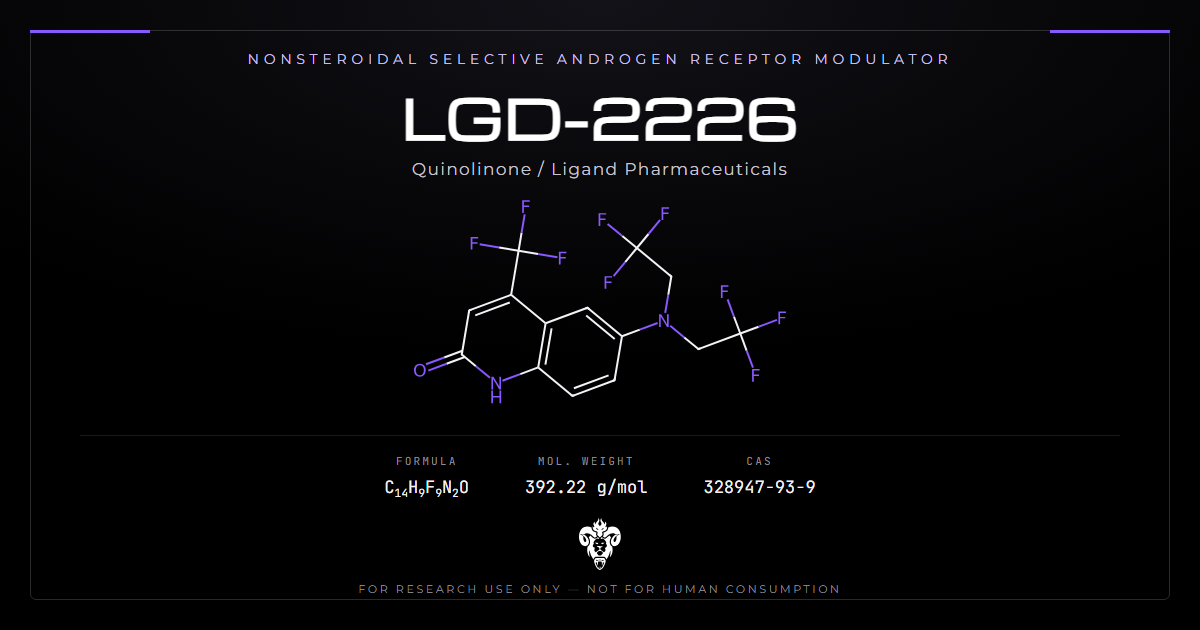
Most compounds on this shelf are known through their effects. Someone dosed a rat, weighed an organ, and wrote it up. What the molecule does inside the receptor is inferred backwards from that.
LGD-2226 is the exception. A team solved the crystal structure of the human androgen receptor ligand-binding domain with this compound in the pocket, at 2.1 Å [3]. They compared it against the same domain holding a reference androgen. Almost nothing else in this catalogue has that.
Set against it: no human has ever taken this compound on the published record. Ten indexed papers exist. Six come from one company between 2002 and 2007, and four are analytical chemistry. Structural detail and clinical silence sit side by side here, and that combination is what makes the compound worth reading about.
Chemical identity
| Property | Value |
|---|---|
| Common names | LGD-2226, LGD2226 |
| Molecular formula | C14H9F9N2O |
| Molecular weight | 392.22 g/mol |
| CAS | 328947-93-9 |
| PubChem CID | 11560224 |
| InChIKey | ULBPQWIGZUGPHU-UHFFFAOYSA-N |
| Class | Nonsteroidal 2-quinolinone |
| Stereocentres | None |
| Originator | Ligand Pharmaceuticals |
The catalogue carries it as LGD-2226.
Nine fluorines and no stereocentre
The systematic name is 6-[bis(2,2,2-trifluoroethyl)amino]-4-(trifluoromethyl)-1H-quinolin-2-one. Three trifluoromethyl-bearing groups hang off a quinolinone core: two trifluoroethyls on the amine and one trifluoromethyl on the ring.
That gives nine fluorine atoms in a molecule of 392 daltons, so fluorine accounts for roughly 44% of the mass. Very few compounds in this catalogue are that heavily fluorinated.
The second feature is an absence. LGD-2226 has no stereocentre at all, which the UHFFFAOYSA second block of its InChIKey records. Every other SARM in this batch is a single enantiomer whose configuration has to be verified separately. This one has nothing to get wrong.
Neither aromatisable nor reducible
Testosterone works partly as itself and partly through two conversions. Aromatase turns it into estradiol; 5-alpha-reductase turns it into dihydrotestosterone. Untangling which effect belongs to which molecule is the standing difficulty in androgen physiology.
Rosen and Negro-Vilar describe LGD-2226 as nonsteroidal, non-aromatisable and non-5-alpha-reducible [4]. Miner and colleagues add that it shows virtually no affinity for the other intracellular receptors [2].
So whatever it does, it does at the androgen receptor as the parent compound. That property is why its results carry an argument the steroid literature cannot make. The sexual function section below is where the argument lands.
The discovery series
Van Oeveren and colleagues at Ligand Pharmaceuticals reported the chemistry [1]. They identified 6-dialkylamino-4-trifluoromethylquinolin-2(1H)-ones as orally available tissue-selective androgen receptor modulators, and LGD-2226 is the lead from that series.
The scaffold matters for reading anything else in this class. Ostarine, andarine and S-23 are arylpropionamides. GSK-2881078 is an indole. This is a quinolinone, a third chemical family, and it shares a receptor with the others rather than a structure.
What the pharmacology showed
Bone, and strength above sham
Rosen and Negro-Vilar ran skeletally mature orchidectomised male rats for four months [4]. Castration caused substantial bone loss, and treatment prevented it. Biochemical markers showed the early rise in bone resorption suppressed.
Histomorphometry found distinct anabolic activity in periosteal bone, which is the outer surface where new bone adds mechanical strength most efficiently. The authors make the therapeutic point plainly. A compound that both prevents resorption and stimulates formation has an advantage over anti-resorptive drugs, which only do the first.
Miner and colleagues then ran biomechanical testing on bones from treated animals [2]. Strength came out above sham levels, meaning above intact controls rather than merely restored toward them.
The duration deserves attention on its own. Four months is long for a preclinical androgen study. ACP-105 ran fourteen days, andarine’s selectivity work eight weeks, and ligandrol’s human trial three. Bone remodels on a slower clock than muscle, so a study short enough to catch a lean-mass change can miss a structural one entirely. Rosen’s group gave the skeleton time to answer.
Muscle
Both studies report anabolic activity on the levator ani muscle [2][4]. Miner’s group also found LGD-2226 fully active in cell-based models of bone and muscle. Prostate growth was reduced relative to the anabolic effect, which is the class’s defining claim.
The numbers are thinner here than in the arylpropionamide literature. Neither paper reports organ-weight percentages of the kind Gao and colleagues published for andarine [11]. There, dihydrotestosterone drove prostate and seminal vesicle above double control weight while the SARM returned them to 16% and 17%.
Sexual function, which nothing else here measures
This is where LGD-2226 departs from every other compound in the batch. Miner’s group ran a sex-behaviour model in male rats, scoring mounts, intromissions, ejaculations and copulation efficiency [2]. The compound was efficacious on those endpoints.
No other SARM article in this catalogue has a sexual function result, because no other developer measured one. The class narrative is muscle and bone without prostate, and libido is usually absent from the discussion entirely.
The finding also carries a mechanistic argument. Because this molecule cannot become an oestrogen, its effect on sexual behaviour shows that androgen receptor activation alone supports that function, without aromatisation [2]. That is a real contribution to androgen physiology, made with a compound nobody ever gave to a person.
What the endpoint can and cannot support
Copulatory behaviour in a rat is a countable, objective measure, and that is its strength. Mounts and intromissions do not depend on a questionnaire or on what an animal reports feeling.
It is also a behavioural proxy several steps from anything a person would describe. Human sexual function involves desire, arousal and satisfaction, and none of those has a rodent equivalent that can be scored. The mechanistic conclusion about aromatisation travels well because receptor biology is conserved. The clinical implication does not travel at all.
The safe reading is that LGD-2226 preserved a behaviour that castration removes, which is a meaningful negative control on the tissue-selectivity claim. It says nothing about how the compound would affect a person, and no study has asked.
A crystal structure exists, and it does not close the argument
The biochemical inference
Miner and colleagues found that the androgen receptor bound to LGD-2226 shows a different pattern of protein-protein interactions [2]. The comparators were testosterone, fluoxymesterone and other steroids. They read that as evidence the ligand alters the shape of the ligand-binding domain.
That is an inference from behaviour. Coregulator proteins bind differently, so the surface they bind to is presumably different, so the fold has presumably moved. Each step is reasonable and none is direct observation.
The structure
Wang and colleagues solved the structure at 2.1 Å [3]. They compared the LGD-2226 complex with the same domain bound to R1881, a reference synthetic androgen.
Read their own conclusion carefully. They write that they hope the structure will aid in further explaining the selectivity observed in the assays. That is not a claim to have explained it. A structure of a single complex shows one conformation captured in one crystal. Selectivity is a property of behaviour across tissues.
So the honest position is that two independent lines of evidence point toward a conformational explanation and neither one closes it. The structure is a genuine asset and it is a starting point rather than an answer. Anyone wanting to test the idea has the coordinates.
Two caveats belong with any structure of this kind. Crystallisation selects a conformation that packs well, which is not always the one that dominates in solution. At 2.1 Å the backbone and most side chains are clear. Shifts of a fraction of an ångström sit near the limit of what the data support.
Neither point diminishes the work. They set what a single structure can carry. A ligand that changes coregulator recruitment must change something at the protein surface. Finding that change takes more than one crystal.
The muscle-specific readout
Hong and colleagues built something useful out of this series [5]. They looked for genes that androgens regulate in muscle and not elsewhere, and settled on skeletal alpha-actin.
The gene is expressed in the levator ani and other skeletal muscles, and not in prostate or preputial gland. Its human promoter responded to androgens in a muscle cell line. It did not respond in liver, prostate or breast cancer lines carrying an introduced androgen receptor. Tissue selectivity was reproduced in the promoter sequence itself.
Then the part that matters for reading the whole class: across an array of SARMs including LGD-2226, muscle effect correlated with promoter activity [5]. A cell-based assay that tracks the in-vivo result is worth more than another organ weight. This one came out of a programme that never reached a patient.
What is missing
| Question | Status for LGD-2226 |
|---|---|
| Human pharmacokinetics | None published |
| Human efficacy or safety | None published |
| Clinical trials | None |
| Species beyond rat | None for efficacy |
| Published metabolite map | Three equine in vitro metabolites only [9] |
| Pharmacology after 2007 | None |
| Reason development stopped | Not in the published record |
Every pharmacology paper comes from Ligand Pharmaceuticals or its collaborators, and the last one appeared in 2007. Everything published since is analytical chemistry written by people who need to detect the compound rather than to develop it.
Why the pharmacokinetic gap is the important one
Of the missing items, the absence of pharmacokinetics matters most, and it is easy to underrate.
Rat efficacy without rat exposure data gives a dose in milligrams per kilogram and nothing to convert it with. No half-life, no bioavailability, no clearance. Allometric scaling needs at least one measured species. A four-month efficacy study with no exposure curve translates to no other animal.
That is the difference between this compound and GSK-2881078, which has human exposure data and a measured half-life. Both stopped. Only one left behind numbers that would let somebody restart.
What no human exposure means for safety
Vignali and colleagues reviewed SARM safety across 33 studies, 2,136 patients and 1,447 exposures [14]. The case literature contributed fifteen drug-induced liver injuries, one Achilles tendon rupture and one rhabdomyolysis, and trials averaged ALT elevation in 7.1% of exposed patients.
LGD-2226 contributes nothing to that review, in either direction. No trial subjects and no case reports, because there has been no exposure to report on.
Read that correctly. A compound with no adverse findings and no exposure has not been shown to be safe; it has been shown to be unstudied. The class-level hepatic signal is the reasonable prior here, and nothing specific to this molecule confirms or excludes it.
Bone strength across the class
Bone strength is where LGD-2226 has its strongest claim, so it is worth setting against the neighbours.
Kearbey and colleagues took andarine to 210 days in aged ovariectomised female rats [10]. Three-point bending of excised femurs found increased load-bearing capacity at the midshaft. LGD-2226 has biomechanical testing showing strength above sham [2]. Ligandrol, in the same kind of model, improved trabecular structure and left biomechanical parameters unchanged. Ostarine’s phase 3 programme never reached a bone endpoint at all.
Four compounds, four different depths of bone evidence, and the two with real strength data are the two that never reached a human trial. That inversion is worth noticing rather than explaining away.
Note also what breaking a bone requires. Biomechanical testing destroys the specimen, so every strength result in this field comes from an animal, and human work stops at density. The constraint shapes the whole literature.
Detection
Quinolinones needed their own method
Thevis and colleagues synthesised four model 6-alkylamino-2-quinolinone SARMs, LGD-2226 among them, and worked out their fragmentation [6]. Detection limits reached 0.01 to 0.2 ng/mL, with recoveries of 81 to 98%.
The method targets intact quinolinones and their likely dealkylated metabolites. That the group had to build it separately makes the chemical-family point concrete: a method tuned to arylpropionamides does not find a quinolinone.
The predicted metabolic route is worth connecting to the chemistry. A bis(trifluoroethyl)amine has two identical alkyl groups on the nitrogen, and N-dealkylation removes one of them. That single step drops three fluorines and 82 daltons.
It also produces the impurity most likely to be confused with the parent in a batch. The same transformation that a doping laboratory looks for is the one a supplier’s chemistry can leave behind, which is why the verification section below treats fluorine as the useful nucleus rather than an afterthought.
Blood, livestock and food safety
Ventura and colleagues developed a blood method covering fifteen SARMs across equine and bovine samples [7]. Detection capability for LGD-2226 was 2 ng/mL, and the validation followed European legislation for inspecting livestock and food of animal origin.
That framing is worth pausing on. Most detection work here protects sport. This one also protects the food supply, which is a use case for these methods that the doping literature rarely mentions. Multi-class urine methods and the class detection reviews cover the compound as well [8][12]. Cutler’s equine work found three in vitro metabolites [9].
Where LGD-2226 sits in the class
The catalogue’s other thin literatures are thin for different reasons. S-23 has one paper because one group characterised it once. OTR-AC has none because it is an unstudied ester. GSK-2881078 has trials, and MK-2866 reached phase 3.
This compound is a fourth case: a complete, coherent preclinical package with a receptor structure attached, stopped before a human ever saw it. Dalton’s commentary on the class describes compounds with “nearly ideal pharmacological and pharmacokinetic properties” that still have not demonstrated the link to physical function [13]. LGD-2226 did not fail that test. It never took it.
Verifying research material
Batch documentation sits on the certificates of analysis page. This compound is easier to verify than most on this shelf, for two structural reasons.
Identity
Formula C14H9F9N2O, molecular weight 392.22, CAS 328947-93-9, InChIKey ULBPQWIGZUGPHU-UHFFFAOYSA-N.
There is no chlorine or bromine, so no halogen isotope pattern helps. Published fragmentation data exist for the quinolinone family and name this compound specifically [6], which is more than most compounds here can offer.
No stereochemistry to check
The molecule is achiral. The chiral chromatography step that every other article in this batch insists on does not apply, because there is no enantiomer to separate.
That removes an entire class of certificate ambiguity. It is the one verification question you can strike off the list rather than answer.
Fluorine as an analytical handle
Nine equivalent-ish fluorines in three groups make fluorine-19 NMR unusually informative here. The two trifluoroethyl groups and the ring trifluoromethyl sit in different environments and should resolve.
A structurally wrong batch, or a dealkylated impurity missing one trifluoroethyl, changes that spectrum in a way an achiral purity number would not reveal. On a molecule that is 44% fluorine by mass, the nucleus doing the reporting is most of the sample.
Common questions about LGD-2226
Has it been given to people? No. The indexed record contains no human study of any kind.
What is the strongest finding? Bone. Four months in orchidectomised rats prevented loss and added periosteal bone, and biomechanical testing put strength above sham levels [2][4].
Is there a receptor structure? Yes, the ligand-binding domain at 2.1 Å [3]. The authors present it as a starting point for explaining selectivity rather than as the explanation.
Does it affect sexual function? In male rats it was efficacious on mounts, intromissions, ejaculations and copulation efficiency [2]. No other compound in this catalogue reports such a measurement.
Does it need chiral analysis? No. It has no stereocentre.
Why did development stop? The published record does not say, and this article does not guess.
How heavily fluorinated is it? Nine fluorine atoms, about 44% of the molecular mass, across one trifluoromethyl and two trifluoroethyl groups.
Summary of the evidence
Strongest evidence is a coherent preclinical package from one company [1][2][4][5]. It covers chemistry, receptor pharmacology, a four-month bone study with histomorphometry and mechanical testing, muscle activity, a muscle-specific transcriptional readout and a sexual function model. Very few catalogue compounds have that breadth.
Unusual asset: a solved crystal structure of the human androgen receptor with LGD-2226 bound [3]. Unusual absence: no pharmacokinetics in any species, no second laboratory, and no human exposure.
Weakest is everything after 2007. Analytical chemists have kept the compound in the literature because they need to detect it [6][7][8][9][12]. Nobody has advanced what is known about what it does.
The transferable point is about how evidence accumulates. A compound can be understood in atomic detail and never tested in a person. That combination says more about development economics than about the molecule. Andarine and this compound have the best bone data in the class, and both stopped. More of this literature sits in the SARMs category.
Status: supplied for laboratory research use only.
References
- van Oeveren A, Motamedi M, Mani NS, Marschke KB, López FJ, Schrader WT, Negro-Vilar A, Zhi L. Discovery of 6-N,N-bis(2,2,2-trifluoroethyl)amino-4-trifluoromethylquinolin-2(1H)-one as a novel selective androgen receptor modulator. J Med Chem. 2006;49(21):6143-6146. PMID 17034117. DOI
- Miner JN, Chang W, Chapman MS, Finn PD, Hong MH, López FJ, Marschke KB, Rosen J, Schrader W, Turner R, van Oeveren A, Viveros H, Zhi L, Negro-Vilar A. An orally active selective androgen receptor modulator is efficacious on bone, muscle, and sex function with reduced impact on prostate. Endocrinology. 2007;148(1):363-373. PMID 17023534. DOI
- Wang F, Liu XQ, Li H, Liang KN, Miner JN, Hong M, Kallel EA, van Oeveren A, Zhi L, Jiang T. Structure of the ligand-binding domain (LBD) of human androgen receptor in complex with a selective modulator LGD2226. Acta Crystallogr Sect F Struct Biol Cryst Commun. 2006;62(Pt 11):1067-1071. PMID 17077481. DOI
- Rosen J, Negro-Vilar A. Novel, non-steroidal, selective androgen receptor modulators (SARMs) with anabolic activity in bone and muscle and improved safety profile. J Musculoskelet Neuronal Interact. 2002;2(3):222-224. PMID 15758439.
- Hong MH, Sun H, Jin CH, Chapman M, Hu J, Chang W, Burnett K, Rosen J, Negro-Vilar A, Miner JN. Cell-specific activation of the human skeletal alpha-actin by androgens. Endocrinology. 2008;149(3):1103-1112. PMID 18063690. DOI
- Thevis M, Kohler M, Maurer J, Schlörer N, Kamber M, Schänzer W. Screening for 2-quinolinone-derived selective androgen receptor agonists in doping control analysis. Rapid Commun Mass Spectrom. 2007;21(21):3477-3486. PMID 17985352. DOI
- Ventura E, Gadaj A, Buckley T, Mooney MH. Development of a multi-residue high-throughput UHPLC-MS/MS method for routine monitoring of SARM compounds in equine and bovine blood. Drug Test Anal. 2020;12(9):1373-1379. PMID 32519780. DOI
- Stacchini C, Botrè F, Comunità F, de la Torre X, Dima AP, Ricci M, et al. Simultaneous detection of different chemical classes of selective androgen receptor modulators in urine by liquid chromatography-mass spectrometry-based techniques. J Pharm Biomed Anal. 2020;195:113849. PMID 33383501. DOI
- Cutler C, Viljanto M, Taylor P, Hincks P, Biddle S, Van Eenoo P. Identification of equine in vitro metabolites of seven non-steroidal selective androgen receptor modulators for doping control purposes. Drug Test Anal. 2022;14(2):349-370. PMID 34714606. DOI
- Kearbey JD, Gao W, Fisher SJ, Wu D, Miller DD, Dalton JT. Effects of selective androgen receptor modulator (SARM) treatment in osteopenic female rats. Pharm Res. 2009;26(11):2471-2477. PMID 19728047. DOI
- Gao W, Reiser PJ, Coss CC, Phelps MA, Kearbey JD, Miller DD, Dalton JT. Selective androgen receptor modulator treatment improves muscle strength and body composition and prevents bone loss in orchidectomized rats. Endocrinology. 2005;146(11):4887-4897. PMID 16099859. DOI
- Thevis M, Schänzer W. Detection of SARMs in doping control analysis. Mol Cell Endocrinol. 2017;464:34-45. PMID 28137616. DOI
- Dalton JT. The long and winding road for selective androgen receptor modulators. Br J Clin Pharmacol. 2017;83(10):2131-2133. PMID 28621446. DOI
- Vignali JD, Pak KC, Beverley HR, DeLuca JP, Downs JW, Kress AT, et al. Systematic review of safety of selective androgen receptor modulators in healthy adults: implications for recreational users. J Xenobiot. 2023;13(2):218-236. PMID 37218811. DOI
LGD-2226 is sold for laboratory research use only. Not for human consumption, nor medical, veterinary, or household uses.
Literature retrieved from PubMed.