
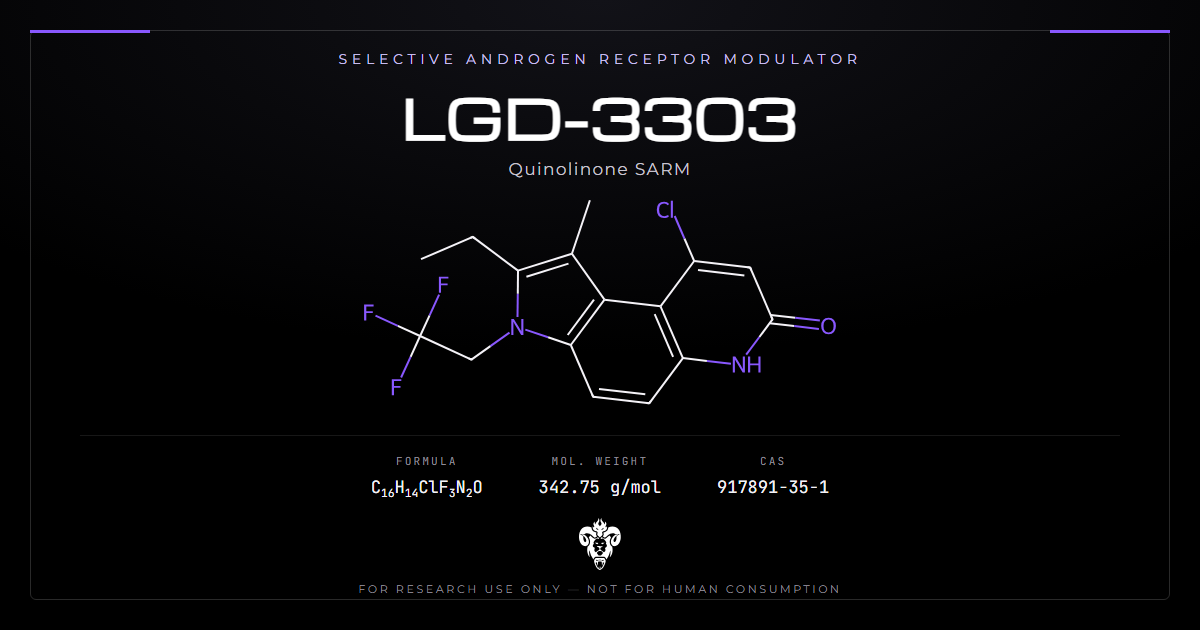
Every selective androgen receptor modulator raises the same question. One receptor mediates androgen signalling in muscle and in prostate alike, so how can a ligand act strongly in one tissue and weakly in the other?
The most economical answer would be pharmacokinetic. If a compound simply reached muscle in higher concentration than prostate, selectivity would need no special receptor biology at all. It would be a distribution phenomenon, and the mechanism debate would be over.
LGD-3303 is the compound that tested that idea directly and found it wanting. Vajda and colleagues at Ligand Pharmaceuticals measured local tissue concentrations alongside tissue responses, and the numbers came out backwards from the prediction [1].
What follows covers the chemistry, that experiment and what it established, the bone and behavioural work built on it, the metabolism data developed for doping control, and how a laboratory verifies the compound.
Chemical identity: what you are actually handling
LGD-3303 is a fused tricyclic quinolinone, structurally unrelated to the SARM classes most people picture.
| Property | Value |
|---|---|
| IUPAC name | 9-chloro-2-ethyl-1-methyl-3-(2,2,2-trifluoroethyl)-6H-pyrrolo[3,2-f]quinolin-7-one |
| CAS | 917891-35-1 |
| Molecular formula | C16H14ClF3N2O |
| Molecular weight | 342.74 g/mol |
| PubChem CID | 25195253 |
| InChIKey | OMXGOGXEWUCLFI-UHFFFAOYSA-N |
| Chemical class | Quinolinone |
| Stereocentres | None |
| Molecular target | Androgen receptor (AR) |
| Originator | Ligand Pharmaceuticals |
The quinolinone class
The scaffold is a pyrrolo[3,2-f]quinolinone bearing a chlorine, an ethyl, a methyl, and a trifluoroethyl group. Anti-doping chemists classify it accordingly. In a method covering nineteen SARMs across nine chemical classes, LGD-3303 sits among the quinolinones alongside LGD-2226, separate from the aryl propionamides, the phenyl-oxadiazoles, and the pyrrolidinyl-benzonitriles [6].
Two features simplify handling. The molecule carries no stereocentre, so no chiral method is required and no enantiomeric excess question arises. And the trifluoroethyl group gives a fluorine handle that fluorine NMR reads directly.
Non-steroidal and non-aromatisable
Kudwa and colleagues characterise the compound as a non-steroidal, non-aromatisable, highly selective androgen receptor ligand that effectively crosses the blood-brain barrier [3].
Each of those terms carries experimental weight. Non-steroidal means it cannot serve as a substrate for the enzymes that interconvert endogenous steroids. Non-aromatisable means it cannot convert to an oestrogen. Oestrogenic effects therefore cannot confound an experiment. And measurable brain penetration puts central effects on the table rather than excluding them by exposure.
Receptor pharmacology
Vajda and colleagues characterised the compound using competitive binding and transcriptional activity assays. They describe it as a potent non-steroidal androgen showing little or no cross-reactivity with related nuclear receptors [2].
That last clause matters for experimental design. The steroid receptor family shares considerable structural similarity. A ligand active at the progesterone or glucocorticoid receptor alongside the androgen receptor produces effects that no androgen hypothesis explains. A clean nuclear receptor profile makes attribution defensible.
Confirmation came from an antagonist experiment. Kudwa and colleagues showed that pretreatment with flutamide, an androgen receptor antagonist, blocked the behavioural effects of LGD-3303 [3]. Blockade by a receptor antagonist is the standard demonstration. It shows an observed effect running through the receptor in question rather than around it.
The experiment that ruled out tissue distribution
This is the compound’s principal contribution to the field, and the design deserves description.
The design
Vajda and colleagues studied the pharmacokinetic and pharmacodynamic relationship in a castrated rat model of androgen deficiency [1].
Two elements make the study informative. They measured compound concentrations in the target tissues themselves, not merely in plasma. And they compared two routes of administration, oral dosing against continuous infusion. Those two routes produce markedly different concentration-versus-time profiles [1].
The result
LGD-3303 showed potent activity on the levator ani muscle while behaving as a partial agonist on the preputial gland and ventral prostate [1].
Then came the measurement that mattered. Despite the greater muscle activity relative to prostate activity, local tissue concentrations of LGD-3303 were higher in the prostate than in the levator ani muscle [1].
The compound was more concentrated in the tissue where it did less. A distribution explanation predicts the opposite.
Route of administration made no difference either. Tissue-selective activity persisted whether the compound arrived by oral dosing or by continuous infusion. If kinetics drove the effect, those two exposure patterns would have produced different results [1].
What it established
The authors concluded that LGD-3303 has selectivity properties independent of its pharmacokinetic profile. The principal mechanism, they argued, arises from altered molecular interactions at the level of the androgen receptor [1].
That conclusion pushes the explanation back to receptor biology, where two candidate accounts compete.
One invokes tissue-specific expression of 5α-reductase. Prostate amplifies testosterone to the more potent dihydrotestosterone while muscle does not, and a non-steroidal ligand receives no such amplification [7].
The other invokes ligand shape. Different ligands impose different receptor conformations, which recruit different coregulatory proteins [10]. Direct evidence exists for this account. The SARM S-101479 stimulated receptor dimerisation at only 34.4 percent of the dihydrotestosterone level while retaining transcriptional activity in osteoblastic cells [8]. A 112-cofactor screen of TSAA-291 identified twelve cofactors recruited differently from dihydrotestosterone, PIAS1 among them [9].
LGD-3303 does not settle which account is correct. It removes the third, simpler possibility from contention, which is a real contribution.
The practical consequence reaches beyond mechanism. If selectivity were a distribution effect, it would be fragile. Anything altering tissue perfusion, plasma protein binding, or transporter activity would shift the muscle-to-prostate ratio, and the selectivity observed in one model might vanish in another.
Because the effect instead sits at the receptor, it should travel better across models, routes and dosing schedules. The oral against infusion comparison already demonstrates that stability across two very different exposure patterns [1]. A laboratory can therefore treat the selectivity ratio as a property of the compound rather than an artefact of how it was delivered.
The prostate ceiling
A second finding from the same programme has direct experimental consequences.
LGD-3303 never stimulated ventral prostate weight above intact levels, despite rising plasma concentrations of compound [1]. The bone study reported the same ceiling more sharply. The compound increased levator ani muscle weight above eugonadal levels. It never raised ventral prostate weight beyond 50 percent of eugonadal levels, even at high doses [2].
Read those two statements together. Muscle response exceeded the intact-animal reference. Prostate response plateaued at half of it. The separation is not a matter of dose, because raising the dose did not close the gap.
That is what partial agonism looks like at a tissue level. A prostate dose-response curve flattening well below maximum is the expected result rather than a failed experiment.
Effects on bone
Bone was a major focus for this compound, and the work used ovariectomised female rats rather than the castrated male model.
Cortical and cancellous responses
Vajda and colleagues treated ovariectomised females with LGD-3303, assessing outcomes by dual-energy X-ray absorptiometry, histomorphometry and biomechanical testing [2].
The compound increased bone mineral density and bone mineral content at both cortical and cancellous sites. At cortical sites the effect arose in part from anabolic activity on the periosteal surface [2]. It also increased muscle weight in female animals, which matters because most SARM muscle data comes from males.
Periosteal apposition is worth flagging. It adds bone to the outer surface, raising resistance to bending disproportionately to the mass added. Antiresorptive agents do not produce it.
The female model deserves a note of its own. Most SARM data comes from castrated males, where the androgen background sits near zero and any agonist raises signalling. An ovariectomised female carries a different hormonal baseline, so results from the two models are not interchangeable.
Combination with a bisphosphonate
The study tested LGD-3303 alongside alendronate. Clinical trials combining antiresorptive and anabolic agents had repeatedly failed to show synergy, which set the expectation [2].
At every measured site, combination treatment matched either single agent, and in some cases showed significant added benefit [2]. The authors framed the rationale mechanistically: the compound produced anabolic effects on muscle and cortical bone that bisphosphonates do not [2].
Reviews of bone-targeted SARM development place this line of work in its wider context [18].
Brain penetration and behavioural work
Because the compound crosses the blood-brain barrier, its effects are not confined to peripheral tissue.
Kudwa and colleagues examined sexual behaviour in gonadectomised female rats given LGD-3303 by daily oral gavage [3]. The results depended on prior experience in a way worth noting. Treatment enhanced male-directed sexual preference in females with previous sexual experience. That held after either one or seven days of treatment. In sexually naive females, the same treatment inhibited preference for males [3].
The compound also increased lordosis and proceptive behaviours in ovariectomised females primed with suboptimal doses of oestradiol benzoate plus progesterone [3]. Flutamide pretreatment blocked the preference effect, confirming androgen receptor mediation [3].
The experience-dependent reversal is the useful methodological lesson. A single compound produced opposite-signed effects in two groups differing only in prior history. Behavioural endpoints carry state dependencies that tissue weights do not.
Metabolism and detection
Two studies characterise how LGD-3303 is metabolised, both conducted in horses for doping-control purposes.
Cutler and colleagues investigated equine phase I metabolism in liver microsomes across seven non-steroidal SARMs. They identified four metabolites for LGD-3303 and reported its equine metabolism for the first time [5].
Broberg and colleagues followed with an in vivo study, administering 0.05 mg/kg orally to horses and collecting blood and urine for 96 hours [4]. They tentatively identified eight metabolites, including one carboxylated and several hydroxylated species, along with glucuronic acid conjugates.
Their analytical recommendation is specific and useful. A monohydroxylated metabolite serves better as a detection target than parent compound, in both plasma and urine, after β-glucuronidase hydrolysis. It gives higher signal intensity and a longer detection window [4].
Two points follow for laboratory work. Glucuronidation is a major route, so a hydrolysis step belongs in any sample preparation meant to capture total compound-related material. And parent compound is not the most persistent marker of exposure. That matters for study designs sampling at later timepoints.
Where LGD-3303 sits among SARMs
Placing the compound against better-developed members clarifies what a citation to it supports.
| Compound | Chemical class | Deepest published evidence |
|---|---|---|
| Enobosarm (ostarine) | Aryl propionamide | Randomised phase 2 in cancer patients [13], phase 3 programme [14] |
| RAD-140 | Phenyl-oxadiazole | Preclinical, covered by validated assays [6] |
| LGD-4033 | Pyrrolidinyl-benzonitrile | Preclinical and early clinical |
| LGD-3303 | Quinolinone | Multiple preclinical studies: PK/PD [1], bone [2], behaviour [3], metabolism [4][5] |
| LGD-2226 | Quinolinone | Preclinical, in vitro metabolism reported [5] |
| AC-262536 | Tropanol | One pharmacology paper, one metabolism study |
LGD-3303 sits in a middle position. Its preclinical file is more developed than most research-supply SARMs. It spans receptor pharmacology, tissue selectivity, bone, behaviour and metabolism. It has never entered human clinical trials.
No SARM holds marketing approval in any jurisdiction. Reviews of sarcopenia pharmacotherapy note that few agents developed for muscle wasting have met clinically relevant outcomes for strength and physical performance [15]. The tissue-selectivity premise remains promising and clinically unproven [10][11].
Physicochemical properties and handling
The molecule is a neutral fused heteroaromatic solid. It carries a lactam carbonyl, an aryl chloride, and a trifluoroethyl group, none of which is strongly labile under ordinary conditions.
The trifluoroethyl group deserves comment. Fluorine substitution at that position blocks a metabolic soft spot, since the carbon-fluorine bond resists oxidative attack far better than the carbon-hydrogen bonds it replaced. That choice is deliberate medicinal chemistry rather than decoration, and it contributes to the oral availability the pharmacokinetic study reported [1].
The aryl chloride is chemically inert and will not hydrolyse under storage conditions. The lactam is likewise stable, requiring strong acid or base to open.
Aqueous solubility is low, as the fused aromatic system and halogen substitution both work against it. Dimethyl sulfoxide is the usual stock solvent. Store the solid sealed, dry, cold and dark.
Analytical characterisation
Four checks cover this compound, and one is unusually easy.
Fluorine NMR is the fastest confirmation. The trifluoroethyl group produces a single clean three-fluorine signal, and few contaminants in this catalogue space carry fluorine in that arrangement.
Accurate mass confirms C16H14ClF3N2O at 342.74. The chlorine isotope pattern gives an M+2 peak near one third of the molecular ion, confirming exactly one chlorine.
Proton NMR confirms the fused tricyclic core and the substitution pattern, distinguishing it from LGD-2226 and other quinolinones.
No chiral method is needed, since the molecule has no stereocentre. That removes the largest analytical uncertainty affecting most compounds in this class.
What a rigorous certificate should contain
Chromatographic purity, with the column and detection conditions stated.
Accurate mass confirming the formula, with the chlorine isotope envelope shown.
Fluorine NMR, confirming the trifluoroethyl group.
Structural confirmation by proton NMR, establishing the quinolinone rather than a same-prefix relative.
Residual solvents from synthesis.
Kimera publishes third-party certificates of analysis for every lot in its COA database. Laboratories source LGD-3303 as a quinolinone-class reference, often alongside AC-262536 as a partial-agonist comparator and RAD-140 (Testolone) from a different chemical class. Related receptor chemistry appears in the SARMs category.
Regulatory and compliance status
LGD-3303 holds no marketing approval in any jurisdiction and has not entered human clinical trials.
The World Anti-Doping Agency classifies SARMs as anabolic agents and has prohibited them since January 2008 [16]. They sit under section S1.2, prohibited at all times, in and out of competition [17]. LGD-3303 is prohibited in equine sport as well, which is why its metabolism has been studied so thoroughly in horses [4].
Adverse analytical findings involving SARMs rose steadily through the second half of the 2010s. Athletes returning them have often blamed contaminated supplements [17]. Forensic practice now includes testing supplements, hair and nail clippings to evaluate such claims [17].
Common misclassifications
Three errors recur, and the first causes real ordering mistakes.
The LGD prefix is treated as a compound family. It is a developer code from Ligand Pharmaceuticals. LGD-3303, LGD-4033 and LGD-2226 are structurally distinct. The first two of those are quinolinones, while LGD-4033 is a pyrrolidinyl-benzonitrile [6]. Order against CAS 917891-35-1 rather than a code.
Its tissue selectivity is attributed to better muscle uptake. The measurement showed the opposite, with higher concentrations in prostate than in muscle [1].
It is described as a full agonist because it raised muscle mass above eugonadal levels. It exceeded that reference in muscle while plateauing below half of it in prostate [2]. Tissue-dependent efficacy is the entire point of the classification.
Experimental design considerations
Measure both tissue types. Levator ani alone reports anabolic response. Prostate and seminal vesicle weights convert that into the selectivity ratio that constitutes the claim [1][2].
Expect a prostate plateau. Raising dose will not raise prostate response proportionally. A flattening curve is documented behaviour rather than an artefact [1][2].
Hydrolyse before analysis. Glucuronide conjugates dominate, and a monohydroxylated metabolite outlasts parent compound as a marker [4].
Record behavioural history in behavioural work. Prior sexual experience reversed the direction of a preference effect [3].
Include a full-agonist comparator. Testosterone or dihydrotestosterone makes partial agonism measurable rather than assumed [12].
Frequently asked questions
What is LGD-3303? A non-steroidal quinolinone androgen receptor modulator from Ligand Pharmaceuticals, CAS 917891-35-1. Kimera supplies it as a laboratory research material.
Is it the same family as LGD-4033? No. They share a developer prefix. LGD-3303 is a quinolinone and LGD-4033 is a pyrrolidinyl-benzonitrile [6].
Why is the tissue distribution finding significant? It ruled out the simplest explanation for SARM selectivity. Concentrations were higher in prostate than muscle, yet muscle response was greater [1].
Does it cross the blood-brain barrier? Yes, and behavioural effects in rats have been reported and blocked by flutamide [3].
Does it aromatise? No. It is described as non-aromatisable, so oestrogenic conversion does not confound experiments [3].
Does it need a chiral method? No. The molecule has no stereocentre, so chemical purity and stereochemical purity are the same question here.
Which metabolite should an assay target? A monohydroxylated species, measured after glucuronidase hydrolysis. It outlasts parent compound in both plasma and urine [4].
Is it approved anywhere? No, and it has never entered human clinical trials.
Summary of the evidence
Identity: C16H14ClF3N2O, 342.74 g/mol, quinolinone class, no stereocentre.
Receptor profile: potent non-steroidal androgen with little or no cross-reactivity against related nuclear receptors [2], effects blocked by flutamide [3].
Central finding: tissue selectivity independent of pharmacokinetics, with higher concentrations measured in prostate than in muscle [1].
Tissue responses: levator ani above eugonadal levels, ventral prostate never beyond 50 percent of eugonadal even at high doses [2].
Bone: increased density and content at cortical and cancellous sites, with periosteal anabolic activity, and additive effects alongside alendronate [2].
Behaviour: experience-dependent effects on sexual preference in female rats, blocked by androgen receptor antagonism [3].
Metabolism: eight metabolites identified in horses, with a monohydroxylated species recommended as the detection target after glucuronidase hydrolysis [4][5].
Gaps: no human data of any kind, no toxicology in the public record, no independent replication of the tissue distribution result.
Status: preclinical, no approval, prohibited in sport at all times under WADA section S1.2 [17].
References
- Vajda EG, López FJ, Rix P, et al. Pharmacokinetics and pharmacodynamics of LGD-3303 [9-chloro-2-ethyl-1-methyl-3-(2,2,2-trifluoroethyl)-3H-pyrrolo-[3,2-f]quinolin-7(6H)-one], an orally available nonsteroidal-selective androgen receptor modulator. J Pharmacol Exp Ther. 2009;328(2):663-670. PMID 19017848. DOI
- Vajda EG, Hogue A, Griffiths KN, et al. Combination treatment with a selective androgen receptor modulator (SARM) and a bisphosphonate has additive effects in osteopenic female rats. J Bone Miner Res. 2009;24(2):231-240. PMID 18847323. DOI
- Kudwa AE, López FJ, McGivern RF, Handa RJ. A selective androgen receptor modulator enhances male-directed sexual preference, proceptive behavior, and lordosis behavior in sexually experienced, but not sexually naive, female rats. Endocrinology. 2010;151(6):2659-2668. PMID 20392832. DOI
- Broberg MN, Knych H, Bondesson U, et al. Equine in vivo metabolite profiling of the selective androgen receptor modulator LGD-3303 for doping control. J Pharm Biomed Anal. 2023;233:115468. PMID 37224728. DOI
- Cutler C, Viljanto M, Taylor P, et al. Identification of equine in vitro metabolites of seven non-steroidal selective androgen receptor modulators for doping control purposes. Drug Test Anal. 2022;14(2):349-370. PMID 34714606. DOI
- Stacchini C, Botrè F, Comunità F, et al. Simultaneous detection of different chemical classes of selective androgen receptor modulators in urine by liquid chromatography-mass spectrometry-based techniques. J Pharm Biomed Anal. 2021;195:113849. PMID 33383501. DOI
- Gao W, Dalton JT. Ockham’s razor and selective androgen receptor modulators (SARMs): are we overlooking the role of 5alpha-reductase? Mol Interv. 2007;7(1):10-13. PMID 17339601. DOI
- Furuya K, Yamamoto N, Ohyabu Y, et al. Mechanism of the tissue-specific action of the selective androgen receptor modulator S-101479. Biol Pharm Bull. 2013;36(3):442-451. PMID 23449329. DOI
- Hikichi Y, Yamaoka M, Kusaka M, Hara T. Selective androgen receptor modulator activity of a steroidal antiandrogen TSAA-291 and its cofactor recruitment profile. Eur J Pharmacol. 2015;765:322-331. PMID 26335395. DOI
- Zhang X, Sui Z. Deciphering the selective androgen receptor modulators paradigm. Expert Opin Drug Discov. 2013;8(2):191-218. PMID 23231475. DOI
- Omwancha J, Brown TR. Selective androgen receptor modulators: in pursuit of tissue-selective androgens. Curr Opin Investig Drugs. 2006;7(10):873-881. PMID 17086931
- McPhaul MJ, Young M. Complexities of androgen action. J Am Acad Dermatol. 2001;45(3 Suppl):S87-S94. PMID 11511858. DOI
- Dobs AS, Boccia RV, Croot CC, et al. Effects of enobosarm on muscle wasting and physical function in patients with cancer: a double-blind, randomised controlled phase 2 trial. Lancet Oncol. 2013;14(4):335-345. PMID 23499390. DOI
- Crawford J, Prado CM, Johnston MA, et al. Study design and rationale for the phase 3 clinical development program of enobosarm. Curr Oncol Rep. 2016;18(6):37. PMID 27138015. DOI
- Hardee JP, Lynch GS. Current pharmacotherapies for sarcopenia. Expert Opin Pharmacother. 2019;20(13):1645-1657. PMID 31120352. DOI
- Thevis M, Schänzer W. Mass spectrometry of selective androgen receptor modulators. J Mass Spectrom. 2008;43(7):865-876. PMID 18521833. DOI
- Kintz P. The forensic response after an adverse analytical finding (doping) involving a selective androgen receptor modulator (SARM) in human athlete. J Pharm Biomed Anal. 2022;207:114433. PMID 34715583. DOI
- Furuya K. Bone and men’s health: bone selective androgen receptor modulators. Clin Calcium. 2010;20(2):225-233. PMID 20118515
LGD-3303 is sold for laboratory research use only. Not for human consumption, nor medical, veterinary, or household uses.
Literature retrieved from PubMed.