
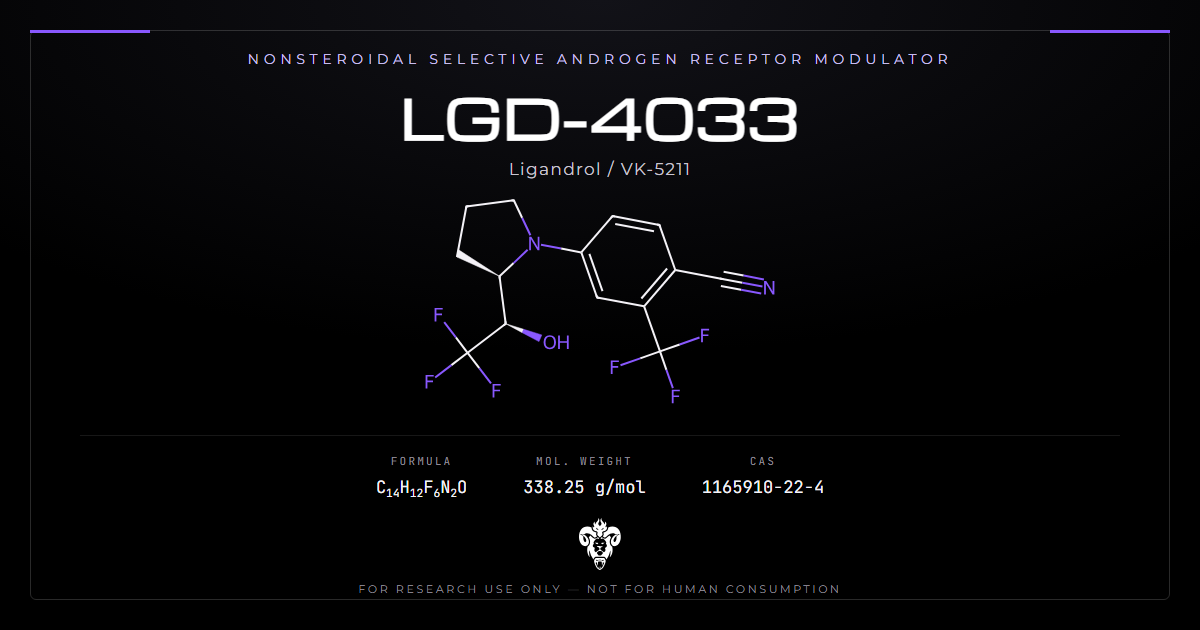
LGD-4033 has exactly one randomised, placebo-controlled trial in humans. It enrolled 76 healthy men, ran for 21 days, and tested a top dose of 1 mg daily [1].
Every claim made for this compound traces back to that study. Every case report of harm describes something else: higher doses, longer durations, and usually other compounds alongside.
That gap between the two bodies of evidence is the article. Three findings define it. Liver enzymes did not move at any dose in the trial. They tripled in a documented five-week case at ten times the top trial dose. And the analytical marker used to detect the compound carried a wrong published structure for fourteen years.
Chemical identity
| Property | Value |
|---|---|
| Common names | LGD-4033, ligandrol, VK-5211 |
| Molecular formula | C14H12F6N2O |
| Molecular weight | 338.25 g/mol |
| CAS | 1165910-22-4 |
| PubChem CID | 44137686 |
| InChIKey | OPSIVAKKLQRWKC-VXGBXAGGSA-N |
| Class | Phenylpyrrolidine, nonsteroidal |
| Stereocentres | Two, both defined |
| Regulatory status | Not approved in any jurisdiction |
The catalogue carries it as LGD-4033.
Reading the structure
A benzonitrile ring carries a trifluoromethyl group and connects through nitrogen to a pyrrolidine. That pyrrolidine bears a second trifluoromethyl group on a hydroxyl-bearing carbon.
Six fluorines on a 338 Da molecule is a high proportion. Both trifluoromethyl groups sit adjacent to the atoms doing the binding. That density is a deliberate metabolic choice, since carbon-fluorine bonds resist the oxidation that would otherwise clear the molecule quickly.
Two stereocentres, both specified
The InChIKey ends in VXGBXAGGSA-N, and the systematic name resolves both centres as (2R) on the pyrrolidine and (1R) on the hydroxyethyl carbon. Neither is a formality.
Mass spectrometry cannot distinguish stereoisomers. A preparation containing the wrong diastereomer has the same formula, the same exact mass and a different pharmacology. Identity by mass alone therefore does not establish what is in a vial.
The only randomised human trial
Basaria and colleagues ran a placebo-controlled ascending-dose study in 76 healthy men aged 21 to 50 [1]. Participants received placebo or 0.1, 0.3 or 1.0 mg daily for 21 days. Measurements continued for five weeks after treatment stopped.
What improved
Lean body mass rose dose-dependently. Fat mass did not change significantly. The compound showed a long elimination half-life with dose-proportional accumulation on repeated dosing.
Those results are real and modest by construction. Three weeks is a short window for a body-composition endpoint. The authors close by calling for longer randomised trials to evaluate physical function and health outcomes. That call has not been answered in the two decades since.
What was suppressed
The suppression pattern is the part usually left out of summaries. Total testosterone, sex hormone-binding globulin, high density lipoprotein cholesterol and triglycerides all fell dose-dependently [1]. Follicle-stimulating hormone and free testosterone fell significantly only at the top 1.0 mg dose.
So axis suppression was already measurable between one tenth and one whole milligram. Hormones and lipids returned to baseline after discontinuation. That is reassuring for a three-week exposure and says nothing about longer ones.
What did not change
This is the finding that matters most for reading the case literature. Haemoglobin, prostate-specific antigen, aspartate aminotransferase, alanine aminotransferase and QT interval did not change significantly at any dose [1].
No liver signal appeared in the trial. That is the baseline against which every hepatotoxicity report has to be read.
Absence of a signal in 76 men over three weeks is not the same as absence of risk. A study that size detects common effects and misses rare ones, and idiosyncratic liver injury is by definition rare. What the trial establishes is narrower and still useful: at these doses, over this period, transaminases did not drift in a way that routine monitoring would catch.
The dose that reaches case reports
| Source | Dose and duration | ALT | Total testosterone | HDL |
|---|---|---|---|---|
| Basaria 2012 [1] | 0.1 to 1.0 mg, 21 days | No significant change | Dose-dependent fall | Dose-dependent fall |
| Cardaci 2022 [8] | 10 mg plus MK-677, 5 weeks | +205% | -62.3% | -36.4% |
| Barbara 2020 [6] | Not stated | Severe DILI, biopsy confirmed | Not reported | Not reported |
| Labban 2024 [11] | High dose, 3 months | Elevated, jaundice | Not reported | Not reported |
A five-week case with full biochemistry
Cardaci and colleagues documented a 25-year-old man taking LGD-4033 at 10 mg with MK-677 at 15 mg daily for five weeks [8]. Blood and body composition were measured before, during and after.
Body mass rose 6.0% and total lean body mass 3.1%. Total fat mass rose 15.4% as well. That is not the selective outcome the class advertises. Bone mineral density fell 2.1%.
The biochemistry moved sharply. Alanine aminotransferase rose 205% and aspartate aminotransferase 95.8%. High density lipoprotein cholesterol fell 36.4% while low density lipoprotein rose 40.0%. Free testosterone fell 85.7%, total testosterone 62.3% and sex hormone-binding globulin 79.6%.
Most values returned toward baseline afterwards. Follicle-stimulating hormone did not, sitting below the clinical reference range on and after cycle. Intramuscular androgen receptor content was 44.6% lower than in non-users.
Two caveats belong with those numbers. It is one person, and MK-677 was taken alongside, so attribution between the two compounds fails. What the case does establish is that the biochemical picture at 10 mg looks nothing like the picture at 1 mg.
Two liver injury cases
Barbara and colleagues report a 32-year-old man with severe drug-induced liver injury after ligandrol use [6]. Biopsy showed cholestatic hepatitis with mild portal, periportal and perisinusoidal fibrosis.
Labban and colleagues describe a 52-year-old with pruritic jaundice, significant weight loss and raised liver enzymes [11]. Three months of high-dose LGD-4033 preceded it, and their workup excluded other causes.
Neither case reports a verified dose or an assayed product. Both describe exposures far outside anything the trial tested. Fibrosis on biopsy in the first case is a finding three weeks of dosing would not produce.
What the animal work adds, and where it stops
Hoffmann and colleagues tested LGD-4033 in an ovariectomised rat model of osteoporosis [10]. Doses ran at 0.03, 0.3 and 3 mg/kg for five weeks, with bone assessed by micro-computed tomography, biomechanics, ashing and gene expression.
Only the top dose changed anything. Trabecular number improved in femur, lumbar vertebra and tibia, and serum phosphorus rose. Biomechanical parameters were not changed.
That distinction is the same one the whole class keeps producing. Structure improved and function did not. Uterus and heart weights also rose at that dose, which is not tissue selectivity. The authors conclude that further investigation for postmenopausal osteoporosis should be reevaluated.
Low and medium doses affected bone not at all, while producing fewer side effects. A compound whose only effective dose is also its only toxic dose has a narrow therapeutic window by definition.
Why the class exists at all
Dalton and colleagues set out the rationale that carried the field, writing from the company developing a competing SARM [2]. SARMs modulate the same anabolic pathways as steroidal androgens. Within the dose range where muscle effects appear, androgenic effects on prostate, skin and hair have not been observed.
They name LGD-4033 among the compounds with clinical efficacy data at that point. Read now, the review records what the class expected to deliver. It also shows that the expectation came largely from the companies developing it.
Basaria’s trial supports the prostate part of that claim directly, since prostate-specific antigen did not change at any dose over 21 days [1]. It supports nothing about higher doses over longer periods. Those experiments were not run.
What the compound was being developed for
The clinical development code is worth following, because it points somewhere the recreational discussion never goes.
A hip fracture programme, not a physique one
LGD-4033 carries a second designation, VK-5211, and the two codes describe one molecule [4]. Under that code the compound entered development for recovery after hip fracture in older patients, which is a sarcopenia indication rather than a performance one.
That target population makes the Basaria trial look different. A three-week study in men aged 21 to 50 is a safety and pharmacokinetic exercise, not a model of the patients the drug was aimed at [1]. Nothing published since has closed that gap.
The bone question was asked, and answered ambiguously
If the indication is fracture recovery, bone strength is the endpoint that matters. The ovariectomised rat study went straight at it and found improved trabecular number with unchanged biomechanical parameters at the only dose that did anything [10].
Trabecular number is a structural count. Biomechanical testing measures whether the bone actually resists load. Improving the first without the second is the same dissociation the rest of this class keeps producing between mass and function, and it appeared here in the tissue the compound was being developed to help.
Why no larger trial followed
The published record does not explain it, and inventing a reason would be dishonest. What the record does show is a compound with one short trial, a plausible indication, an identified developer code, and no phase 3 programme in the indexed literature two decades on.
Meanwhile the same molecule appears in seized consumer products from 2010 onward [3], in hair samples at 14 to 42 pg/mg [7], and in liver injury case reports [6][11]. The development pathway stalled and the distribution pathway did not.
The detection problem
Anti-doping laboratories have characterised LGD-4033 more thoroughly than the clinical literature has, which is an unusual situation and worth noting on its own.
On the market before it was on any label
Krug and colleagues analysed 337 black market products seized in Germany between 2010 and 2013 [3]. They identified 67 active ingredients, and flag LGD-4033 as one of three outstanding findings.
That is roughly a year after the only human trial published. A compound with 76 subjects of clinical exposure was already circulating as a consumer product.
Where it sits in the testing regime
Thevis and Schänzer review detection across the class [4]. SARMs joined the prohibited list in 2008. Numerous adverse analytical findings have followed for many members, despite none of them holding full clinical approval.
Their review names LGD-4033 and VK-5211 as the same compound, which is worth knowing when reading older sources that treat the codes separately.
Hair extends the window
Kintz and colleagues applied hair analysis to three SARMs including ligandrol [7]. Measured concentrations were 14 to 42 pg/mg for ligandrol, against 3 to 21 for ostarine and 0.1 to 0.7 for andarine.
Segmental hair analysis distinguishes long-term use from single exposure, which urine cannot do. The entire safety question for this compound concerns duration, so that distinction is more than a forensic convenience.
The metabolite map
Cutler and colleagues dosed two thoroughbred horses orally and tracked urine, plasma and hair [5]. Eight metabolites appeared in urine, five of them only as phase II conjugates. The parent compound appeared in urine only in the conjugated fraction.
Di- and tri-hydroxylated metabolites gave the longest urinary detection. In plasma, mono-hydroxylated metabolites lasted longest. All eleven phase I metabolites seen in equine liver microsomes also appeared in vivo. That is better model-to-animal agreement than most such comparisons achieve.
The marker that had the wrong structure
Here is the finding worth carrying beyond this compound.
Pitsinos and colleagues revisited the main bishydroxylated long-term metabolic marker for ligandrol [9]. They proposed a chemically more stable structure than the one previously established. Synthesis followed, and NMR plus comparison against a real metabolic sample confirmed the revision.
The compound was prohibited in 2008 and routinely detected for years. Correction of the published structure for its key long-term marker arrived in 2022. Detection worked throughout, because the analytical signal was real. The structural assignment attached to that signal was wrong.
Sakellariou and colleagues have since developed quantification for a different long-term metabolite, the carboxylated M5-b, using newly synthesised certified reference material [12]. Applied to microdose studies at 1, 10 and 50 µg, it shows rapid formation and dose-dependent urinary concentrations. Detectability runs several days after a single dose and substantially longer after repeated intake.
That work exists to distinguish contamination from deliberate use. It is also the first quantitative excretion data for the marker. The interpretation framework therefore postdates the enforcement by nearly two decades.
How to read an LGD-4033 study
Five questions separate what the evidence supports from what gets claimed. They matter more for this compound than for most, because the evidence base has an unusual shape. One well-conducted trial sits at one end, a scatter of case reports at the other, and nothing in between. Claims tend to borrow the rigour of the first while describing the exposures of the second, and the questions below are what catch that substitution.
What dose, and for how long?
The trial tested 0.1 to 1.0 mg for 21 days [1]. Case reports describe 10 mg for five weeks [8] and high doses for three months [11]. Those are different experiments and they produce different biochemistry.
Was another compound involved?
The most complete case report involves MK-677 taken alongside [8]. Post-cycle therapy agents confound the liver literature for this class more broadly. Single-agent attribution is rare here.
Human, rodent or horse?
The bone data are rat [10] and the fullest metabolite map is equine [5]. Both are informative and neither is a human result.
Is the endpoint structure or function?
The rat bone study improved trabecular number and left biomechanics unchanged [10]. Lean mass and physical function are likewise separate endpoints, and this compound has only been measured on the first.
Was the material assayed?
LGD-4033 was found in seized black market products a decade ago [3], and no case report pairs a dose with a content assay. A stated dose describes a label rather than an exposure.
Verifying research material
The compound has two defined stereocentres and a distinctive fluorine count, so verification is straightforward when done properly. Batch documentation sits on the certificates of analysis page.
Identity
Formula C14H12F6N2O, molecular weight 338.25, CAS 1165910-22-4, InChIKey OPSIVAKKLQRWKC-VXGBXAGGSA-N. Six fluorines produce an unmistakable fluorine NMR signature. Two distinct trifluoromethyl environments should appear as two signals rather than one.
Stereochemistry
Both centres carry defined configuration, encoded in the VXGBXAGGSA block of the InChIKey. Chiral chromatography against a characterised reference is the assay that confirms it. Mass spectrometry alone cannot, and a certificate reporting only chemical purity has not addressed diastereomeric composition.
Handling and contamination
The microdose excretion work is the practical warning. Single microgram-scale intakes produce detectable urinary metabolites for days [12]. Shared balances and glassware therefore transfer analytically meaningful quantities. Segregate weighing for compounds in this class, and run blanks between samples when quantifying.
Common questions about LGD-4033
How much human data exists? One randomised placebo-controlled trial of 76 men over 21 days [1]. Everything else in humans is case reports.
Is it liver toxic? The trial saw no transaminase change at up to 1 mg over three weeks [1]. Case reports at higher doses and longer durations describe cholestatic injury with fibrosis on biopsy [6][11], and one documented five-week case tripled alanine aminotransferase [8].
Does it suppress testosterone? Yes, dose-dependently, and that was measurable in the trial at doses at or below 1 mg [1].
Is LGD-4033 the same as VK-5211? Yes. The two codes describe one compound [4].
Does it build bone? In ovariectomised rats the top dose improved trabecular structure without improving biomechanical strength [10]. No human bone endpoint has been published.
What else is in this class? The catalogue carries Ostarine, Andarine and RAD-140 for comparative work.
Summary of the evidence
Strongest evidence is one randomised placebo-controlled trial [1]. It established dose-dependent lean mass gain, dose-dependent hormonal and lipid suppression, and no transaminase or prostate-specific antigen change at up to 1 mg over 21 days. A thorough equine metabolite map supports it [5], alongside quantitative microdose excretion data for a long-term marker [12].
Weakest evidence: everything at doses above 1 mg and durations beyond three weeks. The liver signal rests on case reports, one of which is confounded by a second compound [8]. The bone data are rodent and show structure without function [10]. No trial has tested physical function at all.
One standing reading question follows from all of it. Any LGD-4033 claim that does not state the dose, the duration and whether anything else was taken alongside has described a compound rather than an exposure, and for this molecule those three variables carry the whole difference between the trial and the case reports.
Read plainly, LGD-4033 is a compound with a clean short trial and no long one, and the exposures people actually discuss sit entirely outside the studied range. More of this literature sits in the SARMs category.
Status: supplied for laboratory research use only.
References
- Basaria S, Collins L, Dillon EL, Orwoll K, Storer TW, Miciek R, Ulloor J, Zhang A, Eder R, Zientek H, Gordon G, Kazmi S, Sheffield-Moore M, Bhasin S. The safety, pharmacokinetics, and effects of LGD-4033, a novel nonsteroidal oral, selective androgen receptor modulator, in healthy young men. J Gerontol A Biol Sci Med Sci. 2013;68(1):87-95. PMID 22459616. DOI
- Dalton JT, Taylor RP, Mohler ML, Steiner MS. Selective androgen receptor modulators for the prevention and treatment of muscle wasting associated with cancer. Curr Opin Support Palliat Care. 2013;7(4):345-351. PMID 24189892. DOI
- Krug O, Thomas A, Walpurgis K, Piper T, Sigmund G, Schänzer W, Laussmann T, Thevis M. Identification of black market products and potential doping agents in Germany 2010-2013. Eur J Clin Pharmacol. 2014;70(11):1303-1311. PMID 25168622. DOI
- Thevis M, Schänzer W. Detection of SARMs in doping control analysis. Mol Cell Endocrinol. 2017;464:34-45. PMID 28137616. DOI
- Cutler C, Viljanto M, Hincks P, Habershon-Butcher J, Muir T, Biddle S. Investigation of the metabolism of the selective androgen receptor modulator LGD-4033 in equine urine, plasma and hair following oral administration. Drug Test Anal. 2020;12(2):247-260. PMID 31655494. DOI
- Barbara M, Dhingra S, Mindikoglu AL. Ligandrol (LGD-4033)-induced liver injury. ACG Case Rep J. 2020;7(6):e00370. PMID 32637435. DOI
- Kintz P, Gheddar L, Ameline A, Raul JS. Perspectives in evaluating selective androgen receptor modulators in human hair: a short communication. Ther Drug Monit. 2021;43(2):298-300. PMID 33337588. DOI
- Cardaci TD, Machek SB, Wilburn DT, Heileson JL, Harris DR, Cintineo HP, Willoughby DS. LGD-4033 and MK-677 use impacts body composition, circulating biomarkers, and skeletal muscle androgenic hormone and receptor content: a case report. Exp Physiol. 2022;107(12):1467-1476. PMID 36303408. DOI
- Pitsinos EN, Angelis YS, Petrou M. Structure revision and chemical synthesis of ligandrol’s main bishydroxylated long-term metabolic marker. Org Biomol Chem. 2022;20(46):9112-9116. PMID 36354052. DOI
- Hoffmann DB, Derout C, Müller-Reiter M, Böker KO, Schilling AF, Roch PJ, Lehmann W, Saul D, Hawellek T, Taudien S, Sehmisch S, Komrakova M. Effects of ligandrol as a selective androgen receptor modulator in a rat model for osteoporosis. J Bone Miner Metab. 2023;41(6):741-751. PMID 37407738. DOI
- Labban H, Kwait B, Paracha A, Islam M, Kim DO. LGD-4033 and a case of drug-induced liver injury: exploring the clinical implications of off-label selective androgen receptor modulator use in healthy adults. Cureus. 2024;16(9):e69601. PMID 39421081. DOI
- Sakellariou P, Schröder SM, Thelen J, Korsmeier L, Guddat S, Görgens C, Thomas A, Thevis M. Quantification of the carboxylated LGD-4033 long-term metabolite in human micro-dose excretion study urine samples. Drug Test Anal. 2026. PMID 42547066. DOI
LGD-4033 is sold for laboratory research use only. Not for human consumption, nor medical, veterinary, or household uses.
Literature retrieved from PubMed.