
Give MOTS-c to a mouse on a high-fat diet and it prevents the insulin resistance and the obesity that diet would otherwise produce [1]. That result launched the field in 2015 and it has held up.
Measure MOTS-c in obese humans and the concentration is higher than in lean controls, not lower. Bariatric surgery and six months of weight loss did not bring it down [2].
Both findings are real. Reconciling them is the interesting problem, and anyone reading this compound should start there rather than with the mouse data.
Chemical identity
Sixteen residues, and the striking thing is where the instructions for them live.
| Property | Value |
|---|---|
| Sequence | Met-Arg-Trp-Gln-Glu-Met-Gly-Tyr-Ile-Phe-Tyr-Pro-Arg-Lys-Leu-Arg |
| Common names | MOTS-c, mitochondrial ORF of the 12S rRNA type-c |
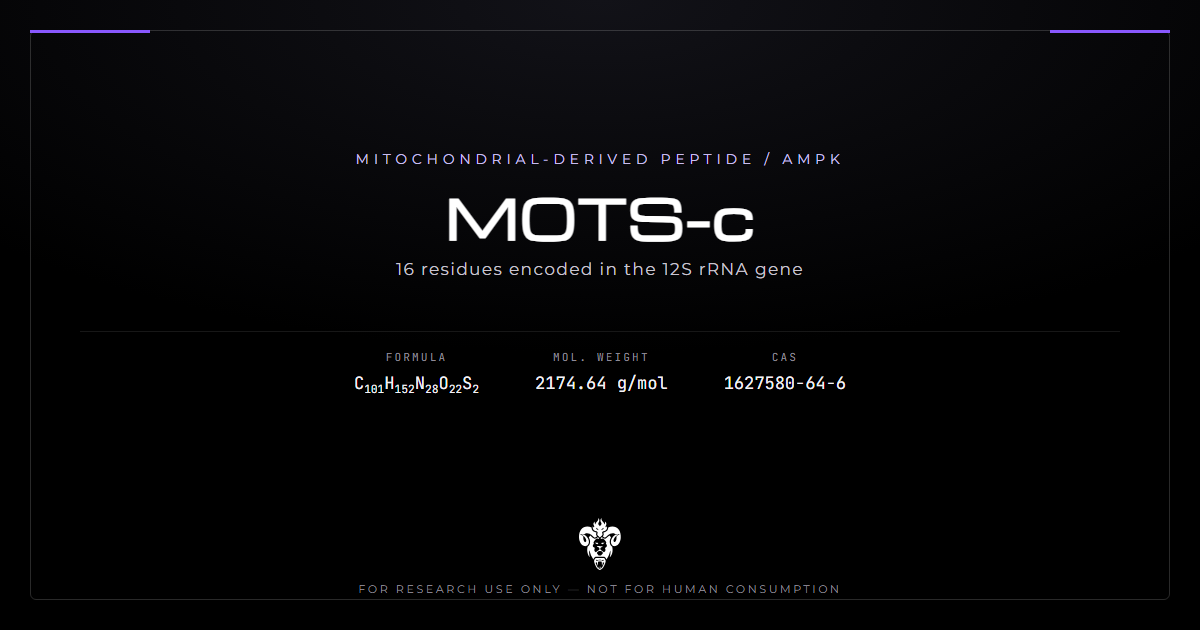
| Molecular formula | C101H152N28O22S2 |
| Molecular weight | 2174.6 |
| CAS | 1627580-64-6 |
| PubChem CID | 146675088 |
| InChIKey | WYTHCOXVWRKRAH-LOKRTKBUSA-N |
Kimera supplies the material as MOTS-c.
Encoded in mitochondrial DNA, not nuclear
The nuclear genome encodes nearly every peptide in this catalogue. MOTS-c is not. It comes from a short open reading frame inside the mitochondrial 12S ribosomal RNA gene [1].
That is a strange place to keep a gene. The mitochondrial genome is tiny, roughly 16.5 kilobases, and it was long assumed to encode only the respiratory chain subunits, tRNAs and rRNAs it obviously needs.
It was found by looking for a second one
Humanin came first, a signalling peptide encoded in a short ORF in mitochondrial DNA. Its discovery raised an obvious question: if one exists, are there others?
MOTS-c is the answer to that question [1]. The search was deliberate, which is worth knowing because it means the finding was not a fluke of annotation.
The mechanism is unusually specific
Most peptides in this catalogue act on a receptor. MOTS-c acts on a metabolic pathway.
The folate cycle route
Its cellular action inhibits the folate cycle and the de novo purine biosynthesis tethered to it, and that inhibition leads to AMPK activation [1]. Skeletal muscle appears to be the primary target organ.
This is a metabolic-intermediate mechanism rather than a receptor-binding one. That distinction matters for experimental design: there is no obvious antagonist to use as a control, and no binding assay to run.
AMPK is the convergence point
AMPK activation connects the peptide to a large literature on metabolic regulation, and it explains why reviewers group the compound with agents like AICAR and metformin.
Sharing an endpoint is not sharing a mechanism. Those compounds reach AMPK by different routes, and read-across between them is unreliable.
What the mouse data showed
The founding study is clean, and it bounds its own claims carefully.
MOTS-c treatment in mice prevented age-dependent insulin resistance, prevented high-fat-diet-induced insulin resistance, and prevented diet-induced obesity [1].
Note the verb. Prevented, in animals treated alongside the insult. That is a different claim from reversing established disease, and the distinction survives into every later discussion of the compound.
The age-dependent result deserves its own line. Insulin resistance that develops with age in an untreated mouse is a slower, less artificial model than diet-induced disease, and preventing it is the more interesting half of that paper. It also sits closest to the ageing framing the compound later acquired.
None of it involved a deficient animal. The mice made their own peptide throughout, and the treatment added to a normal baseline rather than correcting a shortfall. Hold that alongside the human data below.
The human measurements complicate it
Three human studies measured circulating MOTS-c rather than administering it, and together they point somewhere awkward.
| Study | Population | Finding |
|---|---|---|
| Obesity [2] | 32 obese, 22 lean | MOTS-c higher in obese, 273 vs lean; unchanged 6 months after bariatric surgery |
| PCOS [3] | PCOS and healthy | Lipid infusion raised MOTS-c to 232% of basal in controls, 349% in PCOS |
| Stromal cells [4] | Obese vs lean donors | Basal MOTS-c expression lower in obese cells |
Circulating levels rise with metabolic stress
The obesity study compared 32 participants scheduled for bariatric surgery against 22 lean controls, then followed ten of them through six months of post-surgical weight loss [2]. Circulating MOTS-c was significantly higher in the obese group and did not fall as they lost weight.
The PCOS study is more direct still. A five-hour intralipid infusion raised plasma MOTS-c to 232% of baseline in controls and 349% in PCOS subjects [3]. Subsequent insulin infusion blunted that rise.
So delivering a metabolic insult increases circulating MOTS-c, acutely and measurably.
Tissue expression may run the other way
The stromal cell study found the opposite direction in cells: basal MOTS-c expression was lower in mesenchymal stromal cells from obese donors than lean ones [4].
Circulating up, tissue down. Those two need not contradict each other, if tissue releases the peptide under stress. Nobody has demonstrated that, and reviewers routinely quote the two measurements as though they say the same thing.
Why this matters more than it sounds
A compound whose endogenous level rises in disease is not obviously one that patients are deficient in. The pattern fits a compensatory stress response better than a deficiency.
Two readings remain open. Either the rise is an insufficient compensation, in which case more might help. Or it is an adequate response to a problem elsewhere, in which case adding more addresses nothing. The published data does not choose, and the mouse experiments cannot settle it because they dosed animals that were not deficient either.
The stromal cell result is the sharpest caution
That 2026 study did more than measure. It gave MOTS-c to cells and looked at what happened [4].
Exogenous MOTS-c restored intracellular levels in obese-donor cells and activated metabolic signalling, which is the expected result. It also blunted reparative function, which is not.
The design extended to stenotic mouse kidneys, testing whether pre-treated obese stromal cells repaired tissue better. The headline says they did not.
One study, and it deserves replication rather than deference. It is also the only published work that gave the compound to human cells and measured something other than a metabolic marker, which makes it disproportionately informative about what is not yet known.
Where else it appears
The literature has expanded quickly, and most of it measures MOTS-c rather than administering it.
As a biomarker
Investigators have examined circulating levels in breast cancer patients on metformin [5], in Alzheimer’s disease alongside telomere length [6], and in type 2 diabetes with cardiac complications [7]. Another group tested a polymorphism, m.1382A>C, against PCOS [8].
Biomarker studies are cheaper than intervention studies, which is why they dominate. They also cannot establish that changing the level changes anything.
The metformin study is worth a second look
Circulating levels in breast cancer patients on metformin [5] sit at an interesting junction. Metformin activates AMPK, and this peptide activates AMPK, so a study measuring one during treatment with the other is asking whether they share a pathway in people.
That is a better-posed question than most biomarker work manages. It is also small, and correlation between two AMPK-linked measurements does not establish that either drives the other.
Alzheimer’s and Parkinson’s are early
The Alzheimer’s work pairs peptide expression with telomere length as candidate biomarkers [6]. The Parkinson’s material is a review of mitochondrial microproteins generally rather than a study of this one [12].
Both fields have a long history of candidate biomarkers that did not survive replication. Treat these as hypotheses about where to look next, not as findings about the peptide.
The atrial fibrillation work is the exception
That study administered the peptide alongside humanin rather than measuring it, and reported attenuated fibrosis and mitochondrial dysfunction [9]. It belongs in the intervention column.
Pairing the two mitochondrial-derived peptides is a sensible design, given they were discovered the same way and share an organelle. It also means the study cannot attribute its result to either one alone.
As an intervention
Work pairing MOTS-c with humanin reported attenuated atrial fibrillation through suppressed fibrosis and mitochondrial dysfunction [9]. Reviews cover its relationship to stress, metabolism and ageing [10], to exercise-induced muscle-fat crosstalk [11], and to mitochondrial microproteins in Parkinson’s disease [12].
What being mitochondrially encoded actually implies
The location of the gene is not trivia. It carries three consequences that a nuclear-encoded peptide would not have.
Maternal inheritance
Mitochondrial DNA passes down the maternal line only. So any sequence variant in this gene, and any functional consequence of one, follows a different inheritance pattern from every nuclear gene.
That is why a polymorphism such as m.1382A>C attracts attention [8]. Variants in mitochondrial DNA cluster into haplogroups that track ancient population history, which makes them unusually tractable for association studies and unusually easy to confound with ancestry.
Heteroplasmy
A cell carries hundreds to thousands of mitochondrial genome copies, and they need not be identical. The proportion carrying a variant can differ between tissues in the same person and can shift over a lifetime.
Nuclear genes do not behave like that. For this peptide it means “genotype” is a fuzzier concept than usual, and a blood sample may not report what muscle carries.
Copy number is a variable
Mitochondrial DNA copy number varies with tissue, age, exercise and disease. If expression scales with copy number even loosely, then the amount of peptide a tissue makes depends on something that moves for reasons unrelated to the peptide itself.
That is one plausible route to the circulating-versus-tissue discrepancy above, and nobody has ruled it in or out.
The exercise thread
Reviews repeatedly connect this peptide to exercise, and the connection is worth stating precisely because it gets overstated.
What the reviews say
Work on exercise-induced muscle-fat crosstalk treats the peptide as one mediator among several [11]. The broader reviews position it within stress, metabolism and ageing [10].
Skeletal muscle is the primary target organ identified in the founding work [1], so a muscle-exercise link is mechanistically reasonable rather than invented.
What it does not establish
Exercise raising a molecule does not make that molecule the reason exercise works. Dozens of things rise with exercise, and most of them are downstream consequences rather than causes.
The same caution applies here as to the obesity data: a level that moves with metabolic state may be reporting on that state rather than driving it. This peptide gives the clearest example of the problem in the catalogue, which is part of why it is worth reading carefully.
Two experiments that would settle the interpretation
Worth naming, because both are ordinary and neither appears in the literature.
Measure both compartments in the same subjects. Circulating and tissue levels come from different studies in different populations [2][4]. One study measuring both, in the same people, at the same time, would establish whether the directions really diverge or whether the discrepancy is an artefact of comparing cohorts.
Give it to humans and measure something. Every human study to date measures the endogenous peptide. No published work administers it and reports an outcome. Until one does, the gap between the mouse phenotype and the human associations stays exactly as wide as it is now.
How to read a MOTS-c study
Four questions, and the second is the one most reviews skip.
Measured or administered?
Most human MOTS-c papers measure endogenous levels [2][3][5][6]. Those describe an association. Only the administration studies say anything about what the compound does.
Which direction, and in what compartment?
Published work puts circulating and tissue levels moving in opposite directions with obesity [2][4]. A paper calling the peptide “reduced” or “elevated” without naming the compartment has left out half the claim.
Prevention or reversal?
The founding mouse work prevented metabolic disease in animals treated alongside the insult [1]. Extending that to reversal is an assumption, not a finding.
Was reparative function measured?
The one study that looked found metabolic signalling and repair moving in opposite directions [4]. Metabolic markers alone may miss that.
Verifying research material
MOTS-c is a defined chemical entity with published identifiers, so verification is arithmetic rather than judgement. Batch documentation sits on the certificates of analysis page.
Identity
Formula C101H152N28O22S2, molecular weight 2174.6, InChIKey WYTHCOXVWRKRAH-LOKRTKBUSA-N. The PubChem name lookup resolves to a stereo-defined record here.
Note the two sulfurs. Both methionines, at positions 1 and 6, and they are the compound’s main analytical liability.
Methionine oxidation is the check that matters
Methionine oxidises readily to the sulfoxide, adding 16 daltons per residue. With two methionines a preparation can sit at 2174.6, 2190.6 or 2206.6, and the oxidised forms are not the compound every published study used.
This is not a hypothetical. An N-terminal methionine oxidises especially readily, and position 1 here is exactly that. Ask whether the certificate reports oxidised species separately or only a single purity figure.
Handling follows from that
Oxygen and light both drive the oxidation. Lyophilised, cold, dark, and minimal headspace in the vial. Reconstituted solutions degrade faster than the solid, so treat them as short-lived.
There is no cysteine, so disulfide scrambling is not a concern, which distinguishes it from many peptides of similar size. Compare with Epithalon, a much shorter peptide with a very different stability profile.
Common questions about MOTS-c
Identity and origin
What does the name mean? Mitochondrial open reading frame of the 12S rRNA type-c. It describes exactly where the gene sits.
Is it encoded in mitochondrial DNA? Yes, in a short open reading frame within the 12S rRNA gene [1]. That is unusual and it is the compound’s defining feature.
How was it found? By deliberate search. Humanin had already shown that mitochondrial DNA encodes signalling peptides, and MOTS-c came from looking for another [1].
How does it work? It inhibits the folate cycle and the de novo purine synthesis attached to it, which activates AMPK. Skeletal muscle appears to be the main target [1].
Evidence
What did the mouse work show? Prevention of age-dependent and diet-induced insulin resistance, and of diet-induced obesity [1].
Are levels low in metabolic disease? Circulating levels are higher in obesity, not lower, and did not fall with weight loss after bariatric surgery [2].
Does a metabolic insult raise it? Yes. Lipid infusion raised plasma MOTS-c to 232% of basal in controls and 349% in PCOS subjects [3].
Is there a negative finding? One. In human stromal cells, exogenous MOTS-c activated metabolic signalling but blunted reparative function [4].
What is the main handling risk? Methionine oxidation. Two methionines, 16 daltons each, one of them N-terminal.
Why does mitochondrial encoding matter? Three reasons: maternal inheritance, heteroplasmy, and copy number that varies with tissue and age. None of those apply to a nuclear-encoded peptide.
Is it exercise-related? Reviews connect it to exercise-induced muscle-fat crosstalk [11]. That a molecule rises with exercise does not make it the reason exercise works.
Has anyone given it to a human? Not in the published literature. Every human study measures the endogenous peptide.
Handling and verification
What mass should a batch return? 2174.6. Readings at 2190.6 or 2206.6 indicate one or both methionines oxidised.
Does it contain cysteine? No, so disulfide scrambling is not a concern.
How should a certificate report purity? With oxidised species separated out, not folded into a single number. Ask specifically, because a single figure hides the failure mode this sequence is most prone to.
Does PubChem resolve it correctly by name? Yes, to a stereo-defined record. That is not true of every peptide in this catalogue.
Summary of the evidence
Strongest evidence: the founding characterisation [1], which identified the open reading frame, the sequence, the folate-cycle mechanism, the AMPK endpoint and the mouse metabolic phenotype in one paper. That is a lot of independent claims in a single study, and the mechanism has held.
Also solid, and mostly overlooked: the human measurement studies [2][3]. They are small but consistent, and they say the endogenous peptide behaves as a stress-responsive signal rather than a depleted one.
Weakest evidence: everything about administration to humans. It does not exist. The biomarker literature [5][6][7][8] describes associations, and the intervention work is animal or cell-based [4][9].
Read plainly, MOTS-c is a well-characterised discovery with a clear mechanism and an unresolved interpretation. The mouse data says giving it helps. The human data says the body already makes more of it when metabolism comes under stress. Nobody has yet run the experiment that reconciles those, and that experiment is the one worth wanting.
For laboratory purposes that ambiguity is workable, and arguably interesting. A compound whose endogenous behaviour contradicts the simple reading of its pharmacology is a better subject than one where everything lines up, because the disagreement points at a real question. The identity is settled, the mechanism is specified, and the folate-cycle route gives a concrete thing to measure.
What the literature does not support is treating the mouse phenotype as a description of what the compound does in people. That step has not been taken by anyone who published, and it should not be taken by anyone reading them.
The rest of the peptide literature sits in the peptides category.
Status: supplied for laboratory research use only.
References
- Lee C, Zeng J, Drew BG, Sallam T, Martin-Montalvo A, Wan J, Kim SJ, Mehta H, et al. The mitochondrial-derived peptide MOTS-c promotes metabolic homeostasis and reduces obesity and insulin resistance. Cell Metab. 2015;21(3):443-54. PMID 25738459. DOI
- Yoon SH, Yuan F, Zhu X, Tang H, Abdurakhimoova D, Krier J, Eirin A, Lerman A, et al. Systemic MOTS-c levels are increased in adults with obesity in association with metabolic dysregulation and remain unchanged after weight loss. J Clin Transl Endocrinol. 2026;43:100429. PMID 41551324. DOI
- Ramanjaneya M, Jerobin J, Bettahi I, Bensila M, Aye M, Siveen KS, Sathyapalan T, Skarulis M, et al. Lipids and insulin regulate mitochondrial-derived peptide (MOTS-c) in PCOS and healthy subjects. Clin Endocrinol (Oxf). 2019;91(2):278-287. PMID 31066084. DOI
- Xing L, Lu B, Zhu X, Al Saeedi M, Lerman A, Eirin A, Cohen P, Lerman LO. Mitochondrial-derived peptide MOTS-c activates metabolic signaling but blunts reparative function in human mesenchymal stromal cells. Inflamm Regen. 2026;. PMID 42324588. DOI
- Cuyàs E, Verdura S, Martin-Castillo B, Menendez JA. Circulating levels of MOTS-c in patients with breast cancer treated with metformin. Aging (Albany NY). 2022;15(4):892-897. PMID 36490309. DOI
- Rodríguez-Esparragón F, Cazorla-Rivero SE, Torrealba E, Cánovas-Molina Á, González-Hernández AN, Martín-Alfaro R, Afonso-Medina MP, Martínez de Saavedra-Álvarez MT, et al. Insights into the Biomarker Potential of Humanin and Mots-c Expression and Telomere Length in Alzheimer’s Disease. Int J Mol Sci. 2025;26(22). PMID 41303353. DOI
- Fang T, Han JC, Taberner A, Pham T. MOTS-c in type 2 diabetes mellitus: From risk factors to cardiac complications and potential treatment. Life Sci. 2025;382:124009. PMID 41083123. DOI
- Filibeli BE, Dedemoglu F, Garipçin P, Bulut S, Başok Bİ, Kizildağ S, Dündar B, Çatli G. Are serum MOTS-c levels and MOTS-c m.1382A>C polymorphism related to polycystic ovary syndrome?. Arch Endocrinol Metab. 2026;70(3):e260031. PMID 41945630. DOI
- Liao Y, Xu J, Jiao Y, Sun X, Gao M, Ding Y, Cai D, Shen Y, et al. Humanin and MOTS-c Attenuate Atrial Fibrillation by Suppressing Fibrosis and Mitochondrial Dysfunction. Biomedicines. 2026;14(5). PMID 42193373. DOI
- Wan W, Zhang L, Lin Y, Rao X, Wang X, Hua F, Ying J. Mitochondria-derived peptide MOTS-c: effects and mechanisms related to stress, metabolism and aging. J Transl Med. 2023;21(1):36. PMID 36670507. DOI
- Tero-Vescan A, Degens H, Matsakas A, Ștefănescu R, Ősz BE, Slevin M. Exercise-Induced Muscle-Fat Crosstalk: Molecular Mediators and Their Pharmacological Modulation for the Maintenance of Metabolic Flexibility in Aging. Pharmaceuticals (Basel). 2025;18(8). PMID 40872612. DOI
- Patel K, Soni R, Shah J. The unexplored Nexus: Mitochondria derived microproteins and Parkinson’s disease. Pathol Res Pract. 2025;273:156136. PMID 40694987. DOI
MOTS-c is sold for laboratory research use only. Not for human consumption, nor medical, veterinary, or household uses.