
Piracetam needs grams. Noopept works at fractions of a milligram per kilogram, and it was designed specifically to do that.
In one rat model the comparison ran side by side. A single injection at 0.12 to 0.5 mg/kg matched what piracetam achieved at 300 mg/kg given for three consecutive days [2].
The awkward part arrives with the pharmacokinetics. One of its metabolites is a neuropeptide the brain already makes, and that metabolite has a defined mechanism of its own [1][13].
Chemical identity
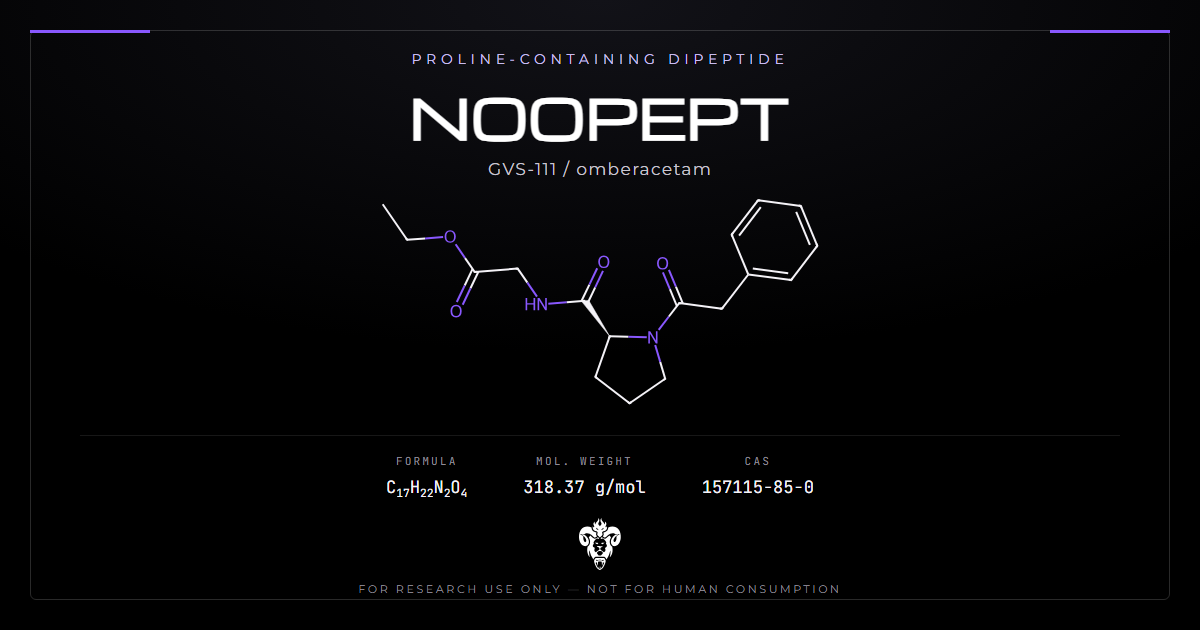
A dipeptide ethyl ester: phenylacetic acid joined to proline, then glycine, then capped as an ester.
| Property | Value |
|---|---|
| Systematic name | Ethyl N-phenylacetyl-L-prolylglycinate |
| Common names | Noopept, GVS-111, omberacetam |
| Molecular formula | C17H22N2O4 |
| Molecular weight | 318.4 g/mol |
| Monoisotopic mass | 318.1580 Da |
| PubChem CID | 180496 |
| InChIKey | PJNSMUBMSNAEEN-AWEZNQCLSA-N |
| Calculated logP | 1.5 |
| Stereocentres | 1, L-proline |
| Active metabolite | Cyclo-L-prolylglycine |
| Originator | Zakusov Research Institute of Pharmacology, Moscow |
Reading the structure
Three fragments, and each was chosen rather than inherited.
Proline sits at the centre. Its ring constrains the backbone and resists peptidases, which is why proline-containing short peptides keep appearing in this catalogue.
A phenylacetyl group caps the N-terminus and an ethyl ester caps the C-terminus. Both blocks improve stability and lipophilicity, and the ester is the part that hydrolyses first in vivo.
Not a racetam
The name and the marketing put Noopept in the racetam family. The structure does not.
A racetam is a 2-pyrrolidinone with substituents. Noopept is a dipeptide, with an amide bond joining two amino acids, and it shares no ring system with piracetam at all.
What it shares is a design brief. Gudasheva’s group built a dipeptide intended to reproduce the piracetam pharmacophore in a peptide scaffold [1][2]. That is why the literature calls it a piracetam analogue while the chemistry says otherwise.
The naming compounds the confusion rather than resolving it. Its international nonproprietary name is omberacetam, and that -acetam stem is the convention for the racetam class. So the formal name asserts a family membership the structure does not support, and anyone sorting compounds by suffix will file it wrongly.
Designed to beat piracetam
The compound exists because somebody thought a gram-scale drug was a solvable problem.
The potency comparison
Lysenko and colleagues immobilised rats for 24 hours (PMID 9483398). That drives lipid peroxidation products up in cortical synaptosomes [2].
A single intraperitoneal injection of Noopept at 0.12 or 0.5 mg/kg reduced that accumulation. Piracetam produced a similar effect at 300 mg/kg, given for three successive days [2].
Read the two regimens against each other. Roughly a thousandfold difference in dose, and a single injection against three days of loading.
Oral activity survived the change of route. Antiamnesic effects in passive avoidance held across 0.5 to 10 mg/kg by mouth, which matters because peptides usually do not survive the gut [3].
What the design method was
The approach was to keep the pharmacophore and discard the scaffold.
Rather than substituting a pyrrolidinone ring further, the group replaced it with a proline-containing dipeptide carrying the same spatial arrangement of features. The natural resistance of proline peptides to cleavage did the stability work that a ring had done before.
Pharmacokinetics confirmed the compound outlasted a natural neuropeptide. It showed greater resistance to enzymatic attack than natural neuropeptides do, with three metabolites detectable in rat plasma [1].
What the potency comparison does not establish
The thousandfold figure is the headline everywhere this compound is sold. It is worth stating what it can and cannot support.
Dose is not affinity
A gap in milligrams per kilogram describes how much material a protocol needs. It says nothing about how tightly anything binds.
Noopept has no established receptor. Its leading mechanistic candidate runs through an enzyme, prolyl hydroxylase 2, rather than a receptor site [11], and piracetam’s leading candidate is a bulk physical effect on membranes rather than a binding event at all.
Without a defined target and an affinity on both sides, there is nothing to normalise the comparison against. The ratio is real and it is a dosing fact.
One assay, two mechanisms
The 1997 comparison rested on a single endpoint: lipid peroxidation products in cortical synaptosomes after 24 hours of immobilisation [2].
Two compounds can reach the same readout by different routes and scale quite differently on the way. A ratio measured on one endpoint belongs to that endpoint, and nothing in the paper claims otherwise.
Metabolism complicates it further. If part of the parent’s activity belongs to cyclo-prolylglycine, which has potency of its own [13], then the milligram figure for Noopept is a composite of two active species rather than a property of one.
None of that makes the comparison wrong. It makes it a statement about how much powder an experiment needs, which is what it was measured as.
The metabolite question
One of those three metabolites is the interesting one, and it complicates every result in this article.
Cyclo-prolylglycine is endogenous
Boyko and colleagues identified cyclo-Pro-Gly as an active metabolite of the parent compound in 1997 [1].
That molecule is not a synthetic fragment. Cycloprolylglycine occurs endogenously in brain, acts as a positive AMPA receptor modulator, and raises BDNF content in neurons [13].
It also carries its own behavioural activity. At 1 mg/kg subchronically in a learned helplessness model, it reduced immobility time from 167.6 to 83.6 seconds [13].
Later pharmacokinetic work compared the two directly. The metabolite differs substantially from the parent in its kinetic parameters while sharing a similar multi-component spectrum of pharmacological action [12].
The evidence against pure prodrug behaviour
If Noopept were only a delivery vehicle, the parent and the metabolite would behave alike. On at least one model they do not.
Ostrovskaya and colleagues used a massed one-session active avoidance schedule (PMID 11782792). Noopept stimulated one-session learning after a single dose. On repeated dosing it increased the number of successful learners among animals that had failed initially [3].
In that respect, the authors write, the parent principally differs from both cycloprolylglycine and piracetam [3].
Hold that against the Selank literature, where the Gly-Pro fragment reproduced most of the parent peptide’s effect and the attribution stayed unresolved. Here there is at least one experiment separating them, which is one more than most compounds in this class have.
What it does to hippocampal circuits
Two electrophysiology papers agree, and their answer is not the one the category name implies.
Inhibition, not excitation
Kondratenko and colleagues patch-clamped CA1 pyramidal cells [6].
Bath application at 1 µM raised the frequency of spike-dependent spontaneous inhibitory postsynaptic currents. Spike-independent miniature currents did not change, which places the action on interneuron firing rather than on transmitter release [6].
Povarov and colleagues reached the same conclusion from the other direction [9]. Stimulating Schaffer collaterals, Noopept enhanced the inhibitory component of the resulting current and left the excitatory component alone, with the effect scaling with concentration.
A compound sold to sharpen cognition turns up the inhibitory side of a hippocampal circuit. That is a real finding rather than a contradiction, since inhibitory interneurons shape the timing that memory encoding depends on.
Neurotrophin expression
Ostrovskaya and colleagues measured NGF and BDNF messenger RNA by Northern blot after single and 28-day treatment [5].
Hippocampal expression of both neurotrophins rose after acute dosing, and chronic treatment potentiated rather than tolerated the effect [5].
The cortex went the other way, and the paper says so. Expression there fell below control after a single dose, with chronic dosing producing only a slight rise in BDNF [5]. The effect is regional, not global.
The HIF-1 finding
The most specific mechanistic claim in the file came from a screen that mostly returned negatives.
Vakhitova and colleagues transfected HEK293 cells with luciferase reporters for nine transcription factors (PMID 27099787). The panel covered CREB, NFAT, NF-kappaB, p53, STAT1, GAS, VDR, HSF1 and HIF-1.
At 10 µM, Noopept increased DNA-binding activity of HIF-1 and of nothing else. Piracetam at 1 mM affected none of the nine [11].
Docking put the parent and its L-isomer metabolite in the active site of prolyl hydroxylase 2 [11]. That enzyme is the oxygen sensor marking HIF-1 alpha for degradation, and the pharmacologically inactive D-isomer did not fit it. On that basis the authors propose the HIF-positive effect as the primary mechanism.
Neuroprotection models
The protective results are consistent across models and mostly come from one laboratory.
| Model | System | Dose or concentration | Result |
|---|---|---|---|
| Olfactory bulbectomy [4] | NMRI mice | 0.01 mg/kg, 21 days | Spatial memory restored, anti-amyloid antibodies up |
| Alpha-synuclein [7] | SH-SY5Y cells | In vitro | Oligomer cytotoxicity rescued |
| Glutamate toxicity [10] | HT-22 hippocampal | 10-11 to 10-5 M | Viability improved before or after insult |
| PINK1 knockout [14] | Rats, intranasal | 20 nM with forskolin | Motor symptoms reversed, BDNF and NGF up |
Amyloid and alpha-synuclein
The bulbectomy model produces Alzheimer-like behaviour, degeneration and raised amyloid beta.
Noopept at 0.01 mg/kg for 21 days restored spatial memory in the Morris water maze. It also raised serum antibody levels to amyloid beta oligomers, leaving antibodies to lysozyme amyloid and to S100b unchanged [4]. The immunotropic effect was selective for the relevant species.
The alpha-synuclein work is independent and its mechanism is unusually honest about being non-specific. Two-dimensional NMR showed no sterically specific binding site on the protein [7]. What the compound does is interact hydrophobically with toxic oligomers and push them into larger fibrillar aggregates, which removes the cytotoxic species.
Glutamate toxicity
Antipova and colleagues exposed immortalised mouse hippocampal HT-22 neurons to 5 mM glutamate [10].
Added before or after the insult, Noopept improved survival across 10-11 to 10-5 M, a range spanning six orders of magnitude. Comparison with earlier work on cortical and cerebellar neurons put hippocampal cells at the more sensitive end [10].
The Parkinson’s model is the newest and the least attributable. Intranasal forskolin with Noopept reversed motor deficits and dopaminergic neuron loss in PINK1 knockout rats [14]. The formulation combined both agents, and forskolin alone did not reduce alpha-synuclein aggregates while the combination did.
The result nobody expected
One paper sits outside the neurology entirely and is worth knowing about.
In streptozotocin-diabetic rats, Noopept normalised blood GLP-1 and insulin, both of which streptozotocin had lowered [8]. The antihyperglycaemic effect was more pronounced orally than intraperitoneally.
The mechanism was not the obvious one. Sitagliptin raised the same measures by inhibiting dipeptidyl peptidase IV, and the dipeptide did not inhibit that enzyme [8].
Treat that as a lead rather than a finding about people. It is one laboratory, one rodent model of chemically induced diabetes, and the authors say plainly that the mechanism requires further investigation.
Who did the work
The authorship pattern in this file is the tightest in the catalogue, and it belongs in any assessment of the evidence.
Ostrovskaya, Gudasheva and Seredenin recur across almost all of it [1][2][3][5][8][11][12][13]. Their names appear on the pharmacokinetics, the behavioural work, the neurotrophin measurements, the electrophysiology, the transcription factor screen and the diabetes result, most of it from one institute in Moscow.
Two exceptions are worth naming because they are the independent replication this compound has. The alpha-synuclein work came from Umeå [7], and the Parkinson’s model from Nevada [14].
Both exceptions are on non-cognitive endpoints. No independent group has reproduced the cognitive results that the compound is sold for, and no controlled human trial appears in the accessible English-language literature.
That absence needs stating carefully rather than overstated. The compound is registered and prescribed in Russia, so clinical work almost certainly exists in Russian-language journals that PubMed indexes thinly or not at all. What can be said is narrower: the trials are not reachable through the databases this article searched, so nobody reading in English can assess their design, size or endpoints.
The same caveat applies to phenibut and to Selank, and it cuts both ways. Absence of accessible evidence is not evidence of absence, and it is also not something a reader can rely on.
How to read a Noopept study
Four questions, and the first is the one the literature keeps raising itself.
Parent or metabolite?
Cycloprolylglycine is endogenous, active, and has its own AMPA-modulating mechanism [13]. A result on the parent may belong to the metabolite unless the study tested both, and most did not.
Which brain region?
Neurotrophin expression rose in hippocampus and fell in cortex after the same dose [5]. Regional dissociation is the rule here rather than the exception.
What concentration?
Protective effects in HT-22 cells spanned 10-11 to 10-5 M [10], while the transcription factor screen used 10 µM [11]. A six-order range is not a dose-response curve, and the mechanism at each end need not be the same.
Whose laboratory?
Most of this literature shares three authors and one institute [1][2][3][5][8][11][12][13]. That does not make it wrong, and it does mean the cognitive claims rest on less independent replication than their prominence suggests.
Verifying research material
A small, single-stereocentre ester is straightforward to characterise, and the ester is where the questions concentrate.
Identity
Mass spectrometry gives 318.4 average and 318.158 monoisotopic. Nuclear magnetic resonance separates it cleanly from anything racetam-shaped, since the aromatic phenylacetyl protons and the proline ring have unmistakable signatures.
The stereocentre is a real question rather than a formality. L-proline is the active configuration, and the D-isomer failed to dock at prolyl hydroxylase 2 in the modelling work [11]. Chiral purity therefore has a mechanistic consequence, and achiral HPLC does not measure it.
Free acid is the impurity to expect. Ester hydrolysis gives N-phenylacetyl-L-prolylglycine, 28 Da lighter, and it forms on standing in anything damp.
Purity and related substances
The synthesis is a short peptide coupling, so the impurity profile is predictable.
Uncoupled fragments and the des-phenylacetyl dipeptide are the plausible process impurities. Both differ by enough mass to see, and both have different pharmacology from the parent.
Residual coupling reagents belong on a certificate for material made this way, alongside the usual solvent panel.
Handling
Store dry and sealed, and keep stock solutions cold and fresh.
The ester is the vulnerable bond. Aqueous solutions hydrolyse it slowly at neutral pH and faster under base. A stock left in buffer becomes a mixture of parent and free acid, with no visible change to warn you.
Aqueous solubility is modest at a logP of 1.5. Ethanol or DMSO stocks with a vehicle control are the practical route for cell work. State the vehicle, because the effective range in those experiments reaches picomolar.
Kimera publishes third-party certificates of analysis for every lot in its COA database. Laboratories source Noopept as a proline-containing dipeptide reference. It appears alongside piracetam, the compound it was designed to improve on, and Selank, which carries the same unresolved question about an active fragment. It also pairs with nooglutyl from the same research tradition. Related work appears in the nootropics category.
Common questions about Noopept
Is it a racetam? No. It is a dipeptide ethyl ester with no pyrrolidinone ring, designed to reproduce the piracetam pharmacophore in a peptide scaffold [1][2].
How much more potent is it than piracetam? Roughly a thousandfold by dose in one matched comparison: 0.12 to 0.5 mg/kg once, against 300 mg/kg for three days [2].
What is cycloprolylglycine? An endogenous brain neuropeptide, a positive AMPA receptor modulator, and an active metabolite of the parent compound [1][13].
Is it just a prodrug for that metabolite? Probably not entirely. On a one-session learning model the parent behaved differently from both the metabolite and piracetam [3].
What is the proposed mechanism? Increased HIF-1 DNA-binding activity, with docking at prolyl hydroxylase 2. Eight other transcription factors did not respond [11].
Is there human evidence? No controlled trial appears in the accessible English-language literature.
Summary of the evidence
Identity: ethyl N-phenylacetyl-L-prolylglycinate, C17H22N2O4, 318.4 g/mol, one stereocentre at proline, logP 1.5.
Design: a dipeptide built to carry the piracetam pharmacophore, from the Zakusov Institute in Moscow [1][2].
Potency: 0.12 to 0.5 mg/kg in a single injection matched piracetam at 300 mg/kg over three days [2]. Oral activity ran from 0.5 to 10 mg/kg [3].
Metabolite: cyclo-Pro-Gly is endogenous, modulates AMPA receptors, raises BDNF and shows antidepressant-like activity alone [1][13]. The parent still behaved differently from it on one learning model [3].
Circuit effect: enhanced inhibitory transmission in CA1 through interneuron firing, with the excitatory component unchanged [6][9].
Neurotrophins: NGF and BDNF messenger RNA up in hippocampus and down in cortex after the same acute dose [5].
Mechanism: HIF-1 alone among nine transcription factors, with docking at prolyl hydroxylase 2 [11].
Protection: spatial memory restored after bulbectomy at 0.01 mg/kg [4]. Alpha-synuclein oligomer toxicity rescued without a specific binding site [7], and HT-22 survival improved across six orders of concentration [10].
Limits: almost all cognitive work comes from one institute and three recurring authors. Independent replication is confined to non-cognitive endpoints [7][14], and no controlled human trial appears in the accessible literature.
Status: supplied for laboratory research use only.
References
- Boyko SS, Zherdev VP, Dvoryaninov AA, Gudasheva TA, Ostrovskaya RU, Voronina TA, Rozantsev GG, Seredenin SB. The pharmacokinetics of the dipeptide analog of piracetam with nootropic activity GVS-111 and of its basic metabolites. Eksp Klin Farmakol. 1997;60(2):53-55. PMID 9206571.
- Lysenko AV, Uskova NI, Ostrovskaya RU, Gudasheva TA, Voronina TA. Dipeptide nootropic agent GVS-111 prevents accumulation of the lipid peroxidation products during immobilization. Eksp Klin Farmakol. 1997;60(5):15-18. PMID 9483398.
- Ostrovskaya RU, Mirsoev TK, Romanova GA, Gudasheva TA, Kravchenko EV, Trofimov CC, Voronina TA, Seredenin SB. Proline-containing dipeptide GVS-111 retains nootropic activity after oral administration. Bull Exp Biol Med. 2001;132(4):959-962. PMID 11782792. DOI
- Ostrovskaya RU, Gruden MA, Bobkova NA, Sewell RD, Gudasheva TA, Samokhin AN, et al. The nootropic and neuroprotective proline-containing dipeptide noopept restores spatial memory and increases immunoreactivity to amyloid in an Alzheimer’s disease model. J Psychopharmacol. 2007;21(6):611-619. PMID 17092975. DOI
- Ostrovskaya RU, Gudasheva TA, Zaplina AP, Vahitova JV, Salimgareeva MH, Jamidanov RS, Seredenin SB. Noopept stimulates the expression of NGF and BDNF in rat hippocampus. Bull Exp Biol Med. 2008;146(3):334-337. PMID 19240853. DOI
- Kondratenko RV, Derevyagin VI, Skrebitsky VG. Novel nootropic dipeptide Noopept increases inhibitory synaptic transmission in CA1 pyramidal cells. Neurosci Lett. 2010;476(2):70-73. PMID 20382202. DOI
- Jia X, Gharibyan AL, Öhman A, Liu Y, Olofsson A, Morozova-Roche LA. Neuroprotective and nootropic drug noopept rescues alpha-synuclein amyloid cytotoxicity. J Mol Biol. 2011;414(5):699-712. PMID 21986202. DOI
- Ostrovskaya RU, Zolotov NN, Ozerova IV, Ivanova EA, Kapitsa IG, Taraban KV, et al. Noopept normalizes parameters of the incretin system in rats with experimental diabetes. Bull Exp Biol Med. 2014;157(3):344-349. PMID 25065315. DOI
- Povarov IS, Kondratenko RV, Derevyagin VI, Ostrovskaya RU, Skrebitskii VG. Nootropic dipeptide noopept enhances inhibitory synaptic transmission in the hippocampus. Bull Exp Biol Med. 2015;158(3):349-351. PMID 25573367. DOI
- Antipova TA, Nikolaev SV, Ostrovskaya RU, Gudasheva TA, Seredenin SB. Dipeptide piracetam analogue noopept improves viability of hippocampal HT-22 neurons in the glutamate toxicity model. Bull Exp Biol Med. 2016;161(1):58-60. PMID 27265136. DOI
- Vakhitova YV, Sadovnikov SV, Borisevich SS, Ostrovskaya RU, Gudasheva TA, Seredenin SB. Molecular mechanism underlying the action of substituted Pro-Gly dipeptide Noopept. Acta Naturae. 2016;8(1):82-89. PMID 27099787.
- Boyko SS, Zherdev VP, Shevchenko RV. Pharmacokinetics of noopept and its active metabolite cycloprolyl glycine in rats. Biomed Khim. 2018;64(5):455-458. PMID 30378564. DOI
- Garibova TL, Gudasheva TA, Seredenin SB. A new component in the mechanism of regulation of endogenous depressive-like states. Dokl Biochem Biophys. 2019;488(1):324-326. PMID 31768852. DOI
- Dagda RK, Dagda RY, Vazquez-Mayorga E, Martinez B, Gallahue A. Intranasal administration of forskolin and noopept reverses parkinsonian pathology in PINK1 knockout rats. Int J Mol Sci. 2022;24(1):690. PMID 36614135. DOI
Noopept is sold for laboratory research use only. Not for human consumption, nor medical, veterinary, or household uses.
Literature retrieved from PubMed.