
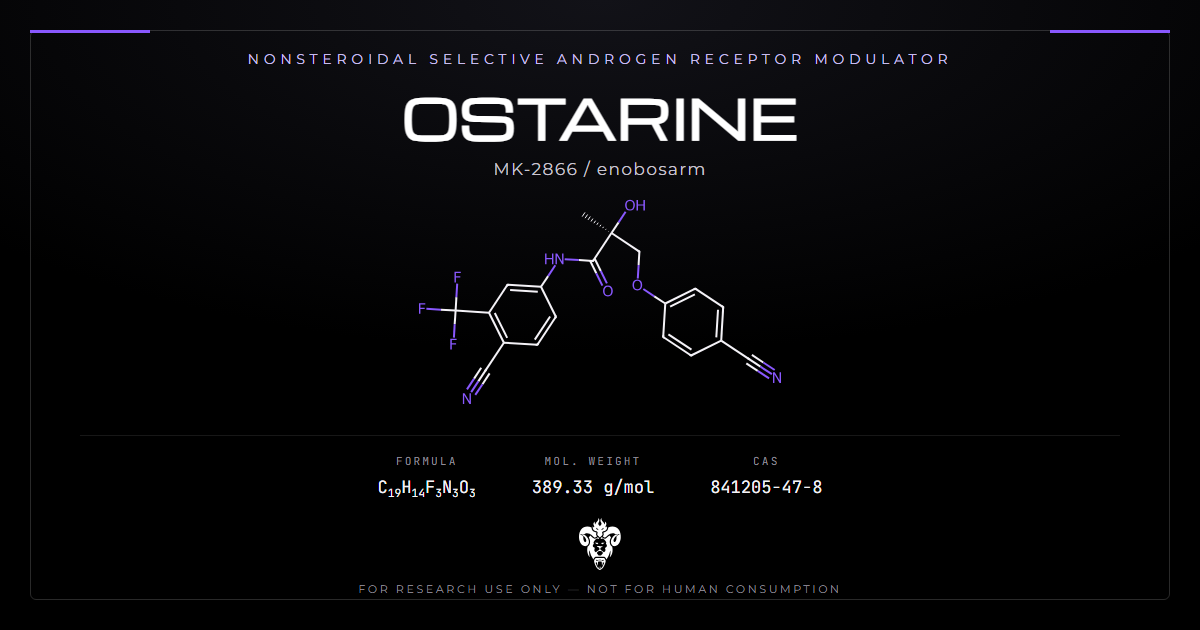
Ostarine is the selective androgen receptor modulator with real phase 3 data behind it. Two identically designed trials enrolled 600 patients with lung cancer. The programme reached the point where the regulator dictated how the endpoints would be analysed [5].
It is still not an approved drug anywhere. Reading why is more useful than reading another mechanism summary, because the reason sits in how the trials were built rather than in whether the compound works.
Three findings carry the file. The co-primary endpoints were defined asymmetrically, so mass could pass while function failed. The compound’s clearest positive result comes from a setting where the androgen receptor suppresses tumours rather than building muscle. And a single one-microgram dose stays detectable in urine for nine days.
Chemical identity
| Property | Value |
|---|---|
| Common names | Ostarine, MK-2866, enobosarm, GTx-024, S-22 |
| Molecular formula | C19H14F3N3O3 |
| Molecular weight | 389.33 g/mol |
| CAS | 841205-47-8 |
| PubChem CID | 11326715 |
| InChIKey | JNGVJMBLXIUVRD-SFHVURJKSA-N |
| Class | Nonsteroidal arylpropionamide |
| Configuration | (2S) |
| AR binding | Ki near 3.8 nM |
The catalogue carries it as MK-2866.
Reading the structure
An arylpropionamide core carries two aromatic rings. One bears a nitrile, the other a nitrile and a trifluoromethyl group. An ether and an amide join them around a tertiary alcohol at the (2S) centre.
Nothing about that skeleton resembles testosterone. No steroid ring system appears anywhere in it, and that absence is the point of the class. The molecule reaches the same receptor by a different chemical route, so it distributes and metabolises differently.
Why the trifluoromethyl group matters
That group is doing electronic work rather than filling space, and medicinal chemists have tested the claim directly. Shao and colleagues synthesised 21 derivatives replacing it with a pentafluorosulfanyl group [7]. That substituent is a more electronegative bioisostere.
Several retained androgen receptor agonist activity in vitro. The scaffold tolerates substitution at that position, which tells you the trifluoromethyl is tuned rather than essential.
How ostarine was framed before the trials
The early literature is worth reading because it shows what the class was expected to deliver.
Zilbermint and Dobs reviewed the compound in 2009, when only phase 1 and 2 data existed [1]. They describe cancer cachexia as affecting up to 60% of roughly 1.4 million patients diagnosed annually in the United States, with existing progestational, anti-inflammatory and anabolic therapy often ineffective and burdened by side effects.
Against that background the promise was specific: a potent anabolic agent with minimal effect on prostate and hair follicles. Their own conclusion is more cautious than the framing that followed, calling for more extensive data before efficacy could be considered confirmed.
Fifteen years on, that caution reads well. The tissue-selectivity claim held up reasonably, since the randomised trials report transaminases and calcium rather than prostate events [11]. The efficacy claim is the one still unsettled.
| Trial | Design | Population | n | Result |
|---|---|---|---|---|
| Dobs 2013 [2] | Phase 2, double-blind | Cancer, >=2% weight loss | 100 evaluable | LBM +1.5 kg at 1 mg, +1.0 kg at 3 mg |
| POWER 1 and 2 [5] | Phase 3, double-blind | NSCLC, first-line chemo | 600 | Co-primaries: LBM and stair climb power |
| Yuan 2021 [9] | Phase 2, open label | AR+ metastatic TNBC | 16 evaluable | CBR 25% at 16 weeks, stopped early |
| Palmieri 2024 [11] | Phase 2, randomised | AR+ ER+ HER2- breast | 102 evaluable | CBR 32% at 9 mg, 29% at 18 mg |
What the phase 2 work established
Dobs and colleagues ran a double-blind, placebo-controlled phase 2 trial [2]. Patients had cancer and had lost at least 2% of body weight. Participants took 1 mg, 3 mg or placebo daily for up to 113 days.
Lean body mass by dual-energy x-ray absorptiometry rose in both active groups. The 1 mg arm gained a median 1.5 kg and the 3 mg arm 1.0 kg. Placebo moved 0.02 kg and did not separate from baseline.
Two things about that result deserve stating. The lower dose outperformed the higher one on the median, which is not what a clean dose-response looks like. And the efficacy population was 100 of the 159 patients analysed for safety. More than a third of enrolled patients therefore contributed no efficacy datapoint.
How the phase 3 endpoints were built
This is the part worth reading closely, and it comes from the design paper rather than from hindsight.
Two co-primary endpoints, defined differently
POWER 1 and POWER 2 were identical randomised, double-blind, placebo-controlled trials [5]. Each randomised 150 patients to placebo and 150 to 3 mg daily for 147 days. All were starting first-line chemotherapy for non-small-cell lung cancer.
The co-primary endpoints were stair climb power and lean body mass, both at day 84. Following extensive feedback from the regulator, both took the form of responder analyses. To count as a lean body mass responder a patient needed no loss against baseline. To count as a physical function responder a patient needed at least 10% improvement.
Those bars are not symmetric. One asks a patient to hold still while losing weight from cancer and chemotherapy. A measurable gain in a performance test is a different order of request.
What the placebo arm showed
A later secondary analysis of the POWER control group makes the asymmetry concrete [6]. Among patients receiving placebo, 53% lost lean body mass by day 84 and 49% lost stair climb power.
Turn those numbers around. Roughly 47% of placebo patients met the lean body mass responder definition without any drug. They qualified by not losing. A compound only had to shift that proportion to succeed on one co-primary while the other asked for something much harder.
That analysis also identified what predicted decline. Advanced stage predicted physical loss. Taxane chemotherapy and prior tobacco use predicted functional loss, and higher body mass index protected against it.
Why the design matters beyond this compound
Its own authors describe the programme as pioneering the methodological and regulatory ground for cancer-associated muscle wasting [5]. That is accurate and it cuts both ways. A first attempt at defining what counts as benefit is also a first attempt at getting the definition wrong.
Ostarine did not fail because androgen receptor activation does nothing to muscle. The phase 2 data say it does something [2]. What the phase 3 design asked was whether that something converts into a stair climb. Mass gain and function gain are not the same endpoint.
Where ostarine did produce a positive trial
The compound’s strongest randomised result is not in muscle at all.
Androgen receptor as tumour suppressor
Palmieri and colleagues ran a randomised, open-label, multinational phase 2 trial [11]. Participants were postmenopausal women with previously treated, oestrogen receptor positive, HER2 negative, androgen receptor positive advanced breast cancer. The premise inverts the usual framing. In that disease the androgen receptor acts as a tumour suppressor, so activating it is the therapeutic move.
Of 136 patients randomised to 9 mg or 18 mg daily, 102 formed the evaluable population. Clinical benefit at 24 weeks reached 32% on 9 mg and 29% on 18 mg. Grade 3 or 4 drug-related adverse events occurred in 8% and 16%. Raised hepatic transaminases led, followed by hypercalcaemia and fatigue.
Again the lower dose did at least as well as the higher one. That pattern has now appeared in two separate randomised trials of this compound.
The trial that ended for a non-scientific reason
A phase 2 study combined ostarine with pembrolizumab in androgen receptor positive metastatic triple-negative breast cancer [9]. It was stopped early because the sponsor withdrew the drug supply.
Eighteen patients enrolled and 16 were evaluable. One complete response, one partial response, two stable disease, twelve progressive disease. Clinical benefit rate 25% at 16 weeks, median overall survival 25.5 months.
A compound whose trials end when a company changes direction accumulates a literature of underpowered fragments. That is a fact about drug development rather than about pharmacology. It still shapes what evidence exists to read.
Pharmacokinetics and interactions
Coss and colleagues ran a series of open-label phase 1 interaction studies against five probes [4]. The results locate the clearance route precisely.
Itraconazole, a CYP3A4 inhibitor, had no effect. Rifampin, an inducer, produced the largest change of any agent tested. Maximum concentration fell 23% and total exposure 43%. Probenecid, a pan-UGT inhibitor, raised parent exposure by 50% and glucuronide exposure by 112%.
Read together, those results put glucuronidation ahead of oxidation. Ostarine did not meaningfully change celecoxib or rosuvastatin pharmacokinetics either. It is neither a strong CYP2C9 nor a strong BCRP perpetrator.
The detection problem
Anti-doping laboratories have characterised this compound more thoroughly than most, and two of their findings are striking.
One microgram, nine days
Walpurgis and colleagues ran single and multiple dose studies at 1, 10 and 50 µg [8]. The design mimicked supplement contamination rather than deliberate use. A single oral dose of 1 µg remained detectable for up to nine days by monitoring the parent compound, and five days by its glucuronide.
Hydroxylated metabolites gave considerably shorter windows. Inter-individual variation in peak concentration and detection window ran high. That variation limits how precisely a measured concentration back-calculates to a dose.
Transfer by kissing, documented
Kintz and colleagues investigated a specific claim [12]. An athlete suspended before the Olympic games said her adverse finding came from kissing a partner who was taking ostarine without telling her.
To test whether that was even possible, a male volunteer took 17.3 mg, with the dose verified by NMR. Oral fluid collection ran over eight hours. Concentration peaked at 468 ng/mL at 15 minutes, and stayed at 1 to 2 ng/mL beyond four hours. The authors conclude the data support transfer during kissing as a plausible contamination route.
That is an unusual sentence to find in a clinical chemistry journal. It follows directly from testing sensitivity. When a nanogram in oral fluid matters, exposure routes that were previously irrelevant become adjudicable.
The safety signal that exists
Koller and colleagues report two young men who developed liver injury after using ligandrol, ostarine or both, followed by so-called post-cycle therapy [10].
Cholestasis dominated the picture. Jaundice and fatigue led the presentation, alkaline phosphatase stayed normal, and bilirubin and serum bile acids ran high. Histology showed canalicular bile plugs, ductopenia and mild hepatocellular damage without significant fibrosis. Both recovered over about three months.
Read the attribution carefully, because the authors do. Injury appeared after stopping the SARM, while on post-cycle therapy, and those agents were unmonitored and taken at supra-therapeutic doses. The paper describes the effects as likely idiosyncratic and flags the other substances as an unrecognised contributor. Two confounded cases is a signal to watch rather than an established hazard. Trial data give a cleaner read, where raised transaminases were the most common grade 3 or 4 event [11].
What separates ostarine from the rest of the class
Every SARM shares the same premise: reach the androgen receptor without a steroid ring, and gain tissue selectivity in the process. What separates them is how far each got before the evidence ran out.
Depth of evidence, not potency
Ostarine is not the most potent compound in the class and that was never the selling point. Its distinction is procedural. It has randomised placebo-controlled data in two diseases [2][11], a completed phase 1 interaction package [4], and a phase 3 programme designed in consultation with a regulator [5].
Most SARMs have none of that. Comparing ostarine to a compound characterised only in rodents is comparing different kinds of claim, and the reading question is which of them has ever been tested in people.
The selectivity claim, checked against outcomes
The class promise was anabolic effect without prostate or hair follicle involvement [1]. Judged against the randomised safety data, the promise partly held. The grade 3 and 4 events reported are hepatic transaminase elevation, hypercalcaemia and fatigue [11], not the androgenic events that steroids produce.
That is a narrower success than it sounds. Avoiding one class of adverse effect is not the same as having none, and the liver signal is where this compound and its relatives keep appearing [10]. Selectivity moved the problem rather than removing it.
Why comparative reading matters here
No head-to-head randomised trial compares ostarine with another SARM on any endpoint. Every cross-compound statement in this area is therefore an inference across different protocols, populations and sponsors.
The catalogue carries several members of the class for exactly that reason, since comparative bench work is the only place those comparisons currently get made. What the published record supports is a statement about one compound at a time.
How to read an ostarine study
Five questions separate what this literature shows from what gets claimed for it.
Which endpoint, mass or function?
Lean body mass and physical function are different endpoints and this compound performs differently on them [2][5]. Any summary reporting only one has answered half the question the phase 3 programme asked.
What was the responder definition?
“No loss” and “at least 10% improvement” are not comparable bars [5]. A responder analysis is only as informative as its threshold, and the threshold belongs in the summary.
Who funded it?
GTx sponsored the phase 2 cachexia trial, the POWER programme and the breast cancer trial, with company authors on several [2][5][11]. That does not invalidate the work. It does mean independent replications carry the weight, and few exist.
Which population?
Results come from cancer patients losing weight, and from postmenopausal women with breast cancer. Neither describes a healthy adult, and read-across from a cachexia trial to any other setting is an assumption rather than a finding.
Is a detected concentration a dose?
At these sensitivities, no. One microgram is detectable for nine days [8], and oral fluid transfer is documented [12]. A positive result establishes exposure, not intent and not quantity.
The same caution applies in the laboratory rather than only in sport. Ostarine turns up as a contaminant in products that never listed it, which is why the microdose work was commissioned in the first place [8]. Anyone quantifying this compound in a shared facility should treat a low-level detection as a question about the workspace before treating it as a result. Blank runs between samples cost little and settle the question quickly.
Verifying research material
The compound is a defined small molecule with a specified stereocentre, so verification is measurement. Batch documentation sits on the certificates of analysis page.
Identity
Formula C19H14F3N3O3, molecular weight 389.33, CAS 841205-47-8, InChIKey JNGVJMBLXIUVRD-SFHVURJKSA-N. Three fluorines give a distinctive mass defect. Fluorine NMR then provides a fast orthogonal identity check that most laboratories can run.
Stereochemistry
That InChIKey carries the SFHVURJKSA block, encoding the (2S) configuration. Mass spectrometry cannot distinguish the enantiomers, and the (2R) form is a different compound at the receptor. Chiral chromatography answers it. A certificate reporting only purity has not addressed enantiomeric excess.
Cross-contamination
The detection data make this practical rather than theoretical. A single microgram produces a nine-day urinary window [8]. Shared balances, spatulas and workspaces therefore transfer meaningful quantities. Segregate weighing for this compound and keep dedicated glassware.
Common questions about ostarine
Is ostarine approved anywhere? No. It has phase 3 data in cancer-associated muscle wasting and phase 2 data in breast cancer, and no approval in any jurisdiction.
Did the phase 3 trials fail? They were built around two co-primary endpoints with asymmetric responder definitions [5], and roughly 47% of placebo patients cleared the mass bar without treatment [6]. Endpoint construction is where the programme turned.
Is it selective? It is nonsteroidal and tissue-selective by design, which is the class claim [3]. The randomised trials report raised transaminases and hypercalcaemia as the leading grade 3 or 4 events [11], so selectivity is relative rather than absolute.
How does it clear? Mainly by glucuronidation. A UGT inhibitor raised exposure 50%, while a CYP3A4 inhibitor did nothing [4].
What else is in this class? The catalogue carries LGD-4033, Andarine and RAD-140 for comparative work.
Summary of the evidence
Strongest evidence sits in four places. One double-blind placebo-controlled phase 2 trial showed lean body mass gain [2]. A randomised phase 2 trial showed clinical benefit in AR-positive breast cancer [11]. The phase 1 interaction package is complete [4], and controlled microdose excretion data exist alongside it [8].
Weakest evidence covers healthy adults, muscle function and long-term safety. The liver cases are confounded by other substances [10]. The largest programme’s results turn on responder definitions [5][6], and one trial ended because a company stopped supplying drug [9].
Read plainly, ostarine is the SARM with the most evidence and no approval, and the gap between those two facts is mostly a story about endpoints. More of this literature sits in the SARMs category.
Status: supplied for laboratory research use only.
References
- Zilbermint MF, Dobs AS. Nonsteroidal selective androgen receptor modulator Ostarine in cancer cachexia. Future Oncol. 2009;5(8):1211-1220. PMID 19852734. DOI
- Dobs AS, Boccia RV, Croot CC, Gabrail NY, Dalton JT, Hancock ML, Johnston MA, Steiner MS. Effects of enobosarm on muscle wasting and physical function in patients with cancer: a double-blind, randomised controlled phase 2 trial. Lancet Oncol. 2013;14(4):335-345. PMID 23499390. DOI
- Srinath R, Dobs A. Enobosarm (GTx-024, S-22): a potential treatment for cachexia. Future Oncol. 2014;10(2):187-194. PMID 24490605. DOI
- Coss CC, Jones A, Dalton JT. Pharmacokinetic drug interactions of the selective androgen receptor modulator GTx-024 (enobosarm) with itraconazole, rifampin, probenecid, celecoxib and rosuvastatin. Invest New Drugs. 2016;34(4):458-467. PMID 27105861. DOI
- Crawford J, Prado CMM, Johnston MA, Gralla RJ, Taylor RP, Hancock ML, Dalton JT. Study design and rationale for the phase 3 clinical development program of enobosarm, a selective androgen receptor modulator, for the prevention and treatment of muscle wasting in cancer patients (POWER trials). Curr Oncol Rep. 2016;18(6):37. PMID 27138015. DOI
- Kinsey E, Ajazi E, Wang X, Johnston MAM, Crawford J. Predictors of physical and functional loss in advanced-stage lung cancer patients receiving platinum chemotherapy. J Thorac Oncol. 2018;13(9):1294-1301. PMID 29981438. DOI
- Shao P, Zhou Y, Yang D, Wang MW, Lu W, Jin J. Synthesis of aryl propionamide scaffold containing a pentafluorosulfanyl moiety as SARMs. Molecules. 2019;24(23):4227. PMID 31757115. DOI
- Walpurgis K, Rubio A, Wagener F, Krug O, Knoop A, Görgens C, Guddat S, Thevis M. Elimination profiles of microdosed ostarine mimicking contaminated products ingestion. Drug Test Anal. 2020;12(11-12):1570-1580. PMID 32959982. DOI
- Yuan Y, Lee JS, Yost SE, Frankel PH, Ruel C, Egelston CA, Guo W, Gillece JD, Folkerts M, Reining L, Highlander SK, Robinson K, Padam S, Martinez N, Tang A, Schmolze D, Waisman J, Sedrak M, Lee PP, Mortimer J. A phase II clinical trial of pembrolizumab and enobosarm in patients with androgen receptor-positive metastatic triple-negative breast cancer. Oncologist. 2021;26(2):99-e217. PMID 33141975. DOI
- Koller T, Vrbova P, Meciarova I, Molcan P, Smitka M, Adamcova Selcanova S, Skladany L. Liver injury associated with the use of selective androgen receptor modulators and post-cycle therapy: two case reports and literature review. World J Clin Cases. 2021;9(16):4062-4071. PMID 34141767. DOI
- Palmieri C, Linden H, Birrell SN, Wheelwright S, Lim E, Schwartzberg LS, Dwyer AR, Hickey TE, Rugo HS, Cobb P, O’Shaughnessy JA, Johnston S, Brufsky A, Tilley WD, Overmoyer B. Activity and safety of enobosarm, a novel, oral, selective androgen receptor modulator, in androgen receptor-positive, oestrogen receptor-positive, and HER2-negative advanced breast cancer (Study G200802): a randomised, open-label, multicentre, multinational, parallel design, phase 2 trial. Lancet Oncol. 2024;25(3):317-325. PMID 38342115. DOI
- Kintz P, Gheddar L, Garnier D. Evidence of ostarine excretion in oral fluid after a single controlled oral administration. Clin Chim Acta. 2024;557:117879. PMID 38499138. DOI
Ostarine is sold for laboratory research use only. Not for human consumption, nor medical, veterinary, or household uses.
Literature retrieved from PubMed.