
Selegiline was famous for one thing: it was the first selective inhibitor of B-type monoamine oxidase. For decades, every effect attributed to it was read through that enzyme.
PPAP is the molecule that showed the reading was incomplete.
It is a selegiline analogue stripped of MAO-inhibitory activity while keeping the rest of the pharmacological profile. It then raised catecholaminergic neuron activity just as selegiline did, and the conclusion followed directly. That effect cannot be enzyme inhibition, because the compound producing it does not inhibit the enzyme [8].
A compound designed as a negative control that instead reveals a new mechanism is a genuinely useful thing to have in a catalogue. This article covers the chemistry, what an activity enhancer is and is not, the exclusion experiments that defined the mechanism negatively, the proposed molecular site, the behavioural record, and how to verify the material.
Chemical identity: what you are actually handling
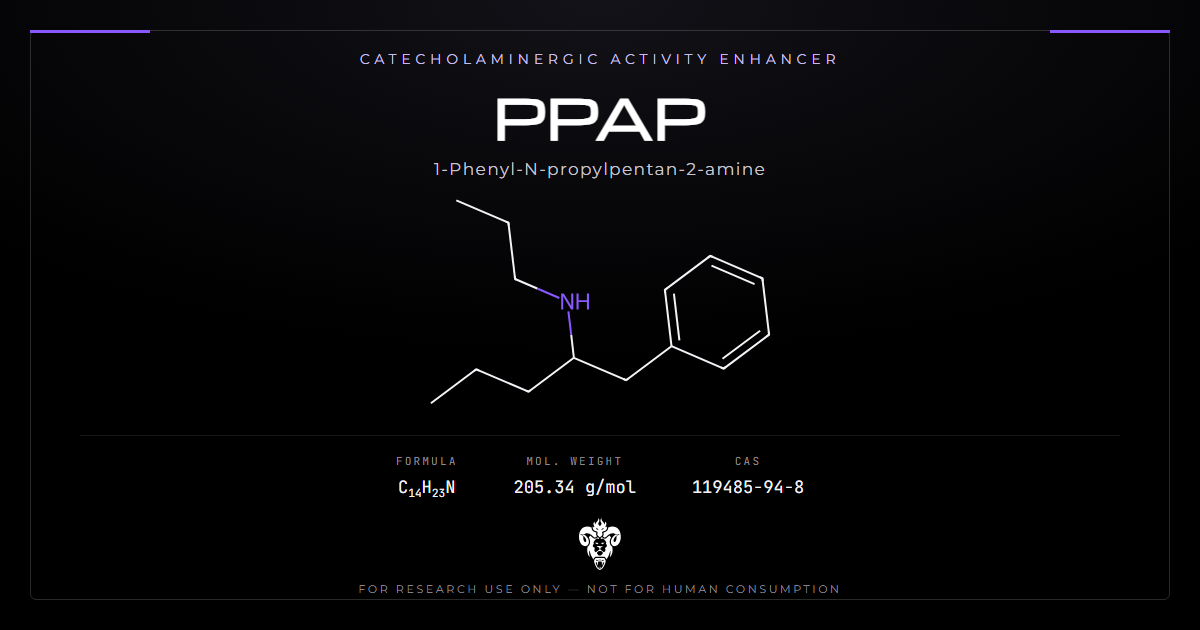
PPAP is a simple secondary amine built on an amphetamine skeleton.
| Property | Value |
|---|---|
| IUPAC name | 1-phenyl-N-propylpentan-2-amine |
| Literature name | 1-phenyl-2-propylaminopentane |
| Common abbreviation | PPAP |
| CAS | 119485-94-8 |
| Molecular formula | C14H23N |
| Molecular weight | 205.34 g/mol |
| PubChem CID | 10262369 |
| InChIKey | PBENSVGEGPJNFJ-UHFFFAOYSA-N |
| Stereocentres | One |
| Parent compound | Selegiline, and beyond it β-phenylethylamine |
An amphetamine skeleton, extended twice
The core is the phenylalkylamine arrangement shared by amphetamine and methamphetamine. A benzyl group sits on carbon 2 of a chain, with an amine on that carbon.
Two extensions distinguish PPAP. The chain runs to five carbons rather than three, and the amine carries an n-propyl group rather than hydrogen or methyl.
Those extensions do the pharmacological work. β-Phenylethylamine and its familiar synthetic derivatives, amphetamine and methamphetamine, all release catecholamines from storage sites [5]. Selegiline stands out as a synthetic derivative of that parent lacking the releasing property [8]. PPAP follows the same design logic.
The absence of a propargylamine group is the second key structural point. That group is what confers irreversible MAO-B inhibition on selegiline. PPAP carries a propyl group in its place, which is sterically similar and chemically inert toward the enzyme.
Stereochemistry
The carbon bearing the amine is a stereocentre, so PPAP exists as two enantiomers. Most of the pharmacology literature works with the (-) form, written (-)PPAP.
The stereochemical picture is not entirely tidy, and a later section explains why.
What an activity enhancer is
The category matters because it is easy to confuse with two better-known mechanisms.
Enhancer against releaser
A releasing agent displaces transmitter from vesicular stores into the cytoplasm and then out through the transporter, producing transmitter efflux that does not depend on neuronal firing. Amphetamine works this way.
An activity enhancer does something different. It increases the amount of transmitter released per nerve impulse, strengthening the coupling between an action potential arriving at the terminal and the exocytotic event that follows [1].
The distinction has a clean experimental signature. A releaser raises extracellular transmitter in quiescent tissue. An enhancer does little there, and instead amplifies the response to stimulation.
This also explains why the effect went undetected for so long. Miklya notes that the releasing effect conceals the enhancer effect. The latter stayed hidden until a compound without releasing activity uncovered it [8].
Why a fourth mechanism was worth having
Conventional drugs acting on monoamine systems work through a short list of routes. They inhibit reuptake, inhibit intraneuronal metabolism, or increase release by blocking inhibitory autoreceptors [13]. Every antidepressant in clinical use at the time acted through one of those three [13].
An agent that instead raises transmitter released per impulse would represent a fourth route, and one that scales with existing neuronal firing rather than overriding it. That is the theoretical attraction of the enhancer concept, and it is why a compound demonstrating the mechanism mattered beyond its own modest pharmacology.
Work on the concept extended to physiological states rather than drugs alone. Miklya and colleagues measured transmitter release from discrete brain regions in food-deprived rats, reporting that orienting and searching behaviour rose with time since feeding, and that dopamine release from substantia nigra roughly doubled between sated animals and those deprived for 72 hours [6].
The endogenous enhancers
The framework proposes that this is a physiological regulatory mechanism with natural ligands rather than a drug artefact.
β-Phenylethylamine and tryptamine are the candidates. Knoll and colleagues characterised both as mixed-acting amines. They show an enhancer effect at low concentration, and a displacing effect only at higher concentration [5]. On an isolated rabbit ear artery, phenylethylamine enhanced stimulation-induced contractions in the 0.2 to 0.8 µg/mL range, while raising smooth muscle tone through displacement only at 4 to 6 µg/mL, and desipramine blocked the second effect but not the first [5].
Both compounds metabolise rapidly in vivo. That limits their usefulness as tools, and explains the interest in stable synthetic analogues [5].
The mechanism that MAO inhibition could not explain
Here is the logical structure of the argument, which is worth following carefully because it is the compound’s principal contribution.
Selegiline raised catecholaminergic activity in rat brain at very small subcutaneous doses, with threshold doses of 0.01 mg/kg for noradrenergic neurons and 0.025 mg/kg for dopaminergic neurons [1]. As an enhancer it proved roughly ten times more potent than its parent methamphetamine [1].
The obvious explanation was MAO-B inhibition. Testing it required a compound sharing the pharmacological profile but not the enzyme activity. PPAP is that compound.
Knoll and Miklya dosed rats subcutaneously for 21 days. The panel covered enantiomers of selegiline, p-fluorodeprenyl, PPAP, methamphetamine and amphetamine. They then measured transmitter release from freshly excised brain tissue by HPLC with electrochemical detection [3].
Selegiline enhanced dopamine release from striatum, substantia nigra and tuberculum olfactorium. It enhanced noradrenaline release from locus coeruleus, while diminishing serotonin release from raphe [3]. PPAP acted like selegiline [3].
The retrospective literature states the conclusion plainly. A selegiline analogue devoid of MAO-inhibitory property enhanced catecholaminergic activity in the same way, which showed the effect to be unrelated to selective MAO-B inhibition [8].
The exclusion experiments
Having ruled out the enzyme, Knoll and colleagues ruled out three further candidates in a single study [1].
What the effect is not
Three readouts featured. Catecholamine release from striatum, substantia nigra, tuberculum olfactorium and locus coeruleus. Stimulation-induced release of tritiated noradrenaline from isolated brain stem. And antagonism of tetrabenazine-induced learning depression in a shuttle box [1].
Four mechanisms failed to account for the results. The effect was unrelated to inhibition of MAO activity. It was unrelated to inhibition of presynaptic catecholamine receptors. It was unrelated to inhibition of catecholamine uptake. And it was unrelated to catecholamine release [1].
Excluding all four leaves the coupling step itself. The authors concluded that selegiline and PPAP act primarily on action-potential-to-transmitter-release coupling in brain catecholaminergic neurons [1].
The calcium observation
One further experiment pointed toward a mechanism. Both compounds enhanced the inward calcium current in sino-auricular fibres of the frog heart. PPAP proved substantially more potent there than either its own (+) enantiomer or selegiline [1].
Calcium influx is the immediate trigger for vesicle fusion. A compound acting on that current would change release per impulse without touching storage, uptake or metabolism.
The proposed molecular site
For most of this literature’s history the enhancer effect had no identified molecular target, which was its principal weakness.
Knoll and colleagues later proposed one. Their account attributes the mechanism to interaction with distinct sites on vesicular monoamine transporter 2. They argue this explains the characteristic concentration-effect curves seen across these compounds [9].
Bell-shaped curves are the signature
Those curves deserve attention from anyone designing an experiment, because they break a standard assumption.
Enhancer compounds show bimodal, bell-shaped concentration-effect relationships [9]. Activity rises to a peak at low concentration and then declines as concentration increases further. The pattern appeared early: phenylethylamine and tyramine enhanced calcium influx from 0.05 to 4 µg/mL and inhibited it at 8 µg/mL [5].
Two consequences follow. A dose-response experiment covering only high concentrations may find nothing, or find inhibition, and wrongly call the compound inactive. And a negative result at one concentration says nothing about activity two orders of magnitude lower.
The effective concentrations reported in this literature are strikingly low. BPAP, the successor compound, enhanced transmitter release from isolated discrete rat brain regions at 10-12 to 10-14 M [7].
The behavioural record
Two behavioural findings recur, and both use the same model.
Tetrabenazine antagonism
Tetrabenazine depletes vesicular monoamine stores and impairs learning performance. Antagonising that impairment is the standard functional assay in this literature.
PPAP antagonised tetrabenazine-induced depression of shuttle box performance [1]. That assay became the reference test for ranking later enhancer compounds. BPAP later came in at roughly 130 times the potency of selegiline in it [7].
Strain-dependent sensitivity
A second study produced a result worth knowing before designing any experiment with this compound.
Knoll and colleagues compared two Wistar-derived rat breeds with markedly different learning performance [2]. High-performing animals released significantly more noradrenaline from locus coeruleus and more serotonin from raphe. Dopamine release from three regions did not differ [2].
PPAP at 1 mg/kg fully antagonised tetrabenazine-induced learning depression in the high-performing rats. The same dose was ineffective in the low-performing ones [2].
That is a substantial confound. Baseline strain differences determined whether an effect appeared at all. A negative result in one supplier’s animals therefore does not generalise.
Developmental context
The same group reported a developmental window. Transmitter release from catecholaminergic and serotonergic neurons runs significantly higher between weaning and the end of the second month than either before or after [4]. Their broader framework treats the decline after that period as the substrate the enhancer compounds act on [8].
Longevity work in rats followed from that framework. One study reported differences in tumour manifestation rates between treated and saline groups [9]. Those are rat data. The authors presented them as grounds for further testing rather than as established, and no human evidence exists.
From PPAP to BPAP
PPAP was a stepping stone rather than an endpoint, and its successor is better characterised.
Knoll and colleagues changed the aromatic ring in the PPAP scaffold and synthesised 65 new compounds. From that series they selected a tryptamine-derived structure, BPAP, as the reference compound for further analysis of the enhancer mechanism [7].
BPAP is more potent and, unlike selegiline, acts strongly on serotonergic as well as catecholaminergic neurons [10]. Work on the successor compound has extended into neurotrophin signalling. Reports cover increased brain-derived neurotrophic factor and trkB expression in mesencephalic slice culture [12], and neuroprotection in dopaminergic cell lines [11].
For anyone choosing between them, the practical distinction is this. PPAP is the compound with historical and mechanistic significance as the MAO-independent control. BPAP is the compound with the deeper modern characterisation.
The stereochemical puzzle
One inconsistency in this literature deserves flagging rather than smoothing over.
In the frog heart calcium assay, (-)PPAP was much more potent than (+)PPAP [1]. The 21-day transmitter release study reported the opposite ordering, with the (+) enantiomers of both p-fluorodeprenyl and PPAP more active than the (-) forms [3].
Those two statements come from the same research group and are not obviously reconcilable. They may reflect genuinely different structure-activity relationships in different assays and species, or a difference in what each readout measures.
Related work on the BPAP series found stereochemistry determining which analogues stabilised mitochondrial membrane potential. Dextrorotatory compounds were active there, levorotatory ones inactive [11].
The practical implication is straightforward. Specify and verify which enantiomer is in hand, and do not assume the (-) form is more active in every readout.
Physicochemical properties and handling
PPAP is a lipophilic secondary amine with no other functional groups of consequence.
Basicity is the dominant property. The secondary amine will be protonated at physiological pH and forms salts readily with acids, which is how the compound is typically isolated and stored.
Confirm salt form before calculating molarity. The free base is 205.34 g/mol, and a hydrochloride salt adds 36.46, changing the molar content per gram by roughly 15 percent.
The molecule has no ester, no phenol and no easily oxidised centre, so it holds up under ordinary conditions. Amines do slowly oxidise on prolonged air exposure. Lipophilic amines also adsorb onto glass and plastic at low concentrations, which matters given the picomolar activity range reported for this class [7].
Store the solid sealed, dry, cold and dark.
Analytical characterisation
Four checks cover this compound.
Chiral purity is first in importance. One stereocentre, two enantiomers, documented differences in activity between them, and no mass-based method that can tell them apart.
Accurate mass confirms C14H23N at 205.34. The composition is simple, carrying a single nitrogen and no oxygen. That alone separates it from selegiline analogues retaining other functionality.
Proton NMR confirms the substitution pattern, specifically the n-propyl group on nitrogen and the pentyl chain length. Both are the features distinguishing PPAP from shorter amphetamine relatives.
Absence of a propargyl group deserves explicit confirmation. A terminal alkyne gives a characteristic NMR signal, and its absence is what separates PPAP from selegiline chemically.
What a rigorous certificate should contain
Enantiomeric purity, by a chiral method, with the enantiomer identified.
Accurate mass confirming the molecular formula.
Structural confirmation by NMR, establishing both the propyl substitution and the pentyl chain.
Salt form, stated explicitly.
Residual solvents from synthesis.
Kimera publishes third-party certificates of analysis for every lot in its COA database. Laboratories source PPAP as a reference enhancer compound, sometimes alongside Bromantane or Noopept. Related chemistry appears in the nootropics category.
Common misclassifications
Four errors recur.
PPAP is grouped with amphetamine as a releasing agent. The published work specifically excluded catecholamine release as its mechanism [1].
It is called a MAO inhibitor. It was designed to lack that activity, and that absence is its entire scientific point [3][8].
Its dose-response is assumed monotonic. Enhancer compounds show bell-shaped curves, active at low concentration and inactive or inhibitory at high [5][9].
Sources treat it as interchangeable with BPAP. Both belong to the same series. BPAP carries a different aromatic ring, greater potency, and a serotonergic component that selegiline-derived compounds lack [7][10].
Experimental design considerations
Work at low concentrations, and go lower than seems reasonable. The reported active range for this class extends into picomolar territory [7], and high-concentration screens will miss the effect entirely.
Use a stimulation-dependent readout. An enhancer amplifies release per impulse, so a resting-release measurement is the wrong assay [1].
Record the animal strain. Sensitivity differed enough between two Wistar-derived breeds that the same dose was fully effective in one and ineffective in the other [2].
Include a releaser comparator. Amphetamine or methamphetamine at matched conditions makes the enhancer-versus-releaser distinction measurable rather than assumed [5].
Specify the enantiomer, and verify it. Activity differences between enantiomers are documented and assay-dependent [1][3][11].
Account for adsorption. At picomolar working concentrations, surface losses are a real source of error.
Frequently asked questions
What is PPAP? 1-phenyl-2-propylaminopentane, CAS 119485-94-8, a selegiline analogue lacking MAO-inhibitory activity. Kimera supplies it as a laboratory research material.
Why does it matter scientifically? It demonstrated that the catecholaminergic activity enhancer effect of selegiline is unrelated to MAO-B inhibition [8].
How does an enhancer differ from a releaser? A releaser displaces stored transmitter independently of firing. An enhancer increases transmitter released per nerve impulse [1].
What is the proposed molecular site? Interaction with distinct sites on vesicular monoamine transporter 2, which the authors argue explains the bell-shaped concentration-effect curves [9].
Why are the dose-response curves bell-shaped? Activity peaks at low concentration and declines at higher concentration, a pattern documented across this compound class [5][9].
How does it compare with BPAP? BPAP came from the same programme, carries a benzofuran ring in place of the phenyl, is considerably more potent, and also acts on serotonergic neurons [7][10].
Is it approved anywhere? No. It is a research compound with no marketing approval and no published human trial.
Does it inhibit monoamine oxidase at all? No, and that is the point of the molecule. The propargyl group responsible for irreversible MAO-B inhibition in selegiline is replaced here by an inert propyl group.
Summary of the evidence
Identity: C14H23N, 205.34 g/mol, one stereocentre, a secondary amine on an extended amphetamine skeleton.
Design rationale: retain the pharmacological profile of selegiline while removing MAO-inhibitory activity [3][8].
Principal finding: catecholaminergic activity enhancement occurs without MAO inhibition, which established the enhancer effect as a separate mechanism [8].
Mechanism, negatively defined: not MAO inhibition, not presynaptic receptor blockade, not uptake inhibition, not transmitter release [1].
Mechanism, positively proposed: stimulation of action-potential-to-transmitter-release coupling [1], attributed to sites on vesicular monoamine transporter 2 [9].
Concentration behaviour: bimodal and bell-shaped, active at very low concentrations [5][7][9].
Behavioural record: antagonism of tetrabenazine-induced learning impairment, with efficacy dependent on rat strain [1][2].
Successor compound: BPAP, from a 65-compound series built on this scaffold, more potent and additionally serotonergic [7][10].
Human data: none published.
References
- Knoll J, Miklya I, Knoll B, Markó R, Kelemen K. (-)Deprenyl and (-)1-phenyl-2-propylaminopentane, [(-)PPAP], act primarily as potent stimulants of action potential-transmitter release coupling in the catecholaminergic neurons. Life Sci. 1996;58(10):817-827. PMID 8602114. DOI
- Knoll J, Knoll B, Miklya I. High performing rats are more sensitive toward catecholaminergic activity enhancer (CAE) compounds than their low performing peers. Life Sci. 1996;58(11):945-952. PMID 8786700. DOI
- Knoll J, Miklya I. Multiple, small dose administration of (-)deprenyl enhances catecholaminergic activity and diminishes serotoninergic activity in the brain and these effects are unrelated to MAO-B inhibition. Arch Int Pharmacodyn Ther. 1994;328(1):1-15. PMID 7893186
- Knoll J, Miklya I. Enhanced catecholaminergic and serotoninergic activity in rat brain from weaning to sexual maturity: rationale for prophylactic (-)deprenyl (selegiline) medication. Life Sci. 1995;56(8):611-620. PMID 7869839. DOI
- Knoll J, Miklya I, Knoll B, Markó R, Rácz D. Phenylethylamine and tyramine are mixed-acting sympathomimetic amines in the brain. Life Sci. 1996;58(23):2101-2114. PMID 8649195. DOI
- Miklya I, Knoll B, Knoll J. An HPLC tracing of the enhancer regulation in selected discrete brain areas of food-deprived rats. Life Sci. 2003;72(25):2923-2930. PMID 12697275. DOI
- Knoll J, Yoneda F, Knoll B, Ohde H, Miklya I. (-)1-(Benzofuran-2-yl)-2-propylaminopentane, [(-)BPAP], a selective enhancer of the impulse propagation mediated release of catecholamines and serotonin in the brain. Br J Pharmacol. 1999;128(8):1723-1732. PMID 10588928. DOI
- Miklya I. The significance of selegiline/(-)-deprenyl after 50 years in research and therapy (1965-2015). Mol Psychiatry. 2016;21(11):1499-1503. PMID 27480491. DOI
- Knoll J, Baghy K, Eckhardt S, et al. A longevity study with enhancer substances (selegiline, BPAP) detected an unknown tumor-manifestation-suppressing regulation in rat brain. Life Sci. 2017;182:57-64. PMID 28623006. DOI
- Gaszner P, Miklya I. Major depression and the synthetic enhancer substances, (-)-deprenyl and R-(-)-1-(benzofuran-2-yl)-2-propylaminopentane. Prog Neuropsychopharmacol Biol Psychiatry. 2006;30(1):5-14. PMID 16023777. DOI
- Maruyama W, Yi H, Takahashi T, et al. Neuroprotective function of R-(-)-1-(benzofuran-2-yl)-2-propylaminopentane, [R-(-)-BPAP], against apoptosis induced by N-methyl(R)salsolinol in human dopaminergic neuroblastoma SH-SY5Y cells. Life Sci. 2004;75(1):107-117. PMID 15102525. DOI
- Hirami C, Takahata K, Shimazu S, et al. Effects of R-(-)-BPAP on the expressions of neurotrophins and their receptors in mesencephalic slices. Biol Pharm Bull. 2005;28(8):1524-1526. PMID 16079507. DOI
- Elhwuegi AS. Central monoamines and their role in major depression. Prog Neuropsychopharmacol Biol Psychiatry. 2004;28(3):435-451. PMID 15093950. DOI
PPAP is sold for laboratory research use only. Not for human consumption, nor medical, veterinary, or household uses.
Literature retrieved from PubMed.