
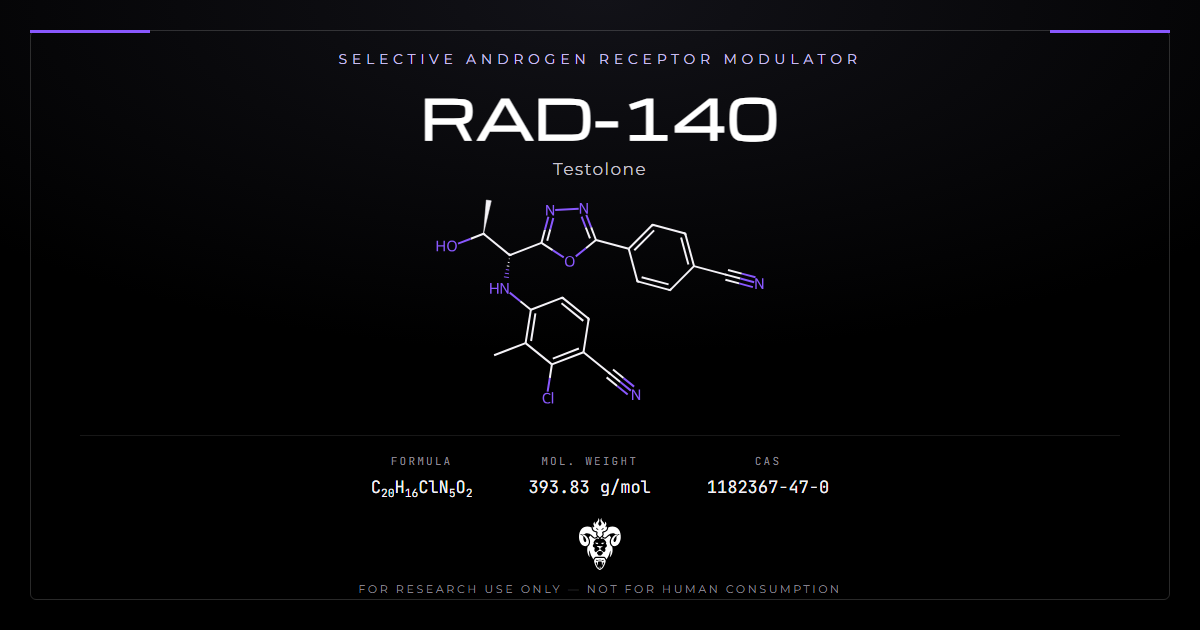
Two bodies of literature exist on RAD-140, and they point in different directions.
The first is a genuine preclinical programme from Radius Health. It reports neuroprotection in cultured neurons and lesioned rats [1]. It also reports growth inhibition across breast cancer xenograft models with a defined mechanism [2]. The compound even earned an international nonproprietary name, vosilasarm, which few compounds in this catalogue carry.
The second is a set of clinical case reports describing organ injury after self-administration. Three independent cardiac cases have appeared since 2022, one of them fatal [7][8][9]. A 2023 mouse study found the compound raised frailty status and mortality risk while failing to improve strength [6].
Both belong in any honest summary. Reading only one produces a badly distorted picture. What follows covers the chemistry, the receptor pharmacology, both literatures in detail, the detection work, and how to verify the material.
Chemical identity: what you are actually handling
RAD-140 is a non-steroidal oxadiazole carrying two nitrile groups.
| Property | Value |
|---|---|
| IUPAC name | 2-chloro-4-[[(1R,2S)-1-[5-(4-cyanophenyl)-1,3,4-oxadiazol-2-yl]-2-hydroxypropyl]amino]-3-methylbenzonitrile |
| INN | Vosilasarm |
| Common names | RAD-140, Testolone |
| CAS | 1182367-47-0 |
| Molecular formula | C20H16ClN5O2 |
| Molecular weight | 393.83 g/mol |
| PubChem CID | 44200882 |
| InChIKey | XMBUPPIEVAFYHO-KPZWWZAWSA-N |
| Stereocentres | Two, (1R,2S) |
| Chemical class | Phenyl-oxadiazole |
| Originator | Radius Health |
The oxadiazole class
Anti-doping chemists classify RAD-140 among the phenyl-oxadiazoles, a category distinct from the aryl propionamides such as ostarine, from the quinolinones such as LGD-3303, and from the tropanol derivatives [10].
That classification matters practically. Methods validated for one chemical class do not automatically transfer to another, and fragmentation behaviour differs between them.
The scaffold carries no steroid nucleus, which is the structural premise of the whole class. A molecule binding the androgen receptor without a steroid ring system cannot serve as a substrate for aromatase or 5α-reductase. It therefore converts to neither an oestrogen nor dihydrotestosterone.
Two stereocentres
The (1R,2S) configuration is defined. Diastereomers share the molecular formula and accurate mass exactly.
Chiral analysis is therefore a requirement rather than a refinement here, and the section on characterisation returns to it.
RAD-140 receptor pharmacology
RAD-140 binds the androgen receptor with high affinity and specificity [2]. It activated the receptor in breast cancer cells but not in prostate cancer cells, which is the tissue-selective behaviour the class is named for [2].
The mechanistic basis of that selectivity remains contested across the class. Two accounts compete. One invokes tissue-specific expression of 5α-reductase. Prostate amplifies testosterone to the more potent dihydrotestosterone while muscle does not, and a non-steroidal ligand receives no such amplification [11]. The other invokes ligand-induced receptor conformation, determining which coregulatory proteins the receptor recruits [12].
Neither account has been tested specifically for RAD-140.
The preclinical case
Two independent lines of work make a positive case for the compound, and both are more interesting than the muscle claims usually attached to it.
Neuroprotection
Jayaraman and colleagues investigated the compound in cultured rat neurons and in male rat brain. They asked whether it reproduced the neuroprotective actions of endogenous androgens [1].
In cultured hippocampal neurons, RAD-140 matched testosterone at reducing cell death induced by apoptotic insults [1]. Protection depended on MAPK signalling. Elevated ERK phosphorylation supported that, as did loss of protection when a MAPK kinase inhibitor was applied [1].
The in vivo work used the kainate lesion model in gonadectomised adult male rats. Three findings emerged together. Peripheral tissue-specific androgen action that largely spared prostate, activation of androgenic gene regulation in brain, and protection of hippocampal neurons against cell death caused by systemic kainate [1].
That is a coherent result: target engagement in brain, a defined signalling pathway, and protection in a lesion model, with prostate largely spared.
Breast cancer models
The second line is more developed and led to clinical interest.
Yu and colleagues evaluated RAD-140 in models of androgen-receptor-positive and oestrogen-receptor-positive breast cancer [2]. Oral administration substantially inhibited growth of patient-derived xenografts.
The mechanism reported is specific rather than generic. Treatment activated the androgen receptor while suppressing oestrogen receptor signalling, including repression of the ESR1 gene itself [2]. It also suppressed a subset of androgen-repressed genes associated with DNA replication. Combining the compound with the cell cycle inhibitor palbociclib appeared to enhance that effect [2].
Combination treatment showed improved efficacy over either agent alone across the xenograft models [2].
This is the strongest preclinical work on the compound, and its limits deserve stating. It is a xenograft study supporting further clinical investigation, not a clinical result.
Metabolism and detection
The doping-control literature is well developed for this compound, and it supplies the most practical analytical detail available.
Mass spectrometric characterisation
Thevis and colleagues characterised the compound under both electrospray and electron ionisation conditions. They synthesised reference material and elucidated its dissociation pathways [3].
They proposed diagnostic product ions at m/z 223 and 205 under electrospray tandem mass spectrometry, and at m/z 421 and 349 under electron ionisation [3]. The m/z 421 ion involves an unusual intramolecular migration of a trimethylsilyl residue. They corroborated that assignment across several analytical approaches [3].
Those numbers are directly usable for anyone building a method, and they provide an external reference point that supplier documentation cannot.
Equine metabolism and detection windows
So and colleagues studied biotransformation in horses. The work covered in vitro incubation with homogenised liver and in vivo administration to three retired Thoroughbred geldings [4].
Four in vitro pathways dominated: hydrolysis, hydroxylation, glucuronidation and sulfation [4]. Most identified metabolites appeared in post-administration urine.
The detection windows are the useful output. In hydrolysed urine, parent compound and its sulfate metabolite gave the longest detection at up to six days post-administration. In plasma, parent compound alone was detectable for up to thirteen days [4].
Most of the metabolites described in that work had never been reported previously [4].
Biomarker approaches
A further study took a different route. It applied label-free proteomics to plasma from castrated horses given the compound [5].
The resulting predictive model comprised 75 proteins and separated treated from control samples [5]. Upregulated proteins included androgen-regulated clusterin, several tied to inflammation, and one tied to erythropoiesis [5].
That approach detects the physiological signature of exposure rather than the molecule, which extends the detection window beyond what parent-compound measurement allows.
The safety literature
This is the part most often omitted, and it has grown considerably since 2022.
The animal finding
Brown and colleagues asked whether the compound would help against sarcopenia. They ran a ten-week supplementation study in young and adult female mice at 5 mg/kg [6].
Dorsiflexor muscles underwent repeated bouts of eccentric contractions, with torque measured before and after each bout. Frailty status and mortality risk served as health span measures [6].
The results ran against the hypothesis. Supplementation raised frailty status and mortality risk in both young and adult treated groups against controls [6]. Adaptive potential fell in young mice. Torque did not differ between groups after two to three weeks of recovery [6].
The authors concluded that long-term supplementation reduced indices of overall health and failed to improve strength, and that at that dose the compound may be more detrimental than beneficial for delaying sarcopenia [6].
Three cardiac case reports
Three independent groups have published cardiac cases associated with RAD-140 self-administration.
Padappayil and colleagues reported possible acute myocarditis in a young male who had self-medicated with the compound for bodybuilding. He presented with shortness of breath and pulmonary oedema [7].
Schwartzman and colleagues reported myopericarditis in a 16-year-old boy following the first dose [8]. Their paper notes that physically active young adults use these drugs widely, while the side effects, which can be life-threatening, remain poorly characterised [8].
Skorupski and colleagues reported heart failure attributed to abuse of the compound, with a fatal outcome [9].
How to weigh case reports
Case reports establish that something can happen. They cannot establish how often, and they cannot establish causation with the confidence a controlled study provides.
Three independent reports from three countries within roughly two years, on a compound with no approved use, still reads as a pattern rather than a coincidence. The case involving a first dose resists attribution to cumulative exposure [8].
Set alongside an animal study reporting raised mortality risk [6], the safety picture is not neutral. Describing this compound as well tolerated does not survive contact with the published record.
Reading the two literatures together
The reconciliation is less contradictory than it first appears.
Preclinical work used defined doses in controlled models, examining neuroprotection and tumour growth [1][2]. Case reports instead involve self-administration of material of unknown provenance, at unknown doses, often alongside other compounds [7][8][9].
Those are different exposures. A favourable xenograft result does not predict cardiac safety at unregulated doses, and a case report does not invalidate a xenograft result.
What follows for a laboratory is straightforward. The compound remains a legitimate research tool, with real preclinical support behind specific claims. Extending those claims to human use has no support, and the case literature shows why that extension is not harmless.
No SARM holds marketing approval in any jurisdiction, and reviews of pharmacotherapy for muscle wasting note that few agents in this space have met clinically relevant strength and function outcomes [14].
Where RAD-140 sits among SARMs
Placing the compound against its class members clarifies both its evidence base and its risk profile.
| Compound | Chemical class | Strongest evidence | Published human case reports |
|---|---|---|---|
| Enobosarm | Aryl propionamide | Randomised phase 2 and phase 3 programme | Trial safety data available |
| LGD-4033 | Pyrrolidinyl-benzonitrile | Preclinical and early clinical | Hepatotoxicity reports exist |
| LGD-3303 | Quinolinone | Preclinical only | None |
| AC-262536 | Tropanol | One pharmacology paper | None |
| RAD-140 | Phenyl-oxadiazole | Neuroprotection and oncology preclinical [1][2] | Three cardiac, one fatal [7][8][9] |
Two features of that table are worth drawing out.
RAD-140 has better mechanistic preclinical work behind it than most of the class, in domains unrelated to muscle. The neuroprotection and oncology programmes were serious efforts with defined signalling pathways, not opportunistic screening.
It also carries the heaviest published case-report burden of any compound in the table. That combination is unusual and probably reflects popularity rather than uniquely high toxicity, since a compound nobody takes generates no case reports. The point stands regardless of explanation: the reports exist, and they concern this compound specifically.
A laboratory choosing a full-agonist reference has alternatives, and the choice should account for both columns rather than the first alone.
Physicochemical properties and handling
The molecule carries two nitriles, an oxadiazole, a secondary aryl amine, a secondary alcohol and an aryl chloride.
None of these is strongly labile under ordinary storage. The oxadiazole ring resists hydrolysis at neutral pH, though strongly basic conditions can open it. The secondary alcohol is the most reactive handle, oxidising to the ketone under forcing conditions.
Two nitriles and a chlorine give the molecule a distinctive elemental composition and strong ultraviolet absorbance, which makes HPLC-UV detection straightforward.
Aqueous solubility is low. Dimethyl sulfoxide is the usual stock solvent. Store the solid sealed, dry, cold and dark.
Analytical characterisation
Four checks cover this compound, ranked by how much each changes what is in the vial.
Stereochemical purity comes first. Two defined centres mean diastereomers share formula and accurate mass, and only a chiral method reports the difference.
Accurate mass confirms C20H16ClN5O2 at 393.83. Five nitrogens with one chlorine is an unusual composition, and the chlorine isotope pattern gives an M+2 peak near one third of the molecular ion.
Fragmentation should match the published diagnostic ions, at m/z 223 and 205 under electrospray conditions [3]. Reference fragmentation data exists for this compound, which is not true of most in this catalogue.
Structural confirmation by NMR establishes the oxadiazole and the substitution pattern, distinguishing it from other SARM chemical classes [10].
What a rigorous certificate should contain
Chiral purity, by a stated method, with the value given.
Accurate mass with the chlorine isotope envelope shown.
Chromatographic purity with column and detection conditions.
Fragmentation data, ideally matched against the published diagnostic ions [3].
Residual solvents from synthesis.
Kimera publishes third-party certificates of analysis for every lot in its COA database. Laboratories source RAD-140 (Testolone) as a full-agonist reference, often alongside AC-262536 as a partial-agonist comparator or LGD-3303 from the quinolinone class. Related receptor chemistry appears in the SARMs category.
Regulatory and doping status
RAD-140 holds no marketing approval in any jurisdiction.
Anti-doping authorities classify SARMs as anabolic agents under section S1.2, prohibited at all times, in and out of competition [13]. Validated screening and confirmation methods cover the compound explicitly [10].
Athletes returning adverse findings have frequently blamed contaminated supplements. Forensic practice now includes testing supplements, hair and nail clippings to evaluate such claims [13].
Common misclassifications
Four errors recur.
Suppliers describe RAD-140 as well tolerated. Three cardiac case reports including a fatality now exist [7][8][9], alongside an animal study reporting raised mortality risk [6].
Copy presents its preclinical results as clinical. The neuroprotection and oncology work are cell culture and animal studies [1][2].
Marketing describes it as a muscle-building agent supported by the literature. The strongest published preclinical results concern neuroprotection and tumour growth inhibition, and the one long-term strength study found no improvement [1][2][6].
Summaries treat its stereochemistry as incidental. Two defined centres, diastereomers sharing accurate mass, and no mass-based way to tell them apart.
Experimental design considerations
Verify stereochemistry before use. This is the single check most likely to be missing and most likely to matter.
Match the published fragmentation. Diagnostic ions exist for this compound, which allows identity confirmation against an external standard rather than against supplier assertion [3].
Account for long plasma persistence. Parent compound remained detectable in equine plasma for up to thirteen days [4], so washout in crossover designs needs planning.
Include cardiac endpoints in any in vivo work. Given three published case reports, cardiac monitoring is a reasonable addition rather than an excess of caution [7][8][9].
Do not assume muscle benefit. The longest published strength study reported none, alongside increased frailty [6].
Specify the model system in any claim. Neuroprotection was shown in rat neurons and rat brain [1]; growth inhibition in breast cancer xenografts [2]. Neither transfers to the other.
Frequently asked questions
What is RAD-140? A non-steroidal phenyl-oxadiazole selective androgen receptor modulator from Radius Health, CAS 1182367-47-0, with the INN vosilasarm. Kimera supplies it as a laboratory research material.
What does the preclinical literature support? Neuroprotection in cultured neurons and lesioned rats [1], and growth inhibition in breast cancer xenograft models with suppression of oestrogen receptor signalling [2].
What does the safety literature show? Three published cardiac case reports following self-administration, one fatal [7][8][9], and an animal study reporting increased frailty and mortality risk [6].
Does it improve strength? The one long-term study measuring strength in mice found no improvement over ten weeks [6].
How long is it detectable? In horses, up to six days in hydrolysed urine and up to thirteen days in plasma [4].
Does it need a chiral method? Yes. Two defined stereocentres, and diastereomers share formula and accurate mass.
Is it approved anywhere? No, and it is prohibited in sport at all times [13].
What does the name vosilasarm signify? It is the international nonproprietary name, assigned to compounds entering serious clinical development. Most compounds in this catalogue never receive one, and its presence reflects the oncology programme rather than any approval.
Why does it activate the receptor in breast cancer cells but not prostate cells? That tissue difference is the reported observation [2]. The mechanism behind it remains contested across the whole class, with tissue enzymology and coregulator recruitment both proposed and neither tested for this compound [11][12].
Can the case reports be dismissed as confounded by other substances? Partly, and that caveat is fair for self-administration cases generally. It sits less comfortably against the report of myopericarditis following a first dose [8], and against the independent animal finding of raised mortality risk [6].
Summary of the evidence
Identity: C20H16ClN5O2, 393.83 g/mol, phenyl-oxadiazole class, two defined stereocentres.
Receptor profile: high-affinity androgen receptor binding, activating the receptor in breast cancer cells but not prostate cancer cells [2].
Neuroprotection: equivalent to testosterone against apoptotic insult in cultured hippocampal neurons, MAPK-dependent, with in vivo protection in a kainate lesion model [1].
Oncology: growth inhibition across androgen and oestrogen receptor positive breast cancer xenografts, with ESR1 repression and additive effect alongside palbociclib [2].
Detection: diagnostic fragmentation published [3], equine metabolism characterised with six-day urine and thirteen-day plasma windows [4], and a proteomic biomarker model developed [5].
Animal safety: increased frailty status and mortality risk, decreased adaptive potential in young animals, no strength gain across ten weeks [6].
Human case literature: acute myocarditis [7], myopericarditis after a first dose in a 16-year-old [8], and fatal heart failure [9].
Status: no approval anywhere, prohibited in sport under section S1.2 [13].
References
- Jayaraman A, Christensen A, Moser VA, et al. Selective androgen receptor modulator RAD140 is neuroprotective in cultured neurons and kainate-lesioned male rats. Endocrinology. 2014;155(4):1398-1406. PMID 24428527. DOI
- Yu Z, He S, Wang D, et al. Selective androgen receptor modulator RAD140 inhibits the growth of androgen/estrogen receptor-positive breast cancer models with a distinct mechanism of action. Clin Cancer Res. 2017;23(24):7608-7620. PMID 28974548. DOI
- Thevis M, Piper T, Beuck S, Geyer H, Schänzer W. Expanding sports drug testing assays: mass spectrometric characterization of the selective androgen receptor modulator drug candidates RAD140 and ACP-105. Rapid Commun Mass Spectrom. 2013;27(11):1173-1182. PMID 23650030. DOI
- So YM, Wong JKY, Choi TLS, et al. Metabolic studies of selective androgen receptor modulators RAD140 and S-23 in horses. Drug Test Anal. 2021;13(2):318-337. PMID 32853476. DOI
- Cheung HW, Wong KS, To NS, et al. Label-free proteomics for discovering biomarker candidates of RAD140 administration to castrated horses. Drug Test Anal. 2021;13(5):1034-1047. PMID 33277807. DOI
- Brown AM, Ganjayi MS, Baumann CW. RAD140 (Testolone) negatively impacts skeletal muscle adaptation, frailty status and mortality risk in female mice. Clin Exp Pharmacol Physiol. 2023;50(12):973-983. PMID 37758180. DOI
- Padappayil RP, Chandini Arjun A, Vivar Acosta J, Ghali W, Mughal MS. Acute myocarditis from the use of selective androgen receptor modulator (SARM) RAD-140 (Testolone). Cureus. 2022;14(1):e21663. PMID 35233331. DOI
- Schwartzman KH, Kohli U, Chaudhuri NR, Hoda M. Myopericarditis following use of selective androgen receptor modifier “RAD-140”. JACC Case Rep. 2024;29(15):102423. PMID 39157568. DOI
- Skorupski WJ, Marko A, Janus M, et al. Selective androgen receptor modulator abuse-induced heart failure: catastrophic effects of RAD-140 (Testolone). Pol Arch Intern Med. 2024;134(7-8):16770. PMID 38864168. DOI
- Stacchini C, Botrè F, Comunità F, et al. Simultaneous detection of different chemical classes of selective androgen receptor modulators in urine by liquid chromatography-mass spectrometry-based techniques. J Pharm Biomed Anal. 2021;195:113849. PMID 33383501. DOI
- Gao W, Dalton JT. Ockham’s razor and selective androgen receptor modulators (SARMs): are we overlooking the role of 5alpha-reductase? Mol Interv. 2007;7(1):10-13. PMID 17339601. DOI
- Zhang X, Sui Z. Deciphering the selective androgen receptor modulators paradigm. Expert Opin Drug Discov. 2013;8(2):191-218. PMID 23231475. DOI
- Kintz P. The forensic response after an adverse analytical finding (doping) involving a selective androgen receptor modulator (SARM) in human athlete. J Pharm Biomed Anal. 2022;207:114433. PMID 34715583. DOI
- Hardee JP, Lynch GS. Current pharmacotherapies for sarcopenia. Expert Opin Pharmacother. 2019;20(13):1645-1657. PMID 31120352. DOI
RAD-140 is sold for laboratory research use only. Not for human consumption, nor medical, veterinary, or household uses.
Literature retrieved from PubMed.