
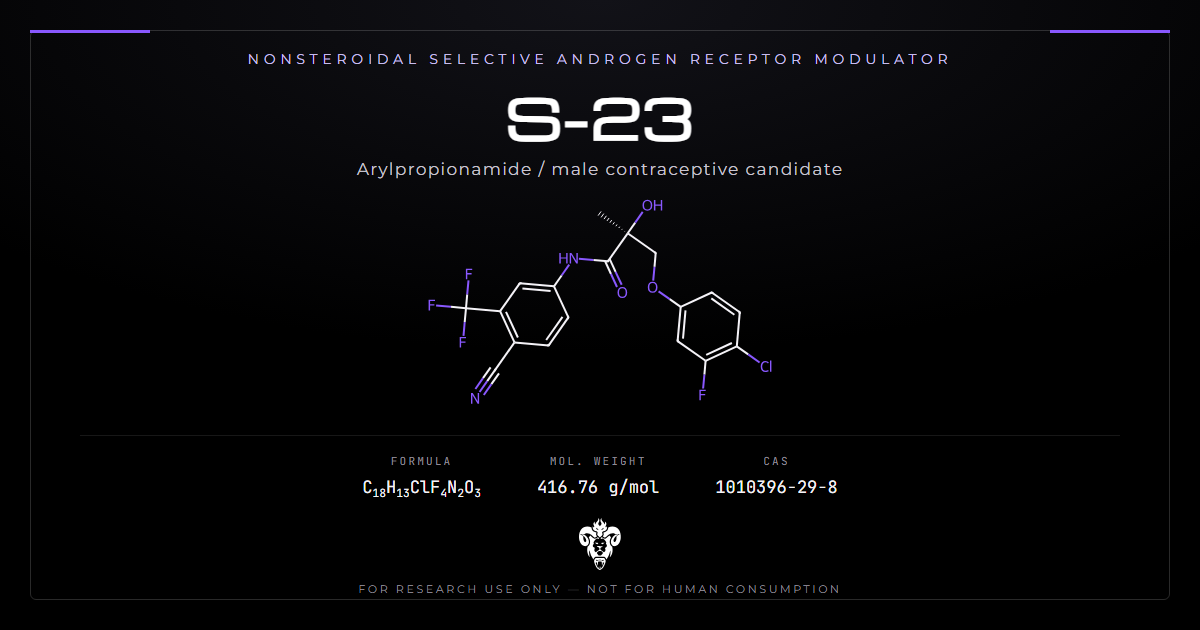
Every selective androgen receptor modulator suppresses gonadotropins. The rest of the class reports that suppression as an unwanted consequence, buried in a safety section.
S-23 is the compound where it was the point. Its single published characterisation is a male contraception study. The endpoint was whether treated rats could still father litters [4].
Three things follow. The suppression data are the efficacy data, not a safety footnote. The compound has one paper and everything else is read-across. And the vendor name attached to it does not appear in any chemical database.
Chemical identity
| Property | Value |
|---|---|
| Common names | S-23, S 23 |
| Molecular formula | C18H13ClF4N2O3 |
| Molecular weight | 416.75 g/mol |
| CAS | 1010396-29-8 |
| PubChem CID | 24892822 |
| InChIKey | SSFVOEAXHZGTRJ-KRWDZBQOSA-N |
| Class | Nonsteroidal arylpropionamide |
| Configuration | (2S) |
| AR binding | Ki 1.7 plus or minus 0.2 nM |
The catalogue carries it as S-23.
The name that is not a name
S-23 is sometimes sold as “Mastorin”. That name resolves to nothing in PubChem, appears in no synonym list for this CAS number, and appears in no indexed publication.
It is a trade name applied downstream of the chemistry rather than a designation from the people who made the compound. Three identifiers will match a certificate: the catalogue code, the CAS number and the InChIKey. Treat anything else as marketing.
Reading the structure
The scaffold is the same arylpropionamide the whole first generation used. One aromatic ring carries a nitrile and a trifluoromethyl group. The other carries chlorine and fluorine, joined through an ether.
Compare that with its relatives. Andarine puts a nitro group and an acetamide where this compound puts a chloro-fluoro pair. Ostarine puts a nitrile and a hydroxyl-bearing phenyl. Three compounds, one skeleton, three substitution patterns [2][4].
The binding affinity that came out of it is the tightest of the group at 1.7 nM [4], against roughly 4 nM for andarine and 3.8 nM for ostarine.
The one study
Jones and colleagues characterised S-23 in male rats as a model of hormonal male contraception [4]. Everything below comes from that paper. Nothing else in the indexed literature characterises this compound.
Tissue selectivity, measured as ED50
In castrated male rats the half-maximal effective dose in prostate was 0.43 mg/day. In levator ani muscle it was 0.079 mg/day.
That is a 5.4-fold separation in favour of muscle, expressed as a dose rather than an organ weight percentage. Stating selectivity that way beats what most of the class manages. It yields a number that compares across compounds directly.
The compound was a full agonist in vitro, not a partial one.
Suppression as the intended effect
In intact male rats treated for 14 days, S-23 alone suppressed luteinising hormone by more than 50% at doses above 0.1 mg/day. Prostate size fell. Levator ani size rose.
Read that sentence again against the rest of the class. Ligandrol’s trial reported dose-dependent testosterone and gonadotropin suppression as a safety finding [12]. Andarine’s selectivity paper reported the same thing as a complication [2]. Here it is the mechanism under demonstration.
The contraceptive result
The main experiment ran up to 10 weeks in intact males, combining S-23 with estradiol benzoate. Rats require that oestrogen to maintain sexual behaviour. On its own it had no effect on spermatogenesis.
In the group receiving estradiol benzoate plus S-23 at 0.1 mg/day, four of six animals had no sperm in the testis at all, and mating trials produced zero pregnancies from six attempts.
Reversibility was complete. After treatment stopped, a 100% pregnancy rate returned following 100 days of recovery.
The body composition finding, stated last
The same paper reports that S-23 increased bone mineral density and lean mass while reducing fat mass, dose-dependently.
That sentence is the one the compound is now sold on. In its source it arrives after the contraception data, as supporting evidence that the molecule is tissue-selective. The ordering matters. A compound optimised to shut down the axis also builds muscle, and both effects come from the same receptor occupancy.
What one paper cannot tell you
| Question | Status for S-23 |
|---|---|
| Human pharmacokinetics | None published |
| Human efficacy | None published |
| Human safety | None published |
| Species beyond rat | None published |
| Metabolite map | None published for this compound |
| Long-term dosing | 10 weeks maximum, in rats |
| Reversal in any species but rat | Not established |
Compare that table with what exists for the compounds beside it. Andarine has pharmacokinetics in rats and dogs and a mapped metabolism [1][3]. Ostarine has phase 3 trials. Ligandrol has a randomised human trial [12].
S-23 has one preclinical paper from 2008 and nothing since. Any statement about how it behaves in a person is inference from rodent data on a related scaffold. That kind of inference is exactly what read-across gets wrong.
Why one paper is a harder problem than it looks
A thin literature is not simply less evidence. It changes what the evidence can be used for, and this compound illustrates the difference well.
A single study cannot be checked
Replication is what converts a result into a finding. With one paper there is nobody to disagree with the effect size, the model choice or the analysis, so every number here rests on one laboratory’s execution.
That laboratory is the Ohio State group behind most of the first-generation work [1][2][3][4], and their other compounds have held up in outside hands. Reputation is a reason to take a result seriously, and it is not the same as independent confirmation.
Dose translation has no anchor
The contraceptive effect appeared at 0.1 mg per day in a rat. Converting that to any other species needs either allometric scaling or a pharmacokinetic bridge, and neither exists for this molecule.
Andarine and ligandrol both have measured pharmacokinetics that would support such a bridge [1][12]. S-23 has a sentence describing its properties as favourable and no dataset behind it [4].
Absence of harm reports is not safety data
Nothing in the indexed literature reports adverse effects for this compound, because nothing in the indexed literature reports anything beyond that one study. Ligandrol and ostarine both have case reports of liver injury, and those exist because people took them in numbers and clinicians wrote the cases up.
A compound with no case reports has either caused no problems or has not been examined. Distinguishing between those requires exposure data nobody has collected, and treating silence as reassurance inverts the evidence.
What would change the picture
Three things would move this compound out of its current position. A published metabolite map would make long-term detection possible and would tell a laboratory what to look for. Pharmacokinetics in a second species would anchor dose translation. And any independent replication of the contraceptive result would convert one paper into a finding.
None of the three requires a clinical trial. All three are ordinary preclinical work, and none has been published in seventeen years.
Where the class context helps, and where it stops
The arylpropionamide scaffold is well characterised as a family, and some of that transfers.
What probably transfers
Kearbey and colleagues established rat pharmacokinetics for the scaffold [1]. Half-lives ran 2.6 to 5.3 hours with complete oral bioavailability at lower doses. Perera and colleagues then mapped metabolism across rats and dogs, finding hepatic elimination through both phase I and phase II routes [3].
Jones and colleagues describe S-23 as having favourable pharmacokinetic properties [4], which is consistent with the scaffold but is not a published dataset for this molecule.
What does not transfer
Substituents change everything downstream of binding. Andarine’s nitro group is reduced in both species studied [3]. S-23 has no nitro group to reduce, and its chlorine and fluorine substituents create metabolic possibilities the other compounds lack.
So the family metabolism work indicates which enzyme systems to examine, not which metabolites to expect. Anyone building an analytical method here is extrapolating.
The human comparator that does exist
S-23 has no human data, and hormonal male contraception does. Reading the two together is the honest way to frame what the rat result would need to become.
The WHO injectable trial
Behre and colleagues ran a multicentre study in 320 healthy men and their partners [6]. Treatment was intramuscular norethisterone enanthate with testosterone undecanoate every eight weeks.
Suppression worked. Within 24 weeks, 95.9 per 100 continuing users reached a sperm concentration at or below 1 million per mL. Four pregnancies then occurred among the partners of 266 men across up to 56 weeks, a rate of 1.57 per 100 continuing users. Cumulative reversibility reached 94.8 per 100 after 52 weeks of recovery.
The trial was terminated early on the recommendation of an external safety review committee. Mood disorders were relatively frequent, alongside acne, injection site pain and increased libido.
That is the benchmark. A regimen that suppressed effectively and reversed reliably still stopped early on tolerability. Any oral candidate would have to clear that bar.
Where the field went instead
Wang and colleagues review the state of hormonal male contraception [10]. Combinations sit in late-phase trials, holding the promise of the first new reversible male method in over half a century.
Bania and colleagues survey the current candidates [11]. The list runs dimethandrolone undecanoate, 11-beta-methyl-19-nortestosterone dodecylcarbonate, MENT, and a segesterone acetate plus testosterone gel. Oral DMAU, 11-beta-MNTDC and the Nestorone gel are named as most promising.
No selective androgen receptor modulator appears among them. The approach S-23 was built to demonstrate has not carried into the clinical candidates now in late-phase development. The published record does not explain why.
What the compound tells you about the class
Setting S-23 beside its relatives makes one point about selective androgen receptor modulators that the individual articles bury.
The same molecule does both jobs
Ligandrol, andarine and ostarine all suppress gonadotropins, and all three literatures treat that as a cost of the anabolic effect [2][12]. This compound demonstrates that the cost and the benefit are not separable, because a research group deliberately optimising for suppression arrived at a molecule that also increased lean mass and bone density [4].
Receptor occupancy in muscle and receptor occupancy in the pituitary come from the same drug in the same bloodstream. Tissue selectivity distinguishes muscle from prostate, which is a real and measured achievement. It has never distinguished muscle from the hypothalamic-pituitary axis, and no compound in the class claims that it does.
Selectivity numbers are comparable, and rarely compared
The ED50 framing used here gives 0.43 mg/day in prostate against 0.079 in levator ani [4]. Andarine’s paper reports organ weights as percentages of intact control instead [2]. Ostarine and ligandrol report neither.
Four compounds, four ways of expressing the same property. Anyone comparing selectivity across the class is comparing different measurements, and the only honest cross-compound statement is that all four separate muscle from prostate to some degree in castrated rodents.
Why the first generation stalled together
Andarine did not advance. This compound did not advance. Ostarine reached phase 3 and did not gain approval, and ligandrol has one three-week trial [12]. The whole first-generation arylpropionamide series produced one clinical programme between four compounds.
That is a pattern rather than four separate stories, and the published record explains none of it. What the record does show is a scaffold that worked reliably in castrated rodents and translated into human approval nowhere.
Detection and supply
Where it sits in testing
SARMs joined the prohibited list in 2008, the same year the S-23 paper published. Thevis and Schänzer review detection across the class [7]. They name ACP-105, BMS-564929, GLPG0492, LG-121071, LGD-2226, ligandrol, ostarine, RAD-140 and S-40503 among the compounds methods were built for.
S-23 is not on that list. Absence from a detection review does not mean a compound evades detection, since screening covers the scaffold. It does mean no dedicated metabolite targets were published for it at that point.
The scaffold is quantifiable
Temerdashev and colleagues published a method covering arylpropionamide SARMs [8]. Detection limits reached 0.05 ng/mL with linearity from 0.25 to 50 ng/mL. Kintz and colleagues extended the class into hair analysis [9].
Both methods target the shared scaffold, so a compound like this one falls within reach. Missing is the compound-specific metabolite work that turns a parent-drug method into a long-term detection window.
Supply chain
Krug and colleagues analysed 337 seized black market products and identified 67 active ingredients, 49 of them prohibited [5]. SARMs appeared among the outstanding findings.
The general lesson applies here with more force than usual. This compound has one paper and no widely circulated analytical reference material. A certificate naming the InChIKey therefore does more work than one naming a trade name.
How to read an S-23 study
Five questions, and for this compound the first one usually ends the discussion.
Is there a second source?
There is one indexed characterisation [4]. Any claim citing multiple studies for this compound is citing studies of relatives.
Was the oestrogen included?
The contraceptive result required estradiol benzoate alongside, because rats need it to maintain sexual behaviour [4]. Suppression figures for S-23 alone come from the shorter 14-day arm rather than the 10-week contraception arm.
Which dose, in which units?
The effective contraceptive dose was 0.1 mg per day in a rat. Converting rodent daily doses to any other species requires an allometric argument the paper does not make.
Is suppression being reported as harm or as effect?
In this compound’s own literature it is the effect. Anywhere else in the class it is reported as harm. Same measurement, opposite framing, and the framing depends entirely on what the study set out to do.
Is the endpoint fertility or a proxy?
Sperm concentration, testis histology and hormone levels are all proxies for the thing that matters. This paper ran mating trials and counted pregnancies [4], which is why its result carries more weight than a suppression figure alone would.
Most of the male contraception literature reports the proxy, because mating trials are impossible in people. The rodent study can do what the human trial cannot, and the human trial can do what the rodent study cannot, which is why neither replaces the other.
Does the certificate name the compound or the brand?
“Mastorin” is not in any chemical database. Verification runs through CAS 1010396-29-8 and InChIKey SSFVOEAXHZGTRJ-KRWDZBQOSA-N.
Verifying research material
The compound is a defined single stereoisomer with an unusual halogen pattern, which makes it straightforward to confirm. Batch documentation sits on the certificates of analysis page.
Identity
Formula C18H13ClF4N2O3, molecular weight 416.75, CAS 1010396-29-8, InChIKey SSFVOEAXHZGTRJ-KRWDZBQOSA-N.
The single chlorine gives a diagnostic isotope pattern in mass spectrometry, with the M+2 peak at roughly a third the height of the molecular ion. Neither andarine nor ostarine contains chlorine, so that check is available here and not for them.
Stereochemistry
The KRWDZBQOSA block encodes the (2S) configuration. Mass spectrometry cannot see it, and the chlorine isotope check does not address it. Chiral chromatography against a characterised reference answers the question. A certificate reporting purity alone has not.
Handling and the missing reference
No compound-specific metabolite standards are published, so a laboratory quantifying this molecule works against parent-drug reference material only. Establish the response factor against a certified standard before quoting concentrations. Treat any long-term detection claim as unvalidated.
Common questions about S-23
How much research exists? One indexed paper characterises this compound [4]. Everything else is class-level work on the shared scaffold.
Was it developed as a muscle drug? No. It was characterised as a candidate for oral male contraception, and the body composition data appear in that paper as supporting evidence [4].
Does it suppress testosterone? Suppression is what it was optimised to do. In intact rats, luteinising hormone fell by more than 50% at doses above 0.1 mg per day [4].
Was the effect reversible? In rats, completely. A 100% pregnancy rate returned after 100 days of recovery [4].
Is it stronger than the others? Its binding affinity is tighter at 1.7 nM [4]. Binding affinity is not potency in tissue and it is certainly not effect size in a person.
What else does the catalogue carry? Andarine, Ostarine and LGD-4033 share the same receptor and have deeper literatures.
Summary of the evidence
Strongest evidence is a single well-constructed rat study [4]. Its endpoint was mating trials rather than a surrogate. It quantified ED50 values separating muscle from prostate, and it demonstrated full reversibility.
Weakest evidence: everything else. No human data, no second species, no published metabolism, no analytical reference beyond the scaffold, and no compound-specific detection targets in the class reviews [7].
One standing reading question follows. Anyone citing S-23 for a body-composition claim is citing a paragraph that sits at the end of a contraception study, and the same receptor occupancy produced both results.
Read plainly, S-23 is a compound with one good paper that was about something other than what it now sells for. More of this literature sits in the SARMs category.
Status: supplied for laboratory research use only.
References
- Kearbey JD, Wu D, Gao W, Miller DD, Dalton JT. Pharmacokinetics of S-3-(4-acetylamino-phenoxy)-2-hydroxy-2-methyl-N-(4-nitro-3-trifluoromethyl-phenyl)-propionamide in rats, a non-steroidal selective androgen receptor modulator. Xenobiotica. 2004;34(3):273-280. PMID 15204699. DOI
- Gao W, Reiser PJ, Coss CC, Phelps MA, Kearbey JD, Miller DD, Dalton JT. Selective androgen receptor modulator treatment improves muscle strength and body composition and prevents bone loss in orchidectomized rats. Endocrinology. 2005;146(11):4887-4897. PMID 16099859. DOI
- Perera MA, Yin D, Wu D, Chan KK, Miller DD, Dalton J. In vivo metabolism and final disposition of a novel nonsteroidal androgen in rats and dogs. Drug Metab Dispos. 2006;34(10):1713-1721. PMID 16815963. DOI
- Jones A, Chen J, Hwang DJ, Miller DD, Dalton JT. Preclinical characterization of a (S)-N-(4-cyano-3-trifluoromethyl-phenyl)-3-(3-fluoro, 4-chlorophenoxy)-2-hydroxy-2-methyl-propanamide: a selective androgen receptor modulator for hormonal male contraception. Endocrinology. 2009;150(1):385-395. PMID 18772237. DOI
- Krug O, Thomas A, Walpurgis K, Piper T, Sigmund G, Schänzer W, Laussmann T, Thevis M. Identification of black market products and potential doping agents in Germany 2010-2013. Eur J Clin Pharmacol. 2014;70(11):1303-1311. PMID 25168622. DOI
- Behre HM, Zitzmann M, Anderson RA, Handelsman DJ, Lestari SW, McLachlan RI, Meriggiola MC, Misro MM, Noe G, Wu FCW, Festin MPR, Habib NA, Vogelsong KM, Callahan MM, Linton KA, Colvard DS. Efficacy and safety of an injectable combination hormonal contraceptive for men. J Clin Endocrinol Metab. 2016;101(12):4779-4788. PMID 27788052. DOI
- Thevis M, Schänzer W. Detection of SARMs in doping control analysis. Mol Cell Endocrinol. 2017;464:34-45. PMID 28137616. DOI
- Temerdashev A, Dmitrieva E, Azaryan A, Gashimova E. A novel approach to the quantification of urinary aryl-propionamide-derived SARMs by UHPLC-MS/MS. Biomed Chromatogr. 2020;34(1):e4700. PMID 31734960. DOI
- Kintz P, Gheddar L, Ameline A, Raul JS. Perspectives in evaluating selective androgen receptor modulators in human hair: a short communication. Ther Drug Monit. 2021;43(2):298-300. PMID 33337588. DOI
- Wang C, Meriggiola MC, Behre HM, Page ST. Hormonal male contraception. Andrology. 2024;12(7):1551-1557. PMID 39016284. DOI
- Bania J, Wrona J, Fudali K, Stęga F, Rębisz PF, Murawski M. Male hormonal contraception: current stage of knowledge. J Clin Med. 2025;14(7):2188. PMID 40217642. DOI
- Basaria S, Collins L, Dillon EL, Orwoll K, Storer TW, Miciek R, Ulloor J, Zhang A, Eder R, Zientek H, Gordon G, Kazmi S, Sheffield-Moore M, Bhasin S. The safety, pharmacokinetics, and effects of LGD-4033, a novel nonsteroidal oral, selective androgen receptor modulator, in healthy young men. J Gerontol A Biol Sci Med Sci. 2013;68(1):87-95. PMID 22459616. DOI
S-23 is sold for laboratory research use only. Not for human consumption, nor medical, veterinary, or household uses.
Literature retrieved from PubMed.