
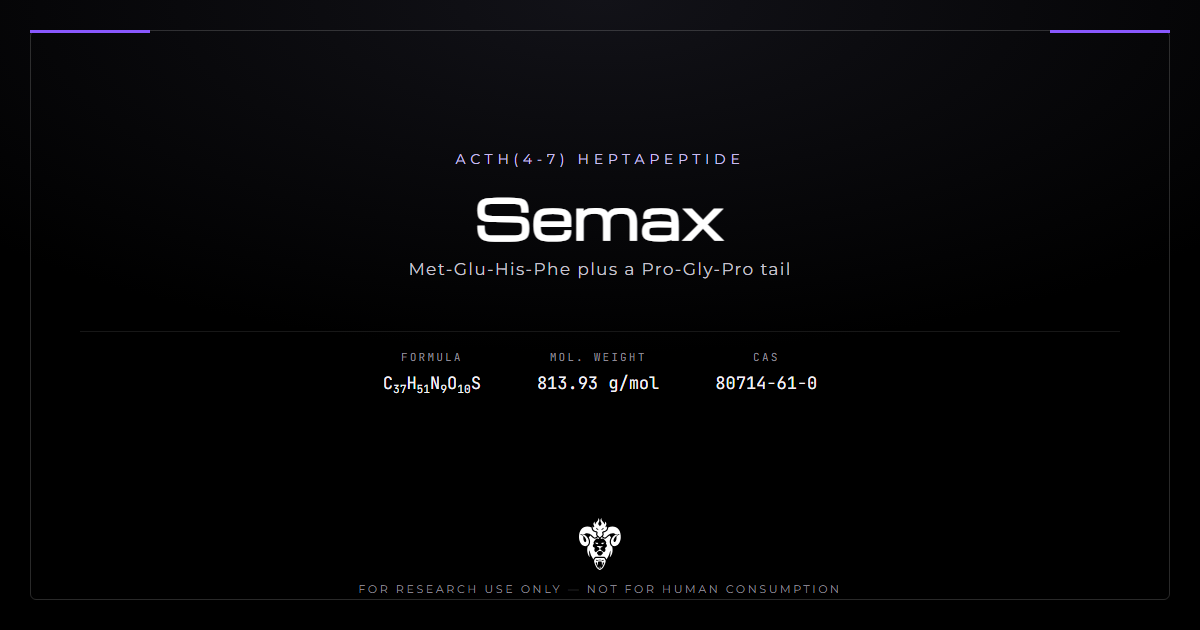
Semax is four residues of adrenocorticotropic hormone with a three-residue tail bolted on. The four residues carry the pharmacology. The tail, Pro-Gly-Pro, was added to slow enzymatic degradation.
Then Russian groups tested the tail by itself. Given alone after experimental stroke, Pro-Gly-Pro activated transcription of the same neurotrophins and receptors [1]. It increased proliferation of neuroglia, blood vessel endothelium and progenitor cells in the subventricular zone, matching the parent compound [2].
One thing separated them in that second study. Only Semax reduced the ischemic damage itself.
That is the shape of this compound’s evidence, and it is more interesting than the summaries suggest.
Chemical identity
Seven residues, and the sequence explains the naming confusion.
| Property | Value |
|---|---|
| Sequence | Met-Glu-His-Phe-Pro-Gly-Pro |
| Common names | Semax, ACTH(4-7)PGP, ACTH(4-10) analogue |
| Molecular formula | C37H51N9O10S |
| Molecular weight | 813.9 |
| CAS | 80714-61-0 |
| PubChem CID | 9811102 |
| InChIKey | AFEHBIGDWIGTEH-AQRCPPRCSA-N |
| Physical form | White lyophilised powder |
| Standard route in the literature | Intranasal |
The two names describe different things
Papers call it an ACTH(4-10) analogue. Papers also call it ACTH(4-7)PGP. Both names appear in the same laboratories’ output, sometimes in the same decade.
The second is the accurate one. Semax carries residues 4 through 7 of ACTH, which are Met-Glu-His-Phe. Residues 8 through 10 of ACTH are not present. Pro-Gly-Pro replaces them.
So “ACTH(4-10) analogue” describes what the molecule was modelled on. “ACTH(4-7)PGP” describes what it is. When you read the literature, treat them as one compound and prefer the second name when precision matters.
Why the tail was added
Short peptides do not last in serum. Aminopeptidases chew them from the N-terminus and other enzymes finish the job.
A 1993 inhibitor study measured which enzymes do the work [3]. Bestatin, an aminopeptidase inhibitor, blocked up to 66% of the total degrading activity in rat serum. Puromycin blocked around 33%, and the ACE inhibitor lisinopril around 15%. Neutral endopeptidase and prolyl endopeptidase were less clear.
Read the design of that study carefully. It measured ACTH(4-10) and Semax side by side, and aminopeptidases plus ACE accounted for most of the hydrolysis of both. The stabilising rationale for the tail is standard in the field, and this particular experiment did not isolate what the tail contributes.
How much reaches the brain
An earlier study injected tritiated Semax intravenously and looked for it in rat brain [4]. The peptide was detectable, and the brain-to-blood ratio exceeded what a vascular compartment alone would give. So it crosses.
The quantity is the number worth carrying: not exceeding 0.01% of the injected dose. That figure explains why intranasal administration became the standard route in this literature.
The tail is not inert
Pro-Gly-Pro belongs to a family called glyprolines, and that family has its own separate literature covering gastric protection, coagulation and stress responses. Anyone treating the tail as an inert protecting group is ignoring a body of work.
Two studies put the comparison directly.
| Study | What Semax did | What PGP alone did |
|---|---|---|
| Neurotrophin transcription after pMCAO [1] | Raised Bdnf, TrkC and TrkA at 3 h; Nt-3 and Ngf at 24 h; Ngf at 72 h | Raised Bdnf and TrkC at 3 h; Ngf, TrkB, TrkC and TrkA at 24 h |
| Brain morphology in global ischemia [2] | Activated the capillary network; raised proliferation of neuroglia, endothelium and subventricular progenitors; reduced ischemic damage to neurons | Activated the capillary network; raised the same proliferation measures; did not reduce ischemic damage |
The transcription profiles overlapped in part rather than matching. The morphology study found the two peptides producing similar changes in control animals, with the parent compound alone protecting against the ischemic insult.
What follows from that
A result showing Semax changes neurotrophin expression does not establish that the ACTH fragment did it. The tail is a candidate, and in the studies that checked, the tail accounted for a good share.
The discriminating endpoint so far is damage rather than gene expression. That is a narrow foundation, and it comes from one laboratory group.
The BDNF and trkB evidence
This is the mechanism most often quoted, and the numbers are modest and specific enough to be worth stating.
A single intranasal application at 50 micrograms per kilogram produced a 1.4-fold rise in hippocampal BDNF protein [5]. Phosphorylation of trkB rose 1.6-fold. Exon III BDNF mRNA rose 3-fold and trkB mRNA 2-fold. Treated rats showed more conditioned avoidance reactions.
A companion paper looked for binding sites [6]. Tritiated Semax bound to basal forebrain membranes in a way that was time-dependent, specific and reversible. The binding required calcium ions.
Nobody has named the receptor
Specific, reversible, calcium-dependent binding is what you would report before identifying a target. Two decades later the target remains unnamed in the published record. Glial cultures respond within minutes with neurotrophin mRNA induction [7], which is fast enough to imply a receptor rather than a slow metabolic route.
The transcriptome work points at the immune system
A genome-wide study of ischemic rat cortex asked what Semax changes rather than assuming it [8]. At 24 hours after permanent middle cerebral artery occlusion, genes related to immune function made up more than half of all the genes responding to the peptide.
That is a different emphasis from the neurotrophic account. Both come from the same institute.
One direction runs against expectation
Vascular endothelial growth factor promotes vessel regrowth, and it also drives inflammation and oedema in the early hours after ischemia. A study of Vegfa expression found Semax reducing Vegfa mRNA in the rat brain after carotid occlusion [9].
Lowering a growth factor is not the story a neurotrophic summary would predict. The authors read it through the oedema role rather than the regrowth role. Either way, the direction is worth knowing before quoting Semax as a straightforward growth-factor booster.
The clinical evidence comes from one country
Semax is registered in Russia and used there for ischemic stroke. No regulator outside Russia has approved it, and the clinical literature is Russian-language.
The most cited recent trial report followed 110 patients after ischemic stroke, 43 men and 67 women, mean age 58 [10]. Patients were divided into early rehabilitation at 89 days and late rehabilitation at 214 days, and each group was subdivided into treated and untreated. The regimen ran two courses of 6000 micrograms per day for 10 days with a 20-day interval. Endpoints were plasma BDNF, motor performance and the Barthel index.
How to weigh that
The design is a comparison of subgroups within a cohort. The report is in Russian with an English abstract. Whatever the result, an outside reader cannot audit the methods without the full text and the language.
This is not a claim that the work is wrong. It is a statement about what is checkable. A compound in clinical use for three decades in one country, with no registration trial anywhere else, sits in an unusual evidential position, and any summary that omits this is omitting the main thing.
The independent work is preclinical
Groups outside Russia have worked on Semax, which cuts against a simple “unreplicated” reading. What they have done is chemistry and animal work rather than clinical trials.
- A CNR group in Catania characterised copper(II) binding and found protection against metal-induced cell toxicity [11].
- The same group showed that acetylating the N-terminus changes both copper(II) and zinc(II) coordination and the biological properties that follow [12].
- A later paper from that line examined effects on copper-induced amyloid-beta aggregation [13].
- A group in Wenzhou reported that Semax acts on the mu opioid receptor gene Oprm1 to promote deubiquitination, with functional recovery after spinal cord injury in female mice [14].
Copper binding is a separate mechanism
The metal-binding line has nothing to do with BDNF or with ACTH receptors. Histidine at position 3 and the free N-terminal amine make a plausible copper site, and the acetylation result confirms the amine is part of it.
Whether copper chelation contributes to anything observed in vivo is untested. It belongs in the picture as a distinct chemistry rather than as support for the neurotrophic account.
Beyond stroke: the dopaminergic and behavioural work
Two Parkinson models from the same institute point different ways, and only one of them gets quoted.
The MPTP model, positive
Rats received a single intraperitoneal dose of the neurotoxin MPTP at 25 mg/kg [15]. That reduced movement activity and raised anxiety measures. Daily intranasal Semax at 0.2 mg/kg lessened the severity of both disturbances. The authors offered two candidate routes: a direct effect on the dopaminergic system, or the neurotrophic action.
The 6-OHDA model, mostly negative
A later study used 6-hydroxydopamine to damage dopaminergic neurons and tested Semax and Selank side by side [16]. Neither peptide changed motor activity in the elevated cross maze. Neither changed passive defensive behaviour. Selank alone reduced anxiety in the lesioned animals, and Semax did not.
Two toxin models, one institute, opposite outcomes on behaviour. The MPTP result circulates widely and the 6-OHDA result does not, which is a reason to go looking for the second kind of paper rather than the first.
Chronic stress
A 2024 paper tested Semax and Melanotan II in male rats under chronic unpredictable stress, and reports antidepressant-like and antistress effects for both [17]. The rationale is worth noting: both compounds are noncorticotropic analogues of the ACTH(4-10) fragment, and the hypothalamic-pituitary-adrenal axis is regulated in part by feedback that ACTH itself mediates. So the design tests whether a fragment stripped of corticotropic activity can still act on that loop.
Two experiments that would settle the interpretation
Neither is a recommendation. They are the gaps a reader should notice.
Repeat the damage comparison, powered, and elsewhere
Everything separating Semax from its own tail rests on one endpoint in one study, which its authors called a pilot [2]. Gene expression, capillary activation and progenitor proliferation did not distinguish them. Ischemic damage did. That single discriminator deserves a powered replication, and ideally one run outside the institute that developed the compound.
Identify the binding site
Specific, reversible, calcium-dependent binding in basal forebrain membranes has been on record since 2006 with no named receptor [6]. Photoaffinity labelling or an affinity pull-down would settle two questions at once: whether the effects run through a receptor at all, and whether Pro-Gly-Pro engages the same site. The second question is the one this compound’s evidence keeps running into.
What the studies actually used
Amounts are scattered across papers and species, so they are worth collecting.
| Study | Species and model | Route and amount |
|---|---|---|
| Potaman 1991 [4] | Rat, tracer study | Intravenous, tritiated; brain content not exceeding 0.01% of dose |
| Dolotov 2006 [5] | Rat, intact hippocampus | Intranasal, single dose, 50 micrograms per kilogram |
| Levitskaya 2004 [15] | Rat, MPTP lesion | Intranasal, daily, 0.2 milligrams per kilogram |
| Gusev 2018 [10] | Human, after ischemic stroke | Two 10-day courses at 6000 micrograms per day, 20 days apart |
Intranasal dosing dominates the animal work, which follows from the tracer result: an intravenous route delivers almost nothing to brain tissue.
Several key papers state no amount in the abstract
The two comparisons against Pro-Gly-Pro report their design and their outcome without a dose in the abstract [1][2]. So does the genome-wide transcriptome study [8]. Anyone building a picture of exposure across this literature needs the full texts, and the four entries above are what the abstracts support.
How to read a Semax study
Four questions separate what a given paper can support from what gets claimed for it.
Was PGP run as a comparator?
If not, the paper cannot tell you whether the ACTH fragment or the tail produced the effect. Several studies from the Moscow group did run it, and those are the informative ones [1][2][9].
Which endpoint?
Gene expression, protein level, cell proliferation and tissue damage are four different claims. The only endpoint that separated Semax from PGP so far is damage [2].
What route and species?
Intranasal in rats dominates. Intravenous entry to brain is around 0.01% of dose [4], so an intravenous result and an intranasal result are not interchangeable.
Is the source auditable?
For the clinical claims, check whether the report is a Russian-language article with an English abstract. That is not a dismissal. It is a limit on what a reader outside that language can verify.
Verifying research material
Two checks matter more than purity for this compound, and both come from its chemistry.
Methionine oxidation
Position 1 is methionine, and an N-terminal methionine oxidises readily. The sulfoxide adds 16 units, so 829.9 is the mass to watch alongside 813.9. Any material that has been stored warm, wet or in air for long should be checked at that mass before use.
Semax and N-acetyl Semax amidate are different compounds
Material is widely sold as N-acetyl Semax amidate, with the N-terminus acetylated and the C-terminus amidated. The names are close and the compounds are not the same.
The copper work makes this concrete rather than pedantic. Acetylating the N-terminal amine changed copper(II) and zinc(II) coordination and the biological properties measured alongside it [12]. So an acetylated analogue is chemically distinct at a site that at least one mechanism depends on. Papers on Semax do not automatically transfer to it.
Handling
The lyophilised solid is hygroscopic. Equilibrate the vial to room temperature before opening. Reconstituted solutions degrade faster than the solid, and the methionine is the reason to keep them short-lived. Every batch we supply carries a certificate of analysis recording the identity and purity data behind it.
Common questions about Semax
Identity and origin
Is Semax an ACTH fragment? It contains ACTH residues 4 to 7. Residues 8 to 10 are replaced by Pro-Gly-Pro, so it is a modified fragment rather than a natural one.
Does it act on melanocortin receptors? No published work has established that. The binding reported in basal forebrain is specific and calcium-dependent, and the site remains unidentified [6].
How does it compare to Selank? Selank is a different heptapeptide derived from tuftsin, developed by the same institute and also carrying a proline-glycine-proline extension. The shared design is real. The pharmacology is not.
Evidence
What is the best-supported effect? Induction of neurotrophin and receptor transcripts in rat brain after ischemia, replicated across several studies from one institute [1][7][8].
What is the strongest caution? The Pro-Gly-Pro tail reproduces much of that induction on its own [1][2].
Is there Western clinical evidence? No. The clinical literature is Russian-language and the registration is Russian.
Do the animal models agree? Not in Parkinson models. Semax reduced behavioural disturbance after MPTP and changed nothing after 6-OHDA [15][16].
Handling and verification
What mass should a COA show? 813.9 for the intact peptide. Check 829.9 for the methionine sulfoxide.
Is the sequence enough to identify it? For seven residues, yes. Unlike a tripeptide, a heptapeptide’s mass is effectively unique, so the identity risk here is oxidation and terminal modification rather than sequence ambiguity.
Why intranasal in almost every animal study? Because the intravenous tracer work put brain delivery at or below 0.01% of the injected dose [4]. The route was chosen to get around that, not for convenience.
Does an N-acetylated product behave the same? Not in the one place it has been tested. Acetylation changed metal coordination and the associated biological properties [12].
Summary of the evidence
Semax is a designed heptapeptide: four residues of ACTH, plus a Pro-Gly-Pro tail intended to resist peptidases. It raises BDNF protein and trkB phosphorylation in rat hippocampus by modest factors, binds specifically to basal forebrain membranes in a calcium-dependent way, and shifts a mostly immune-related gene set after experimental stroke.
The complication is the tail. Where investigators tested Pro-Gly-Pro on its own, it reproduced much of the transcriptional and proliferative response, and the parent compound separated from it on tissue damage rather than on gene expression. Nobody has identified the receptor. The clinical use is real, three decades old, and confined to one country’s literature.
Kimera Chems supplies Semax alongside related research peptides including Cerebrolysin and Noopept, with full analytical documentation. More compounds in this class are covered in our peptides research library.
Research use only. Not for human or veterinary use. Nothing here describes a therapy or a dosing protocol.
References
- Dmitrieva VG, Povarova OV, Skvortsova VI, Limborska SA, Myasoedov NF, Dergunova LV. Semax and Pro-Gly-Pro activate the transcription of neurotrophins and their receptor genes after cerebral ischemia. Cell Mol Neurobiol. 2010;30(1):71-9. PMID 19633950. DOI
- Stavchansky VV, Yuzhakov VV, Botsina AY, Skvortsova VI, Bondurko LN, Tsyganova MG, Limborska SA, Myasoedov NF, et al. The effect of Semax and its C-end peptide PGP on the morphology and proliferative activity of rat brain cells during experimental ischemia: a pilot study. J Mol Neurosci. 2011;45(2):177-85. PMID 20617398. DOI
- Potaman VN, Alfeeva LY, Kamensky AA, Nezavibatko VN. Degradation of ACTH/MSH(4-10) and its synthetic analog semax by rat serum enzymes: an inhibitor study. Peptides. 1993;14(3):491-5. PMID 8392718. DOI
- Potaman VN, Antonova LV, Dubynin VA, Zaitzev DA, Kamensky AA, Myasoedov NF, Nezavibatko VN. Entry of the synthetic ACTH(4-10) analogue into the rat brain following intravenous injection. Neurosci Lett. 1991;127(1):133-6. PMID 1652713. DOI
- Dolotov OV, Karpenko EA, Inozemtseva LS, Seredenina TS, Levitskaya NG, Rozyczka J, Dubynina EV, Novosadova EV, et al. Semax, an analog of ACTH(4-10) with cognitive effects, regulates BDNF and trkB expression in the rat hippocampus. Brain Res. 2006;1117(1):54-60. PMID 16996037. DOI
- Dolotov OV, Karpenko EA, Seredenina TS, Inozemtseva LS, Levitskaya NG, Zolotarev YA, Kamensky AA, Grivennikov IA, et al. Semax, an analogue of adrenocorticotropin (4-10), binds specifically and increases levels of brain-derived neurotrophic factor protein in rat basal forebrain. J Neurochem. 2006;97 Suppl 1:82-6. PMID 16635254. DOI
- Shadrina MI, Dolotov OV, Grivennikov IA, Slominsky PA, Andreeva LA, Inozemtseva LS, Limborska SA, Myasoedov NF. Rapid induction of neurotrophin mRNAs in rat glial cell cultures by Semax, an adrenocorticotropic hormone analog. Neurosci Lett. 2001;308(2):115-8. PMID 11457573. DOI
- Medvedeva EV, Dmitrieva VG, Povarova OV, Limborska SA, Skvortsova VI, Myasoedov NF, Dergunova LV. The peptide semax affects the expression of genes related to the immune and vascular systems in rat brain focal ischemia: genome-wide transcriptional analysis. BMC Genomics. 2014;15:228. PMID 24661604. DOI
- Stavchanskiĭ VV, Tvorogova TV, Botsina AIu, Limborskaia SA, Skvortsova VI, Miasoedov NF, Dergunova LV. [The effect of semax and its C-end peptide PGP on Vegfa gene expression in the rat brain during incomplete global ischemia]. Mol Biol (Mosk). 2013;47(3):461-6. PMID 23888777. DOI
- Gusev EI, Martynov MY, Kostenko EV, Petrova LV, Bobyreva SN. [The efficacy of semax in the tretament of patients at different stages of ischemic stroke]. Zh Nevrol Psikhiatr Im S S Korsakova. 2018;118(3. Vyp. 2):61-68. PMID 29798983. DOI
- Tabbì G, Magrì A, Giuffrida A, Lanza V, Pappalardo G, Naletova I, Nicoletti VG, Attanasio F, et al. Semax, an ACTH4-10 peptide analog with high affinity for copper(II) ion and protective ability against metal induced cell toxicity. J Inorg Biochem. 2015;142:39-46. PMID 25310602. DOI
- Magrì A, Tabbì G, Giuffrida A, Pappalardo G, Satriano C, Naletova I, Nicoletti VG, Attanasio F. Influence of the N-terminus acetylation of Semax, a synthetic analog of ACTH(4-10), on copper(II) and zinc(II) coordination and biological properties. J Inorg Biochem. 2016;164:59-69. PMID 27586814. DOI
- Sciacca MFM, Naletova I, Giuffrida ML, Attanasio F. Semax, a Synthetic Regulatory Peptide, Affects Copper-Induced Abeta Aggregation and Amyloid Formation in Artificial Membrane Models. ACS Chem Neurosci. 2022;13(4):486-496. PMID 35080861. DOI
- Liu R, Chen Y, Huang H, Li X, Lv J, Jiang L, Jiang H, Wu C, et al. Semax peptide targets the μ opioid receptor gene Oprm1 to promote deubiquitination and functional recovery after spinal cord injury in female mice. Br J Pharmacol. 2025;182(22):5489-5516. PMID 40692165. DOI
- Levitskaya NG, Sebentsova EA, Andreeva LA, Alfeeva LY, Kamenskii AA, Myasoedov NF. The neuroprotective effects of Semax in conditions of MPTP-induced lesions of the brain dopaminergic system. Neurosci Behav Physiol. 2004;34(4):399-405. PMID 15341218. DOI
- Slominsky PA, Shadrina MI, Kolomin TA, Stavrovskaya AV, Filatova EV, Andreeva LA, Illarioshkin SN, Myasoedov NF. Peptides semax and selank affect the behavior of rats with 6-OHDA induced PD-like parkinsonism. Dokl Biol Sci. 2017;474(1):106-109. PMID 28702721. DOI
- Inozemtseva LS, Yatsenko KA, Glazova NY, Kamensky AA, Myasoedov NF, Levitskaya NG, Grivennikov IA, Dolotov OV. Antidepressant-like and antistress effects of the ACTH(4-10) synthetic analogs Semax and Melanotan II on male rats in a model of chronic unpredictable stress. Eur J Pharmacol. 2024;984:177068. PMID 39442746. DOI
Research use only. Not for human or veterinary use. Nothing here describes a therapy or a dosing protocol.