
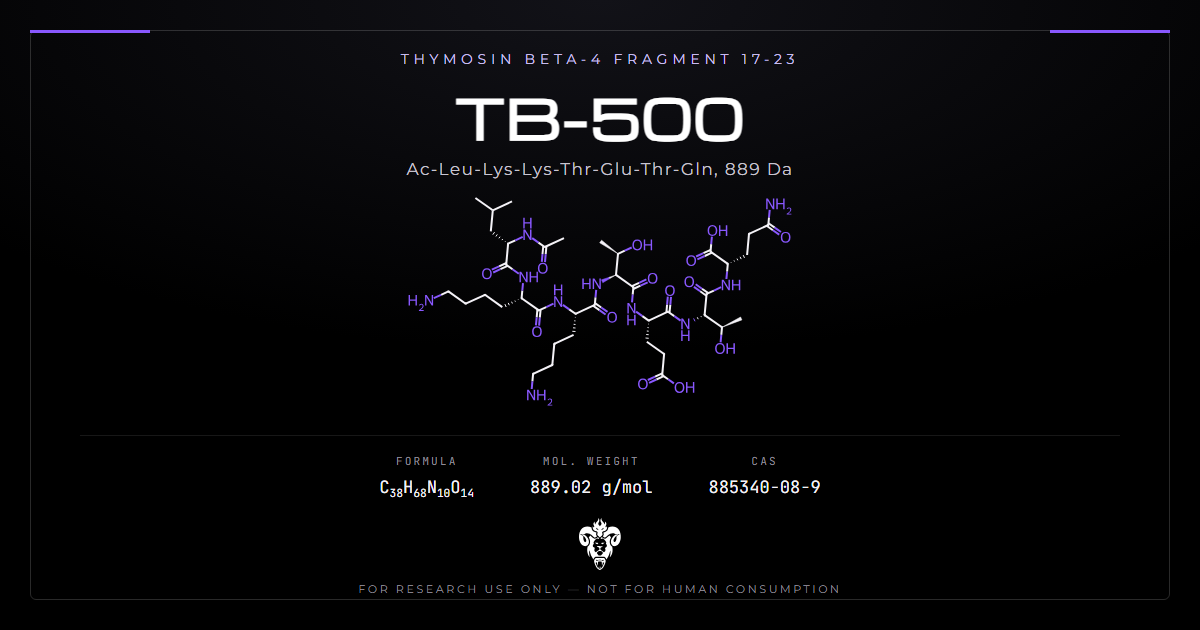
Two names travel together in this corner of the catalogue. They belong to two different compounds.
Thymosin beta-4 is a 43-residue protein of 4963 daltons. TB-500 is a seven-residue peptide of 889 daltons. It carries residues 17 to 23 of that protein, with an acetyl group on the front. A doping-control laboratory took a TB-500 preparation apart and reported exactly that [1]. A second laboratory synthesised the fragment and confirmed the match [2].
The gap between them is 4,074 daltons. Almost every study people cite for TB-500 was run on the protein.
Chemical identity
Both compounds, side by side, because that is the whole problem.
| Property | TB-500 | Thymosin beta-4 |
|---|---|---|
| Sequence | Ac-Leu-Lys-Lys-Thr-Glu-Thr-Gln | 43 residues, full length |
| Short form | Ac-LKKTETQ | Timbetasin |
| Residues | 7 | 43 |
| Molecular formula | C38H68N10O14 | C212H350N56O78S |
| Molecular weight | 889.0 | 4963 |
| CAS | 885340-08-9 | 77591-33-4 |
| PubChem CID | 62707662 | 16132341 |
| InChIKey | ADKDNDYYIZUVCZ-ZQNQAVPYSA-N | UGPMCIBIHRSCBV-XNBOLLIBSA-N |
Note the sulfur. Thymosin beta-4 contains a methionine and TB-500 does not. So the two differ in elemental composition, not only in size.
Why the acetyl group is there
Short peptides get chewed from the N-terminus by aminopeptidases. Capping that end with an acetyl group slows the attack. The same reasoning produced the Pro-Gly-Pro tail on Semax, and it is worth remembering that a stabilising modification can carry consequences of its own.
The masses are far enough apart to be diagnostic
Most identity confusion in peptides needs sequencing to resolve. This one does not. A mass near 889 and a mass near 4963 cannot be mistaken for each other on any instrument. Whichever compound is in a vial, the number on the certificate settles it.
What is actually in TB-500
A Hong Kong racing laboratory published the analysis in 2012 [1]. Their description is worth reading closely because it is the primary source for what this product is.
Their paper describes a veterinary preparation containing a synthetic version of the naturally occurring peptide LKKTETQ. The segment is residues 17 to 23 of thymosin beta-4. That site carries actin binding, cell migration and wound healing in the parent protein. Their conclusion names the key ingredient: LKKTETQ with artificial acetylation of the N-terminus.
A Ghent group ran the confirmation from the other direction [2]. High-resolution mass spectrometry identified the N-terminal acetylated 17-23 fragment inside a TB-500 product. The group then synthesised Ac-LKKTETQ independently and built a detection method for plasma and urine.
So the composition is not inferred. Two laboratories opened the product and looked.
Where TB-500 came from
The 2012 analysis calls it a veterinary preparation [1]. Detection methods for horse plasma and urine followed [1][3].
That origin explains the shape of the literature. TB-500 entered circulation as a product rather than as a research compound. The analytical community responded to it as something to detect.
The peptide’s own literature is mostly detection work
Search for TB-500 by name and the results skew toward method development. Three examples: adsorption behaviour during sample handling [4], in vitro metabolism models for synthetic doping peptides [5], and quantification of the peptide with its metabolites by orbitrap mass spectrometry [6].
Those are careful papers. None of them is an efficacy study. A 2026 review of peptides marketed direct to patients places compounds of this kind in a gray market operating outside regulatory oversight [7]. That describes the regulatory position rather than the chemistry.
The parent protein has more than one active site
Here is the fact that makes the naming problem worse. Thymosin beta-4 is not a single-function molecule with one business end.
A 2010 review mapped the active sites onto short sequences [8]. Three regions carry distinct functions.
| Region | Sequence | Reported function |
|---|---|---|
| Residues 1-4 | Ac-SDKP | Blocks inflammation, reduces fibrosis |
| Residues 1-15 | Ac-SDKPDMAEIEKFDKS | Promotes cell survival, blocks apoptosis |
| Residues 17-23 | LKKTETQ | Actin binding, cell migration |
TB-500 is the third row. The first two rows are a different end of the same protein.
Why that matters for citation
A claim that thymosin beta-4 reduces fibrosis usually traces to Ac-SDKP, residues 1 to 4. TB-500 does not contain those residues. So moving a fibrosis result from the protein onto the fragment moves it across an active site the fragment lacks.
The Ac-SDKP branch is a different fragment
The tetrapeptide has a substantial literature of its own, and following how it is produced makes the separation concrete.
Prolyl oligopeptidase releases Ac-SDKP from thymosin beta-4. That enzyme can only hydrolyse peptides shorter than 30 amino acids, and the protein is 43 [9]. So something has to cut first. Renal meprin-alpha does it, with prolyl oligopeptidase finishing the job.
Downstream of that, Ac-SDKP reduced renal fibrosis in wild-type and knockout mice after ureteral obstruction [10]. Collagen and fibronectin deposition fell, and so did myofibroblast and macrophage counts. Reviews now describe a thymosin beta-4 to prolyl oligopeptidase to Ac-SDKP axis in organ fibrosis [11].
That is a coherent body of work about a four-residue peptide. It is not evidence about a seven-residue peptide from the other end of the chain.
What the fragment itself has been shown to do
The fragment is not inert, and an article making the distinction has to say so plainly.
A 2003 study compared thymosin beta-4 against a synthetic peptide containing its actin-binding domain in full-thickness dermal wounds [12]. Both were active, in diabetic db/db mice and in aged mice, where healing is delayed.
A later study set two thymosin beta-4 fragments against hepatic stellate cells [13]. One was the amino-terminal 1-15 peptide, the other the actin-binding LKKTETQ. The authors attribute the inhibition of platelet-derived growth factor-driven activation, proliferation and migration to the actin-binding domain.
More recently, rats underwent Achilles tendon transection and repair [14]. Four groups of eight received nothing, BPC-157 at 10 micrograms per kilogram per day, TB-500 at 60 micrograms per kilogram per day, or both. Dosing ran intraperitoneally for four weeks. Endpoints were maximum load to failure plus histology, histochemistry and immunohistochemistry.
That study calls TB-500 “synthetic thymosin beta-4” in its own objectives. The conflation has reached the primary literature.
A 2025 paper built an alkaline-phosphatase-triggered hydrogel around the peptide for corneal repair [15]. The formulation work seen with other short peptides is starting here too.
The fragment has metabolites of its own
A 2024 method paper tracked TB-500 and its breakdown products in vitro and in rats, then screened those metabolites for wound-healing activity in cell culture [6]. Two things follow. A seven-residue peptide is short enough that people assume it either works or disappears, and this work treats its fragments as candidate actives in their own right. It also means a measurement of the parent peptide in a sample does not describe everything present.
What the parent protein has been shown to do
The protein’s evidence is deeper and it reaches further into humans.
Thymosin beta-4 increased the rate of dermal healing across preclinical models, including diabetic and aged animals and burns [16]. It also accelerated repair in phase 2 trials covering pressure ulcers, stasis ulcers and epidermolysis bullosa wounds. Those are trials of the 43-residue protein.
Losing the endogenous protein accelerated glomerular disease in mice [17]. That is evidence from the deletion side rather than the dosing side. Reviews continue to treat the protein as a candidate in kidney disease [18].
Two findings that cut the other way
Any honest summary has to carry these.
The protein supports invasiveness in a tumour model
Silencing the thymosin beta-4 gene decreased stemness and invasiveness in glioblastoma [19]. Less of the protein meant a less invasive phenotype. A molecule whose reputation rests on promoting cell migration will promote it in cells where migration is the problem. Here it did.
Loss-of-function is not the same claim as adding more
Both of the cautions here, and one of the supporting findings, come from removing the protein rather than adding it [17][19]. Deleting it accelerated glomerular disease. Silencing it reduced glioblastoma invasiveness. Those results establish that endogenous thymosin beta-4 matters in both tissues, and they point in opposite directions.
Neither tells you what a dose of the fragment does. Loss-of-function evidence maps what a molecule is for. It does not map a dose-response curve, and it says nothing at all about a seven-residue piece of the molecule.
The store’s own product note says the same thing
Our own product listing for this compound carries a line about enhanced tumour cell migration, cooperatively with hypoxia-inducible factor 1-alpha. That belongs in the article rather than only on the label.
What the studies actually used
Amounts are scattered across species and routes, and several key abstracts omit them entirely.
| Study | Species and model | Route and amount |
|---|---|---|
| Bicer 2026 [14] | Rat, Achilles tendon transection and repair, n=8 per group | Intraperitoneal, daily for four weeks; TB-500 60 micrograms per kilogram, BPC-157 10 micrograms per kilogram |
| Philp 2003 [12] | Mouse, full-thickness dermal wounds, db/db and aged | Topical, in phosphate-buffered saline or a hydrogel formulation |
| Kleinman 2016 [16] | Human, pressure, stasis and epidermolysis bullosa ulcers | Phase 2 trials of the full-length protein |
| Zuo 2013 [10] | Mouse, unilateral ureteral obstruction | Ac-SDKP, the four-residue fragment, not TB-500 |
The one clean TB-500 dose on this list is 60 micrograms per kilogram per day in rats [14]. Everything else either used the protein, used a different fragment, or did not state an amount in the abstract.
The blend design is worth noticing
That tendon study ran BPC-157, TB-500 and the combination as separate arms against a control. Blended products are common in this catalogue, and a study with all four arms can attribute an effect to one component or to the pairing. A study dosing only the blend cannot.
Two experiments that would settle the interpretation
Neither is a recommendation. They are the gaps a reader should notice.
A head-to-head at matched molar dose
The closest thing on record is from 2003, and it compared the protein against “a synthetic peptide containing its actin-binding domain” rather than against Ac-LKKTETQ specifically [12]. Twenty years on, no modern study has run the 43-residue protein and the acetylated seven-residue fragment side by side at matched molar dose on one endpoint. Until somebody does, how much of the parent’s activity the fragment carries is an open question rather than a settled one.
Test whether the fibrosis claims transfer at all
Ac-SDKP drives the antifibrotic literature, and TB-500 cannot produce it. The sequence rules it out: residues 1 to 4 are simply absent from the fragment. So a single experiment with three arms, protein against Ac-SDKP against Ac-LKKTETQ in one fibrosis model, would show whether any antifibrotic effect survives the truncation. Nobody has run those three arms together. Meanwhile the fibrosis claim keeps getting attached to the fragment.
The naming problem has a cost beyond citation
Two compounds sharing a name makes a literature hard to search. Query the protein’s name and the fragment’s papers scatter across doping-control journals that a therapeutic search would never surface. Query the fragment’s name and the phase 2 human work does not appear at all, because those trials never used the word.
So a reader who searches one name sees a biased slice, and which slice depends on which name they happened to type. Anyone assembling a picture of this compound should run both searches and keep the results in separate piles.
How to read a TB-500 study
Four questions, and the first one resolves most of the confusion by itself.
What molecular weight appears in the methods?
889 means the fragment. 4963 means the protein. A paper saying “thymosin beta-4” while reporting a mass near 889 is studying TB-500 under the parent’s name. That happens [14]. A paper saying TB-500 while reporting 4963 has made the opposite swap.
Which fragment, if a fragment?
Ac-SDKP, the 1-15 peptide and LKKTETQ are three different compounds with three different reported functions [8]. A result attributed to “a thymosin beta-4 peptide” is incomplete until the sequence appears.
Is the endpoint an outcome or a detection limit?
A large share of TB-500-specific papers are analytical method development [4][5][6]. They establish that the peptide can be measured, not what it does.
Species and route
Equine work, rat work and human trial work sit side by side here. The human trials are on the protein [16]. Intraperitoneal dosing in rats [14] is not interchangeable with topical or intravenous work.
Verifying research material
For once the identity check is simple, and the handling check is where the attention should go.
One number tells you which compound you have
Ask what mass the certificate reports. Near 889 is the acetylated seven-residue fragment. Near 4963 is the full-length protein. No sequencing is needed to tell these apart, unlike the short peptides where isomers share a mass. Every batch we supply carries a certificate of analysis recording the identity and purity data behind it.
Check the acetyl group
Unmodified LKKTETQ differs from the acetylated form by 42 units, which puts free LKKTETQ near 847. Both analytical papers treat the acetylation as part of what defines the product [1][2]. So a mass at 847 is a different material from the one they describe.
What a certificate should carry
Mass and purity are the minimum. For this compound the useful addition is the sequence or the CAS, because either one resolves the ambiguity that the product name creates. A certificate reading 885340-08-9 describes the fragment. One reading 77591-33-4 describes the protein.
Handling
With no cysteine and no methionine, the fragment lacks the oxidation route that dominates larger peptides. Its parent contains a methionine and does have that route. That is one more practical difference between them. Both arrive as hygroscopic lyophilised powders. Equilibrate a vial to room temperature before opening, and treat reconstituted solutions as short-lived.
Common questions about TB-500
Identity
Is TB-500 the same as thymosin beta-4? No. It is residues 17 to 23 of that protein with an N-terminal acetyl group, 889 daltons against 4963 [1][2].
Why do vendors use the names interchangeably? The habit predates the analytical work. It has since reached the primary literature: a 2026 animal study calls TB-500 synthetic thymosin beta-4 [14].
What does the sequence do? LKKTETQ is the actin-binding site of the parent protein [1][8].
Evidence
Has the fragment been tested on its own? Yes. Dermal wounds in diabetic and aged mice [12], hepatic stellate cells [13], and rat Achilles tendon repair [14].
Where are the human trials? On the protein. Phase 2 work in pressure ulcers, stasis ulcers and epidermolysis bullosa used thymosin beta-4 [16].
What is the strongest caution? Gene silencing reduced stemness and invasiveness in glioblastoma [19]. The migration-promoting property has a direction nobody wants.
Verification
Does purity settle identity here? Purity and identity stay separate questions. Unlike a tripeptide, though, mass alone tells these two compounds apart.
Does the fragment produce Ac-SDKP? No. Residues 1 to 4 are absent from it, so the antifibrotic tetrapeptide cannot come from this sequence [8][9].
Which CAS number should appear on the paperwork? 885340-08-9 for the acetylated seven-residue fragment. 77591-33-4 for the full-length protein. The two are not alternative registrations for one substance.
What about the blends? Material sold with BPC-157, KPV or GHK-Cu should carry the component masses. The same 889-against-4963 question applies to whichever thymosin component is present.
Summary of the evidence
TB-500 is a seven-residue acetylated peptide, and two doping-control laboratories established its composition by taking the product apart. Thymosin beta-4 is the 43-residue protein it was cut from. They differ by 4,074 daltons and by one sulfur atom.
Three separate active regions sit on the protein, and the fragment sold as TB-500 is only one of them. Ac-SDKP, at the opposite end of the chain, carries the fibrosis literature. Human phase 2 work used the whole protein. Against that, the fragment has its own results in dermal wounds, hepatic stellate cells and rat tendon repair. Real, and a much smaller evidence base than the name implies.
Kimera Chems supplies Thymosin Beta-4 with full analytical documentation. The batch certificate is the document that tells you which molecule you have. More compounds in this class are covered in our peptides research library.
Research use only. Not for human or veterinary use. Nothing here describes a therapy or a dosing protocol.
References
- Ho EN, Kwok WH, Lau MY, Wong AS, Wan TS, Lam KK, Schiff PJ, Stewart BD. Doping control analysis of TB-500, a synthetic version of an active region of thymosin β₄, in equine urine and plasma by liquid chromatography-mass spectrometry. J Chromatogr A. 2012;1265:57-69. PMID 23084823. DOI
- Esposito S, Deventer K, Goeman J, Van der Eycken J, Van Eenoo P. Synthesis and characterization of the N-terminal acetylated 17-23 fragment of thymosin beta 4 identified in TB-500, a product suspected to possess doping potential. Drug Test Anal. 2012;4(9):733-8. PMID 22962027. DOI
- Kwok WH, Ho EN, Lau MY, Leung GN, Wong AS, Wan TS. Doping control analysis of seven bioactive peptides in horse plasma by liquid chromatography-mass spectrometry. Anal Bioanal Chem. 2013;405(8):2595-606. PMID 23318763. DOI
- Judák P, Van Eenoo P, Deventer K. Adsorption effects of the doping relevant peptides Insulin Lispro, Synachten, TB-500 and GHRP 5. Anal Biochem. 2017;537:69-71. PMID 28887173. DOI
- Zvereva I, Semenistaya E, Krotov G, Rodchenkov G. Comparison of various in vitro model systems of the metabolism of synthetic doping peptides: Proteolytic enzymes, human blood serum, liver and kidney microsomes and liver S9 fraction. J Proteomics. 2016;149:85-97. PMID 27569051. DOI
- Rahaman KA, Muresan AR, Min H, Son J, Han HS, Kang MJ, Kwon OS. Simultaneous quantification of TB-500 and its metabolites in in-vitro experiments and rats by UHPLC-Q-Exactive orbitrap MS/MS and their screening by wound healing activities in-vitro. J Chromatogr B Analyt Technol Biomed Life Sci. 2024;1235:124033. PMID 38382158. DOI
- Mendias CL, Awan TM. Safety and Efficacy of Approved and Unapproved Peptide Therapies for Musculoskeletal Injuries and Athletic Performance. Sports Med. 2026;56(8):1921-1935. PMID 41966639. DOI
- Sosne G, Qiu P, Goldstein AL, Wheater M. Biological activities of thymosin beta4 defined by active sites in short peptide sequences. FASEB J. 2010;24(7):2144-51. PMID 20179146. DOI
- Kumar N, Nakagawa P, Janic B, Romero CA, Worou ME, Monu SR, Peterson EL, Shaw J, et al. The anti-inflammatory peptide Ac-SDKP is released from thymosin-β4 by renal meprin-α and prolyl oligopeptidase. Am J Physiol Renal Physiol. 2016;310(10):F1026-34. PMID 26962108. DOI
- Zuo Y, Chun B, Potthoff SA, Kazi N, Brolin TJ, Orhan D, Yang HC, Ma LJ, et al. Thymosin β4 and its degradation product, Ac-SDKP, are novel reparative factors in renal fibrosis. Kidney Int. 2013;84(6):1166-75. PMID 23739235. DOI
- Wang W, Jia W, Zhang C. The Role of Tβ4-POP-Ac-SDKP Axis in Organ Fibrosis. Int J Mol Sci. 2022;23(21). PMID 36362069. DOI
- Philp D, Badamchian M, Scheremeta B, Nguyen M, Goldstein AL, Kleinman HK. Thymosin beta 4 and a synthetic peptide containing its actin-binding domain promote dermal wound repair in db/db diabetic mice and in aged mice. Wound Repair Regen. 2003;11(1):19-24. PMID 12581423. DOI
- Shah R, Reyes-Gordillo K, Rojkind M. Thymosin β4 inhibits PDGF-BB induced activation, proliferation, and migration of human hepatic stellate cells via its actin-binding domain. Expert Opin Biol Ther. 2018;18(sup1):177-184. PMID 30063851. DOI
- Biçer O, Adanir O, Güleryüz Y, Balci EC, Dinçel YM, Yenigün MY, Aydin C, Bayrak BY. Effects of BPC-157 and TB-500 on Achilles tendon healing in rats: A histopathological and biomechanical study. Jt Dis Relat Surg. 2026;37(3):822-837. PMID 42542926. DOI
- Lu P, Shan M, Peng C, Ji W, Yang T, Yang Z, Zhang Z, Wang Y. Alkaline Phosphatase-Triggered Spatiotemporal Repair of Corneal Injury with TB500 Peptide Hydrogel. ACS Appl Mater Interfaces. 2025;17(50):67503-67518. PMID 41359360. DOI
- Kleinman HK, Sosne G. Thymosin β4 Promotes Dermal Healing. Vitam Horm. 2016;102:251-75. PMID 27450738. DOI
- Vasilopoulou E, Kolatsi-Joannou M, Lindenmeyer MT, White KE, Robson MG, Cohen CD, Sebire NJ, Riley PR, et al. Loss of endogenous thymosin β(4) accelerates glomerular disease. Kidney Int. 2016;90(5):1056-1070. PMID 27575556. DOI
- Di H, Huang J, Zhang D, Ni F, Zheng R, Geng H. Thymosin beta 4: An emerging therapeutic candidate for kidney diseases. Peptides. 2026;195:171467. PMID 41570941. DOI
- Wirsching HG, Krishnan S, Florea AM, Frei K, Krayenbühl N, Hasenbach K, Reifenberger G, Weller M, et al. Thymosin β 4 gene silencing decreases stemness and invasiveness in glioblastoma. Brain. 2014;137(Pt 2):433-48. PMID 24355709. DOI
Research use only. Not for human or veterinary use. Nothing here describes a therapy or a dosing protocol.