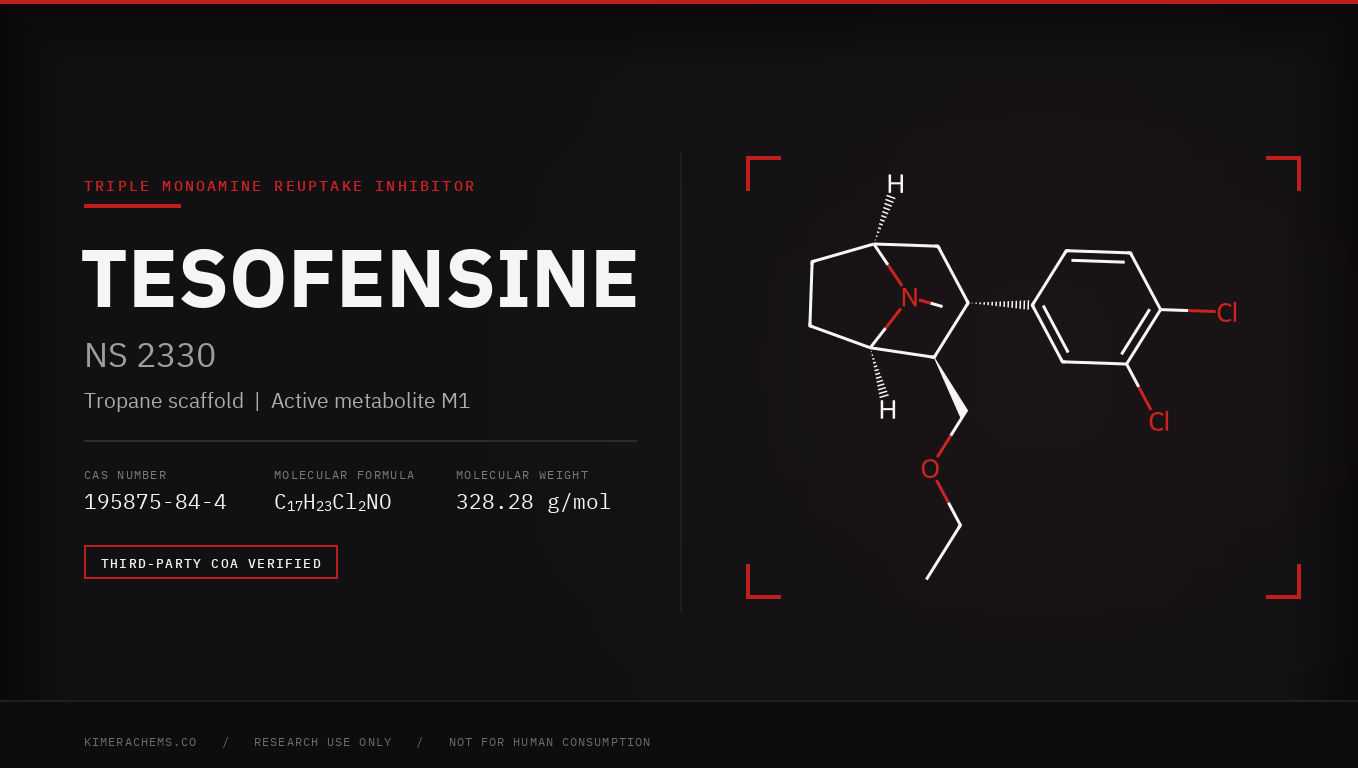
Two facts about tesofensine matter more than anything else for anyone designing an experiment with it, and neither appears in most summaries.
The first is kinetic. Population modelling in 320 patients measured two terminal half-lives. Parent compound came in at 234 hours, its major metabolite at 374 hours [8]. That is roughly ten days and fifteen days. Steady state takes weeks to reach, and washout takes months.
The second is that the compound is never present alone. A metabolite designated M1 accumulates to roughly eightfold higher steady-state concentrations than parent, and it carries its own activity [7].
Together those facts have one consequence. Any study using tesofensine observes a two-species mixture whose ratio shifts with time, at concentrations still climbing long after dosing begins.
What follows covers five areas. The chemistry, and the transporter pharmacology with the receptor pathways behind its effects. Human target engagement measured directly by imaging. That pharmacokinetic profile in detail. The clinical history, including a publishing controversy. And how to verify the material.
Chemical identity: what you are actually handling
Tesofensine is a tropane derivative, sharing its bicyclic core with a large family of transporter ligands.
| Property | Value |
|---|---|
| IUPAC name | (1R,2R,3S,5S)-3-(3,4-dichlorophenyl)-2-(ethoxymethyl)-8-methyl-8-azabicyclo[3.2.1]octane |
| Synonym | NS 2330 |
| CAS | 195875-84-4 |
| Molecular formula | C17H23Cl2NO |
| Molecular weight | 328.28 g/mol |
| PubChem CID | 11370864 |
| InChIKey | VCVWXKKWDOJNIT-ZOMKSWQUSA-N |
| Stereocentres | Four, defined |
| Halogens | Two chlorines, aromatic |
| Originator | NeuroSearch |
The tropane scaffold
The core is an 8-azabicyclo[3.2.1]octane, the same framework found in cocaine and in the transporter radioligands used for dopamine imaging. Here it carries a 3,4-dichlorophenyl group at position 3 and an ethoxymethyl group at position 2.
Sharing a scaffold with cocaine invites an inference that the pharmacology does not support, and the abuse-potential section below addresses it with direct human data.
Four stereocentres and no chiral shortcut
The compound carries four defined stereocentres in the (1R,2R,3S,5S) configuration. Several stereoisomers share its molecular formula and accurate mass exactly.
That makes chiral chromatography a requirement rather than a refinement. A certificate reporting purity by a standard reversed-phase method has not established that the material matches the compound in the published literature.
Tesofensine transporter pharmacology
Tesofensine blocks reuptake at all three monoamine transporters, inhibiting dopamine, noradrenaline and serotonin transport [1].
Triple inhibition distinguishes it from the selective agents that dominate this space. Blocking one transporter produces a comparatively narrow neurochemical change. Blocking three raises synaptic availability across three systems at once. No single-transporter comparator predicts that combined profile.
The receptor pathways behind the effect
Transport blockade is upstream. Which receptors carry the downstream signal is a separate question, and one study answered it by systematic antagonism.
Axel and colleagues treated diet-induced obese rats and measured food intake across twelve hours, then tested which receptor antagonists blocked the effect [2].
The result was specific. Prazosin, an α1 adrenoceptor antagonist, almost completely reversed the hypophagic response. SCH23390, a dopamine D1 antagonist, partially antagonised it. Four other antagonists did nothing at all. Those were an α2 antagonist, a D2 antagonist, a D3 antagonist, and a 5-HT2A/C antagonist [2].
That pattern narrows a broad mechanism to two pathways. The compound blocks serotonin transport, yet the feeding effect in this model ran through α1 adrenoceptor and D1 receptor function instead [2].
The half-maximal effective dose for the hypophagic response was 1.3 mg/kg subcutaneously in that model [2].
Human target engagement measured by PET
Most research compounds have no direct evidence that they occupy their target in humans. Tesofensine does.
Appel and colleagues used positron emission tomography with a labelled tracer to measure striatal dopamine transporter occupancy at steady state. Dosing ran from 0.125 to 1 mg orally over eight to twelve days [10].
Occupancy rose dose-dependently from 18 percent to 77 percent. A sigmoid model described the relationship between occupancy and plasma concentration well, estimating maximum achievable occupancy near 80 percent. Half of that maximum was reached at approximately 0.25 mg and a plasma concentration around 4 ng/mL [10].
Those numbers are unusually useful. They convert a dose into a measured degree of target engagement, which is the bridge between an in vitro potency figure and an in vivo effect.
Pharmacokinetics
The kinetic profile of this compound is its most distinctive feature and its most common omission.
Half-lives measured in weeks
Lehr and colleagues built a population pharmacokinetic model from 1,969 parent and 1,714 metabolite concentrations. The data came from 320 patients receiving multiple oral doses [8].
One-compartment models with first-order elimination described both species best. Low apparent clearance combined with large apparent volume of distribution produced half-lives of 234 hours for the parent compound and 374 hours for M1 [8].
The practical consequences are substantial. Accumulation continues for weeks before plasma concentrations plateau, so an early sample does not represent steady state. A washout period between crossover arms has to be measured in months rather than days. And any adverse effect that emerges is slow to resolve after stopping.
Enterohepatic recycling
Plasma profiles for this compound show multiple peaks, which a simple absorption model cannot generate.
Lehr and colleagues developed a quantitative enterohepatic circulation model. It used intravenous tesofensine data from 21 healthy subjects given six-hour infusions [9]. The profiles fitted best to a three-compartment model with a dedicated gallbladder compartment, released periodically under a sine-function control keyed to clock time [9].
Enterohepatic recycling explains both the multiple peaks and part of the prolonged apparent half-life. For laboratory work it means sampling schedules designed around a single absorption peak will misrepresent the exposure profile.
Covariates that shift exposure
The population model identified weight, sex, creatinine clearance, body mass index and age as influencing pharmacokinetics [8].
Simulation narrowed that list. Only creatinine clearance and sex produced significant effects on steady-state profiles. Females with a creatinine clearance of 35.6 mL/min showed 62 percent greater exposure than males without renal impairment [8].
Renal function driving exposure by that margin is worth noting in any study design that does not control for it.
The M1 metabolite
Lehr and colleagues characterised the metabolite’s contribution directly. They built a pharmacokinetic-pharmacodynamic model in 228 mice, dosing parent and metabolite separately by intravenous and oral routes. Dopamine transporter occupancy served as the readout [7].
M1 showed half-maximal effective concentrations four to five times higher than parent, making it the weaker of the two. It also reached roughly eightfold higher steady-state concentrations. The authors concluded M1 contributes to overall activity in mice [7].
Pharmacokinetics were non-linear, with elimination and metabolism kinetics changing as dose rose [7]. Doubling the dose does not double exposure for this compound.
Preclinical obesity pharmacology
A substantial body of rodent work followed the clinical weight observation, and it is more mechanistically informative than the trials.
Comparison against established comparators
Hansen and colleagues treated diet-induced obese rats for 28 days, comparing tesofensine against sibutramine and rimonabant [3].
Tesofensine produced dose-dependent sustained weight loss of 5.7 and 9.9 percent at two doses. Sibutramine produced 7.6 percent, and rimonabant produced only a transient reduction. The hypophagic effect of tesofensine lasted longer than either comparator [3].
One control deserves attention. Pair-fed animals received the same reduced food intake without the drug. They returned to baseline body weight by the end of the study, while treated animals did not [3]. That dissociation suggests the effect involves more than appetite suppression alone. The authors also reported suppressed insulin response on oral glucose tolerance testing below the level obtainable by paired feeding [3].
Dopamine system findings
Two studies examined dopamine directly, and they point in different directions.
Hansen and colleagues found diet-induced obese rats had reduced baseline extracellular dopamine in nucleus accumbens and prefrontal cortex compared with chow-fed animals. Acute tesofensine normalised accumbal dopamine in obese rats while having no effect in chow-fed rats [4].
Van de Giessen and colleagues measured striatal dopamine D2/D3 receptor availability after 28 days of treatment. It came out lower in treated animals than in either vehicle controls or calorie-restricted controls. No correlation appeared between food intake or body weight and receptor availability. The authors therefore described the receptor change as mainly a pharmacological effect rather than a mediator of the weight change [5]. Caloric intake and weight gain returned after treatment stopped [5].
Hypothalamic circuit work
A 2024 study took the mechanism to the circuit level, recording neuronal ensembles in the lateral hypothalamus and using optogenetic and chemogenetic tools in transgenic mice [6].
Tesofensine inhibited a subset of GABAergic lateral hypothalamic neurons, reducing their capacity to promote feeding. Chemogenetic silencing of those same neurons enhanced the food-suppressing effect [6]. The study also reported that effects on sucrose responses were independent of taste aversion and did not alter perception of sweetness or palatability [6].
One comparative observation is relevant to the stimulant question. Unlike phentermine, tesofensine produced few head-weaving stereotypies at therapeutic doses in that work [6].
The clinical record
The human history of this compound runs through two indications and ends without approval in either.
Parkinson disease
Rascol and colleagues ran the ADVANS study. It was a randomised double-blind placebo-controlled phase 2 trial in patients with advanced Parkinson disease and levodopa-related motor fluctuations, dosed once daily for 14 weeks [12].
Modest improvements appeared at some doses on rating-scale subscores and in off time. The trial could not establish a dose-response relationship for efficacy. Gastrointestinal and neuropsychiatric adverse events became more frequent at higher doses [12].
The observation that redirected the programme
Astrup and colleagues performed a meta-analysis of body weight across four randomised double-blind trials in Parkinson and Alzheimer disease. The pooled data covered 740 patients on tesofensine and 228 on placebo [11].
Weight change after 14 weeks ordered by dose across the treatment arms, with a significant dose effect. No diet or lifestyle programme accompanied it. Heart rate rose in a dose-related manner while blood pressure did not change [11].
An endpoint nobody set out to measure produced the clearest signal in the dataset. The programme redirected toward obesity on that basis [1].
The obesity trial
Astrup and colleagues then ran a phase 2 randomised double-blind placebo-controlled trial across five Danish obesity management centres. They randomised 203 patients to 0.25, 0.5 or 1.0 mg daily or to placebo, for 24 weeks alongside an energy-restricted diet [13].
Mean weight loss reached 4.5, 9.2 and 10.6 percent across the three doses, against 2.0 percent for diet plus placebo. Common adverse events included dry mouth, nausea, constipation, hard stools, diarrhoea and insomnia. Heart rate rose by 7.4 beats per minute in the 0.5 mg group. That dose and the lower one showed no significant blood pressure increase against placebo [13].
The authors concluded the results needed confirmation in phase 3 trials [13].
The Expression of Concern
That trial does not stand unqualified in the literature, and anyone citing it should know why.
Correspondence published in 2009 raised questions about cardiovascular and psychiatric adverse effects and about blood pressure reporting [14][15].
More consequentially, in 2013 the journal published an Expression of Concern regarding the trial [16]. An Expression of Concern is a formal editorial notice. It signals unresolved questions about a published paper. Such a notice is not a retraction, and it does not establish that the findings are wrong. The paper does, however, carry a standing editorial caveat from that point on.
Reviews of obesity pharmacotherapy from that period list tesofensine among first-in-class molecules whose clinical development had limited success [17]. No phase 3 programme delivered an approval, and the compound holds no marketing authorisation in any jurisdiction.
Abuse potential
Because the scaffold resembles cocaine, the question of abuse liability was addressed directly rather than assumed.
Schoedel and colleagues ran a single-dose randomised double-blind crossover study in 52 recreational stimulant users. It compared tesofensine against placebo, against D-amphetamine as a positive control, and against bupropion and atomoxetine as negative controls. Subjective and objective measures ran for 48 hours [18].
D-amphetamine produced significantly greater effects than placebo on all primary and secondary subjective measures. Tesofensine did not differ significantly from placebo. Its effects fell below D-amphetamine on all primary and most secondary measures. Its effects were either lower than or not different from bupropion and atomoxetine [18].
The authors concluded the abuse potential is no greater than that of bupropion or atomoxetine [18]. A tropane scaffold does not by itself predict a stimulant subjective profile.
Physicochemical properties and handling
The molecule is a lipophilic tertiary amine carrying an ether linkage and no ester. It is chemically stable under ordinary storage, and the practical concerns are salt form and stereochemical integrity rather than degradation.
The ether is resistant to hydrolysis. The tertiary amine confers basicity, so the compound will form salts with acids and its aqueous solubility depends on pH.
Confirm salt form before converting a weighed mass into moles. Free base and salt differ in molar content per gram. A citrate or hydrochloride salt changes the calculation substantially.
Store the solid sealed, dry, cold and dark.
Analytical characterisation
Four checks cover this compound, ranked by how much each changes the identity of the material.
Stereochemical purity is first. Four defined centres mean several stereoisomers share the formula and accurate mass, and only a chiral method reports the difference.
The chlorine isotope envelope is the fastest confirmation. Two chlorines produce an M+2 peak near two thirds of the molecular ion intensity, with a clearly visible M+4. That pattern separates the compound at a glance from mono-chlorinated relatives.
Accurate mass confirms C17H23Cl2NO at 328.28.
Chromatographic purity is the figure most certificates lead with and the least informative of the four here.
What a rigorous certificate should contain
Chiral purity, by a stated method, with the value given.
Accurate mass with the isotope envelope shown, confirming exactly two chlorines.
Salt form, stated explicitly, with the counterion named.
Structural confirmation by NMR, establishing the tropane substitution pattern.
Kimera publishes third-party certificates of analysis for every lot in its COA database. Laboratories source Tesofensine as a reference triple reuptake inhibitor, sometimes alongside CE-123, a selective transporter inhibitor with a very different profile, or Adrafinil. Related chemistry appears in the metabolic category.
Common misclassifications
Four errors recur.
The compound is treated as a single chemical entity. M1 reaches roughly eightfold higher steady-state concentrations than parent and contributes to activity [7].
Its serotonergic component is assumed to drive the feeding effect. Antagonist work found the effect ran through α1 and D1 pathways, with a 5-HT2A/C antagonist producing no change [2].
Its tropane scaffold is read as implying stimulant liability. A controlled human abuse-potential study placed it no higher than bupropion or atomoxetine [18].
The obesity trial is cited without qualification. It carries a 2013 Expression of Concern from the publishing journal [16].
Experimental design considerations
Allow for the half-life. At 234 hours for parent and 374 hours for metabolite, steady state takes weeks and washout takes months [8].
Account for M1. A single-compound assumption misdescribes what is present after repeated dosing [7].
Expect non-linearity. Elimination and metabolism kinetics change with dose [7].
Sample for multiple peaks. Enterohepatic recycling produces profiles that a single-peak schedule will miss [9].
Measure heart rate. It rose consistently across human trials [11][13] and is the endpoint most likely to confound a behavioural readout.
Record renal function and sex. Both shifted exposure materially in the population model [8].
Frequently asked questions
What is Tesofensine? A tropane-derived triple monoamine reuptake inhibitor, CAS 195875-84-4, developed by NeuroSearch as NS 2330. Kimera supplies it as a laboratory research material.
Which transporters does it block? Dopamine, noradrenaline and serotonin [1].
How long is the half-life? About 234 hours for parent compound and 374 hours for the M1 metabolite [8].
What is M1? The major metabolite. It is four to five times less potent at the dopamine transporter but reaches roughly eightfold higher steady-state concentrations [7].
How much transporter occupancy does a given dose produce? Striatal dopamine transporter occupancy ranged from 18 to 77 percent across 0.125 to 1 mg, with a ceiling near 80 percent [10].
Is it a stimulant in the abuse-liability sense? A controlled study in recreational stimulant users found effects no greater than bupropion or atomoxetine [18].
Is it approved? No, in any jurisdiction.
Summary of the evidence
Identity: C17H23Cl2NO, 328.28 g/mol, tropane scaffold, four defined stereocentres, two chlorines.
Mechanism: reuptake inhibition at all three monoamine transporters [1], with the feeding effect running through α1 adrenoceptor and D1 receptor pathways [2].
Human target engagement: 18 to 77 percent striatal dopamine transporter occupancy across the studied dose range [10].
Kinetics: half-lives of 234 and 374 hours, non-linear with dose, with enterohepatic recycling producing multiple plasma peaks [7][8][9].
Preclinical obesity data: sustained weight loss exceeding rimonabant and comparable to or greater than sibutramine, with effects beyond matched food restriction [3]. Reversal of lowered forebrain dopamine [4]. Inhibition of GABAergic lateral hypothalamic neurons [6].
Clinical record: phase 2 in Parkinson disease without a reliable dose-response [12]. A dose-ordered weight change found retrospectively across four trials [11]. A 24-week obesity trial reporting up to 10.6 percent weight loss [13].
Caveat on that trial: a 2013 Expression of Concern from the publishing journal [16], preceded by published correspondence questioning cardiovascular and psychiatric reporting [14][15].
Cardiovascular signal: heart rate rose with dose consistently, including 7.4 beats per minute at 0.5 mg [11][13].
Status: no approval anywhere, no successful phase 3 programme [17].
References
- Bello NT, Zahner MR. Tesofensine, a monoamine reuptake inhibitor for the treatment of obesity. Curr Opin Investig Drugs. 2009;10(10):1105-1116. PMID 19777399
- Axel AM, Mikkelsen JD, Hansen HH. Tesofensine, a novel triple monoamine reuptake inhibitor, induces appetite suppression by indirect stimulation of alpha1 adrenoceptor and dopamine D1 receptor pathways in the diet-induced obese rat. Neuropsychopharmacology. 2010;35(7):1464-1476. PMID 20200509. DOI
- Hansen HH, Hansen G, Tang-Christensen M, et al. The novel triple monoamine reuptake inhibitor tesofensine induces sustained weight loss and improves glycemic control in the diet-induced obese rat: comparison to sibutramine and rimonabant. Eur J Pharmacol. 2010;636(1-3):88-95. PMID 20385125. DOI
- Hansen HH, Jensen MM, Overgaard A, et al. Tesofensine induces appetite suppression and weight loss with reversal of low forebrain dopamine levels in the diet-induced obese rat. Pharmacol Biochem Behav. 2013;110:265-271. PMID 23932919. DOI
- van de Giessen E, de Bruin K, la Fleur SE, et al. Triple monoamine inhibitor tesofensine decreases food intake, body weight, and striatal dopamine D2/D3 receptor availability in diet-induced obese rats. Eur Neuropsychopharmacol. 2012;22(4):290-299. PMID 21889317. DOI
- Perez CI, Luis-Islas J, Lopez A, et al. Tesofensine, a novel antiobesity drug, silences GABAergic hypothalamic neurons. PLoS One. 2024;19(4):e0300544. PMID 38656972. DOI
- Lehr T, Staab A, Tillmann C, et al. Contribution of the active metabolite M1 to the pharmacological activity of tesofensine in vivo: a pharmacokinetic-pharmacodynamic modelling approach. Br J Pharmacol. 2008;153(1):164-174. PMID 17982477. DOI
- Lehr T, Staab A, Tillmann C, et al. Population pharmacokinetic modelling of NS2330 (tesofensine) and its major metabolite in patients with Alzheimer’s disease. Br J Clin Pharmacol. 2007;64(1):36-48. PMID 17324246. DOI
- Lehr T, Staab A, Tillmann C, et al. A quantitative enterohepatic circulation model: development and evaluation with tesofensine and meloxicam. Clin Pharmacokinet. 2009;48(8):529-542. PMID 19705923. DOI
- Appel L, Bergström M, Buus Lassen J, Långström B. Tesofensine, a novel triple monoamine re-uptake inhibitor with anti-obesity effects: dopamine transporter occupancy as measured by PET. Eur Neuropsychopharmacol. 2014;24(2):251-261. PMID 24239329. DOI
- Astrup A, Meier DH, Mikkelsen BO, Villumsen JS, Larsen TM. Weight loss produced by tesofensine in patients with Parkinson’s or Alzheimer’s disease. Obesity (Silver Spring). 2008;16(6):1363-1369. PMID 18356831. DOI
- Rascol O, Poewe W, Lees A, et al. Tesofensine (NS 2330), a monoamine reuptake inhibitor, in patients with advanced Parkinson disease and motor fluctuations: the ADVANS Study. Arch Neurol. 2008;65(5):577-583. PMID 18474731. DOI
- Astrup A, Madsbad S, Breum L, et al. Effect of tesofensine on bodyweight loss, body composition, and quality of life in obese patients: a randomised, double-blind, placebo-controlled trial. Lancet. 2008;372(9653):1906-1913. PMID 18950853. DOI
- Tsai AG. Tesofensine and weight loss. Lancet. 2009;373(9665):719. PMID 19249625. DOI
- Sommet A, Pathak A, Montastruc JL. Tesofensine and weight loss. Lancet. 2009;373(9665):719. PMID 19249626. DOI
- Expression of concern: effect of tesofensine on bodyweight loss, body composition, and quality of life in obese patients: a randomised, double-blind, placebo-controlled trial. Lancet. 2013;381(9873):1167. PMID 23561987. DOI
- George M, Rajaram M, Shanmugam E. New and emerging drug molecules against obesity. J Cardiovasc Pharmacol Ther. 2014;19(1):65-76. PMID 24064009. DOI
- Schoedel KA, Meier D, Chakraborty B, Manniche PM, Sellers EM. Subjective and objective effects of the novel triple reuptake inhibitor tesofensine in recreational stimulant users. Clin Pharmacol Ther. 2010;88(1):69-78. PMID 20520602. DOI
Tesofensine is sold for laboratory research use only. Not for human consumption, nor medical, veterinary, or household uses.
Literature retrieved from PubMed.