
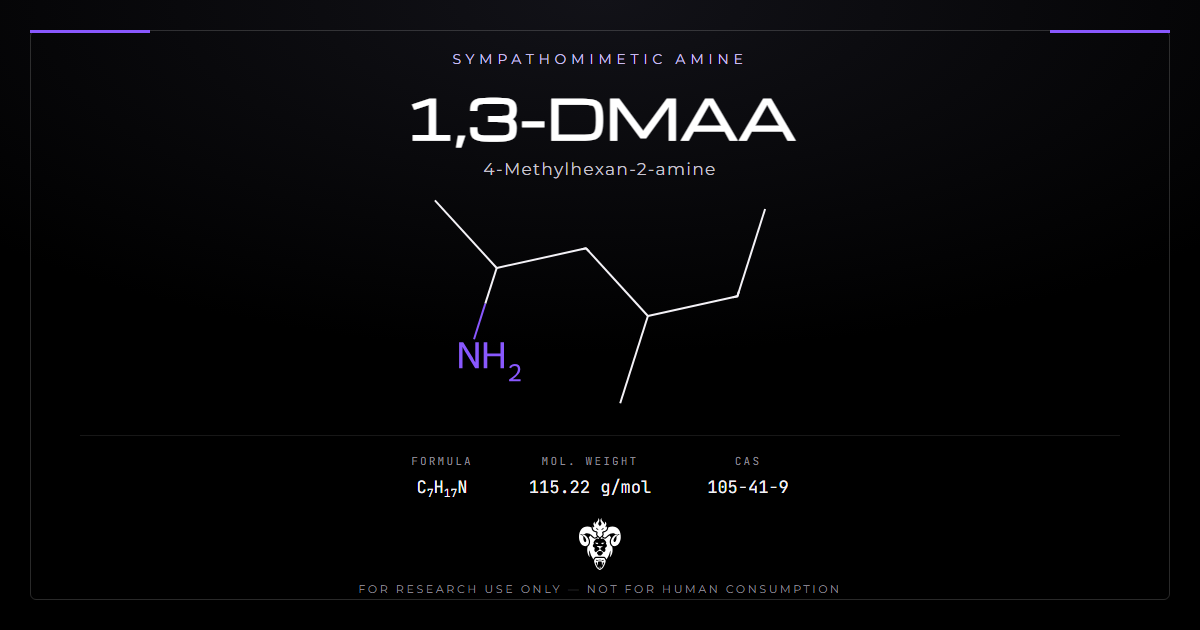
1,3-DMAA is a seven-carbon amine with a longer paper trail than most research chemicals. Almost all of that trail concerns one question. Does the molecule occur in a plant?
The answer decided the compound’s regulatory fate on two continents. It also produced four independent analytical investigations and a case study in how a botanical-origin claim can be tested to destruction. The pharmacology occupies a much smaller shelf.
That imbalance shapes what follows. The analytical record on 1,3-DMAA is unusually strong. The pharmacological record is thin, dated and mostly indirect. Anyone working with this material should know which of the two they are relying on.
Chemical identity: a small aliphatic amine
1,3-DMAA is structurally unremarkable. Seven carbons, one nitrogen, no rings, no heteroatoms other than the amine.
| Property | Value |
|---|---|
| Systematic name | 4-methylhexan-2-amine |
| Common names | 1,3-DMAA, methylhexanamine, methylhexaneamine |
| Historical trade names | Forthane, Geranamine |
| Molecular formula | C7H17N |
| Molecular weight | 115.22 g/mol |
| CAS number | 105-41-9 |
| PubChem CID | 7753 |
| InChIKey | YAHRDLICUYEDAU-UHFFFAOYSA-N |
| SMILES | CCC(C)CC(C)N |
| Stereocentres | Two, at C2 and C4 |
| Stereoisomers | Four |
| Chemical class | Aliphatic primary amine, sympathomimetic |
| Typical salt form | Hydrochloride |
Two stereocentres, four stereoisomers
The amine sits at C2 and a methyl branch at C4. Both are stereocentres, which gives four stereoisomers: (2R,4R), (2R,4S), (2S,4R) and (2S,4S).
This detail looks academic until you reach the geranium question. Chemical synthesis and biosynthesis produce stereoisomers in different proportions. A plant enzyme making an amine tends to produce one isomer heavily. A reductive amination of 4-methyl-2-hexanone in a reactor produces a ratio set by the reaction. That ratio repeats across every batch made the same way.
The stereoisomer ratio is therefore a fingerprint. It became the decisive piece of evidence [3].
The naming carries history
The compound answers to at least six names, and each belongs to a different era.
Methylhexaneamine is the pharmaceutical name, used when the compound was a prescription product. Forthane was the trade name of that product. 1,3-dimethylamylamine and its abbreviation DMAA came from the supplement industry, which reached for a name that sounded technical. Geranamine is a coined trademark, and the coining is the whole story of this article. Methylhexanamine is the spelling that anti-doping literature settled on [13].
Searching one name returns one slice of the record. Searching all of them returns a coherent picture.
Forthane: the pharmaceutical original
The compound was not invented by the supplement industry. Eli Lilly registered methylhexaneamine as a nasal decongestant under the name Forthane in the 1940s, delivered as an inhaler. The vasoconstriction that clears a blocked nose is the same peripheral action that raises blood pressure. That pairing recurs across sympathomimetic amines.
The product was withdrawn decades before it resurfaced. When it returned in the late 2000s it arrived without the pharmaceutical framing, as a botanical extract.
The distinction matters for the literature. A compound that was once a marketed drug carries mid-century pharmacology behind it. Almost none of that work reached PubMed’s indexed era. Anyone expecting a modern mechanistic package will not find one. What exists instead is a set of studies driven by regulators and anti-doping laboratories, asking narrow questions.
Where the geranium claim came from
The claim was specific: 1,3-DMAA is a natural constituent of geranium oil, obtained from Pelargonium graveolens. Some versions cited a 1996 Chinese paper reporting the compound in geranium oil.
The provenance of that citation is worth stating plainly. The report is hard to obtain, was not published in a widely indexed journal, and predates the analytical methods that later groups applied. It was never replicated by a laboratory working with botanically authenticated material. A single unreplicated detection carried the regulatory weight for an ingredient sold in millions of units.
The trademark Geranamine encoded the claim in the product name. Supplements listed “geranium oil extract” or “geranium stem and leaves” on the label, and the listed ingredient did the regulatory work.
Why the claim was load-bearing
Under the US Dietary Supplement Health and Education Act, a pre-1994 food-supply ingredient faces a lower barrier than a new chemical entity. A synthetic amine is a new dietary ingredient requiring notification. A constituent of a plant already in commerce is not.
So the geranium claim was not decoration. It determined whether the ingredient could be sold at all. That is why it drew analytical attention no ordinary marketing claim would attract.
Online discussion of the compound tracked the same fault line. A qualitative study of user forums found the community split. Some posters treated the compound as a plant product, others as a synthetic stimulant, and the botanical framing was used to argue for safety [10].
Four analytical tests of the geranium claim
Between 2012 and 2015, four independent groups tested the claim. The methods differ, the laboratories differ, and the conclusions converge.
| Study | Material tested | Method | Detection limit | Finding |
|---|---|---|---|---|
| Zhang 2012 [3] | 8 geranium extracts, 13 supplements | Chiral GC-MS | 10 ppb | Not detected in plants |
| Gauthier 2013 [6] | Published reports | Literature synthesis | n/a | Conflicting, source-dependent |
| ElSohly 2014 [8] | 18 plant samples, 6 species, 9 oils | LC-MS/MS and GC-MS, four laboratories | ~10 ppb | Not detected |
| Avula 2015 [9] | Authentic P. graveolens, pelargonium oil | DART-QToF-MS | n/a | Not detected |
The stereoisomer fingerprint
Zhang and colleagues did two things at once. They looked for the compound in eight geranium extracts and found nothing at a 10 ppb limit. Then they measured stereoisomer ratios in thirteen commercial supplements and compared them against synthetic reference standards [3].
The supplement ratios were indistinguishable from the synthetic standards.
That is a stronger result than absence alone. Absence can be argued away with claims about cultivar, harvest or extraction. A synthetic stereoisomer signature in the finished product says the material in the bottle came out of a reactor, whatever the label says.
The multi-centre replication
ElSohly and colleagues addressed the obvious objection. One laboratory examining a few samples could miss the compound in the right plant material [8].
They tested eighteen plant samples spanning six Pelargonium species plus nine commercial oils. The work was split across four laboratories, using both LC-MS/MS and GC-MS. Nothing was found at roughly 10 ppb in any sample, at any laboratory, by either technique.
A negative result replicated across four laboratories and two orthogonal methods is about as firm as analytical chemistry gets.
Ambient ionisation as an independent check
Avula and colleagues used direct analysis in real time coupled to quadrupole time-of-flight mass spectrometry [9]. DART-QToF-MS skips chromatographic separation and sample preparation. That removes one escape route for a positive claim, since no extraction step could have destroyed the analyte first.
Authentic P. graveolens material and pelargonium oil again gave nothing.
The dissenting reports
A handful of papers did report detecting the compound in geranium material. Naming them is more useful than ignoring them. Gauthier reviewed the conflicting evidence and examined why results diverged (PMID 23843687) [6].
The pattern that emerges concerns provenance. Positive reports tended to involve material of uncertain origin or extraction conditions that could generate artefacts. Negative results dominated where the plant material was botanically authenticated and the method validated against reference standards.
Weight of evidence sits with absence. The Zhang stereoisomer work is the piece that no dissenting report has addressed [3].
Sympathomimetic pharmacology: what DMAA is inferred to do
Mechanistic work on 1,3-DMAA is sparse. The compound is a branched aliphatic primary amine, structurally analogous to other indirect sympathomimetics. Its actions are attributed to that class behaviour. The usual account is displacement of noradrenaline from peripheral stores, followed by vasoconstriction.
The class inference is not the same as a measured mechanism for this molecule. No modern receptor-binding panel or transporter assay has been published for 1,3-DMAA at the level available for better-studied stimulants.
The downstream consequence has been measured in controlled human studies. Those give a clearer picture than any mechanism paper would.
Controlled hemodynamic studies
Three published studies dosed the compound under controlled conditions and measured cardiovascular variables.
Single ingestion
Bloomer and colleagues gave caffeine and 1,3-DMAA alone and in combination to healthy adults (PMID 22030947). Heart rate and blood pressure were tracked across the following hours [1].
The combination at 75 mg raised systolic pressure by roughly 20 percent and diastolic by roughly 17 percent. The peak fell near 60 minutes. Heart rate did not rise. Circulating noradrenaline and adrenaline were unaffected.
The dissociation is informative. Pressure rose while heart rate and catecholamines held steady. That pattern points to peripheral vasoconstriction rather than a central sympathetic surge.
Repeated ingestion
Farney and colleagues extended the design to fourteen days. They used two commercial supplements containing the compound with caffeine, and added a blood panel [2].
Resting heart rate and blood pressure were not elevated after fourteen days. No measured haematologic or metabolic variable changed, except a rise in fasting glucose with one of the two products. Acute post-dose pressure rises of five to fifteen percent persisted, peaking at 60 to 90 minutes.
Bloomer’s twelve-week study dosed 50 mg per day in fifty men and reported no significant changes in the measured variables [5].
The sample sizes are small and the products were multi-ingredient. These studies bound the acute pressure response better than they characterise long-term risk.
The poison centre record
Controlled studies and population exposure data answer different questions.
Forrester analysed 56 exposures reported to Texas poison centres [4]. Tachycardia appeared in 28.6 percent of cases. The series is small. It captures the tail of the exposure distribution rather than typical use, which is what a poison centre series does.
The FDA’s regulatory action cited cardiovascular events including hypertension and myocardial infarction. The compound has also been investigated as a contributor to haemorrhagic stroke and sudden death [11]. Case reports of that kind establish temporal association. They do not establish causation, and the compound was taken alongside caffeine and other stimulants in most instances.
The summary is a compound with a demonstrated pressor effect in controlled studies. It also carries an adverse event signal from uncontrolled exposure. No adequately powered study connects the two.
Label content does not predict actual content
Monakhova and colleagues quantified the compound in commercial products by quantitative proton NMR [7]. Nine of sixteen products tested positive. Content ranged from 3.1 to 415 g/kg.
That is a spread of more than two orders of magnitude across products sold for the same purpose.
Two consequences follow. Any study using commercial products as the dosing vehicle carries an unknown actual dose. That weakens the human literature described above. And any analytical work on this compound needs its own quantification rather than a label figure.
Anti-doping status and detection
The World Anti-Doping Agency prohibits methylhexanamine as a specified stimulant in competition. The compound has generated a disproportionate share of positive tests.
Rule violations
Lauritzen examined anti-doping rule violations attributed to supplement use and found methylhexanamine implicated in 16 of 27 cases [13].
The dominance is a labelling problem as much as a pharmacological one. Athletes reported products whose labels named a botanical rather than the compound. The ingredient reaching the analytical laboratory was not the ingredient on the panel.
Wastewater surveillance
Causanilles and colleagues applied wastewater analysis to doping surveillance, measuring stimulant residues at the population level [12]. The approach sidesteps individual testing and gives a community-scale estimate of use.
Methylhexanamine appears in this work as a detectable and quantifiable residue. Population exposure continued after the regulatory action.
The analogue succession
Cohen and colleagues analysed six supplement brands whose labels named ingredients that might be analogues of the banned compound [11].
They identified four stimulants: octodrine (2-amino-6-methylheptane), 1,4-DMAA, 1,3-DMAA itself and 1,3-DMBA. Octodrine appeared at 72 mg per serving. That compound was once sold in Europe as a pharmaceutical at 8 to 33 mg. The supplement dose exceeded the largest pharmaceutical dose by more than double. 1,4-DMAA appeared at 21 to 94 mg per serving with no prior approval for human consumption anywhere. In one product, 1,3-DMAA and 1,4-DMAA appeared together.
The finding matters for anyone sourcing reference material. Compounds in this family are close structural neighbours and share fragmentation behaviour. A certificate identifying one of them by mass alone does not exclude the others.
Verifying research material
Given the substitution record, identity confirmation is not optional for this compound.
Chiral GC-MS has the most published precedent. It resolves the stereoisomers and supports the ratio comparison Zhang used (PMID 22786761) [3]. A synthetic ratio is expected for any modern material.
Proton NMR gives independent structural confirmation. It also quantifies without a reference standard for every analyte, which is what Monakhova exploited [7]. For a molecule this small, the spectrum is straightforward to interpret.
LC-MS/MS with a validated method distinguishes 1,3-DMAA from 1,4-DMAA and 1,3-DMBA. Unit-resolution mass spectrometry alone does not. Cohen’s work used reference standards in two independent laboratories for exactly this reason [11].
A third-party certificate of analysis should identify the specific isomer, state the method, and report content rather than presence.
Kimera publishes third-party certificates of analysis for every lot in its COA database. Laboratories source 1,3-DMAA as a sympathomimetic reference standard. Work on stimulant pharmacology often holds it alongside bromantane and chlodantane, which are adamantane actoprotectors with a different mechanism, or the wakefulness agents adrafinil and modafiendz. Related chemistry appears in the nootropics category.
What the literature does not establish
Several things are absent from the record. Naming them is part of describing it.
There is no modern receptor pharmacology for this molecule. The sympathomimetic attribution rests on structural class and on the observed pressor response, not on binding data.
There is no published human pharmacokinetic study with adequate characterisation of absorption, distribution and elimination.
There is no adequately powered controlled study of cardiovascular risk. The controlled studies are small, short and used multi-ingredient products of unverified content [1][2][5].
Caffeine is a confound in most of the record. Bloomer’s first study did include arms giving each compound alone [1], but the reported combination figures are the ones usually quoted, and the two later studies dosed the pair together or used multi-ingredient commercial products of unverified content [2][5]. The isolated dose-response for the amine rests on a single small experiment.
The mechanism of the reported serious adverse events remains unestablished. A pressor effect is a plausible route but has not been demonstrated as the operative one in any individual case.
Common questions about DMAA
Is DMAA a natural product? No published analysis of authenticated plant material supports that description. Four groups tested Pelargonium material and oils by three different techniques and found nothing at roughly 10 ppb [3][8][9].
Could the compound occur below 10 ppb? Possibly. A detection limit is a floor, not proof of zero. The point is quantitative. Supplements contained the compound at gram-per-kilogram levels [7], so a trace below 10 ppb in a plant could not be the source of that material.
Why does the stereoisomer argument matter more than absence? Absence invites explanations about cultivar, season and extraction. A stereoisomer ratio matching a synthetic standard is positive evidence about the origin of the material in hand, not an argument about what a plant might contain [3].
Is 1,3-DMAA the same as 1,4-DMAA or DMBA? No. They are separate compounds with separate carbon skeletons, and all three have turned up in products labelled otherwise [11]. Mass alone does not tell them apart.
Why is a former decongestant on anti-doping lists? The peripheral action that shrinks nasal blood vessels is a stimulant action, and WADA lists it as a specified stimulant in competition. It accounted for 16 of 27 supplement-linked violations in one analysis [13].
What is the biggest gap in the record? Human pharmacokinetics. Absorption, distribution and elimination have not been characterised in a published study, which leaves every dose comparison in the literature loosely anchored.
Summary of the evidence
Identity: 4-methylhexan-2-amine, C7H17N, 115.22 g/mol, CAS 105-41-9. Two stereocentres, four stereoisomers.
Origin: a mid-century pharmaceutical nasal decongestant, reintroduced as a supplement ingredient under a botanical claim.
The geranium claim: tested by four independent groups and not supported. Not detected in authenticated Pelargonium material at roughly 10 ppb by any of chiral GC-MS, LC-MS/MS or DART-QToF-MS [3][8][9]. Stereoisomer ratios in commercial products match synthetic standards [3]. Conflicting earlier reports trace to material of uncertain provenance [6].
Measured effects: acute systolic and diastolic pressure rises of roughly 20 and 17 percent at 75 mg with caffeine. Heart rate and catecholamines did not change [1]. No resting elevation after fourteen days or twelve weeks in small samples [2][5].
Adverse events: tachycardia in 28.6 percent of 56 poison centre exposures [4]. Serious cardiovascular events have been reported in uncontrolled settings [11].
Product variability: 3.1 to 415 g/kg across nine positive products [7].
Doping status: prohibited in competition, implicated in 16 of 27 supplement-linked rule violations [13], detectable in wastewater surveillance [12].
Substitution risk: three structural analogues found in products labelled as something else [11].
Status: supplied for laboratory research use only.
References
- Bloomer RJ, Harvey IC, Farney TM, Bell ZW, Canale RE. Effects of 1,3-dimethylamylamine and caffeine alone or in combination on heart rate and blood pressure in healthy men and women. Phys Sportsmed. 2011;39(3):111-120. PMID 22030947. DOI
- Farney TM, McCarthy CG, Canale RE, Allman RJ, Bloomer RJ. Hemodynamic and hematologic profile of healthy adults ingesting dietary supplements containing 1,3-dimethylamylamine and caffeine. Nutr Metab Insights. 2012;5:1-12. PMID 23882143. DOI
- Zhang Y, Woods RM, Breitbach ZS, Armstrong DW. 1,3-Dimethylamylamine (DMAA) in supplements and geranium products: natural or synthetic? Drug Test Anal. 2012;4(12):986-990. PMID 22786761. DOI
- Forrester MB. Exposures to 1,3-dimethylamylamine-containing products reported to Texas poison centers. Hum Exp Toxicol. 2013;32(1):18-23. PMID 23060409. DOI
- Bloomer RJ, Farney TM, Harvey IC, Alleman RJ. Safety profile of caffeine and 1,3-dimethylamylamine supplementation in healthy men. Hum Exp Toxicol. 2013;32(11):1126-1136. PMID 23424215. DOI
- Gauthier TD. Evidence for the presence of 1,3-dimethylamylamine (1,3-DMAA) in geranium plant materials. Anal Chem Insights. 2013;8:29-40. PMID 23843687. DOI
- Monakhova YB, Ilse M, Hengen J, et al. Determination of dimethylamylamine (DMAA) in sports nutrition and dietary supplements using qNMR. Drug Test Anal. 2014;6(9):944-948. PMID 24913715. DOI
- ElSohly MA, Gul W, ElSohly KM, et al. Pelargonium oil and methyl hexaneamine (MHA): analytical approaches supporting the absence of MHA in authenticated Pelargonium graveolens plant material and oil. Drug Test Anal. 2015;7(7):645-654. PMID 25346500. DOI
- Avula B, Wang YH, Duzgoren-Aydin NS, Khan IA. Detection and quantification of 1,3-dimethylamylamine in geranium by DART-QToF and LC-QToF mass spectrometry. J AOAC Int. 2015;98(3):580-586. PMID 26086254. DOI
- Van Hout MC, Hearne E. Plant or poison: a netnographic study of recreational use of 1,3-dimethylamylamine (DMAA). Int J Drug Policy. 2015;26(12):1279-1281. PMID 26001628. DOI
- Cohen PA, Travis JC, Keizers PHJ, Deuster P, Venhuis BJ. Four experimental stimulants found in sports and weight loss supplements: 2-amino-6-methylheptane (octodrine), 1,4-dimethylamylamine (1,4-DMAA), 1,3-dimethylamylamine (1,3-DMAA) and 1,3-dimethylbutylamine (1,3-DMBA). Clin Toxicol (Phila). 2018;56(6):421-426. PMID 29115866. DOI
- Causanilles A, Baz-Lomba JA, Burgard DA, et al. Improving wastewater-based epidemiology to estimate doping prevalence. Anal Bioanal Chem. 2018;410(6):1793-1803. PMID 29335765. DOI
- Lauritzen F. Dietary supplements as a major cause of anti-doping rule violations. Front Sports Act Living. 2022;4:868228. PMID 35399596. DOI
1,3-DMAA is sold for laboratory research use only. Not for human consumption, nor medical, veterinary, or household uses.
Literature retrieved from PubMed.