Skip to content

Chlodantane
Chlodantane (investigational code name ADK-910 or Chlodantan) is a synthetic adamantane derivative classified in chemical literature as an actoprotector and synthetic adaptogen. Closely related to bromantane, Chlodantane features a highly rigid, three-dimensional lipophilic cage core linked directly to a halogenated aromatic ring via a stable amide bond. Within preclinical chemical and cell-free environments, this compound serves as an essential benchmark molecule for exploring steric hindrance kinetics, nucleophilic displacement pathways, and the structure-activity relationships (SAR) of benzoylaminoadamantane scaffolds.
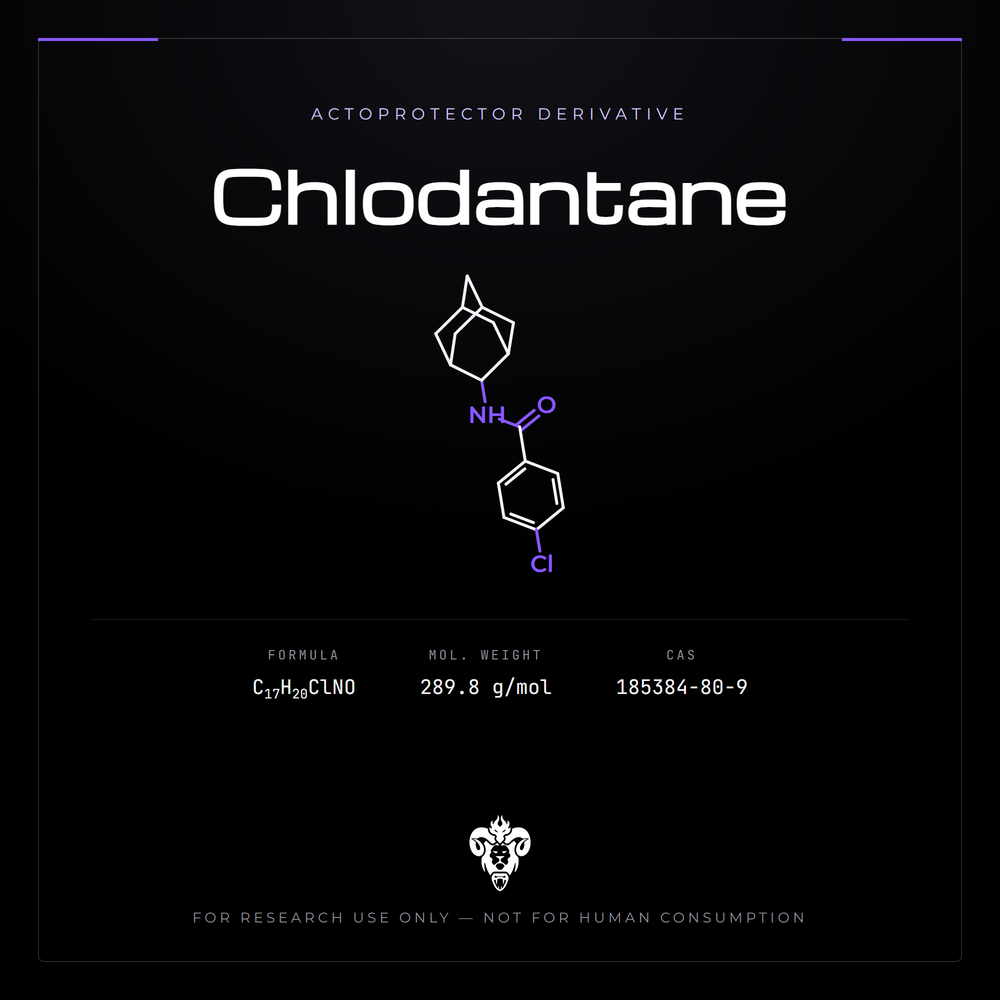
Structural Nuances to Observe: The structural diagram above highlights the distinct spatial orientation of Chlodantane. On the left sits the symmetric, lipophilic adamantyl cage, which introduces massive steric bulk to the molecular environment. This core is coupled via a central amide bridge to a para-substituted chlorobenzene ring on the right. The chlorine atom serves as an electron-withdrawing center, creating a localized polar footprint that researchers leverage to analyze nucleophilic reactivity and bond-cleavage rates compared to brominated analogues.
Research Applications & Chemical Dynamics
In advanced laboratory testing, Chlodantane provides an exceptional framework for examining how bulky polycyclic rings impact adjacent functional groups. Its chemical reactivity is heavily studied under variable thermodynamic profiles.
Primary fields of investigative laboratory research include:
-
Amide Bond Hydrolysis Kinetics: Measuring the precise rate of amide linkage cleavage in the presence of strong acid or base catalysts. Investigators exploit the adjacent adamantyl structure to calculate how localized steric shielding alters activation energy parameters.
-
Nucleophilic Halogen Substitution: Tracking displacement parameters where the para-positioned chlorine atom on the aromatic ring serves as a target site for nucleophilic exchange under controlled, cell-free laboratory settings.
-
Comparative Actoprotector Profiling: Benchmarking Chlodantane against legacy mono-substituent adamantanes to chart relative stability, anti-radical properties, and membrane-stabilization thresholds across lipophilic liquid matrices.
-
Analytical Detection Calibration: Deploying the compound as a reference standard to calibrate liquid chromatography (HPLC-UV) and gas chromatography-mass spectrometry (GC-MS) screening panels for synthetic adaptogen matrices.
Storage & Handling Guidelines
Store at controlled room temperature. Keep tightly closed.
Storage guidance is a house recommendation. Analytical documentation is per-lot release testing.
Frequently Asked Research Questions
How does Chlodantane’s chemical bridge differ from Bromantane?
While Bromantane features a direct amine (NH) link bridging the adamantyl cage to a bromophenyl ring, Chlodantane integrates a full amide (NH-C=O) carbonyl link bonded to a chlorophenyl ring. This alteration changes the molecular weight, shifts the electron distribution across the aromatic ring, and provides a distinct layout for steric hindrance evaluations.
What are the solubility characteristics of Chlodantane in laboratory assays?
Due to the dominant lipophilicity of the nonpolar adamantane cage structure, Chlodantane displays very poor solubility in purely aqueous systems. For effective cell-free assays or liquid chromatography calibration, the material must be fully dissolved in organic solvents such as dimethyl sulfoxide (DMSO) or ethanol before introduction into working laboratory buffers.
Scientific References
-
Morozov, I. S., Ivanova, I. A., & Lukicheva, T. A. (2001). “Actoprotector and Adaptogen Properties of Adamantane Derivatives (A Review).” Pharmaceutical Chemistry Journal, 35(5), 235–238. doi:10.1023/A:1011905302667.
-
Oliynyk, S., & Oh, S. (2012). “The pharmacology of actoprotectors: practical application for improvement of mental and physical performance.” Biomolecules & Therapeutics, 20(5), 446–456. doi:10.4062/biomolther.2012.20.5.446.
Research Use Only Disclaimer: This product is labeled and sold “For Research Use Only — NOT FOR HUMAN CONSUMPTION.” It is not a drug, dietary supplement, food, cosmetic, or medical device, and it is not approved by the FDA or any other regulator for human or veterinary use. It is supplied to approved account holders as a research chemical for laboratory use and must be handled in accordance with applicable law.