Skip to content
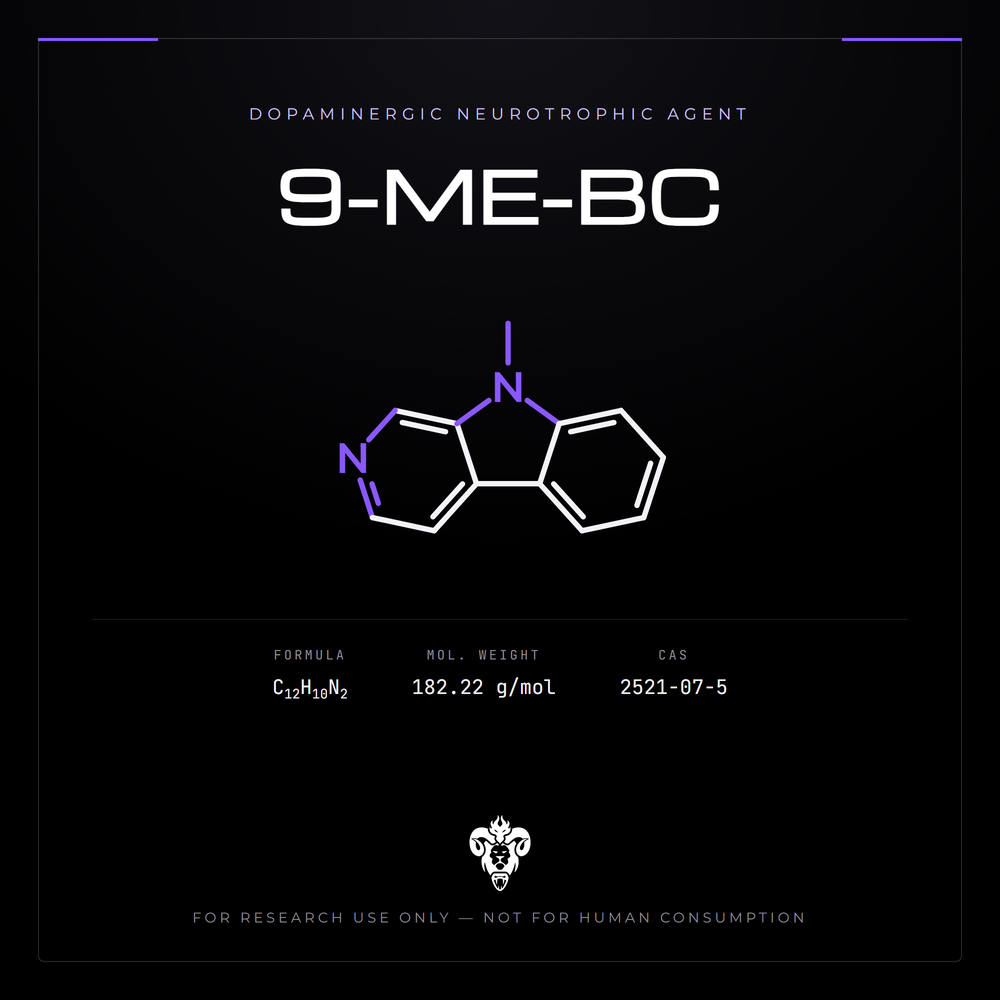

9-ME-BC (9-Methyl-beta-carboline) Research Standard
9-ME-BC (9-Methyl-beta-carboline) is a heterocyclic amine derivative belonging to the beta-carboline family. Within the field of neuropharmacology, it is an investigative compound characterized by its potential dopaminergic and neurotrophic properties. Researchers utilize 9-ME-BC as a pharmacological probe to study pathways involved in neuroprotection, the stimulation of neurite outgrowth, and the enhancement of dopaminergic signaling in controlled in vitro and animal models.
Physical & Handling Properties
| Property | Specification |
|---|---|
| Physical Appearance | White to off-white/pale brown powder |
Mechanism of Action & Research Context
9-ME-BC is primarily investigated for its effects on the dopaminergic system and its potential neuro-regenerative influence, as detailed in established scientific literature.
-
Neurite Outgrowth and TH Expression: 9-ME-BC is notably researched for its neurotrophic properties. Foundational studies by Gille et al. (2011) demonstrated that the compound stimulates neurite outgrowth and increases the expression of tyrosine hydroxylase (TH)—the rate-limiting enzyme in dopamine synthesis—in cultured mesencephalic dopaminergic neurons.
-
Neuroprotective Mechanisms: Research into the compound’s neuroprotective capacity indicates it may mitigate dopaminergic degeneration. Studies by Polanski et al. (2010) evaluated the compound’s ability to provide protection against neurotoxic insults in cellular models, suggesting a role in maintaining dopaminergic neuronal integrity under stress.
-
Cognitive and Behavioral Research: Investigations into the compound’s potential effects on higher-order function have utilized animal models. Research by Gille et al. (2013) observed improvements in spatial learning and memory following administration, hypothesizing that 9-ME-BC may modulate synaptic connectivity pathways.
Research Applications
9-ME-BC is a specialized reagent essential for modern neuroscience and neuro-degenerative research.
Primary fields of in vitro and laboratory investigation include:
-
Neuroprotection Studies: Assessing the ability of the compound to rescue dopaminergic neurons from neurotoxin-induced damage in cellular models.
-
Neurite Outgrowth Analysis: Quantifying the effect of 9-ME-BC on axonal and dendritic extension in cultured primary neurons.
-
Dopaminergic Signaling: Benchmarking the compound’s efficacy in modulating dopamine synthesis and turnover rates.
-
Cognitive Enhancement Models: Utilizing animal models to observe the impact of 9-ME-BC on memory, learning, and synaptic connectivity pathways.
Storage & Handling Guidelines
Store at controlled room temperature. Keep tightly closed.
Storage guidance is a house recommendation. Analytical documentation is per-lot release testing.
Related Research Compounds
Research Use Disclaimer
Research Use Only Disclaimer: This product is labeled and sold “For Research Use Only — NOT FOR HUMAN CONSUMPTION.” It is not a drug, dietary supplement, food, cosmetic, or medical device, and it is not approved by the FDA or any other regulator for human or veterinary use. It is supplied to approved account holders as a research chemical for laboratory use and must be handled in accordance with applicable law.