Skip to content

CDP-Choline
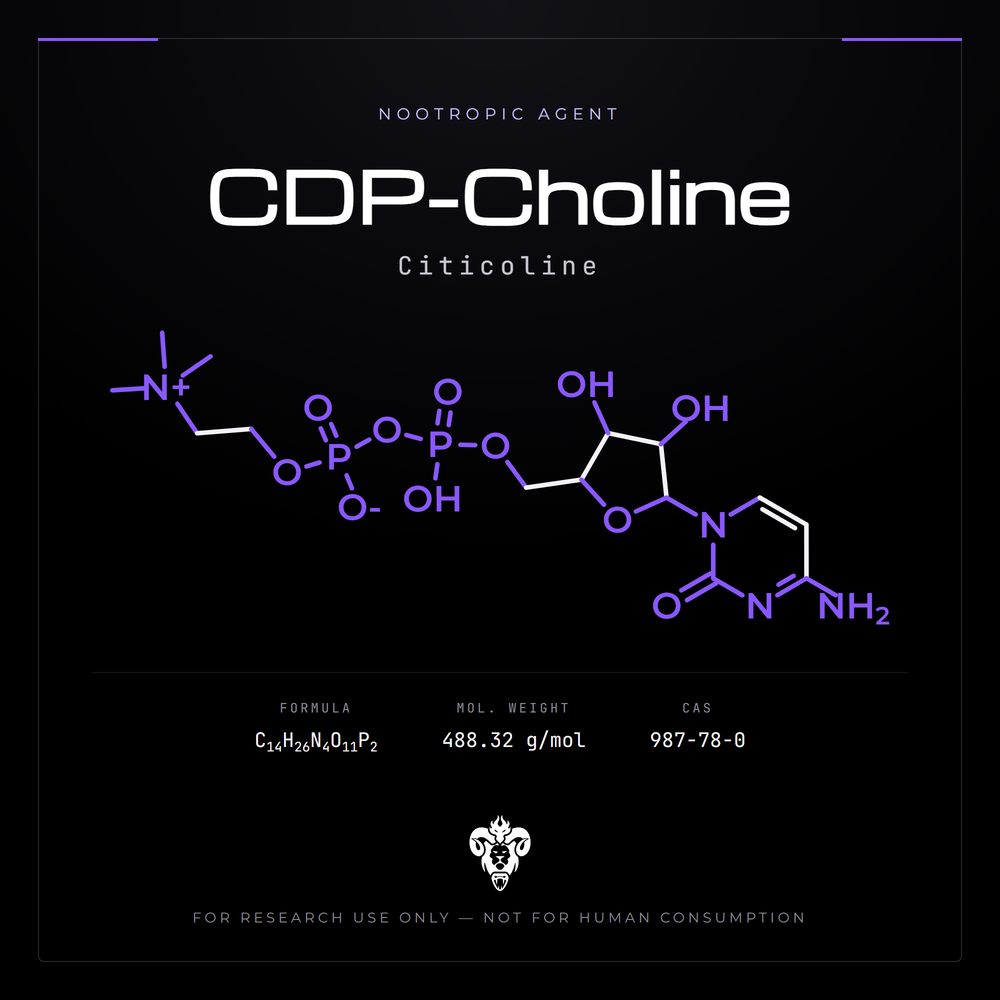
CDP-Choline (Cytidine-5′-diphosphocholine, also commercially referred to as Citicoline) is a vital endogenous nucleotide intermediate playing a foundational role in cellular membrane biology. As a key rate-limiting precursor in the biosynthesis of structural phospholipids—most notably phosphatidylcholine—CDP-Choline is highly sought after in neurochemical, metabolic, and cognitive science research. By serving as both a choline donor and a cytidine donor, this compound provides researchers with an elegant biochemical tool to study cellular membrane dynamics, phospholipid turnover, and neurotransmission pathways under controlled in vitro environments.
Physical & Handling Properties
| Property | Specification |
|---|---|
| Solubility Profile | Freely soluble in water; sparingly soluble in ethanol |
Research Applications & Mechanism of Interest
The biological significance of CDP-Choline lies in its unique dual-action precursor pathway. In cellular environments, the molecule is cleaved into its constituent parts—cytidine and choline—before being resynthesized inside target tissues via the Kennedy pathway.
Primary fields of preclinical and in vitro laboratory investigation include:
-
The Kennedy Pathway (Phospholipid Biosynthesis): Researchers utilize CDP-Choline to study the kinetics of phosphatidylcholine (PtdCho) synthesis. Phosphatidylcholine is a major structural constituent of eukaryotic cell membranes. Investigators track how external administration of the compound restores membrane integrity and limits the activation of destructive phospholipases (specifically phospholipase A₂).
-
Mitochondrial and Cardiolipin Preservation: Academic studies published in the Journal of Neurochemistry and Stroke examine the compound’s capacity to protect highly specialized membrane structures, including cardiolipin (an inner mitochondrial membrane component critical to electron transport chain function) and sphingomyelin.
-
Cholinergic Neurotransmission: Because CDP-Choline acts as a highly bioavailable choline donor, cell culture and tissue model researchers deploy it to analyze rates of acetylcholine (ACh) synthesis and release. This is heavily studied in models of synaptic transmission, learning, and cognitive science.
-
Glutathione Redox Modulation: Preclinical literature suggests that metabolites of CDP-Choline influence methionine pathways, aiding in downstream glutathione (GSH) synthesis. Researchers monitor these pathways to evaluate cellular resilience and oxidative stress profiles in neural and vascular tissue models.
Storage & Handling Guidelines
Store at controlled room temperature. Keep tightly closed.
Storage guidance is a house recommendation. Analytical documentation is per-lot release testing.
Related Research Compounds
Frequently Asked Research Questions
How does CDP-Choline differ from traditional choline salts like Choline Bitartrate?
While simple choline salts only provide the raw material for acetylcholine synthesis, CDP-Choline is a far more complex molecule. It provides both choline and cytidine simultaneously. Cytidine is a direct precursor to uridine, which is necessary for synthesizing the cytidine triphosphate (CTP) that drives the rate-limiting step of membrane phospholipid synthesis. This makes CDP-Choline a dual-pathway tool for studying both neurotransmitter levels and physical membrane repair.
Why is moisture control so critical during the storage of this compound?
Due to its zwitterionic pyrophosphate structure, CDP-Choline is highly hygroscopic. If exposed to ambient moisture, it will absorb water molecules rapidly, causing physical clumping and potentially altering the concentration of precise analytical solutions. Keeping the material tightly sealed with a desiccant is vital to maintaining an accurate dry weight.
Scientific References
-
Rao, A. M., Hatcher, J. F., & Dempsey, R. J. (2001). “Effects of Citicoline on Phospholipid and Glutathione Levels in Transient Cerebral Ischemia.” Stroke, 32(10), 2376–2381. doi:10.1161/hs1001.096010.
-
Weiss, G. B. (1995). “Metabolism and actions of CDP-choline as an endogenous compound and administered exogenously as citicoline.” Life Sciences, 56(9), 637–660. doi:10.1016/0024-3205(94)00427-t.
-
D’Orlando, K. J., & Sandage, B. W., Jr. (1995). “Citicoline (CDP-choline): mechanisms of action and effects in ischemic brain injury.” Neurological Research, 17(4), 281–284. doi:10.1080/01616412.1995.11740327.
-
Secades, J. J., & Frontera, G. (1995). “CDP-choline: pharmacological and clinical review.” Methods and Findings in Experimental and Clinical Pharmacology, 17 Suppl B, 1–54. PMID: 8709678.
Research Use Only Disclaimer: This product is labeled and sold “For Research Use Only — NOT FOR HUMAN CONSUMPTION.” It is not a drug, dietary supplement, food, cosmetic, or medical device, and it is not approved by the FDA or any other regulator for human or veterinary use. It is supplied to approved account holders as a research chemical for laboratory use and must be handled in accordance with applicable law.