
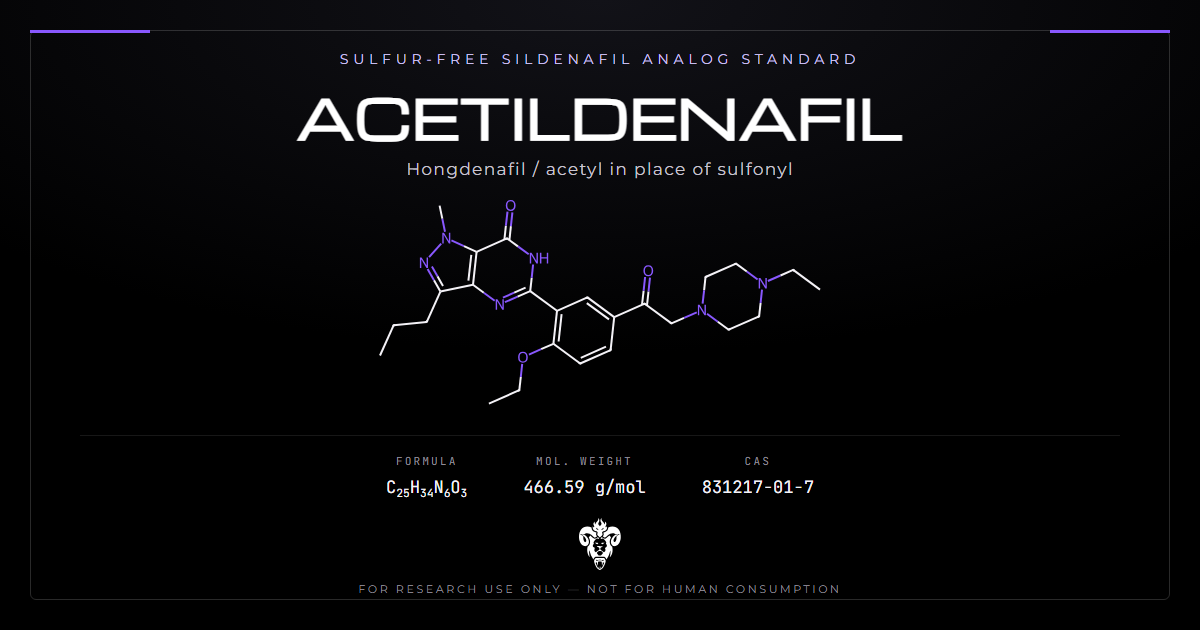
Sildenafil carries a phenylsulfonyl group, and its molecular formula carries a sulfur atom to match: C22H30N6O4S. Acetildenafil replaces that sulfonyl with an acetyl. The formula becomes C25H34N6O3, dropping the sulfur entirely.
That single substitution does more analytical damage than its size suggests. It removes the isotope signature that flags the family, it deletes the fragment that diagnoses sildenafil by mass spectrometry, and in the paper that first pinned down a close relative, it forced the investigators to abandon spectroscopy and cleave the molecule chemically instead [1].
Kimera supplies acetildenafil as an analytical reference standard. It is research material, not a pharmaceutical, and not a substitute for any approved product.
All information here describes laboratory research findings. This material is supplied for research use only and is not for human or veterinary use.
What acetildenafil is
The compound is a pyrazolopyrimidinone built on the sildenafil scaffold, with a ketone linkage where sildenafil has a sulfonamide. It also travels under the name hongdenafil.
Identity and physical data
| Property | Value |
|---|---|
| Compound | Acetildenafil |
| Synonym | Hongdenafil |
| PubChem CID | 135566112 |
| CAS number | 831217-01-7 |
| Molecular formula | C25H34N6O3 |
| Molecular weight | 466.6 g/mol |
| InChIKey | RRBRQNALHKQCAI-UHFFFAOYSA-N |
| Stereocentres | None |
| Chemical class | Pyrazolopyrimidinone, phenacylamine |
Comparison with the parent scaffold
| Sildenafil | Acetildenafil | |
|---|---|---|
| Linking group | sulfonyl, SO2 | acetyl, C=O |
| Molecular formula | C22H30N6O4S | C25H34N6O3 |
| Molecular weight | 474.6 | 466.6 |
| Sulfur present | Yes | No |
| Stereocentres | None | None |
The masses sit only 8 Da apart while the elemental composition differs substantially. That combination is what makes the pair awkward on a low-resolution instrument and straightforward on a high-resolution one.
Why the missing sulfur matters
Sulfur has a distinctive natural isotope pattern. The 34S isotope sits at roughly 4.4 percent relative abundance, two mass units above the main peak, which produces a visible shoulder in the isotope cluster of any sulfur-containing ion.
The screen that keys on sulfur will miss it
An analyst scanning for sildenafil-type compounds can use that isotope shoulder as a quick family marker. Acetildenafil produces no such shoulder, because it contains no sulfur. A screen relying on the pattern therefore passes over it.
The same applies to any elemental filter. A search of high resolution data constrained to sulfur-containing formulae will exclude this compound by construction, and exclude it silently.
The diagnostic fragment disappears too
A 2009 study used high-energy collision-induced dissociation to map the fragmentation of sildenafil and its analogs [2]. Its authors report that product ions carry information about three regions: the piperazine ring, the phenylsulfonyl group and the pyrazolopyrimidine core.
Two of those three survive in acetildenafil. The phenylsulfonyl region does not exist, so the fragments diagnosing it cannot form. An identification built on a sildenafil fragmentation template will fail on the region that changed, which is precisely the region that distinguishes the compounds.
The structure that needed a chemical reaction
The clearest demonstration of the analytical difficulty comes from a 2007 study at the FDA Division of Pharmaceutical Analysis [1].
What spectroscopy could establish
Investigators analysed a herbal supplement by HPLC with photodiode array and mass spectral detection. From ultraviolet spectra, mass spectra and direct infusion multi-stage mass spectrometry, they identified the compound tentatively as a sildenafil analog with the sulfonyl replaced by an acetyl.
Tentatively is the word they used. The spectra narrowed it to a close relative of acetildenafil without settling which one.
What settled it
They cleaved the phenacylamine group chemically (DOI). That reaction released N-methylpiperazine, and the remaining cleavage products matched those generated from an authentic acetildenafil sample.
The unknown carried an N-methyl where acetildenafil carries an N-ethyl, one CH2 less. They named it nor-acetildenafil.
Why that method is worth remembering
Degradative chemistry to identify an unknown looks old-fashioned beside high resolution mass spectrometry. It answered a question the spectra could not. Cleaving a molecule at a known bond and identifying the pieces against authentic fragments is unambiguous in a way that spectral similarity is not.
Note also what the comparison required: an authentic acetildenafil sample to cleave alongside the unknown. The reference standard was load-bearing.
Reference standards had to be synthesised
This is the recurring practical complaint across the acetildenafil literature, and it explains why catalogue material for these compounds exists.
Not commercially available
The 2009 fragmentation study states the problem directly [2]. Acetildenafil, homosildenafil and hydroxyhomosildenafil were not commercially available, so the investigators synthesised them in order to compare tandem mass spectra against the compounds isolated from supplements.
A laboratory without synthetic capability cannot run that comparison at all.
Published routes for in-house preparation
A 2014 study from the Istituto Superiore di Sanità went further [3]. It characterised sildenafil, thiosildenafil, acetildenafil and thirteen analogs by NMR and tandem mass spectrometry, tabulating key signals for each.
Its authors then included synthesis routes, stating the purpose plainly: for the benefit of medicines control laboratories that need to prepare analog reference standards in-house. A paper publishing synthetic procedures so that regulators can make their own standards is a clear statement that the supply gap is real.
What that means for a purchaser
An authentic sample removes the synthesis step and the uncertainty that comes with a self-prepared standard. Confirm identity on receipt regardless, by mass and by NMR. Naming in this family varies enough that a label alone settles little.
The analogs of the analog
Acetildenafil has itself become a parent structure in the literature, which mirrors what happened to nortadalafil on the other scaffold.
| Compound | Relationship |
|---|---|
| Acetildenafil | acetyl in place of sildenafil’s sulfonyl |
| Nor-acetildenafil | N-methyl piperazine instead of N-ethyl, one CH2 less [1] |
| Hydroxyacetildenafil | hydroxyl added, found in bulk powder [4] |
A 2006 study isolated hydroxyacetildenafil from pre-mixed bulk powder destined for encapsulation [4]. Its structure came from NMR, high resolution electrospray mass spectrometry, multi-stage mass spectrometry and infrared together.
Bulk powder is worth noting as a sample type. Material intercepted before encapsulation has not yet entered a formulation. Concentrations therefore run high, and the matrix stays simpler than a finished product.
Screening methods that include it
Several validated multi-analyte methods cover this compound, which makes method development largely a matter of selection rather than invention.
Chromatographic screens
A 2005 method paired HPLC with diode array detection and liquid chromatography with electrospray tandem mass spectrometry, covering sildenafil, vardenafil, tadalafil, homosildenafil, acetildenafil and hydroxyhomosildenafil [5]. Its authors applied it to pre-market samples at the Singapore Health Sciences Authority. Identification rested on retention time, ultraviolet spectrum and mass spectrum against reference standards.
A 2015 high resolution method screened eleven added compounds, including both acetildenafil and nor-acetildenafil [6]. Detection limits ran at 25.0 ng/mL for most analytes and 5.0 ng/mL for nor-acetildenafil, with recoveries from 82.0 to 105.9 percent.
Sample preparation matters more than the instrument
A 2017 study combined solid-phase extraction with dispersive liquid-liquid microextraction based on solidification of a floating organic droplet, then ion-pairing liquid chromatography with ultraviolet detection [7]. Detection limits reached 2.5 to 7.5 ng/mL.
One detail in that paper deserves attention. Linearity ran from 5.0 to 100 ng/mL for five compounds and from 10 to 100 ng/mL for acetildenafil, a narrower working range than its siblings under the same conditions. Where a method treats a family uniformly, check whether every member actually behaves uniformly.
Metabolism, and how little is known
A 2017 study opens by stating that the metabolic profiles of illegal sildenafil analogs have not been reported [8]. That was the motivation for the work.
Five metabolites
Investigators incubated hongdenafil with human liver microsomes and dosed rats, then analysed urine and faeces by liquid chromatography with quadrupole time of flight mass spectrometry (DOI). They characterised five metabolites for this compound, alongside six for homosildenafil and seven for hydroxyhomosildenafil.
Why that matters for detection
Analysing a biological sample for the parent compound alone risks a false negative, the same trap that appears with the tadalafil family. If metabolism moves the signal, a method blind to metabolites reports clean.
Those authors also note the reverse use: metabolite identification supplies the fundamental data needed to consider side effects and toxicity of compounds that entered products without any assessment. That framing explains the funding honestly.
Where it turns up, and how often
Survey work sets the context for why validated methods exist at all.
Screening surveys
A 2018 survey examined tonic liquors, screening for 86 phosphodiesterase type 5 inhibitors by liquid chromatography with quadrupole time of flight mass spectrometry [9]. Four of 28 samples carried undeclared compounds, a rate of 14.3 percent.
A 2023 study took a different approach, using high performance thin layer chromatography as a first pass with high resolution tandem mass spectrometry to confirm [10]. It reported sildenafil, tadalafil or both in 73.3 percent of products tested. Every product carried a natural label, and the amounts found matched or exceeded those in approved medicinal products.
Read those numbers carefully
Both figures come from products chosen because someone suspected them. Neither describes prevalence in the wider market. They establish that the analysis earns its funding, and nothing more.
The thin layer method deserves a second look for a different reason. It is cheap, it needs no mass spectrometer, and it narrowed the queue before the expensive instrument ran. For a laboratory short on instrument time, that sequencing matters more than the sensitivity of any single technique.
Both scaffolds share one detection problem
The catalogue category spans two unrelated chemical families, and reading their literatures side by side shows the same difficulty appearing twice.
The pattern repeats
On the tadalafil scaffold, the earliest report dates to 2006 and closes by recommending the compound for inclusion on screening target lists [11]. Analysts kept finding new substitutions at one position, and each new compound arrived with a trivial name coined by whoever isolated it.
On the sildenafil scaffold, the same thing happened around this compound. Nor-acetildenafil and hydroxyacetildenafil both entered the record as modifications of a modification [1][4].
Why targeted methods keep falling behind
Both families grow by small edits to a fixed core. Each edit shifts precursor mass while leaving the chromophore and most of the fragmentation intact. A targeted method therefore detects the compounds already in its library and misses the next one by construction.
Non-target acquisition is the only structural answer. Record unassigned peaks above a threshold, keep the raw high resolution data, and accept that a later library may need applying retrospectively.
Biological matrix adds a second layer
A 2025 forensic method quantified four inhibitors and twelve metabolites in rat plasma [12]. Two tadalafil-related species went undetected as parent compounds while their glucuronide conjugates carried the signal.
The metabolite work on this compound points the same way [8]. For product analysis the parent is the target. For biological matrix it may not be, and a method that assumes otherwise returns clean on positive samples.
Physicochemical properties and handling
| Parameter | Detail |
|---|---|
| Solubility | Soluble in DMSO and methanol; limited aqueous solubility |
| Storage | Sealed, dry, protected from light |
| Stability | Stable as a dry solid at ambient conditions |
| Stock solutions | Prepare in DMSO or methanol; aliquot to avoid freeze-thaw |
Methanol extraction is standard across the screening literature [6], so a methanolic stock aligns with published methods and avoids a solvent-switch step.
No chiral method required
The InChIKey ends UHFFFAOYSA, and here that reflects a genuinely achiral molecule rather than an undefined mixture. Acetildenafil has no stereocentre.
A single achiral purity method characterises it completely. That separates it, and mirodenafil, from the four tadalafil-family compounds in the same catalogue category, each of which carries two stereocentres and a live configuration question.
Acetildenafil among the phosphodiesterase inhibitors
| Compound | Scaffold | Sulfur | Chiral method |
|---|---|---|---|
| Acetildenafil | pyrazolopyrimidinone | No | No |
| Mirodenafil | pyrrolopyrimidinone | Yes | No |
| Nortadalafil | tetracyclic tadalafil type | No | Yes |
| N-ethyl Tadalafil | tetracyclic tadalafil type | No | Yes |
| Aminotadalafil | tetracyclic tadalafil type | No | Yes |
| N-Isopropyl Tadalafil | tetracyclic tadalafil type | No | Yes |
Two axes, and they do not align
Read that table across and the category divides twice, differently each time. Scaffold separates the sildenafil types from the tadalafil types. Sulfur separates mirodenafil from everything else, including its own scaffold-mate.
Neither division follows the category name, which groups by target. Anyone building methods rather than reading pharmacology should work from the columns rather than the heading. Further reading sits in the PDE5 inhibitor research library, and the reference standard ships against batch documentation.
Certificates, standards and method transfer
Purity by HPLC with the method named, identity by mass spectrometry against 466.6, and structural confirmation by NMR. Residual solvent matters for synthetically prepared material more than for isolated material.
Ask specifically about the near neighbours. Nor-acetildenafil differs by one CH2 and hydroxyacetildenafil by one oxygen, and a purity method that cannot resolve them is not evidence of their absence [1][4]. Batch documentation for catalogue material sits in the certificate of analysis database.
Practical notes for method transfer
Most laboratories adopt a published method rather than build one. Four things travel badly between laboratories, and each has caused a quiet failure somewhere.
Check the working range per analyte
Published multi-analyte methods often quote one linear range for the whole panel. At least one does not, and the compound described here was the exception in it. Verify each analyte separately rather than trusting a single headline figure.
Confirm the extraction, not just the separation
Cleanup carries more risk than chromatography. A solid-phase cartridge chosen for one scaffold may retain the other poorly, and the two families here differ in polarity. Spike the matrix and measure recovery for every target before running samples.
Watch the detector choice
Ultraviolet detection is adequate for product powders at the concentrations usually present. It is not adequate for trace work or for distinguishing near neighbours. Where the question is identity rather than presence, mass spectrometry is the minimum.
Reference standards degrade in solution
Prepare working standards fresh from solid where possible. A dilute standard held for months can drift low, which shifts every quantitation against it without triggering any obvious failure. Bracket runs with a freshly prepared point to catch that.
Open questions and how to read this literature
Almost none of it is pharmacology
Papers naming acetildenafil are analytical and forensic with few exceptions. Isolation, structure elucidation, method validation, screening survey. The 2017 metabolite study states outright that clinical effects have not been reported [8].
Anything said about activity at the target is read across from sildenafil, and the sulfonyl-to-acetyl change is exactly the sort of modification that makes read-across unreliable.
The naming is inconsistent, again
Acetildenafil and hongdenafil name one compound. Nor-acetildenafil describes a CH2 less without stating where, though in this case the originating paper does specify. The same problem runs through the tadalafil family on the other scaffold.
Search on the CAS number where possible. And note that database term mapping can silently expand a query on these trivial names into the parent drug concept, returning thousands of records that have nothing to do with the analog.
The metabolite work has not been extended
One study characterised five metabolites [8]. Nobody appears to have followed it with quantitative methods for those metabolites, so a laboratory wanting to measure them is building from structure assignments rather than from validated transitions.
What would help
Commercial availability of the near neighbours would close the largest gap, since nor-acetildenafil and hydroxyacetildenafil are the compounds a purity method most needs to exclude and the ones hardest to obtain.
Frequently asked questions
How does acetildenafil differ from sildenafil?
An acetyl group replaces the sulfonyl that links the aryl ring to the piperazine [1]. Formula changes from C22H30N6O4S to C25H34N6O3, and the sulfur is lost.
Why does the missing sulfur matter analytically?
Sulfur gives a distinctive isotope pattern and a diagnostic fragment region. Both are absent here, so a screen keyed on either will miss the compound [2].
Is hongdenafil the same compound?
Yes. The two names appear for one substance, with a single CAS number and InChIKey.
Does it need a chiral purity method?
No. The molecule has no stereocentre, and its InChIKey carries an undefined stereo block accordingly.
Why did reference standards have to be synthesised?
Because no supplier offered them when the key method papers appeared [2]. One study went further and published synthesis routes, so control laboratories could prepare their own [3].
What is the fastest way to distinguish it from sildenafil?
High resolution mass measurement. The elemental compositions differ by more than the 8 Da mass gap suggests, so an accurate mass and its isotope pattern separate them immediately. On a low-resolution instrument the two sit close enough to cause trouble.
Which sample types does the literature cover?
Herbal supplements, capsules, pre-mixed bulk powder awaiting encapsulation, tonic liquors and health care products [1][4][6][9]. Bulk powder is the simplest matrix of those, since nothing has been formulated around the compound yet.
Are its metabolites known?
Investigators characterised five, in human liver microsomes and in rat urine and faeces [8]. Validated quantitative methods for them have not followed.
References
- Reepmeyer JC, Woodruff JT. Use of liquid chromatography-mass spectrometry and a chemical cleavage reaction for the structure elucidation of a new sildenafil analogue detected as an adulterant in an herbal dietary supplement. J Pharm Biomed Anal. 2007;44(4):887-93. PubMed DOI
- Ahn S, Hong JY, Hong MK, et al. Structural determination of sildenafil and its analogues in dietary supplements by fast-atom bombardment collision-induced dissociation tandem mass spectrometry. Rapid Commun Mass Spectrom. 2009;23(19):3158-66. PubMed DOI
- Mustazza C, Borioni A, Rodomonte AL, et al. Characterization of Sildenafil analogs by MS/MS and NMR: a guidance for detection and structure elucidation of phosphodiesterase-5 inhibitors. J Pharm Biomed Anal. 2014;96:170-86. PubMed DOI
- Hou P, Zou P, Low MY, et al. Structural identification of a new acetildenafil analogue from pre-mixed bulk powder intended as a dietary supplement. Food Addit Contam. 2006;23(9):870-5. PubMed DOI
- Zou P, Oh SS, Hou P, et al. Simultaneous determination of synthetic phosphodiesterase-5 inhibitors found in a dietary supplement and pre-mixed bulk powders for dietary supplements. J Chromatogr A. 2006;1104(1-2):113-22. PubMed DOI
- Hu T, Qu X, Kang M, et al. Rapid screening and confirmation of illegally added anti-impotence preparations in health care products by high performance liquid chromatography-high resolution mass spectrometry. Se Pu. 2015;33(8):897-901. PubMed DOI
- Li J, Roh SH, Shaodong J, et al. Solid-phase extraction assisted dispersive liquid-liquid microextraction based on solidification of floating organic droplet to determine sildenafil and its analogues in dietary supplements. J Sep Sci. 2017;40(15):3120-3129. PubMed DOI
- Yeo M, Park Y, Lee H, et al. New metabolites of hongdenafil, homosildenafil and hydroxyhomosildenafil. J Pharm Biomed Anal. 2018;149:586-590. PubMed DOI
- Ding B, Wang Z, Xie J, et al. Phosphodiesterase-5 inhibitors in Chinese tonic liquors by liquid chromatography coupled with quadrupole time of flight mass spectrometry. Food Addit Contam Part B. 2018;11(3):214-222. PubMed DOI
- Gheorghiu ORC, Ciobanu AM, Guțu CM, et al. Determination of Phosphodiesterase Type-5 Inhibitors (PDE-5) in Dietary Supplements. Molecules. 2023;28(10):4116. PubMed DOI
- Zou P, Hou P, Low MY, Koh HL. Structural elucidation of a tadalafil analogue found as an adulterant of a herbal product. Food Addit Contam. 2006;23(5):446-51. PubMed DOI
- Xia X, Song Z, He W, et al. Simultaneous determination of four PDE5 inhibitors and metabolites in rat plasma by UPLC-MS/MS. J Pharm Biomed Anal. 2025;262:116883. PubMed DOI