

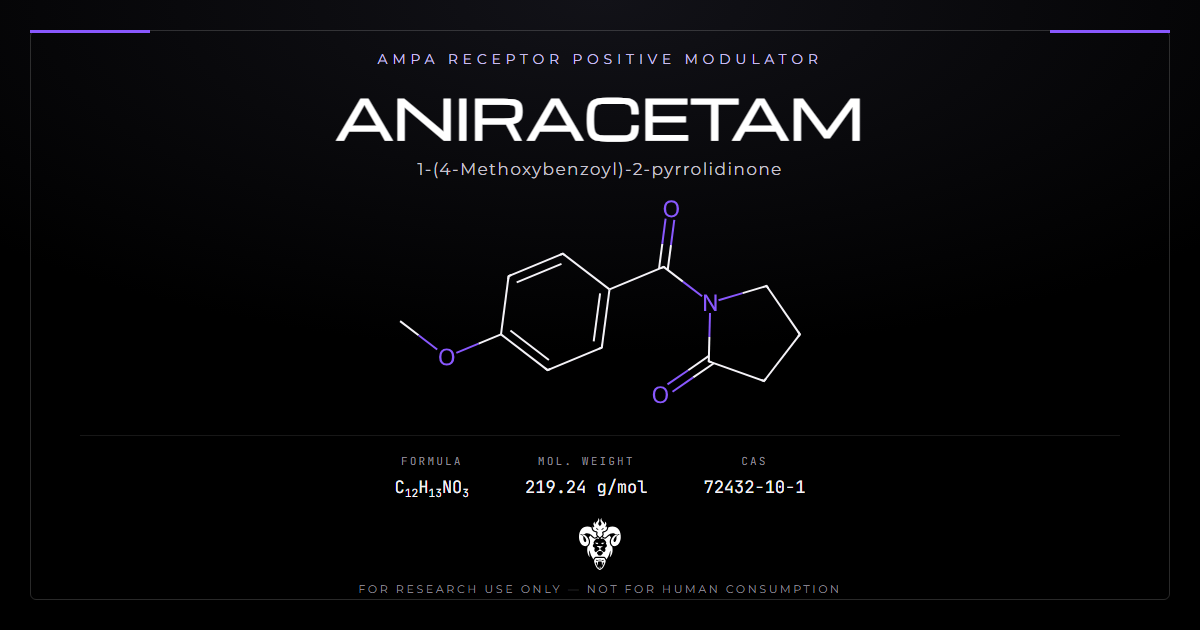
Piracetam founded a drug category and never acquired a molecular target. Its successor did, and that target is well characterised. Aniracetam slows the desensitisation of AMPA receptors, and it gave a whole field of drug design its prototype [1][11].
That is the good news, and it is genuine. A problem sits one level down.
Potentiation in a brain slice needs at least 0.1 mM [1]. Validated assays for the parent drug in human plasma top out at 800 ng/mL, roughly 27 times lower [2]. So the one racetam with a target may never reach it.
What circulates instead is metabolite, in quantities the assays were built to expect. The manufacturer’s own reviewer conceded that those metabolites may carry the effects [10].
Chemical identity
A small lipophilic molecule: a pyrrolidinone ring acylated with an anisoyl group, which is what separates it from piracetam.
| Property | Value |
|---|---|
| Chemical name | 1-(4-Methoxybenzoyl)-2-pyrrolidinone |
| Also written | 1-p-Anisoyl-2-pyrrolidinone |
| Development code | Ro 13-5057 |
| Trade names | Draganon, Sarpul, Ampamet |
| Molecular formula | C12H13NO3 |
| Average mass | 219.24 Da |
| Monoisotopic mass | 219.0895 Da |
| XLogP | 1.6 |
| CAS number | 72432-10-1 |
| PubChem CID | 2196 |
| InChIKey | ZXNRTKGTQJPIJK-UHFFFAOYSA-N |
| Main metabolite | N-anisoyl-GABA |
| Class | Pyrrolidinone nootropic, AMPA receptor positive allosteric modulator |
Reading the structure
Piracetam is 2-oxo-1-pyrrolidine acetamide, and it is strikingly water-loving, with an XLogP of -1.3. Aniracetam takes the same five-membered ring and hangs a methoxyphenyl ketone on the nitrogen.
That one substitution moves XLogP from -1.3 to +1.6, a shift of nearly three log units. The molecule crosses membranes far more readily, which was the design intent for a second-generation compound.
The same change creates the liability. An aryl ketone on a ring nitrogen is a substrate for hydrolysis. The bond that makes the molecule lipophilic is the bond the liver breaks.
Where it sits among the racetams
The family shares a scaffold and very little else. Piracetam has no established receptor. Oxiracetam adds a hydroxyl. Noopept is not a racetam at all despite the naming convention, being a dipeptide.
Aniracetam is the member with a defined molecular action. That makes it the interesting case in the family rather than the strongest one.
The founding experiment
One 1990 paper in The Journal of Physiology established what this compound does, and it remains the reference [1].
What Ito measured
Ito and colleagues at Chugai injected rat brain messenger RNA into Xenopus oocytes and recorded the responses (PMID 1975272) [1]. Aniracetam potentiated ionotropic quisqualate responses reversibly.
Selectivity was clean. Kainate, NMDA and GABA responses in the same oocytes were unaffected [1]. Potentiation raised conductance without changing receptor affinity for agonist or the reversal potential. That points at gating rather than binding.
The slice work agreed. Responses in CA1 pyramidal cells were potentiated, as were excitatory postsynaptic potentials at Schaffer collateral and mossy fibre synapses [1].
The concentration in that experiment
The number that matters appears in the same abstract. Potentiation “was observed above the concentrations of 0.1 mM” [1].
At a molecular mass of 219.24, 0.1 mM is 21.9 µg/mL. Hold that figure, because the pharmacokinetics section returns to it.
What positive allosteric modulation means here
AMPA receptors desensitise within milliseconds of glutamate binding. A modulator that slows the process leaves the channel open longer for the same synaptic release.
Slowing desensitisation and deactivation
Aniracetam acts on the receptor’s gating kinetics rather than on the glutamate binding site [1][7]. At a synapse the result is a larger, slower excitatory current. That is why the compound turns up throughout the long-term potentiation literature.
Wijayawardhane and colleagues used it as a tool for exactly that purpose, in rats exposed to ethanol in utero [12]. They reported improvement in miniature EPSC amplitude, frequency and decay time. Changes were visible at the single-channel level, including open probability, conductance and burst duration.
A site distinct from cyclothiazide’s
Two lines of evidence separate this compound from the other classical modulator. Partin and colleagues mutated residue 750 of the GluRA subunit, the residue controlling cyclothiazide’s action [7]. Kinetic analysis came out consistent with the two compounds acting through distinct mechanisms.
Lei and colleagues added a second separation. Protons enhance AMPA receptor desensitisation. Cyclothiazide reduces that proton sensitivity, while the effect of aniracetam runs independent of pH [9].
Two modulators of the same receptor, two different sites and two different mechanisms. The receptor has more than one allosteric handle.
The second reported target
AMPA modulation is not the only action attributed to this compound. The 1994 review describes positive modulation of metabotropic glutamate receptors as well, along with a possible facilitation of cholinergic transmission [5].
Those additional actions are worth holding loosely. They come from a period when the same laboratory tradition attributed cholinergic effects to every racetam, and the AMPA result is the one that has been replicated independently and refined by mutagenesis [7][8][9].
A compound credited with three mechanisms usually has one that is well measured and two that are inferred from downstream readouts.
The field it founded outgrew it
Being first is not the same as being best, and the medicinal chemistry that followed makes the point numerically.
| Compound | Reported potency relative to aniracetam | Source |
|---|---|---|
| IDRA-21 | 20 to 30 times more potent, orally, in rats | [6] |
| PEPA | At least 100 times more potent in vitro | [8] |
| Cyclothiazide | Distinct mechanism, higher potency | [7][9] |
The successors
Zivkovic and colleagues developed IDRA-21, a benzothiadiazine that attenuates AMPA receptor desensitisation [6]. Given orally to rats, it ran 20 to 30 times more potent than aniracetam across water maze and passive avoidance tests. Only the (+) enantiomer was active, which argues for a stereoselective site.
Sekiguchi and colleagues then described PEPA, a sulfonylamino compound at least 100 times more potent in vitro [8]. It prefers flop splice variants where cyclothiazide prefers flip.
What the class became
A 2006 review of the patent literature names three chemical families pursued as AMPA potentiators [11]. They are aniracetam derivatives, cyclothiazide derivatives and biarylpropylsulfonamides. One family carries this compound’s name, and what reached development were its derivatives rather than the parent.
So Aniracetam is the prototype of a class that moved past it. That is an ordinary outcome in medicinal chemistry, and a strange basis for a purchase decision.
The pharmacokinetic problem
One gap sits at the centre of this compound: bench concentration against plasma concentration. Published assay work answers it.
What the assays imply
Guenzi and Zanetti validated two plasma methods for this compound (PMID 2079514) [2]. They applied them to more than 1,000 samples from two bioavailability studies in healthy volunteers.
Look at the calibrated ranges they chose. The parent method was validated to 800 ng/mL. The method for N-anisoyl-GABA was validated to 50 µg/mL [2]. Assay ranges are built around the concentrations a laboratory expects to measure, and these two differ by roughly sixtyfold.
The arithmetic
Ito’s threshold was 0.1 mM, which is 21.9 µg/mL [1]. The top of the parent’s validated plasma range is 0.8 µg/mL [2].
Potentiating AMPA receptors in a slice takes around 27 times the highest concentration the human plasma assay was built to quantify. Two caveats belong with that figure. Brain concentration is not plasma concentration. A bath concentration in a slice chamber is not a tissue concentration either.
Neither caveat closes a gap of that size, and the direction of the discrepancy is consistent.
The metabolite question
Aniracetam is hydrolysed to N-anisoyl-GABA, and that metabolite dominates what circulates [2]. The same pattern appears elsewhere in this catalogue. Noopept has cycloprolylglycine and Selank has its own fragment. In each case the parent may be a delivery vehicle.
Nakamura, writing from Nippon Roche, put it plainly. Several metabolites affect learning and memory in animals, so major metabolites may well contribute to the effects [10].
That review closes with a sentence worth quoting for its restraint. There is no convincing evidence, its author wrote, that the animal-model results guarantee clinical efficacy [10].
The clinical record
Unlike most compounds in this catalogue, this one has controlled human trials. They are old, small and mostly Italian.
The Alzheimer trials
Senin and colleagues randomised 109 elderly patients with probable Alzheimer’s disease (PMID 1822317) [4]. Treatment ran six months against placebo. The treated group differed significantly by the end, improving on psychobehavioural measures while placebo patients deteriorated steadily.
A 1994 review summarised the wider programme [5]. At 1,500 mg/day the compound beat placebo on all tests at four and six months, in mild to moderate senile dementia of the Alzheimer type.
Against piracetam
The same review reports the comparison that matters more. In a six-month trial against piracetam at 2,400 mg/day, aniracetam was more effective on 8 of 18 tests [5].
Read that number in both directions. It beat the first-generation compound on fewer than half the measures. On the other ten the trial reports no separation.
How the trials read thirty years on
Age changes what these results mean, and not only through the usual complaint about small sample sizes.
Senin’s patients met NINCDS-ADRDA criteria for probable Alzheimer’s disease [4]. That was the standard in 1991, and it was a clinical diagnosis made without biomarkers. Modern cohorts are defined by amyloid and tau measurements, and the older criteria admitted a substantial fraction of patients who would now receive a different diagnosis.
Endpoints have moved too. The six-month trials read out on psychometric batteries and behavioural scales rather than on the standardised composites regulators now expect.
None of that makes the results wrong. It means a positive six-month result from 1991 does not sit on the same footing as a modern trial of the same length, and the compound has not been retested to current standards in the three decades since.
What a 2018 meta-analysis can and cannot say
A multiple-treatments meta-analysis pooled 235 studies and 44,854 patients [13]. It found symptomatic treatment for vascular dementia the most effective intervention available.
Aniracetam sits inside that finding. So do piracetam, nimodipine, flunarizine, vinpocetine, oxiracetam, hyperbaric oxygen and a Ginkgo extract, pooled as one category [13]. The result belongs to the category. Attributing it to any single member repeats the attribution error that runs through the CoQ10 and selenium literature.
The adrenal dependence nobody mentions
One 1989 finding deserves far more attention than it gets, and it applies to the whole family.
Mondadori and colleagues at Ciba-Geigy reported that piracetam, oxiracetam, pramiracetam and aniracetam are all inactive in adrenalectomised animals [3]. Blocking the adrenal cortex chemically, or pretreating with a mineralocorticoid antagonist, eradicated the memory-enhancing effect of all four compounds.
Whatever these drugs do, they do not do it independently of adrenal steroids. That is a mechanistic constraint on the entire class, published in a supplement, and largely absent from the modern discussion.
Where the modern work is
Interest revived through a specific piece of receptor biology rather than through cognition research.
TARP gamma-8 and ADHD
Transmembrane AMPA receptor regulatory protein gamma-8 is an auxiliary subunit of the receptor. Mice lacking it show hyperactivity, impulsivity and memory deficits.
Sun and colleagues treated those knockouts and reported improvement in locomotor activity, recognition memory and fear conditioning [15]. A 2026 follow-up used microdialysis with mass spectrometry [16]. It reported shifts in glutamate, GABA and monoamine transporter expression in prefrontal cortex.
Both are mouse studies in one knockout line, and both come from the same group in Hebei.
Breadth of models is not breadth of evidence
The 2002 review lists the rodent models this compound has been run through. They cover hypoattention, hypovigilance, impulsiveness, hyperactivity, fear and anxiety, depression, impaired rapid-eye-movement sleep, disturbed temporal regulation and bladder hyperactivity [10].
That list reads as a strength and should be read as a warning. A compound reported active in ten dissimilar models is either broadly useful or non-specific, and the two look identical from a list of positive results.
The same review draws the line itself, stating that no convincing evidence establishes that these model results will translate into clinical efficacy [10]. Its author worked for the company that developed the drug.
A hypothesis paper worth labelling
A 2024 paper in the Journal of Alzheimer’s Disease proposes that aniracetam prevents amyloid accumulation [14]. The proposed route runs through alpha-secretase activity, raised by BDNF expression and metabotropic glutamate receptor modulation.
It is a single-author proposal from a commercial research department, and it presents a model rather than new data. Read it as a hypothesis with a citation trail, which is what it says it is.
Four questions to ask of any Aniracetam result
The literature is unusually easy to misread because the good experiments and the human dosing live at different concentrations.
Is this a bath concentration or a plasma concentration?
Slice and oocyte work runs at 0.1 mM and above [1]. Human plasma assays were built for hundreds of ng/mL [2]. Numbers from the two settings are not comparable.
Parent or metabolite?
N-anisoyl-GABA dominates circulating material, and several metabolites are active in animals [2][10]. A result attributed to the parent after oral dosing may belong to something else.
Which racetam, and was the comparison run?
Against piracetam at 2,400 mg/day, the advantage appeared on 8 of 18 tests [5]. That is the only head-to-head worth citing.
Category or compound?
The 2018 meta-analysis result belongs to a pooled category of eight interventions [13]. Pull one member out and the finding no longer holds.
Verifying research material
A 219 Da small molecule is the easiest identity problem in this catalogue, which is no reason to skip it.
Identity
Melting point, nuclear magnetic resonance and mass spectrometry all settle this structure quickly. Monoisotopic mass is 219.0895 and the InChIKey is ZXNRTKGTQJPIJK-UHFFFAOYSA-N.
The methoxy singlet near 3.9 ppm and the para-substituted aromatic pattern are diagnostic in proton NMR. A certificate reporting only appearance and a melting range has not identified the compound.
Purity and related substances
Hydrolysis is the expected degradation route, and it produces p-anisic acid and 2-pyrrolidinone. Both are detectable by reversed-phase chromatography, and their presence indicates exposure to moisture rather than a synthesis problem.
That same hydrolysis is what happens metabolically, so a partly degraded sample contains the metabolite rather than an unrelated impurity. Chromatographic purity by area percent at a single wavelength can flatter a sample here. The degradants absorb differently from the parent.
Handling
Store dry, cold and dark, and keep the container closed against ambient moisture. The compound is a neutral solid with modest water solubility. It dissolves readily in dimethyl sulfoxide or ethanol for stock solutions.
Prepare aqueous working solutions fresh. An amide bond adjacent to an aromatic ketone hydrolyses slowly in water, and faster at extremes of pH. A stock kept in buffer on a bench is a different sample by the end of the week.
Kimera publishes third-party certificates of analysis for every lot in its COA database. Laboratories source aniracetam as an AMPA receptor modulator reference. It pairs with unifiram, a structurally unrelated comparator from the same research tradition. Related work appears in the nootropics category.
Common questions about Aniracetam
What does aniracetam do at the molecular level? It slows AMPA receptor desensitisation and deactivation, raising conductance without changing agonist affinity [1].
How is that different from piracetam? Piracetam has no established receptor. This compound has a defined action on a named receptor, at concentrations above 0.1 mM [1].
Why does the concentration matter? The bench threshold is about 21.9 µg/mL. The human plasma assay for the parent was validated to 0.8 µg/mL [1][2].
What happens to it in the body? It is hydrolysed to N-anisoyl-GABA, which dominates plasma, and several metabolites are active in animals [2][10].
What did the human trials show? Improvement against placebo over six months in mild to moderate Alzheimer’s disease [4][5]. Against piracetam, an advantage on 8 of 18 tests [5].
Is it still being studied? Yes, mainly in TARP gamma-8 knockout mice as an ADHD model [15][16].
Summary of the evidence
Identity: C12H13NO3, 219.24 Da, XLogP 1.6, CAS 72432-10-1. An anisoyl group on the piracetam ring shifts lipophilicity by nearly three log units.
Mechanism: positive allosteric modulation of AMPA receptors, acting on gating rather than binding [1]. Kainate, NMDA and GABA responses are unaffected. The site differs from cyclothiazide’s [7][9].
Concentration gap: potentiation above 0.1 mM, equal to 21.9 µg/mL [1]. The parent plasma assay was validated to 0.8 µg/mL [2].
Metabolism: hydrolysis to N-anisoyl-GABA, which dominates circulating material, with several metabolites active in animals [2][10].
Potency in context: IDRA-21 runs 20 to 30 times more potent orally [6], PEPA at least 100 times more potent in vitro [8]. The class is named after this compound and moved past it [11].
Clinical: positive six-month placebo-controlled results in Alzheimer’s disease at 1,500 mg/day [4][5], and an advantage over piracetam on 8 of 18 tests [5]. A 2018 meta-analysis reports a finding that belongs to a pooled category rather than to this compound [13].
Class constraint: all four classical racetams are inactive in adrenalectomised animals [3].
Status: supplied for laboratory research use only.
References
- Ito I, Tanabe S, Kohda A, Sugiyama H. Allosteric potentiation of quisqualate receptors by a nootropic drug aniracetam. J Physiol. 1990;424:533-543. PMID 1975272. DOI
- Guenzi A, Zanetti M. Determination of aniracetam and its main metabolite, N-anisoyl-GABA, in human plasma by high-performance liquid chromatography. J Chromatogr. 1990;530(2):397-406. PMID 2079514. DOI
- Mondadori C, Petschke F, Häusler A. The effects of nootropics on memory: new aspects for basic research. Pharmacopsychiatry. 1989;22(Suppl 2):102-106. PMID 2690149. DOI
- Senin U, Abate G, Fieschi C, Gori G, Guala A, Marini G, Villardita C, Parnetti L. Aniracetam (Ro 13-5057) in the treatment of senile dementia of Alzheimer type (SDAT): results of a placebo controlled multicentre clinical study. Eur Neuropsychopharmacol. 1991;1(4):511-517. PMID 1822317. DOI
- Lee CR, Benfield P. Aniracetam. An overview of its pharmacodynamic and pharmacokinetic properties, and a review of its therapeutic potential in senile cognitive disorders. Drugs Aging. 1994;4(3):257-273. PMID 8199398. DOI
- Zivkovic I, Thompson DM, Bertolino M, Uzunov D, DiBella M, Costa E, Guidotti A. IDRA 21: a benzothiadiazine derivative that enhances cognition by attenuating AMPA receptor desensitization. J Pharmacol Exp Ther. 1995;272(1):300-309. PMID 7815345.
- Partin KM, Fleck MW, Mayer ML. AMPA receptor flip/flop mutants affecting deactivation, desensitization, and modulation by cyclothiazide, aniracetam, and thiocyanate. J Neurosci. 1996;16(21):6634-6647. PMID 8824304. DOI
- Sekiguchi M, Fleck MW, Mayer ML, Takeo J, Chiba Y, Yamashita S, Wada K. A novel allosteric potentiator of AMPA receptors: 4-[2-(phenylsulfonylamino)ethylthio]-2,6-difluoro-phenoxyacetamide. J Neurosci. 1997;17(15):5760-5771. PMID 9221774. DOI
- Lei S, Orser BA, Thatcher GR, Reynolds JN, MacDonald JF. Positive allosteric modulators of AMPA receptors reduce proton-induced receptor desensitization in rat hippocampal neurons. J Neurophysiol. 2001;85(5):2030-2038. PMID 11353019. DOI
- Nakamura K. Aniracetam: its novel therapeutic potential in cerebral dysfunctional disorders based on recent pharmacological discoveries. CNS Drug Rev. 2002;8(1):70-89. PMID 12070527. DOI
- Francotte P, de Tullio P, Fraikin P, Counerotte S, Goffin E, Pirotte B. In search of novel AMPA potentiators. Recent Pat CNS Drug Discov. 2006;1(3):239-246. PMID 18221205. DOI
- Wijayawardhane N, Shonesy BC, Vaithianathan T, Pandiella N, Vaglenova J, Breese CR, Dityatev A, Suppiramaniam V. Ameliorating effects of preadolescent aniracetam treatment on prenatal ethanol-induced impairment in AMPA receptor activity. Neurobiol Dis. 2008;29(1):81-91. PMID 17916430. DOI
- Perng CH, Chang YC, Tzang RF. The treatment of cognitive dysfunction in dementia: a multiple treatments meta-analysis. Psychopharmacology (Berl). 2018;235(5):1571-1580. PMID 29502274. DOI
- Love RWB. Aniracetam: an evidence-based model for preventing the accumulation of amyloid-beta plaques in Alzheimer’s disease. J Alzheimers Dis. 2024;98(4):1235-1241. PMID 38552113. DOI
- Sun XL, Cui J, Bai H, Zhang W, Bai WJ. Aniracetam ameliorates attention deficit hyperactivity disorder behavior in adolescent mice. eNeuro. 2025;12(3). PMID 40118526. DOI
- Cui J, Sun XL, Shi S, Bai H, Zhang W, Bai WJ. Aniracetam restores the excitation-inhibition balance of neurotransmitters in the prefrontal cortex of mice with ADHD. Sci Rep. 2026;16(1). PMID 41644999. DOI
Aniracetam is sold for laboratory research use only. Not for human consumption, nor medical, veterinary, or household uses.
Literature retrieved from PubMed.