
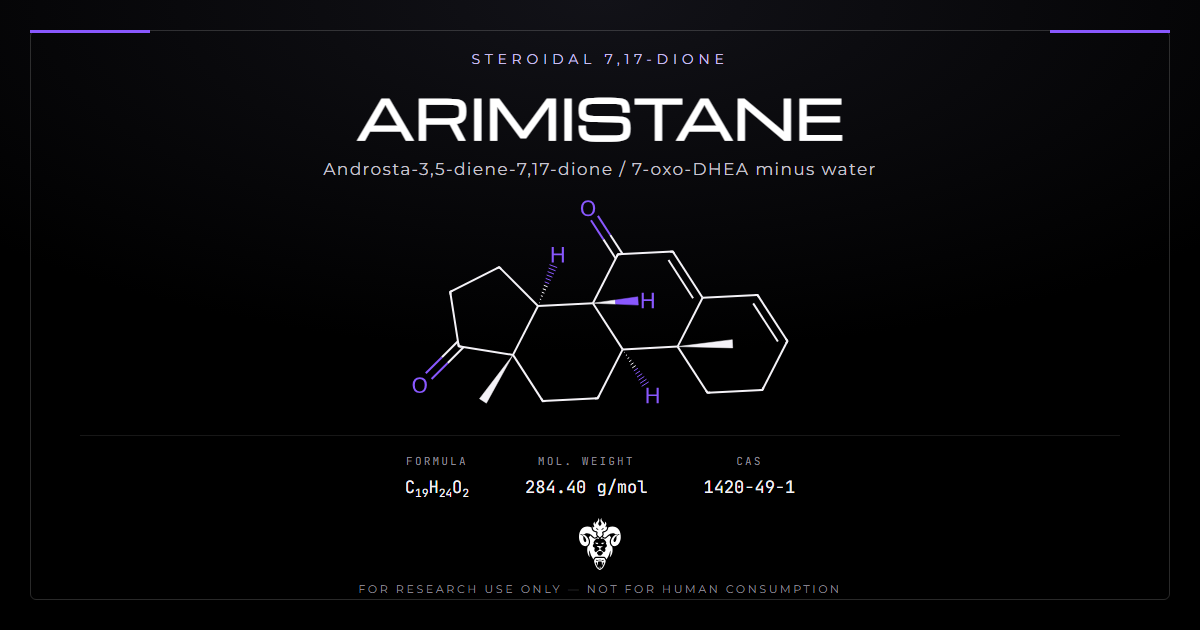
A 2021 paper in Drug Testing and Analysis carries a title most compounds never earn: “Arimistane: Degradation product or metabolite of 7-oxo-DHEA?” [1].
That question is not rhetorical. Arimistane is chemically 7-oxo-DHEA with a molecule of water removed. Water loss is the most ordinary thing that happens to a hydroxysteroid in a hot gas chromatograph injector.
So a laboratory that detects Arimistane in a sample faces a genuine ambiguity. It may have found a compound that was there. It may have made one.
Chemical identity
A steroid ketone with a conjugated diene in the A ring and carbonyls at C7 and C17.
| Property | Value |
|---|---|
| Systematic name | Androsta-3,5-diene-7,17-dione |
| Common names | Arimistane, androstadienedione, NSC-134910 |
| Molecular formula | C19H24O2 |
| Molecular weight | 284.4 |
| CAS | 1420-49-1 |
| PubChem CID | 150910 |
| InChIKey | VHDOTNMSJDQVEE-ZENYQMPMSA-N |
Kimera supplies the material as Arimistane.
Reading the structure
Three features define it. A 3,5-diene runs across the A and B ring junction. At C7 sits a carbonyl, where most steroids carry nothing. The third, at C17, is conventional.
That C7 oxygen is the unusual one. Steroids oxygenated at position 7 are a small family, and their behaviour under analysis is the subject of most of the literature below.
The diene matters for a different reason. Conjugation across two double bonds gives the A ring a rigid, planar geometry. The parent compound has no such constraint. It also shifts ultraviolet absorbance into a range that a diode array detector reads easily. That is convenient for chromatography and a liability in storage, as the handling section returns to.
The 18-dalton question
Set the two compounds side by side and the relationship is arithmetic.
| Compound | Formula | MW | InChIKey |
|---|---|---|---|
| 7-oxo-DHEA | C19H26O3 | 302.4 | KPRGOTLNGIBVFL-GINZOMEDSA-N |
| Arimistane | C19H24O2 | 284.4 | VHDOTNMSJDQVEE-ZENYQMPMSA-N |
The difference is H2O, exactly 18 daltons. Remove the 3-hydroxyl from 7-oxo-DHEA, let the double bond shift, and you have Arimistane.
Arimistane is 7-oxo-DHEA minus water
That single relationship generates the entire analytical problem, so it is worth stating carefully rather than in passing.
Where 7-oxo-DHEA comes from
7-oxo-DHEA is endogenous. Human tissues produce it from dehydroepiandrosterone by 7-alpha-hydroxylation followed by oxidation, and that pathway has been mapped in human tissue preparations [2].
It is not a trace curiosity either. A radioimmunoassay developed specifically for it established physiological reference levels in humans nearly twenty years ago [3]. Later LC-MS/MS methods quantified it alongside other neuroactive and immunomodulatory steroids in plasma and cerebrospinal fluid [4].
So the parent compound circulates in everyone, at measurable concentrations, without anyone taking anything.
Why dehydration is the suspicious part
Losing water from a secondary alcohol is the most pedestrian reaction in preparative chemistry. It happens under acid, under heat, and reliably in the injector of a gas chromatograph.
Arimistane is precisely that dehydration product. Every human sample contains 7-oxo-DHEA. So any analytical method involving heat has a plausible route to producing Arimistane, whether or not a molecule of it was there to begin with.
The metabolite-or-artefact question
This is the live question in the literature, and one research group has pursued it across several papers.
What the 2021 study asked
That paper examined whether Arimistane found in urine is a genuine metabolite of administered 7-oxo-DHEA, or a degradation product formed during sample handling [1]. The framing matters. Both possibilities predict the same molecule in the same sample.
An earlier paper from the same group had already flagged the interpretive problem, titled around pitfalls in reading 7-keto-DHEA results in the antidoping field [5].
The derivatisation evidence
The most specific evidence sits in a study of how 7-oxygenated androst-5-ene structures behave during trimethylsilyl derivative formation [6].
Derivatisation is a preparation step, performed before the instrument sees anything. If the derivative chemistry itself alters 7-oxygenated steroids, then part of what the detector reports was created at the bench. That study exists because the effect is real enough to characterise.
Why this matters beyond doping control
Anti-doping laboratories care because a sanction may follow. Anyone else running the assay inherits the same problem without the same scrutiny.
A method that cannot separate “present in the sample” from “produced during analysis” does not become reliable by being used for a different purpose. The uncertainty is a property of the chemistry, not of the application.
What would actually settle it
Three experiments would close the question, and none of them is exotic.
Spike a blank matrix with pure 7-oxo-DHEA, carry it through the full preparation, and quantify any Arimistane that appears. Whatever comes out is artefact, because none went in. That establishes the conversion rate for a given protocol.
Vary the injector temperature across a range and plot the ratio. A conversion that tracks heat is thermal, and one that does not is something else. Dehydration in a GC inlet is well behaved enough that the curve is informative.
Run the same samples by LC and compare. The published work already treats the two techniques as complementary for exactly this reason [8], so the comparison is available to anyone who runs both.
The reason to spell this out is that the question stays open in the literature. A laboratory using this compound can answer it locally for its own method, which is worth more than waiting for someone else to answer it generally.
How the laboratories actually detect it
Three techniques appear in the literature, and they answer different questions.
Gas chromatography
A 2019 method detected urinary Arimistane metabolites by gas chromatography coupled to high-accuracy mass spectrometry [7]. GC brings sensitivity and an established metabolite map.
It also brings a hot injector, which is the exact condition under which the dehydration in question occurs. The technique best characterised for this compound is the one most exposed to the artefact.
Liquid chromatography
A 2021 method added LC-MS detection of urinary Arimistane metabolites, presented explicitly as complementary to the GC data [8].
The complementarity is the point. LC runs without the injector heat, so agreement between the two techniques is evidence the analyte was real. Disagreement localises the problem.
Carbon isotope ratios
The technique that settles origin rather than identity is isotope ratio mass spectrometry. A 2020 method used it to detect misuse of 7-oxo-DHEA in doping control [9].
Synthetic steroids carry a different carbon-13 signature from steroids the body made, because the plant sterols used in synthesis fix carbon differently. That difference survives metabolism. Where identity is ambiguous, isotope ratio answers a question the mass spectrum cannot.
What the pharmacology literature contains
Very little, and stating that plainly is more useful than padding it.
The aromatase claim
Arimistane circulates commercially as an aromatase inhibitor. Searching the indexed literature for the compound returns six papers, and all six are analytical or metabolic. None establishes aromatase inhibition in a controlled experiment.
The absence is not evidence against the mechanism. A 3,5-diene-7,17-dione is structurally plausible as an aromatase substrate analogue, and related steroidal diones do inhibit the enzyme. The point is narrower: the specific claim attached to this specific compound rests on structural inference rather than published measurement.
Why structural inference is weak here
Aromatase is fussy about its substrates. The enzyme acts on the A ring, aromatising it by stripping the C19 methyl group across three successive oxidations. Steroidal inhibitors typically work by occupying that site and reacting there.
A 3,5-diene changes the A ring geometry substantially. That could improve binding, or prevent it, and the direction is not predictable from a drawing. Steroid pharmacology is full of pairs that differ by one double bond and by an order of magnitude in potency.
A cell-based aromatase assay would resolve this in a week. The absence of one after years of commercial availability is itself informative about how the compound is sold.
The endogenous complication
There is a second reason the pharmacology question is hard to answer cleanly. Any assay measuring an effect on estrogen synthesis in a human-derived system is working in a matrix that already contains 7-oxo-DHEA [3][4].
That parent compound converts to this one under the right conditions, and both are present. Attributing an observed effect to the administered compound therefore needs the same provenance control the analytical papers keep insisting on [9]. Pharmacology inherits the identity problem rather than escaping it.
Where the biology work went instead
Research on the parent compound went toward immunology. 7-oxo-DHEA levels shift in HIV and tuberculosis coinfection [10], and the compound enhanced impaired pathogen-specific T cell responses in that setting [11].
That is a long way from the commercial framing, and the distance is informative. Investigators who study this chemistry treat 7-oxo-DHEA as an immunomodulator worth measuring in disease, not as a hormone-control agent.
Biotransformation studies form the other cluster, using fungal systems to hydroxylate 7-oxo-DHEA into further derivatives [12][13]. That work treats it as a synthetic starting material rather than a drug.
What the six papers have in common
Every indexed paper naming Arimistane comes from analytical chemistry, and most from a single group working in anti-doping. Nobody has published a pharmacology study on it.
Read that as a map of where the evidence is, not as a verdict. A compound can be under-studied without being inert. The honest statement is that the analytical literature is unusually good for a compound this obscure, and the pharmacological literature does not exist.
For laboratory work that is a workable position, provided the claims made about a result stay inside what the methods can support.
Arimistane in the supplement supply
Steroidal compounds in bodybuilding supplements are a documented analytical problem, and methods exist specifically to identify what is actually in such products [14].
The general finding is consistent: label and contents diverge. Bioassay work detecting estrogenic and antiestrogenic activity, including false positives, exists for the same reason [15].
For a compound whose detection is already ambiguous, an uncertain supply chain compounds the problem. An unassayed sample of unknown provenance, analysed by a method that can generate the analyte, produces a result that means very little.
Two failure modes that look alike
Consider what a laboratory sees when a supplement product assays positive for this compound. One story is that the product contains it. Another is that the product contains 7-oxo-DHEA and the assay converted it.
Both stories produce the same chromatogram. Distinguishing them needs the spiking control described earlier, and a purchased product rarely arrives with one.
That is why the analytical papers keep returning to provenance rather than identity [1][5]. Identity is the easy half.
The naming problem makes it worse
Arimistane, androstadienedione and androsta-3,5-diene-7,17-dione all name one compound. NSC-134910 names it too, from an older screening collection.
Product labels use these interchangeably, and some use none of them. A search on one name misses material sold under another, which is the ordinary reason two analyses of “the same” product disagree.
Match on the InChIKey or the CAS number rather than the name. VHDOTNMSJDQVEE-ZENYQMPMSA-N and 1420-49-1 are unambiguous, and neither is subject to marketing.
How to read an Arimistane study
Four questions separate a usable result from an ambiguous one.
Which technique produced the identification?
GC alone, on this compound, cannot exclude in-injector dehydration. LC agreement strengthens it [8]. Isotope ratio answers origin [9].
Was 7-oxo-DHEA present or possible?
Since 7-oxo-DHEA is endogenous [3], the answer in any human-derived sample is yes. A study that does not address the parent compound has not addressed the artefact.
Endogenous, administered, or synthesised?
These are three different provenances producing one molecule. Only isotope ratio separates the synthetic from the biological [9].
Was the material assayed?
Supplement analyses repeatedly find contents that do not match labels [14]. A stated identity is not a measured one.
Verifying research material
Arimistane is a defined chemical entity with published identifiers, so verification is arithmetic rather than judgement. Batch documentation sits on the certificates of analysis page.
Identity
Formula C19H24O2, molecular weight 284.4, InChIKey VHDOTNMSJDQVEE-ZENYQMPMSA-N. A result near 302.4 indicates 7-oxo-DHEA, the hydrated parent, not this compound.
The 18-dalton gap is the whole verification in one number. It is also small enough that a low-resolution instrument reporting a broad peak may not resolve a mixture of the two.
The dehydration trap runs both ways
A batch assayed by gas chromatography presents the mirror image of the problem above. If the method can convert 7-oxo-DHEA into Arimistane, then a sample contaminated with the parent compound will assay cleaner than it is.
Ask which technique produced the certificate. An LC-based purity determination does not share that failure mode, and for this particular compound that distinction is worth more than a slightly better reported percentage.
The same logic applies to a nuclear magnetic resonance check, which many suppliers skip on cost grounds. NMR sees the diene directly and reads position rather than mass, so it separates the compound from its isomers in a way no mass measurement can.
Isomers share the formula
Double-bond position is the weak point. A 3,5-diene, a 4,6-diene and a 5,7-diene all carry C19H24O2 and all weigh 284.4. Mass spectrometry alone will not tell them apart, and acid exposure can interconvert them.
That matters for anyone comparing results across sources. Two laboratories can agree perfectly on formula and mass while holding different compounds, and neither would learn this from a certificate that reports only those two numbers.
Handling
The conjugated diene is the reactive feature. Extended conjugation absorbs ultraviolet light and oxidises at allylic positions, so amber glass and cold storage are not decorative here.
Avoid acid contact. Acid catalyses the same dehydration chemistry that produced the compound. Under acid the diene can also migrate, giving isomers that share both the formula and the mass.
Common questions about Arimistane
Identity and origin
What is Arimistane chemically? Androsta-3,5-diene-7,17-dione, a steroid with carbonyls at C7 and C17 and a conjugated diene in the A ring.
How is it related to 7-oxo-DHEA? It is the dehydration product. Remove water from 7-oxo-DHEA, C19H26O3, and you reach C19H24O2 [1].
Is 7-oxo-DHEA a drug? No, it is an endogenous human steroid with established physiological levels [3], produced from DHEA by 7-hydroxylation and oxidation [2].
Why do anti-doping laboratories study this compound? Because detecting it may indicate an administered substance, and separating that from an analytical artefact is a prerequisite for any finding [1][5].
Is there evidence it inhibits aromatase? Not in the indexed literature. All six papers indexed for the compound are analytical or metabolic.
Analysis and handling
Which assay should a certificate use? Prefer a liquid chromatography method. Gas chromatography can convert the parent compound into this one in the injector, which flatters the result [6][7].
How would a laboratory prove the conversion for its own method? Spike a blank matrix with pure 7-oxo-DHEA, run the full preparation, and quantify whatever Arimistane appears. None went in, so anything measured is artefact.
Why does carbon isotope ratio work when mass spectrometry cannot? Synthetic steroids carry a different carbon-13 signature from ones the body made, because the plant sterols used in synthesis fix carbon differently. The signature survives metabolism [9].
Is androstadienedione the same compound? Yes, along with androsta-3,5-diene-7,17-dione and NSC-134910. Match on InChIKey or CAS rather than name.
What should storage protect against? Light and acid. The conjugated diene absorbs ultraviolet and oxidises at allylic positions, and acid drives both further dehydration chemistry and double-bond migration.
Does the compound occur naturally? The parent does. 7-oxo-DHEA circulates in humans at measurable concentrations [3], which is exactly why a detection of its dehydration product is hard to interpret.
Summary of the evidence
Strongest evidence: the analytical chemistry. Three complementary detection methods exist for the compound in human urine, by GC-HRMS [7], by LC-MS [8], and an isotope ratio approach that resolves origin [9]. The parent compound’s endogenous status is established by dedicated assay [3][4] and its biosynthetic route mapped in human tissue [2].
Weakest evidence: everything pharmacological. The commercial claim has no controlled experiment behind it in the indexed literature. The compound’s own identity in a sample stays an open question, one that a single research group has published on repeatedly without closing [1][5][6].
Read plainly, Arimistane is a well-characterised analyte and an uncharacterised pharmacological agent. That is an unusual combination, and it makes the compound more interesting as a subject for method development than as anything else. Most compounds in this catalogue have the opposite problem, with a mechanism established and the analysis routine.
The rest of this class sits in the endocrine category, alongside Endoxifen and 4-Hydroxytamoxifen.
Status: supplied for laboratory research use only.
References
- Martínez Brito D, Leogrande P, Colamonici C, Curcio D, Botrè F, de la Torre X. Arimistane: degradation product or metabolite of 7-oxo-DHEA? Drug Test Anal. 2021;13(7):1430-1439. PMID 33783974. DOI
- Hennebert O, Chalbot S, Alran S, Morfin R. Dehydroepiandrosterone 7alpha-hydroxylation in human tissues: possible interference with type 1 11beta-hydroxysteroid dehydrogenase-mediated processes. J Steroid Biochem Mol Biol. 2007;104(3-5):326-333. PMID 17467270. DOI
- Kazihnitková H, Zamrazilová L, Hill M, Lapčík O, Pouzar V, Hampl R. A novel radioimmunoassay of 7-oxo-DHEA and its physiological levels. Steroids. 2007;72(4):342-350. PMID 17298836. DOI
- Sosvorova L, Vitku J, Chlupacova T, Mohapl M, Hampl R. Determination of seven selected neuro- and immunomodulatory steroids in human cerebrospinal fluid and plasma using LC-MS/MS. Steroids. 2015;98:1-8. PMID 25676787. DOI
- Martinez-Brito D, de la Torre X, Colamonici C, Curcio D, Botrè F. 7-keto-DHEA metabolism in humans. Pitfalls in interpreting the analytical results in the antidoping field. Drug Test Anal. 2019;11(11-12):1629-1643. PMID 31701664. DOI
- Martinez-Brito D, de la Torre X, Parr MK, Botrè F. Mass spectrometric analysis of 7-oxygenated androst-5-ene structures. Influence in trimethylsilyl derivative formation. Rapid Commun Mass Spectrom. 2020;34(17):e8834. PMID 32424893. DOI
- Martinez Brito D, de la Torre X, Botrè F. Detection of urinary metabolites of arimistane in humans by gas chromatography coupled to high-accuracy mass spectrometry for antidoping analyses. Rapid Commun Mass Spectrom. 2019;33(24):1894-1905. PMID 31295379. DOI
- Martinez Brito D, Leogrande P, Botrè F, de la Torre X. Detection of urinary arimistane metabolites in humans using liquid chromatography-mass spectrometry: complementary results to gas chromatography mass spectrometric data and its application to antidoping analyses. Rapid Commun Mass Spectrom. 2021;35(12):e9080. PMID 33713366. DOI
- Piper T, Fusshöller G, Geyer H, Toboc A, Dănilă MG, Thevis M. Detecting the misuse of 7-oxo-DHEA by means of carbon isotope ratio mass spectrometry in doping control analysis. Rapid Commun Mass Spectrom. 2020;34(12):e8776. PMID 32143236. DOI
- Vecchione MB, Eiras J, Suarez GV, Angerami MT, Marquez C, Sued O, Ben G, et al. Determination of dehydroepiandrosterone and its biologically active oxygenated metabolites in human plasma evinces a hormonal imbalance during HIV-TB coinfection. Sci Rep. 2018;8(1):6692. PMID 29703963. DOI
- Vecchione MB, Laufer N, Sued O, Corti M, Salomon H, Quiroga MF. 7-oxo-DHEA enhances impaired M. tuberculosis-specific T cell responses during HIV-TB coinfection. J Biomed Sci. 2020;27(1):20. PMID 31906962. DOI
- Świzdor A, Panek A, Milecka-Tronina N. Biohydroxylation of 7-oxo-DHEA, a natural metabolite of DHEA, resulting in formation of new metabolites of potential pharmaceutical interest. Chem Biol Drug Des. 2016;88(6):844-849. PMID 27369457. DOI
- Łyczko P, Panek A, Ceremuga I, Świzdor A. The catalytic activity of mycelial fungi towards 7-oxo-DHEA, an endogenous derivative of steroidal hormone dehydroepiandrosterone. Microb Biotechnol. 2021;14(5):2187-2198. PMID 34327850. DOI
- Avula B, Chittiboyina AG, Bae JY, Haider S, Wang YH, Wang M, Zhao J, et al. The power of hyphenated chromatography-time of flight mass spectrometry for unequivocal identification of spirostanes in bodybuilding dietary supplements. J Pharm Biomed Anal. 2019;167:74-82. PMID 30753977. DOI
- Ronzheimer A, Schreiner T, Morlock GE. Multiplex planar bioassay detecting estrogens, antiestrogens, false-positives and synergists as sharp zones on normal phase. Phytomedicine. 2022;103:154230. PMID 35724612. DOI
Arimistane is sold for laboratory research use only. Not for human consumption, nor medical, veterinary, or household uses.