Skip to content

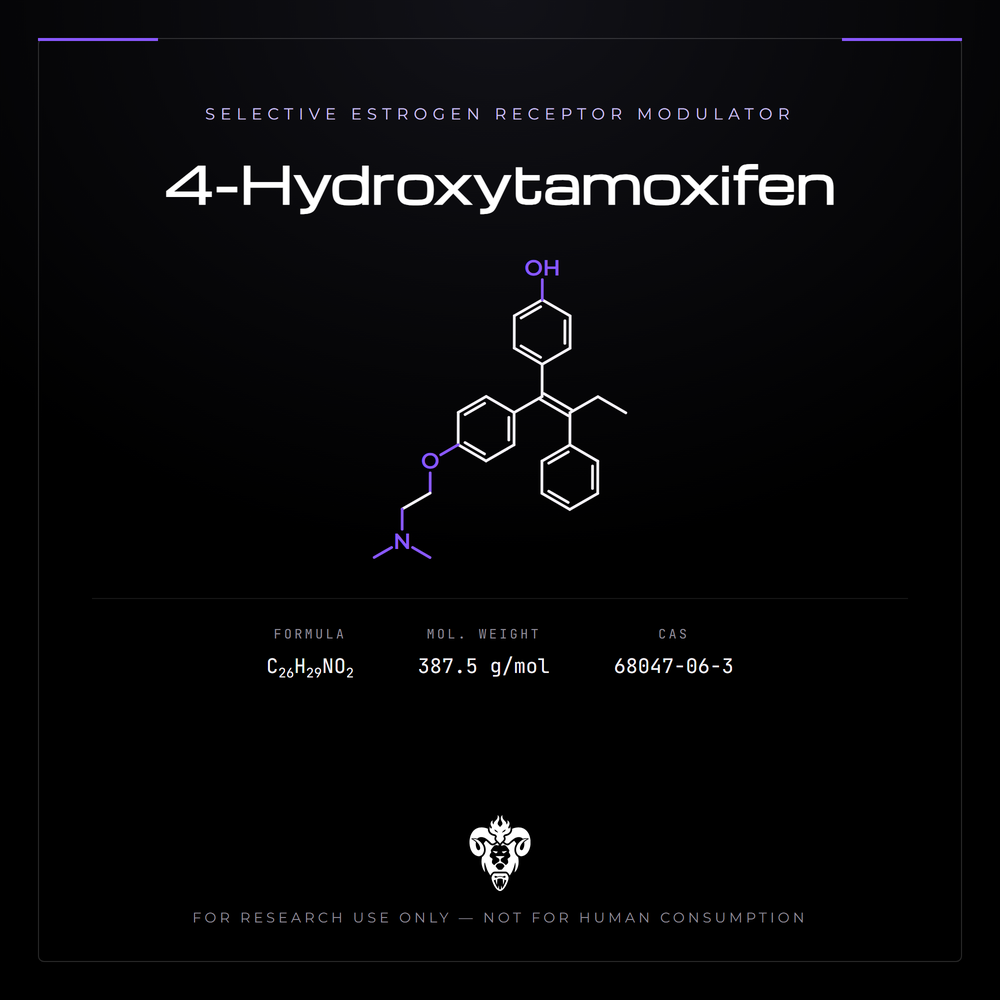

4-hydroxytamoxifen (Afimoxifene) Research Standard
4-hydroxytamoxifen (Afimoxifene) is a synthetic selective estrogen receptor modulator (SERM) and the primary active metabolite of Tamoxifen. With an affinity for estrogen receptors (ER) approximately 100 times higher than that of Tamoxifen, it serves as a foundational research tool for investigating estrogen-dependent signaling. Beyond its use in oncology and endocrine research, 4-hydroxytamoxifen is widely utilized in molecular biology as the specific ligand for the inducible Cre-ERT2 recombinase system, allowing for the precise temporal control of gene expression in transgenic research models.
Physical & Handling Properties
| Property | Specification |
|---|---|
| Physical Appearance | White to off-white solid |
Mechanism of Action & Research Context
4-hydroxytamoxifen acts as a high-affinity ligand for both ER-alpha and ER-beta, functioning as a molecular switch for gene transcription.
-
Cre-ERT2 Recombinase Induction: The most common laboratory application is the nuclear translocation of the Cre-ERT2 fusion protein. 4-hydroxytamoxifen binds to the mutant estrogen receptor domain (ERT2), inducing a conformational change that forces the fusion protein into the nucleus, where Cre-recombinase can then excise floxed DNA sequences.
-
ER Binding & Modulation: It exhibits tissue-specific pharmacology, acting as an antagonist in mammary tissue—making it essential for breast cancer proliferation models—while exerting partial agonist effects in other tissues like bone and endometrium.
-
Transcriptional Signaling: It inhibits estrogen-stimulated gene transcription by competitively binding to the receptor, providing a mechanism to study the suppression of hormone-dependent pathways in ER-positive cell lines.
Research Applications
4-hydroxytamoxifen is a specialized reagent essential for modern genetic and oncology research.
Primary fields of in vitro and in vivo laboratory investigation include:
-
Conditional Gene Targeting: Utilizing the Cre-ERT2 system for spatiotemporal control of gene deletion or expression in developmental studies.
-
Oncology Research: Evaluating the inhibitory effects on estrogen-stimulated cellular growth in ER-positive breast cancer cell lines.
-
Comparative SERM Pharmacology: Serving as the benchmark reference for potency and affinity in studies involving novel estrogen receptor ligands.
-
Molecular Signaling: Mapping the downstream proteomic and transcriptomic shifts following competitive ER blockade.
Storage & Handling Guidelines
Store at controlled room temperature. Keep tightly closed.
Storage guidance is a house recommendation. Analytical documentation is per-lot release testing.
Related Research Compounds
Research Use Disclaimer
Research Use Only Disclaimer: This product is labeled and sold “For Research Use Only – NOT FOR HUMAN CONSUMPTION.” It is not a drug, dietary supplement, food, cosmetic, or medical device, and it is not approved by the FDA or any other regulator for human or veterinary use. It is supplied to approved account holders as a research chemical for laboratory use and must be handled in accordance with applicable law.