Skip to content
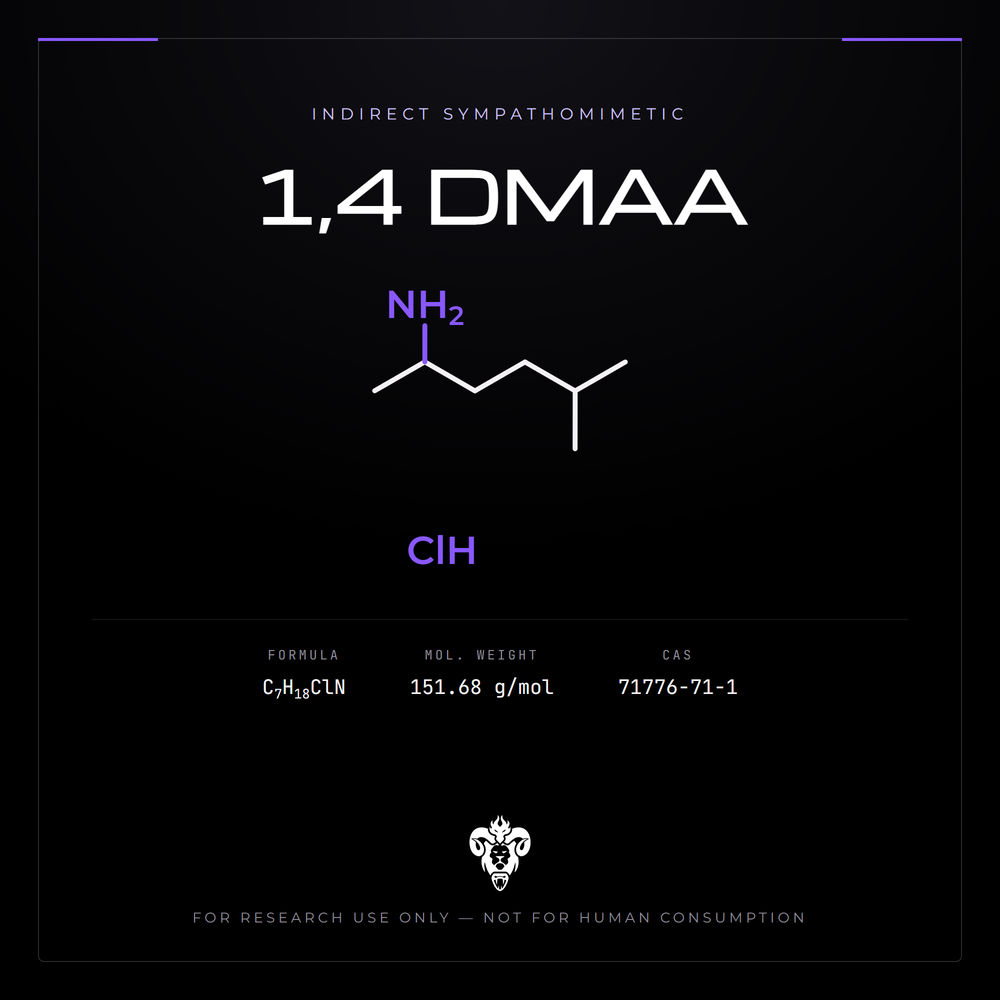

1,4-DMAA (1,4-Dimethylamylamine) Research Standard
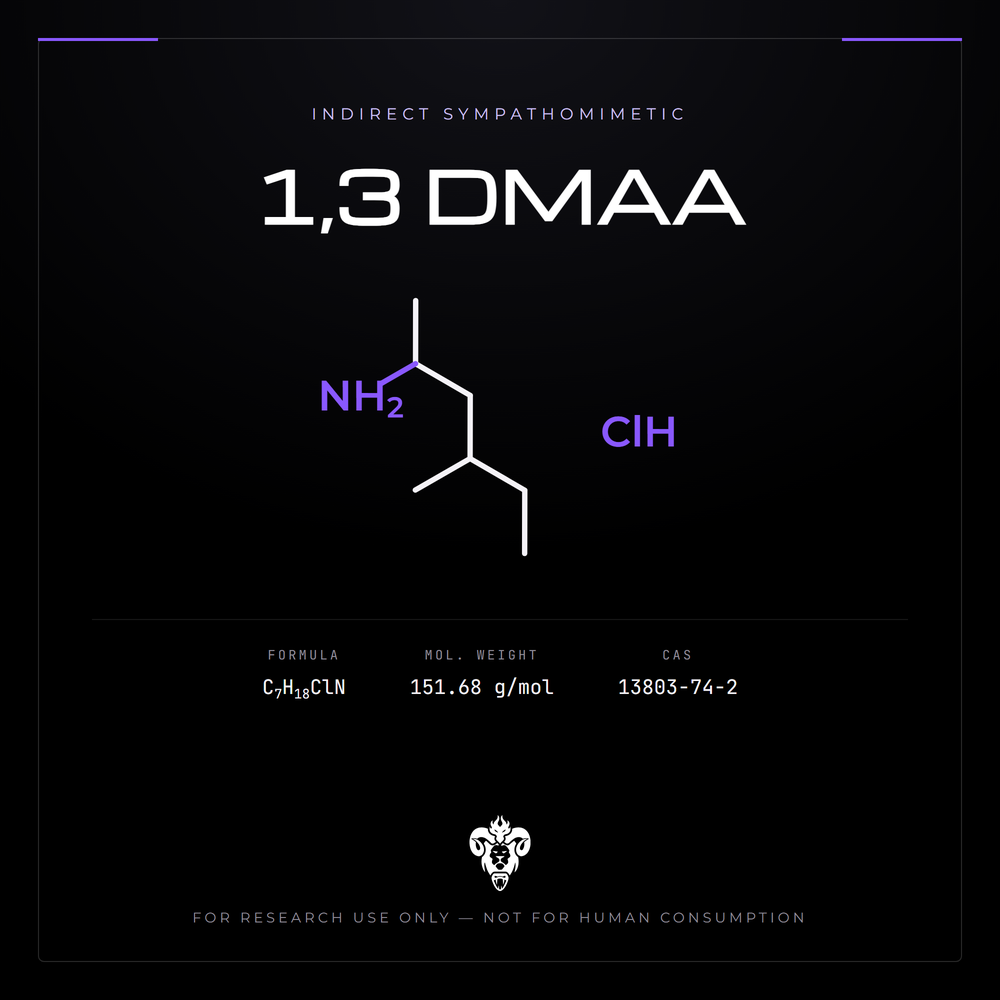
1,4-DMAA (5-methylhexan-2-amine) is a synthetic aliphatic amine and a structural isomer of 1,3-DMAA. As a sympathomimetic amine, it serves as a specialized reagent in adrenergic research, primarily employed to investigate how the positioning of alkyl substitutions on an aliphatic amine chain influences receptor binding affinity and sympathomimetic potency. In laboratory research, it acts as a tool for probing the structural requirements for norepinephrine release and adrenergic receptor modulation within neuronal and physiological models.
Physical & Handling Properties
| Property | Specification |
|---|---|
| Physical Appearance | White to pale yellow powder |
| Solubility | Soluble in water and common organic solvents |
| Solution Base | Deionized Water, Ethanol |
Mechanism of Action & Research Context
Research into 1,4-DMAA focuses on its properties as an indirect sympathomimetic agent, providing a comparative model to its 1,3-isomer.
-
Adrenergic Modulation: Like other aliphatic amines in this class, 1,4-DMAA functions by facilitating the release of norepinephrine from presynaptic storage vesicles. This leads to an increased concentration of catecholamines within the synaptic cleft, stimulating postsynaptic adrenergic receptors.
-
Structural Isomerism & SAR: The primary research utility of 1,4-DMAA lies in Structure-Activity Relationship (SAR) studies. By comparing 1,4-DMAA with 1,3-DMAA, investigators can elucidate how the displacement of the methyl group along the aliphatic backbone alters the molecule’s interaction with the norepinephrine transporter (NET) and its subsequent effect on neurotransmitter release.
-
Receptor Pharmacology: Investigations utilize this compound to determine whether variations in the aliphatic chain significantly impact the potency of the resultant adrenergic response, helping to map the steric requirements of the transporter binding site.
Research Applications
1,4-DMAA is a specialized reagent essential for comparative pharmacological research and adrenergic signaling studies.
Primary fields of in vitro and laboratory investigation include:
-
Structure-Activity Relationship (SAR) Panels: Benchmarking 1,4-DMAA against other aliphatic isomers (e.g., 1,3-DMAA) to define the influence of molecular geometry on sympathomimetic activity.
-
Adrenergic Signaling Pathways: Analyzing the release kinetics of catecholamines in neuronal cell models to compare efficacy across different amine scaffolds.
-
Transporter Interaction Studies: Elucidating how different aliphatic amine structures interact with catecholamine reuptake transporters.
-
Receptor Potency Analysis: Comparing the signaling output of 1,4-DMAA in adrenergic receptor-transfected cell lines to assess subtype specificity and affinity.
Storage & Handling Guidelines
Store at controlled room temperature. Keep tightly closed. Liquid formats: do not refrigerate or freeze. Cold storage may cause the solution to cloud or precipitate. If this occurs, return to room temperature and mix until clear.
Storage guidance is a house recommendation. Analytical documentation is per-lot release testing.
Related Research Compounds
Research Use Disclaimer
Research Use Only Disclaimer: This product is labeled and sold “For Research Use Only — NOT FOR HUMAN CONSUMPTION.” It is not a drug, dietary supplement, food, cosmetic, or medical device, and it is not approved by the FDA or any other regulator for human or veterinary use. It is supplied to approved account holders as a research chemical for laboratory use and must be handled in accordance with applicable law.