Skip to content

CL-316243
CL-316243 is a highly potent, synthetic small molecule recognized as one of the most selective β₃-adrenoceptor agonists available in modern pharmacology. By operating as a high-affinity target ligand, it serves as the universal gold-standard benchmark for isolating and studying β₃-mediated physiological effects.
The primary value of CL-316243 lies in its extreme selectivity profile—exhibiting over a 10,000-fold preference for the β₃ subtype over traditional β₁ and β₂ receptors. This virtually eliminates the confounding cardiotonic and smooth-muscle variables typically triggered by broad-spectrum adrenergic agonists, allowing investigators to study localized adipose tissue metabolism and bladder dynamics with clinical-grade precision.
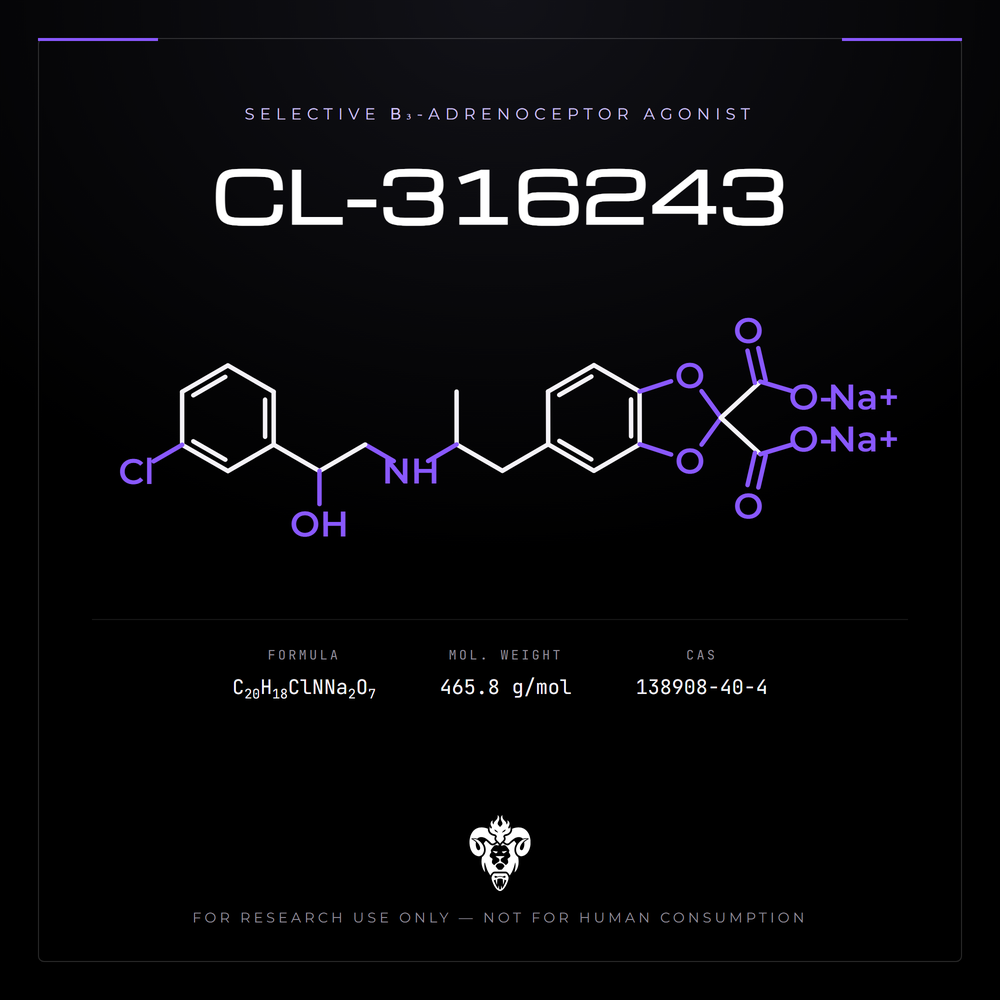
Structural Elements to Observe: When analyzing the skeletal structure above, researchers should note the precise dual-chiral configuration (specifically the (R,R) diastereomer) that dictates its extreme binding selectivity. On the left sits the meta-chlorophenyl ring, which features a critical chlorine substituent that coordinates deep within the active binding pocket of the β₃ receptor. This aromatic system is joined via an ethanolamine linkage to a central methyl-substituted amine bridge. On the far right, the molecule features a unique benzodioxole ring capped with a dicarboxylate disodium core (CO₂Na), a bulky, highly polar configuration that prevents steric and electrostatic cross-reactivity with β₁ and β₂ receptor subtypes.
Physical & Handling Properties
| Property | Specification |
|---|---|
| Solubility Profile | Soluble in water (~100 mM) and PBS (pH 7.2) |
Research Applications & Mechanism of Interest
In biological models, CL-316243 binds selectively to the β₃-adrenergic G-protein coupled receptor (GPCR). This binding stimulates adenylyl cyclase activity, triggering a cascade that elevates intracellular cyclic adenosine monophosphate (cAMP) levels.
Primary fields of preclinical and in vitro laboratory investigation include:
-
Mitochondrial Uncoupling & UCP1 Regulation: Researchers utilize the compound in brown adipocyte (fat cell) cultures to track the upregulation of Uncoupling Protein 1 (UCP1) within the inner mitochondrial membrane. This pathway is heavily studied to map how uncoupling the proton gradient dissipates energy directly as heat rather than storing it as ATP.
-
Adipose Lipolysis Kinetics: Deploying the agent in isolated white and brown adipocyte assays to measure the rates of cAMP-dependent lipolysis (the metabolic breakdown of stored triacylglycerols into free fatty acids and glycerol).
-
Glucose Homeostasis & Insulin Sensitivity: Investigating cellular glucose uptake mechanisms. Preclinical rodent models indicate that selective β₃ activation can significantly alter systemic glucose handling and lower circulating insulin concentrations, serving as a vital baseline model for type 2 diabetes and metabolic syndrome research.
-
Detrusor Muscle Relaxation: Evaluated within urological tissue models to study the role of the β₃ receptor in bladder compliance, detrusor muscle relaxation, and the mitigation of hyperreflexia (overactive bladder).
-
Receptor Subtype Profiling: Serving as a crucial, highly selective control ligand to map the comparative binding affinities of novel, uncharacterized sympathomimetic compounds across adrenergic receptor families.
Storage & Handling Guidelines
Storage after receipt: refrigerate at 2-8 °C. Do not freeze. Refrigeration is a post-receipt storage condition, not a transit requirement.
Storage guidance is a house recommendation. Analytical documentation is per-lot release testing.
Related Research Compounds
Further reading: CL-316243 research overview
Frequently Asked Research Questions
Why does CL-316,243 behave differently in rodent assays versus human tissue models?
The tissue distribution and molecular structure of the β₃-adrenoceptor differ significantly between species. While β₃ receptors are abundant and functionally dominant in rodent adipose tissues, they are far more sparse in adult humans, where β₁ and β₂ subtypes predominate. Consequently, while CL-316243 is highly effective for studying rodent thermogenesis, translating these exact receptor kinetics to human cellular models requires careful cross-species calibration.
What is the significance of the disodium salt form over the free acid?
The disodium salt formulation of CL-316243 dramatically increases its hydrophilic properties, making it freely soluble in aqueous buffers like PBS or pure laboratory-grade water. This eliminates the need for aggressive organic solvents (such as high concentrations of DMSO) which can be toxic to delicate cell cultures during in vitro lipolysis assays.
Scientific References
-
Bloom, J. D., Dutia, M. D., Johnson, B. D., et al. (1992). “Disodium (R,R)-5-[2-[[2-(3-chlorophenyl)-2-hydroxyethyl]-amino] propyl]-1,3-benzodioxole-2,2-dicarboxylate (CL 316,243). A potent beta-adrenergic agonist virtually specific for beta 3 receptors.” Journal of Medicinal Chemistry, 35(16), 3081–3084. doi:10.1021/jm00094a019.
-
Yoshida, T., et al. (1994). “Anti-obesity and anti-diabetic effects of CL 316,243, a highly specific beta 3-adrenoceptor agonist, in yellow KK mice.” Life Sciences, 54(7), 491-498. doi:10.1016/0024-3205(94)00824-6.
-
Woods, M., et al. (2001). “Efficacy of the beta3-adrenergic receptor agonist CL-316243 on experimental bladder hyperflexia and detrusor instability in the rat.” The Journal of Urology, 166(3), 1142–1147. doi:10.1016/S0022-5347(05)65939-5.
Research Use Only Disclaimer: This product is labeled and sold “For Research Use Only — NOT FOR HUMAN CONSUMPTION.” It is not a drug, dietary supplement, food, cosmetic, or medical device, and it is not approved by the FDA or any other regulator for human or veterinary use. It is supplied to approved account holders as a research chemical for laboratory use and must be handled in accordance with applicable law.