
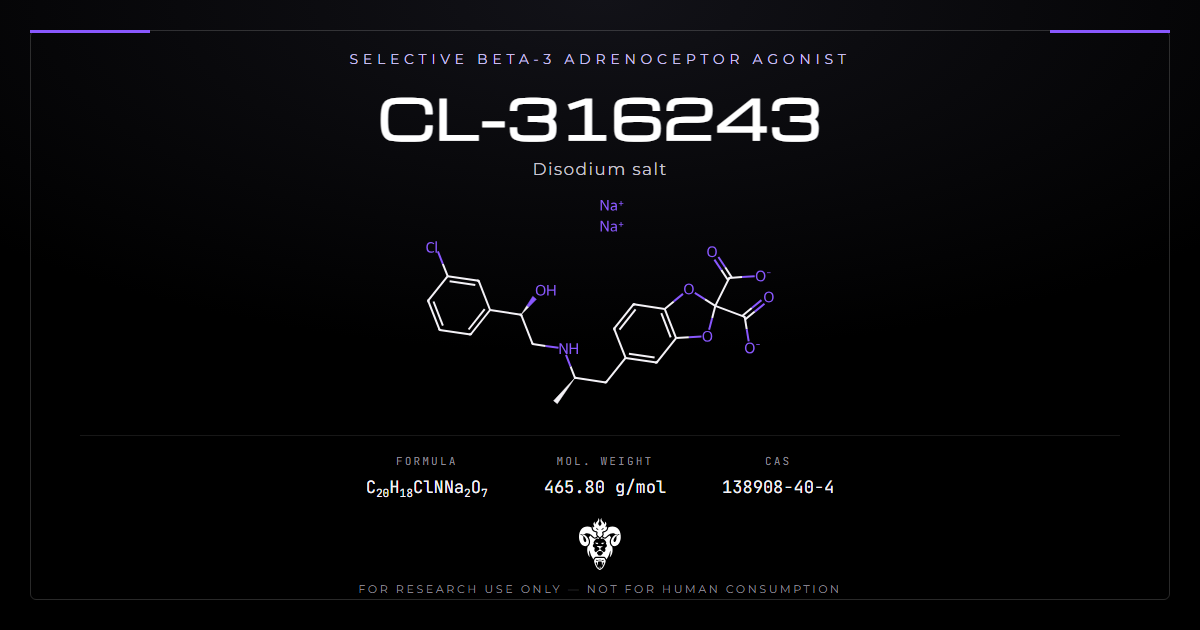
CL-316243 is the reference β3-adrenoceptor agonist of rodent metabolic research. Reported in 1992 with an EC50 near 3 nM and more than 10,000-fold selectivity over β1 and β2 receptors, it became the standard pharmacological tool for activating adipose tissue thermogenesis, driving lipolysis, and inducing the beige adipocyte phenotype in white fat depots. Three decades of literature rest on it. This reference covers its chemistry, mechanism, published preclinical findings, the species-selectivity problem that ended its clinical development, and the analytical considerations that matter when verifying identity and purity.
CL-316243 is supplied strictly for laboratory research use. It is not approved for human or veterinary use anywhere, and nothing below should be read as guidance for administration.
Chemical Profile and Identifiers
| Property | Value |
|---|---|
| Compound name | CL-316243 (CL 316,243) |
| Chemical name | Disodium (R,R)-5-[2-[[2-(3-chlorophenyl)-2-hydroxyethyl]amino]propyl]-1,3-benzodioxole-2,2-dicarboxylate |
| CAS number | 138908-40-4 |
| Molecular formula | C₂₀H₁₈ClNNa₂O₇ (disodium salt) |
| Molecular weight | 465.8 g/mol |
| Free diacid | C₂₀H₂₀ClNO₇ · 421.8 g/mol |
| InChIKey | FUZBPOHHSBDTJQ-CFOQQKEYSA-L |
| PubChem CID | 15669209 (disodium salt); 5486546 (free diacid) |
| Compound class | Benzodioxole-2,2-dicarboxylate; arylethanolamine |
| Receptor target | β3-adrenoceptor agonist |
| Reported EC50 | ~3 nM (β3), >10,000-fold selective over β1 / β2 ¹ |
| Stereochemistry | (R,R) — both centres defined |
Four structural features define the molecule and shape both its pharmacology and its analytical behaviour: a gem-dicarboxylate on the benzodioxole ring, a secondary β-amino alcohol linker, a meta-chlorophenyl ring, and a methyl-bearing stereocentre. The dicarboxylate in particular is not incidental — it is the single design decision that explains most of what follows.
What CL-316243 Actually Targets
The β3-adrenoceptor is the third member of the β-adrenergic receptor family, cloned in 1989 and distinguished from β1 and β2 by a restricted expression pattern and an unusual ligand-recognition profile — including low affinity for propranolol and several other antagonists once assumed to block all β subtypes.⁹ In rodents, β3 receptors are expressed almost exclusively on adipocytes, which is exactly why a selective agonist became such a useful probe.
Signalling Cascade
Agonist binding couples the receptor to Gs, activating adenylyl cyclase and raising intracellular cAMP. Protein kinase A then phosphorylates hormone-sensitive lipase (HSL) and perilipin, releasing adipose triglyceride lipase (ATGL) activity at the lipid droplet surface. The result is rapid triglyceride hydrolysis and release of free fatty acids and glycerol.
In brown adipose tissue the same cAMP signal transcriptionally upregulates and allosterically activates uncoupling protein 1 (UCP1), which short-circuits the mitochondrial proton gradient and dissipates the resulting energy as heat rather than capturing it as ATP.
Why Selectivity Mattered
Earlier β-agonists studied for thermogenesis carried β1 and β2 cross-reactivity, which brings cardiovascular and tremorgenic confounds that are difficult to separate from the adipose signal. CL-316243’s >10,000-fold selectivity was the point of the molecule: it let investigators attribute an observed phenotype to β3 engagement rather than to generalised sympathomimetic activity.¹ Genetic work later confirmed the attribution — in β3-adrenoceptor-deficient mice, CL-316243’s effects on adipocyte adenylate cyclase activity, lipolysis, insulin secretion, energy expenditure, and food intake were abolished.⁸
Medicinal Chemistry: Why the Dicarboxylate Matters
The gem-dicarboxylate is the defining feature of the scaffold and it cuts both ways.
At physiological pH the molecule carries two negative charges. That makes it extremely polar, highly water-soluble as the disodium salt, and effectively peripherally restricted — it does not meaningfully cross the blood–brain barrier. For a compound designed to hit adipocyte receptors, keeping it out of the CNS was a feature, not a bug.
The cost is absorption. CL-316243 showed only about 10% oral bioavailability in humans, which forced a 1500 mg dose in clinical work.⁷ That liability drove a dedicated prodrug programme: Sum and colleagues synthesised ester-type prodrugs that masked the carboxylates and reported substantially improved oral bioavailability in both rodent and primate models.⁷ In practice, published rodent studies overwhelmingly use parenteral routes — intraperitoneal or subcutaneous injection, or continuous delivery by osmotic minipump.
The dicarboxylate also matters analytically. Two ionisable acids and a basic secondary amine make the molecule strongly zwitterionic across a wide pH range, which governs its chromatographic behaviour and its ionisation efficiency in mass spectrometry.
Preclinical Research Findings
All of the work summarised below is preclinical unless explicitly noted. These are descriptions of what investigators observed in cell and animal models, not claims about effects in people.
Energy Balance and Brown Adipose Tissue
The foundational in vivo characterisation came from Himms-Hagen and colleagues, who treated young rats on a high-fat obesogenic diet.² Chronic CL-316243 raised body temperature and 24-hour energy expenditure, driven mainly by an increase in resting metabolic rate. Food intake was unchanged while carcass fat fell — an important dissociation, because it separates the thermogenic mechanism from an appetite-suppression mechanism.
That study also documented the morphological signature that later defined the field: changes in both brown and white adipose depots, not brown fat alone.
Browning and Adipose Remodelling
The white-fat findings turned out to be the more consequential ones. Sustained β3 activation with CL-316243 reduces unilocular fat cell size and increases the appearance of multilocular, mitochondria-rich adipocytes in white depots — the cells now called beige or brite adipocytes.
Granneman’s group mapped the cellular basis. Lee and colleagues used in vivo lineage tracing to identify bipotential adipocyte progenitors recruited by β3-adrenoceptor activation and by high-fat feeding, establishing that browning involves genuine recruitment of new cells and not only conversion of existing ones.⁵ A later study using UCP1-RFP reporter mice found that a subset of UCP1-positive beige adipocytes proliferate in response to seven days of CL-316243 and give rise to new beige adipocytes.¹⁰
The metabolic consequence is counterintuitive and worth internalising before designing an experiment. Mottillo and colleagues delivered CL-316243 by minipump (0.75 nmol/h) for seven days and found that de novo lipogenesis and triglyceride turnover increased dramatically and similarly in all adipose depots, despite large differences in UCP1 abundance between them.⁶ Lipolysis and lipid synthesis rise together. β3 activation does not simply drain fat depots; it converts them into high-flux futile-cycling tissue, engaging both UCP1-dependent and UCP1-independent processes.
Follow-up imaging work reinforced that beiging in white fat is detectable and quantifiable: a mitochondrial complex-I PET tracer detected newly formed beige adipocytes in inguinal white adipose tissue after subchronic CL-316243, with higher uptake and earlier detection than [¹⁸F]FDG.¹¹
Insulin Action and Glucose Handling
CL-316243 improves insulin sensitivity in rodents through mechanisms partly separable from weight loss. In nonobese rats, it enhanced insulin-stimulated glucose disposal.³ In the MKR mouse model of type 2 diabetes, treatment improved circulating glucose and insulin and restored expression of peroxisomal fatty acid oxidation genes that were suppressed in the diabetic state — including genes not previously known to be β3-regulated.¹²
Acutely, a single dose produces a rapid fall in blood glucose. The mechanism is indirect: β3-driven lipolysis raises circulating fatty acids, which stimulate insulin secretion, which lowers glucose.¹³
Tachyphylaxis — A Design Trap
This is the finding most often missed by researchers new to the compound. Medak and colleagues demonstrated that the acute effects of CL-316243 on serum fatty acids, insulin, and blood glucose are substantially attenuated after repeated dosing, in parallel with reduced PKA signalling in white adipose tissue including diminished HSL phosphorylation.¹³ The attenuation held across low-fat-fed, high-fat-fed, and UCP1-knockout mice.
Critically, the thermogenic response did not desensitise in the same way — increases in energy expenditure persisted. Desensitisation of the glucose-lowering arm was rescued by the phosphodiesterase inhibitor cilostamide, implicating cAMP degradation rather than receptor loss.¹³
Any protocol that compares an acute endpoint in treatment-naive animals against the same endpoint in chronically treated animals risks reading receptor desensitisation as a biological effect.
The Species-Selectivity Problem
This section deserves the most attention, because it is where secondary coverage of CL-316243 is most often wrong.
CL-316243 is a rodent tool. β3-adrenoceptors have a species-dependent ligand-recognition profile, and CL-316243 specifically has considerably greater efficacy at the rodent receptor than at the human receptor.⁹ The direction of that bias is not universal across the class — mirabegron and solabegron show higher affinity for the human receptor, while BRL 27,344 and ritobegron favour the rodent one.⁹
Two further factors compound the gap. Human adipose tissue expresses β3 mRNA at much lower levels than rodent adipose tissue, and adult humans carry far less classical brown fat.⁹ ¹⁴
The human trial data reflect this. Weyer and colleagues treated human subjects with CL-316243 and reported an increase in insulin action and fat oxidation.⁴ Those are real, measurable effects — but they arrived without the dramatic thermogenic and anti-obesity response the rodent literature had predicted, and at a 1500 mg oral dose necessitated by ~10% bioavailability.⁷ Clinical development did not continue.
The target itself was subsequently validated in humans by a different molecule. Mirabegron, a β3 agonist approved for overactive bladder, was shown to stimulate human brown adipose tissue metabolic activity and whole-body energy expenditure — and work in primary human brown/beige adipocytes confirmed that the human β3 receptor mediates lipolysis and thermogenesis in those cells.¹⁴ The β3 hypothesis survived; the first-generation chemistry did not translate.
Practical implication: data generated with CL-316243 in mice or rats should not be extrapolated to human β3 pharmacology, and CL-316243 is a poor choice of probe for human cell systems. Use a human-optimised agonist for that work.
CL-316243 vs. Mirabegron
Both are selective β3 agonists, and they are routinely confused in secondary sources. They are not interchangeable research tools.
| CL-316243 | Mirabegron | |
|---|---|---|
| Core scaffold | Benzodioxole dicarboxylate arylethanolamine | Anilide / thiazolylaminoethyl phenyl |
| CAS | 138908-40-4 | 223673-61-8 |
| Species bias | Greater efficacy at rodent β3 ⁹ | Higher affinity at human β3 ⁹ |
| Charge at pH 7.4 | Dianionic — peripherally restricted | Neutral |
| Oral bioavailability | ~10% in humans ⁷ | Adequate for oral dosing |
| Regulatory status | Never approved; development discontinued | Approved (overactive bladder) |
| Best research use | Rodent adipose browning, lipolysis, thermogenesis | Human β3 pharmacology, human BAT studies |
Experimental Design Notes
Several variables reliably determine whether a CL-316243 experiment reproduces published results.
- Housing temperature. Standard vivarium housing (~22 °C) is a chronic cold stress for mice and already elevates baseline sympathetic tone in brown fat. Thermoneutral housing (~30 °C) lowers that baseline and changes both the size and interpretation of an observed thermogenic response. Published studies differ on this and the difference is not cosmetic.¹³
- Route and delivery. Bolus injection and continuous minipump delivery produce different pharmacodynamic profiles. Browning and remodelling studies commonly use multi-day continuous or once-daily protocols; acute lipolysis and glucose studies use single doses.⁶ ¹³
- Treatment history. Because of the desensitisation described above, treatment-naive and pre-treated animals are not comparable for acute endpoints.¹³
- Depot selection. Inguinal (subcutaneous) white adipose tissue beiges readily; epididymal (visceral) white fat responds differently. Reporting a single depot as “white adipose tissue” obscures real biology.⁶
- UCP1-independent readouts. Because β3 activation drives lipid cycling independent of UCP1, UCP1 expression alone is an incomplete measure of the response.⁶
Handling, Solubility, and Storage
- Storage. Store the lyophilised or crystalline disodium salt sealed at −20 °C, protected from light and moisture. Keep prepared aqueous stocks at −80 °C and avoid repeated freeze–thaw cycles.
- Solubility. The disodium salt is freely water-soluble, which distinguishes it from most small-molecule metabolic probes and removes the need for DMSO in aqueous work. Sterile water and saline are the standard vehicles in published in vivo protocols.
- Hygroscopicity. The material is commonly supplied and catalogued as a hydrate. Water uptake affects gravimetric accuracy directly, so weigh in a controlled environment and treat the stated hydration state as a real variable when calculating concentrations.
- Solution stability. Aqueous stocks of the β-amino alcohol are best prepared fresh or aliquoted single-use. Solutions supplied at defined concentration should be kept refrigerated at 2–8 °C per the product specification.
Always consult the safety data sheet before handling, and follow standard practice for fine research powders and research-grade solutions.
Analytical Verification
The dicarboxylate and the chlorine atom together give this compound two convenient orthogonal identity handles.
Chlorine isotope signature. Natural chlorine is roughly 76% ³⁵Cl and 24% ³⁷Cl, so any chlorine-containing molecular ion displays an M+2 satellite at approximately one third the intensity of the main peak. That pattern is fast to check and difficult to fake — it confirms chlorine is genuinely present rather than inferred from retention time.
Sodium stoichiometry. Identity confirmation of the salt is a separate question from identity confirmation of the molecule. A sample can contain the correct organic species at the wrong counterion stoichiometry or hydration state, which shifts the effective potency of every solution prepared from it. Elemental analysis provides an independent anchor on mass balance that chromatographic purity alone cannot.
Meaningful verification for this compound should draw on multiple orthogonal methods rather than a single trace:
- HPLC for purity and impurity profiling — note that the zwitterionic character makes mobile-phase pH and ion-pairing conditions decisive for peak shape
- Mass spectrometry for molecular ion confirmation, including the chlorine isotope pattern; negative-mode electrospray suits the dicarboxylate
- NMR for structural confirmation, particularly the benzodioxole and chlorophenyl aromatic regions
- Chiral methods where stereochemical integrity matters — the (R,R) configuration is pharmacologically relevant and achiral HPLC will not detect a diastereomeric or enantiomeric impurity
- Elemental analysis to anchor salt form, hydration, and mass balance independently
Every lot is released only after third-party COA verification. Batch documentation is published in the Kimera COA archive, and related reference materials are catalogued under metabolic compounds. Researchers building comparative metabolic panels frequently pair β3 work with nuclear-receptor tools such as SLU-PP-332 and its orally bioavailable successor SLU-PP-915, which act through the estrogen-related receptors rather than through adrenergic signalling.
Regulatory and Anti-Doping Status
CL-316243 is investigational. No regulatory authority has approved it for human or veterinary use in any jurisdiction, and clinical development for obesity, type 2 diabetes, and urinary incontinence was discontinued. It is supplied for laboratory research only.
Anti-doping status warrants specific attention. CL-316243 is not individually named on the WADA Prohibited List, and β3-adrenoceptor agonists are not covered by category S3, which addresses β2 agonists specifically. However, the List states that a substance need not be named individually to be prohibited: category S0 (Non-Approved Substances) captures any pharmacological substance not currently approved by any governmental regulatory health authority for human therapeutic use. CL-316243 has never held such approval anywhere. Any research programme touching sport or human-performance testing should treat it accordingly.
Frequently Asked Questions
What is CL-316243? A highly selective β3-adrenoceptor agonist used as a research tool for studying adipose tissue lipolysis, thermogenesis, browning of white fat, and β3-mediated metabolic signalling in rodent models.
What is the EC50 of CL-316243? Approximately 3 nM at the β3 receptor, with greater than 10,000-fold selectivity over β1 and β2.¹
Why did CL-316243 fail in clinical development? Two reasons compounded. It has considerably greater efficacy at the rodent β3 receptor than the human one, and its dicarboxylate structure gave it only about 10% oral bioavailability in humans.⁷ ⁹ Human trials showed increased insulin action and fat oxidation but not the dramatic anti-obesity response rodent data predicted.⁴
Is CL-316243 the same as mirabegron? No. Both are selective β3 agonists, but they are chemically unrelated and their species preferences run in opposite directions. Mirabegron is human-optimised and approved for overactive bladder; CL-316243 is rodent-optimised and unapproved.⁹
Does CL-316243 lose effect with repeated dosing? Its acute effects on fatty acids, insulin, and blood glucose attenuate markedly with repeated treatment, though increases in energy expenditure persist. The attenuation was rescued by a phosphodiesterase inhibitor, pointing to cAMP degradation rather than receptor loss.¹³
Does CL-316243 cross the blood–brain barrier? Its dianionic character at physiological pH makes it effectively peripherally restricted, which is why it is used to isolate peripheral adipose β3 signalling from central effects.
Is CL-316243 approved for human use? No. It is an investigational research compound supplied strictly for laboratory use, not for human or veterinary application.
References
- Bloom JD, Dutia MD, Johnson BD, Wissner A, Burns MG, Largis EE, Dolan JA, Claus TH. Disodium (R,R)-5-[2-[[2-(3-chlorophenyl)-2-hydroxyethyl]amino]propyl]-1,3-benzodioxole-2,2-dicarboxylate (CL 316,243). A potent β-adrenergic agonist virtually specific for β3 receptors. Journal of Medicinal Chemistry. 1992;35(16):3081–3084. doi:10.1021/jm00094a025 · PMID 1354264
- Himms-Hagen J, Cui J, Danforth E Jr, Taatjes DJ, Lang SS, Waters BL, Claus TH. Effect of CL-316,243, a thermogenic β3-agonist, on energy balance and brown and white adipose tissues in rats. American Journal of Physiology. 1994;266(4 Pt 2):R1371–R1382. PMID 7910436
- de Souza CJ, Hirshman MF, Horton ES. CL-316,243, a β3-specific adrenoceptor agonist, enhances insulin-stimulated glucose disposal in nonobese rats. Diabetes. 1997;46(8):1257–1263. doi:10.2337/diab.46.8.1257
- Weyer C, Tataranni PA, Snitker S, Danforth E Jr, Ravussin E. Increase in insulin action and fat oxidation after treatment with CL 316,243, a highly selective β3-adrenoceptor agonist, in humans. Diabetes. 1998;47(10):1555–1561. doi:10.2337/diabetes.47.10.1555 · PMID 9753292
- Lee YH, Petkova AP, Mottillo EP, Granneman JG. In vivo identification of bipotential adipocyte progenitors recruited by β3-adrenoceptor activation and high-fat feeding. Cell Metabolism. 2012;15(4):480–491. doi:10.1016/j.cmet.2012.03.009
- Mottillo EP, Balasubramanian P, Lee YH, Weng C, Kershaw EE, Granneman JG. Coupling of lipolysis and de novo lipogenesis in brown, beige, and white adipose tissues during chronic β3-adrenergic receptor activation. Journal of Lipid Research. 2014;55(11):2276–2286. doi:10.1194/jlr.M050005
- Sum FW, et al. Prodrugs of CL316243: a selective β3-adrenergic receptor agonist for treating obesity and diabetes. Bioorganic & Medicinal Chemistry Letters. 1999;9(10):1921–1926. doi:10.1016/S0960-894X(99)00316-9 · PMID 10450954
- Susulic VS, Frederich RC, Lawitts J, Tozzo E, Kahn BB, Harper ME, Himms-Hagen J, Flier JS, Lowell BB. Targeted disruption of the β3-adrenergic receptor gene. Journal of Biological Chemistry. 1995;270(49):29483–29492. doi:10.1074/jbc.270.49.29483
- Okeke K, Angers S, Bouvier M, Michel MC. Agonist-induced desensitisation of β3-adrenoceptors: where, when, and how? British Journal of Pharmacology. 2019;176(14):2539–2558. doi:10.1111/bph.14633
- Wang QA, et al. Progenitor-like characteristics in a subgroup of UCP1+ cells within white adipose tissue. Developmental Cell. 2021;56(7):985–999. doi:10.1016/j.devcel.2021.02.018
- Imaging adipose tissue browning using mitochondrial complex-I tracer [¹⁸F]BCPP-EF. Molecular Metabolism / EJNMMI Research, 2022. PMC PMC9173993
- Kumar A, Shiloach J, Betenbaugh MJ, Gallagher EJ. The β3-adrenergic agonist (CL-316,243) restores the expression of down-regulated fatty acid oxidation genes in type 2 diabetic mice. Nutrition & Metabolism. 2015;12:8. doi:10.1186/s12986-015-0003-8
- Medak KD, McKie GL, Shamshoum H, Seguin I, Wright DC. The glucose lowering effects of CL 316,243 dissipate with repeated use and are rescued by cilostamide. Physiological Reports. 2022;10(4):e15187. doi:10.14814/phy2.15187
- Cero C, Lea HJ, Zhu KY, Shamsi F, Tseng YH, Cypess AM. β3-Adrenergic receptors regulate human brown/beige adipocyte lipolysis and thermogenesis. JCI Insight. 2021;6(11):e139160. doi:10.1172/jci.insight.139160
- Cypess AM, Weiner LS, Roberts-Toler C, et al. Activation of human brown adipose tissue by a β3-adrenergic receptor agonist. Cell Metabolism. 2015;21(1):33–38. doi:10.1016/j.cmet.2014.12.009
- National Center for Biotechnology Information. PubChem Compound Summary for CID 15669209, CL 316243 disodium salt. https://pubchem.ncbi.nlm.nih.gov/compound/15669209
CL-316243 is sold for laboratory research use only. It is not a drug, supplement, food, or cosmetic, and is not intended for human or veterinary use, ingestion, injection, or topical application. Access full specifications and batch COA data by logging in or creating a research account.