
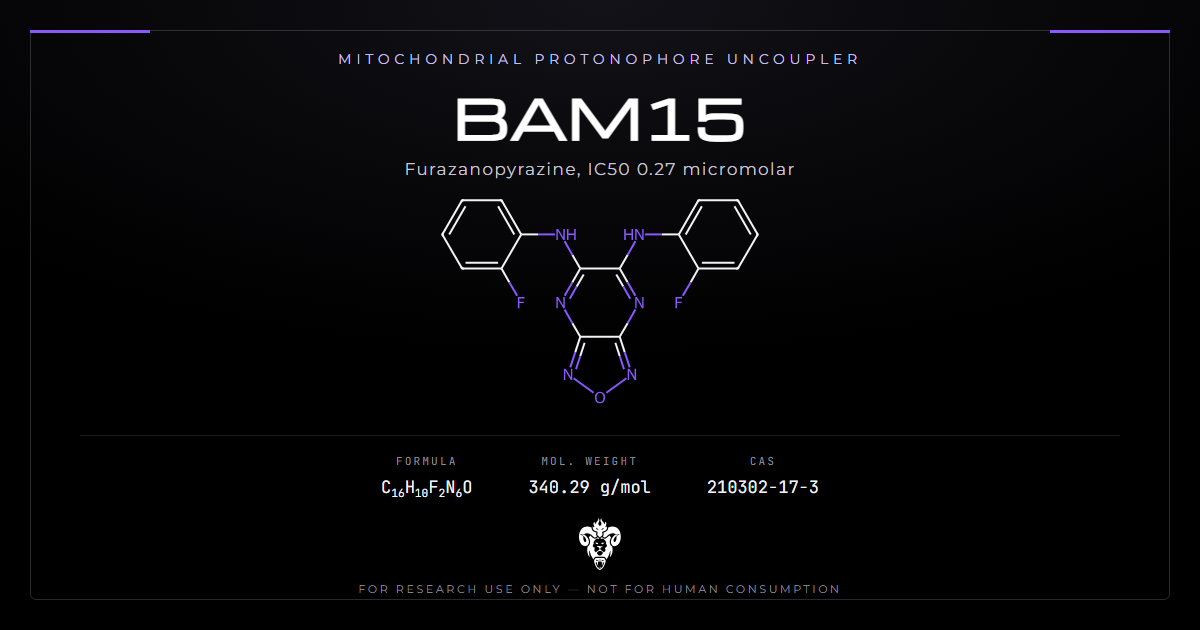
Chemical uncouplers carry protons into the mitochondrial matrix without passing through ATP synthase. Nutrient oxidation continues. ATP production does not follow it. The energy leaves as heat.
Biochemists have understood that mechanism for decades, and it carries a known problem. The widely used protonophores, FCCP and 2,4-dinitrophenol, act at membranes other than the mitochondrial inner membrane. They depolarise the plasma membrane, inhibit mitochondria and kill cells, and the resulting therapeutic index is narrow enough to limit clinical use [1].
BAM15 came out of a screen run specifically to find an uncoupler without that off-target activity. Its founding paper says so in its title.
Chemical identity
A small molecule rather than a peptide, and the naming needs a note.
| Property | Value |
|---|---|
| Systematic name | N5,N6-bis(2-fluorophenyl)-[1,2,5]oxadiazolo[3,4-b]pyrazine-5,6-diamine |
| Molecular formula | C16H10F2N6O |
| Molecular weight | 340.29 |
| CAS | 210302-17-3 |
| PubChem CID | 565708 |
| InChIKey | OEGJBRZAJRPPHL-UHFFFAOYSA-N |
| Potency | IC50 0.27 micromolar [2] |
| Class | Furazanopyrazine protonophore |
Two ring numberings describe one compound
The founding paper names it as an oxadiazolo[3,4-e]pyrazine [1]. PubChem and the later chemistry papers name it as an oxadiazolo[3,4-b]pyrazine. The 2015 structure-activity work calls the whole series furazano[3,4-b]pyrazines [3].
All three describe the same molecule. The InChIKey settles any doubt, and it is worth checking rather than matching on the written name.
What a mitochondrial uncoupler does
Two consequences follow from collapsing the proton motive force, and only one of them gets discussed.
Respiration speeds up, because the electron transport chain no longer works against a full gradient. That is the effect behind the energy-expenditure story.
Reactive oxygen species production falls at the same time [1]. A lower gradient means less back-pressure at the complexes where electrons leak. So an uncoupler is both a metabolic tool and an antioxidant intervention, depending on which readout somebody chose to measure.
Why that matters for reading the literature
Papers reporting protection from oxidative injury and papers reporting fat loss are describing the same mechanism from opposite ends. Neither is evidence for the other. A study measuring reactive oxygen species has not established anything about body weight.
The problem BAM15 was built to solve
The founding group screened a small molecule chemical library with one requirement: uncoupling activity at mitochondria, without activity at the plasma membrane [1].
BAM15 came out of that screen. Later work put its potency at 0.27 micromolar and described it as stimulating mitochondrial respiration across a broad dosing range [2][3].
That last phrase is the design goal restated. A narrow dosing range is what a narrow therapeutic index looks like at the bench.
Two independent groups, one year
In 2020 two laboratories published mouse obesity results within two months of each other, in different journals, from different institutions.
| Study | Institutions | Reported |
|---|---|---|
| Alexopoulos 2020 [4] | University of New South Wales, Virginia Tech, University of Virginia | Reversal of diet-induced obesity and insulin resistance in mice |
| Axelrod 2020 [5] | Pennington Biomedical Research Center, Cleveland Clinic, Case Western Reserve | Protection against obesity and improved glycemic control |
Independent replication in the same year is not common for a compound at this stage. It is the strongest thing in this file.
Reversal and prevention are different claims
Read the two titles closely. One says the compound reverses diet-induced obesity and insulin resistance [4]. The other says it protects against obesity and improves glycemic control [5].
Reversal means treating an animal that is already obese. Protection means intervening before or during the development of obesity. Those designs answer different questions, and a compound can succeed at one and fail at the other.
Taken together the pair is stronger than either alone, because the two groups covered both halves. Taken separately, a citation that flattens them into “BAM15 works in obese mice” has lost the distinction the authors chose to make in their own titles.
A disclosure that belongs in the open
Two author affiliations on the Nature Communications paper name Continuum Biosciences Pty Ltd, a company [4]. The chemistry group at Virginia Tech that made the molecule appears on that author list too.
None of this is hidden. The affiliations print it, and naming it is ordinary practice rather than an accusation. Commercial involvement and good science coexist routinely. A reader weighing the evidence should know which papers carry it.
The comparison that complicates it
In 2025 the originating laboratory published the most useful paper in this file, and it is the least quoted [6].
Their framing of the problem is worth quoting in substance. Any molecule that increases proton transport into the matrix independent of ATP production gets classified as an uncoupler, whatever else it does. So dozens of chemical classes carry one label while producing a wide spectrum of phenotypes.
They compared 15 structurally unrelated uncouplers side by side in CHO-K1 cells. The top five went into male db/db mice at two doses each, across 11 groups.
The benchmark is the part to notice
They did not only compare the compounds against each other. They benchmarked against a lifestyle intervention of 35% calorie restriction, and against lean db/+ mice that were metabolically healthy to begin with [6].
Setting a drug against calorie restriction and against a healthy animal is the honest comparison, and it is rare. Anyone reading uncoupler results should ask what the comparator was.
Its own chemists have been trying to replace it
A steady medicinal chemistry programme has run since the original discovery, and every paper in it is an attempt to do better than BAM15.
- An imidazo[4,5-b]pyridine scaffold described as derived from iterative modifications of BAM15, aimed at steatohepatitis [7].
- Unsymmetric hydroxylamine and hydrazine derivatives [2].
- An oxadiazolo[3,4-b]pyridin-7-ol series [8].
- N-substituted trifluoromethyl purin-6-amines profiled by structure-activity relationship [9].
Read that as information rather than as criticism. Chemists iterate on a scaffold when they see room to improve it. Ten years of follow-up series tells you the original compound has properties worth changing, and the papers themselves state which ones.
The indication list is growing fast
Since 2024 the compound has appeared as a tool across fields with no obvious connection to obesity.
| Field | Model | Reference |
|---|---|---|
| Atherosclerosis | ApoE-null mice on high-fat diet, 5 mg/kg/day subcutaneous | [10] |
| Liver lipid metabolism | High-fat-diet obese mice, AMPK and mitophagy route | [11] |
| Fatty liver, combination | GAN mouse model, alongside resmetirom | [12] |
| Oocyte quality | Obesity model, PPAR-gamma dependent | [13] |
| Sperm cryopreservation | Human sperm | [14] |
| CAR-T cell function | CD7 CAR-T cells | [15] |
| Breast cancer metastasis | Serine catabolism via FTO | [16] |
The cancer entries run the mechanism backwards
Two of these use uncoupling as a disruption rather than a benefit. One reports that mitochondrial uncoupling inhibits serine catabolism in metastatic breast cancer [16]. Another uses it to enhance CAR-T cell function [15].
In the obesity work the goal is burning more substrate in a metabolically healthy direction. In the tumour work the goal is starving a cell of something it needs, or reshaping the environment around it. Same molecule, same biophysics, opposite intent.
That is normal for a tool compound and it is a reason to read the aim of each paper rather than collecting positive results. A compound that helps in seven unrelated models is usually being used seven different ways.
What a spreading indication list means and does not mean
Mitochondria participate in nearly every cellular process, so a compound that changes mitochondrial bioenergetics will change something measurable almost anywhere somebody looks. Breadth of this kind is weak evidence for any single application.
The combination paper is the more interesting entry. Its authors note that over 60% of patients receiving resmetirom do not achieve resolution of steatohepatitis, which is the gap the combination was built to address [12].
What the studies actually used
Doses scatter across species and models, and several key abstracts omit them.
| Study | Species and model | Route and amount |
|---|---|---|
| Zhong 2025 [10] | ApoE-null mice, high-fat diet | Subcutaneous, 5 mg/kg/day |
| Shah 2025 [6] | Male db/db mice, 11 groups | Two doses per compound, against 35% calorie restriction |
| Quinlan 2025 [2] | Cell assay | IC50 0.27 micromolar |
| Alexopoulos 2020 [4], Axelrod 2020 [5] | Diet-induced obese mice | Amounts not stated in the abstracts |
No clinical trial of BAM15 appears in the indexed literature. Every result discussed here comes from cells or animals.
The combination result asks a different question
Most entries on that list test whether BAM15 does something on its own. The fatty liver paper tests whether it adds to a drug that already has approval [12].
That is a harder bar and a more useful one. A compound that improves an outcome on top of standard care answers a question a monotherapy result cannot, because the comparator is a working treatment rather than a vehicle. The authors chose it because most patients on the approved drug do not reach resolution, so the remaining gap is where a second mechanism would have to earn its place.
Two experiments that would settle the interpretation
Neither is a recommendation. They are the gaps a reader should notice.
Publish the plasma membrane comparison at matched exposure
The founding claim is selectivity: mitochondrial uncoupling without plasma membrane depolarisation [1]. That claim came from a screen. A direct measurement of both membranes across a full dose range, with FCCP and 2,4-dinitrophenol run alongside at matched exposure, would show how wide the separation actually is. Selectivity is a ratio, and the ratio is what determines whether the design goal was met.
Run the calorie restriction benchmark on BAM15 specifically
The 2025 comparison put five uncouplers against 35% calorie restriction [6]. A reader wanting to know how BAM15 alone measures against that benchmark, at more than two doses, has to wait for somebody to run it that way. Until then, the honest summary runs like this: somebody finally compared an uncoupler to eating less, and the field has started asking the right question.
What the structure-activity work shows
The 2015 study that mapped this series is the least glamorous paper in the file and it carries the most practical information [3].
Chemical uncouplers are lipophilic weak acids. Two properties have to hold at once. The molecule must cross the inner membrane freely in both its protonated and deprotonated forms, which needs lipophilicity. It must also pick up and release a proton in the right pH range, which needs an acidic site of the right strength. Change a substituent and both properties move together.
That is why the furazanopyrazine core carries two anilines rather than one, and why the fluorine sits where it does. The series exists because the group varied those positions and measured what happened to uncoupling potency.
The practical consequence
A compound one substituent away from BAM15 is not a near-equivalent. It is a different point on a curve the original authors published, and it may sit anywhere on that curve including the inactive end.
This matters more here than for most compounds in the catalogue, because the successor series [2][7][8][9] share the general description “mitochondrial uncoupler” with BAM15 while differing in scaffold. Shared class language hides real differences, which is exactly the point the 2025 comparison makes at the level of the whole field [6].
How to read a BAM15 study
Four questions, and the first is the one most reviews skip.
Which readout, respiration or reactive oxygen species?
The mechanism produces both, and they support different conclusions [1]. A protection-from-oxidative-injury result is not an energy expenditure result.
What was the comparator?
Against vehicle, almost any uncoupler looks active. Against calorie restriction and a healthy control animal, the question becomes how much it is worth [6].
Is the paper about BAM15 or about a successor?
Much of the chemistry literature uses BAM15 as the benchmark while advancing a different molecule [2][7][8][9]. The abstract will name the new scaffold.
Cells, mice, or neither?
Nothing here has reached a clinical trial. A cell result and a mouse result are separate claims, and neither is a human claim.
Verifying research material
The identity risk for this compound is positional rather than gross.
The fluorine position is the thing to check
BAM15 carries two 2-fluorophenyl groups. Move either fluorine to the 3 or 4 position and the formula stays C16H10F2N6O and the mass stays 340.29. A mass spectrum cannot separate them.
That is not a hypothetical concern. The 2015 structure-activity study exists precisely because substituent position and identity change uncoupling potency across this series [3]. An isomer is a different compound with different activity and an identical mass.
Nuclear magnetic resonance resolves the substitution pattern. So does a retention-time comparison against a characterised reference on the same method. Every batch we supply carries a certificate of analysis recording the identity and purity data behind it.
Lipophilicity is a handling property too
The same property that lets this molecule cross the inner mitochondrial membrane makes it poorly soluble in water. Stock solutions go into an organic solvent, and the working dilution is where material comes out of solution if the step is too large.
Watch for precipitate rather than assuming a clear tube. A concentration that looks right on paper and has partly crashed out will read as a weak compound rather than as a preparation problem.
Handling
The compound is a lipophilic solid with no ester and no obvious hydrolytic route, so it tolerates handling better than the peptides in this catalogue. Standard practice applies: keep it dry, keep it dark, and equilibrate a vial to room temperature before opening. Aliquot stock solutions in organic solvent rather than freeze-thawing them repeatedly.
Common questions about BAM15
Identity and mechanism
What class of molecule is BAM15? A furazanopyrazine protonophore, 340.29 daltons, and a small molecule rather than a peptide.
How does it differ from DNP and FCCP? Those act at membranes beyond the mitochondrial inner membrane, which produces plasma membrane depolarisation and cytotoxicity. BAM15 came from a screen designed to avoid that [1].
Does it work like AICAR or SLU-PP-332? No. Those act on AMPK and on nuclear receptors respectively. Uncoupling is a biophysical effect on a membrane gradient, not receptor pharmacology.
Evidence
What is best supported? Reversal or prevention of diet-induced obesity in mice, reported independently by two groups in 2020 [4][5].
What is the strongest caution? The originating laboratory’s own 2025 comparison, which shows the uncoupler label covering a wide spectrum of behaviour and benchmarks the class against calorie restriction [6].
Are there human trials? None appear in the indexed literature.
Why does an uncoupler lower reactive oxygen species? A smaller proton gradient means less back-pressure at the complexes where electrons leak, so fewer escape to form superoxide [1]. That is the same event as the energy-expenditure effect, measured at a different point.
Verification
Does mass identify it? Not completely. The 3-fluoro and 4-fluoro positional isomers share the formula and the mass, so the substitution pattern needs nuclear magnetic resonance or a reference comparison [3].
Which systematic name is correct? Both ring numberings in circulation describe the same compound. Match on the InChIKey rather than the name.
Is a near analogue an acceptable substitute? No. The published structure-activity series shows potency moving with substituent position across this scaffold [3].
What should a certificate carry beyond mass and purity? Something that fixes the substitution pattern. Nuclear magnetic resonance does it, and so does a retention-time match against a characterised reference.
Summary of the evidence
BAM15 exists because older protonophores were too indiscriminate to use. A screen looked for mitochondrial uncoupling without plasma membrane activity, and this molecule came out of it at 0.27 micromolar. Two independent groups then reported reversal or prevention of diet-induced obesity in mice in the same year, which is a stronger preclinical position than most compounds in this catalogue hold.
Three things belong alongside that. The laboratory that discovered it has spent a decade making successor molecules. Its own 2025 comparison found the uncoupler label stretched across a wide spectrum of behaviour, and benchmarked the class against 35% calorie restriction rather than against vehicle alone. And no clinical trial appears in the indexed literature.
Kimera Chems supplies BAM15 alongside related metabolic research compounds including 5-Amino-1MQ, with full analytical documentation. Our metabolic research library covers more compounds in this class.
Research use only. Not for human or veterinary use. Nothing here describes a therapy or a dosing protocol.
References
- Kenwood BM, Weaver JL, Bajwa A, Poon IK, Byrne FL, Murrow BA, Calderone JA, Huang L, et al. Identification of a novel mitochondrial uncoupler that does not depolarize the plasma membrane. Mol Metab. 2014;3(2):114-23. PMID 24634817. DOI
- Quinlan JE, Salamoun JM, Garcia CJ, Hargett S, Beretta M, Shrestha R, Li C, Hoehn KL, et al. Unsymmetric hydroxylamine and hydrazine BAM15 derivatives as potent mitochondrial uncouplers. Bioorg Med Chem. 2025;118:118045. PMID 39740573. DOI
- Kenwood BM, Calderone JA, Taddeo EP, Hoehn KL, Santos WL. Structure-activity relationships of furazano[3,4-b]pyrazines as mitochondrial uncouplers. Bioorg Med Chem Lett. 2015;25(21):4858-4861. PMID 26119501. DOI
- Alexopoulos SJ, Chen SY, Brandon AE, Salamoun JM, Byrne FL, Garcia CJ, Beretta M, Olzomer EM, et al. Mitochondrial uncoupler BAM15 reverses diet-induced obesity and insulin resistance in mice. Nat Commun. 2020;11(1):2397. PMID 32409697. DOI
- Axelrod CL, King WT, Davuluri G, Noland RC, Hall J, Hull M, Dantas WS, Zunica ER, et al. BAM15-mediated mitochondrial uncoupling protects against obesity and improves glycemic control. EMBO Mol Med. 2020;12(7):e12088. PMID 32519812. DOI
- Shah DP, Vancuylenburg CS, Olzomer EM, Chen SY, Grams RJ, Beretta M, Byrne FL, Santos WL, et al. Diverse actions of 15 structurally unrelated mitochondrial uncouplers in cells and mice. Mol Metab. 2025;99:102204. PMID 40639664. DOI
- Salamoun JM, Krinos EL, Foutz MA, Hargett SR, Beretta M, Shrestha R, Hoehn KL, Santos WL. Design, synthesis, and biological evaluation of imidazo[4,5-b]pyridine mitochondrial uncouplers for the treatment of metabolic dysfunction-associated steatohepatitis (MASH). Eur J Med Chem. 2024;280:116916. PMID 39406121. DOI
- Foutz MA, Krinos EL, Beretta M, Hargett SR, Shrestha R, Murray JH, Duerre E, Salamoun JM, et al. Design, Synthesis, and Biological Evaluation of [1,2,5]Oxadiazolo[3,4-b]pyridin-7-ol as Mitochondrial Uncouplers for the Treatment of Obesity and Metabolic Dysfunction-Associated Steatohepatitis. J Med Chem. 2024;67(23):21486-21504. PMID 39614818. DOI
- Krinos EL, Fields RJ, DeLuca IM, Foutz MA, Li C, Hargett SR, Beretta M, Zhou M, et al. Structure-activity relationship profiling of N-substituted 8-trifluoromethyl-9H-purin-6-amines as mitochondrial protonophores. Eur J Med Chem. 2026;308:118694. PMID 41734593. DOI
- Zhong S, Shen H, Dai X, Liao L, Huang C. BAM15 inhibits endothelial pyroptosis via the NLRP3/ASC/caspase-1 pathway to alleviate atherosclerosis. Atherosclerosis. 2025;406:119226. PMID 40393254. DOI
- Liu Z, Wang W, Wang S, Lv R, Li C, Sun C. Mitochondrial uncoupler BAM15 ameliorates liver lipid metabolism disorders by activating the AMPK pathway. FEBS J. 2026;293(10):2999-3014. PMID 41527408. DOI
- Zhou M, Li C, Byrne FL, Vancuylenburg CS, Olzomer EM, Hargreaves A, Wu LE, Shackel NA, et al. Beneficial effects of MGL-3196 and BAM15 combination in a mouse model of fatty liver disease. Acta Physiol (Oxf). 2024;240(10):e14217. PMID 39152636. DOI
- Ma RJ, Zhang HL, Wu X, Lu PS, Zhang KH, Hou YX, Wu ZJ, Wang Y, et al. BAM15 improves oocyte quality against obesity via PPARγ-dependent mitochondrial function. Protein Cell. 2026;. PMID 42178393. DOI
- Chen B, Liu C, Xiong M, Xu L, Yao J, Guan L, Sun Z, Xie Q, et al. Mitochondrial uncoupler BAM15 attenuates cryopreservation-induced damage in human sperm by stabilizing mitochondrial homeostasis. Biol Reprod. 2026;. PMID 42295994. DOI
- Ma Y, Zhang H, Dou L, Sun H, Jing Y, Gu Z, Wang L, Gao C. Mitochondrial uncoupler BAM15 enhances the function of CD7CAR-T(CD7-) cells and reduces the release of cytokines for the therapy of T-cell malignancies. Int Immunopharmacol. 2025;155:114577. PMID 40215779. DOI
- Jin X, Li AM, Zhao M, Jiang H, Xiao Y, Yip M, Melemenidis S, Jackson S, et al. Mitochondrial uncoupling inhibits serine catabolism via FTO activation in metastatic breast cancer. Cancer Biol Med. 2026;. PMID 41821182. DOI
Research use only. Not for human or veterinary use. Nothing here describes a therapy or a dosing protocol.