
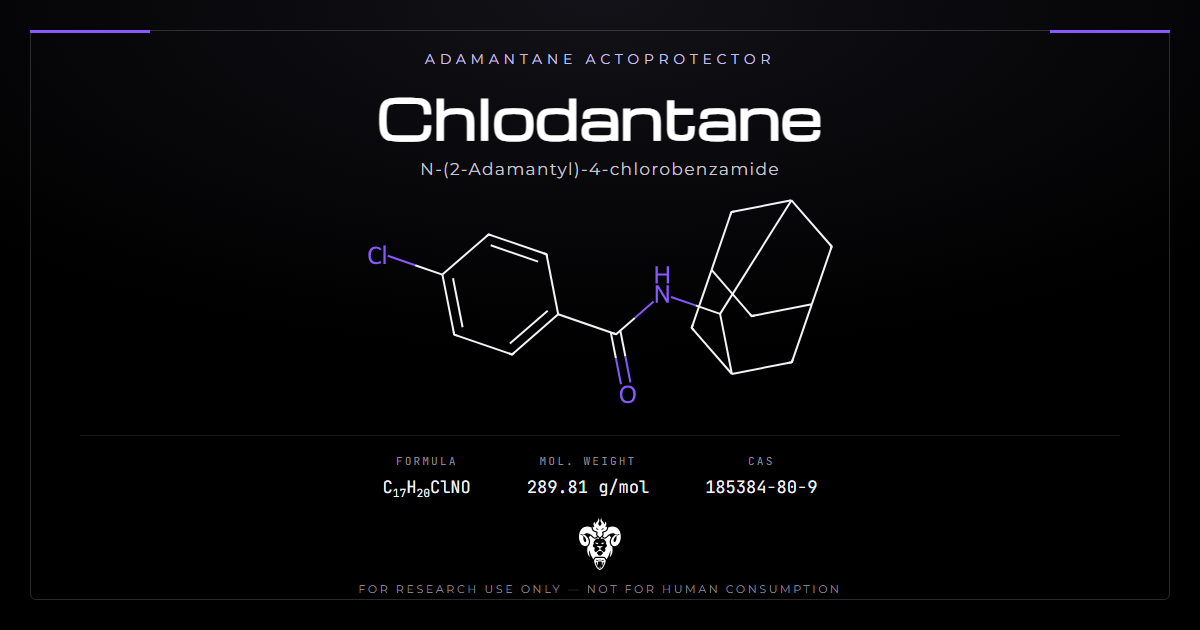
Almost every supplier describes chlodantane as the chlorine version of bromantane. That description is wrong, and the error is not cosmetic.
Bromantane joins its adamantane cage to an aryl ring through a nitrogen atom, making it a secondary aromatic amine. Chlodantane joins its cage to the ring through a nitrogen and a carbonyl, making it a benzamide. The two differ by more than a halogen. They differ by a functional group, and an amide is not a bioisostere of an amine.
That distinction governs everything downstream: basicity, hydrogen bonding, metabolic handling, chromatographic behaviour, and whether the substantial published record on bromantane can inform work on chlodantane at all. It cannot, and the reasons are worth setting out precisely.
What follows covers the verified identity of the compound, the adamantane scaffold it belongs to, the Soviet pharmacological category it was built for, what its single indexed source actually claims, and how to verify a vial of it in a laboratory.
Chemical identity: what you are actually handling
Chlodantane is N-(2-adamantyl)-4-chlorobenzamide. The adamantane cage bonds through its 2-position to an amide nitrogen, and that nitrogen bonds to a carbonyl carrying a para-chlorinated phenyl ring.
| Property | Value |
|---|---|
| IUPAC name | N-(2-adamantyl)-4-chlorobenzamide |
| Russian designation | 2-(para-chlorobenzoylamino)adamantane |
| CAS | 185384-80-9 |
| Molecular formula | C17H20ClNO |
| Molecular weight | 289.80 g/mol |
| PubChem CID | 959689 |
| InChIKey | VOHIYJJUKAUCCU-UHFFFAOYSA-N |
| Functional class | Secondary benzamide |
| Halogen | One chlorine, aromatic, para |
| Stereocentres | None |
Reading the Russian name
Russian sources render the compound as 2-(para-chlorobenzoylamino)adamantane [1]. The construction is worth parsing, because it encodes the structure precisely and the English shorthand does not.
The “benzoyl” fragment is the acyl group, a phenyl ring attached to a carbonyl. “Benzoylamino” places that acyl group on a nitrogen, which is what defines an amide. Anyone reading the Russian name is told the compound is a benzamide. Anyone reading “chlodantane” beside “bromantane” is told nothing of the kind.
Why the amide changes the molecule
An aromatic amine nitrogen carries a lone pair delocalised into the ring, retains measurable basicity, and offers a hydrogen-bond donor. An amide nitrogen has its lone pair delocalised into the carbonyl instead. The result is a group that is effectively non-basic, planar at nitrogen, and a much stronger hydrogen-bond acceptor through its carbonyl oxygen.
Three practical consequences follow. Chlodantane will not form salts with acids the way an amine does, so questions about hydrochloride versus free base do not arise in the same way. Its chromatographic retention and peak shape differ from an amine on the same column, since amines interact with residual silanols and amides do not. And its metabolic fate differs, because amide hydrolysis is a route available to chlodantane that has no counterpart in bromantane.
The absence of stereocentres simplifies matters considerably. Adamantane is symmetrical. Substitution at the 2-position produces no chirality here, so no chiral method applies.
The adamantane scaffold
Chlodantane belongs to a large and well-characterised structural family, and the scaffold literature supplies context its own literature does not.
A rigid lipophilic cage
Adamantane is a tricyclic hydrocarbon whose carbons occupy the same arrangement as the diamond lattice, which makes it exceptionally rigid and conformationally locked. Wanka, Iqbal and Schreiner surveyed its medicinal chemistry at length. They characterise the group as a lipophilic anchor that reliably alters how a molecule distributes [3].
Lamoureux and Artavia organised the same territory around four functions the cage performs. It modifies absorption, distribution, metabolism and excretion. It supplies hydrophobic bulk, interacts with ion channels, and acts as a rigid scaffold fixing substituent geometry [4].
Attaching adamantane to a pharmacophore raises lipophilicity substantially and often slows oxidative metabolism. The cage presents mostly strong, hindered carbon-hydrogen bonds, which resist oxidative attack [17].
That last property explains why Soviet chemists screened the scaffold so heavily. A rigid, metabolically resistant, membrane-partitioning group is a reasonable starting point for compounds intended to act in the central nervous system.
Adamantane compounds in clinical practice
The scaffold has produced approved medicines across unrelated indications. Spilovska and colleagues reviewed those in clinical use. The list covers amantadine and rimantadine as antivirals, memantine in Alzheimer disease, tromantadine and adapalene in topical therapy, and saxagliptin and vildagliptin as antidiabetic dipeptidyl peptidase inhibitors [5].
The list makes an instructive point. Adamantane is a delivery and distribution feature rather than a pharmacophore in its own right. Memantine blocks NMDA receptors, saxagliptin inhibits a peptidase, and adapalene binds retinoic acid receptors. Sharing a cage tells you almost nothing about shared pharmacology.
Nitrogen-substituted variants form their own subfield, with azaadamantanes showing reduced lipophilicity relative to their all-carbon parents and correspondingly different bioavailability [17].
What an actoprotector is meant to be
Chlodantane emerged from a pharmacological category with no direct Western equivalent. That category is worth understanding before reading any claim made under it.
The definition
Oliynyk and Oh define actoprotectors as preparations that raise the body’s stability against physical loads without increasing oxygen consumption or heat production. They characterise the class as synthetic adaptogens with capacity to improve physical performance [2]. The two compounds they treat as the class representatives are bemitil and bromantane [2].
The definitional clause matters more than it might appear. Requiring that performance improve without raised oxygen consumption distinguishes the category from conventional stimulants, which typically raise metabolic rate. It is a mechanistic claim built into a category name.
Later reviews of adaptogens place bromantane among the synthetic members alongside levamisole, aphobazole and bemethyl, set against plant adaptogens such as Rhodiola and Eleutherococcus extracts [15]. Those reviews note that clinical trial evidence in humans remains limited across the whole category [15].
Where chlodantane sits
The category is Soviet and post-Soviet in origin, and military and aerospace medical institutes did most of the developing [2]. Investigators judged compounds within it against endpoints reflecting that setting. Heat tolerance, hypoxia, fatigue recovery, and operant performance under load all recur.
Comparative toxicity work within the class illustrates how closely halogen variants were tracked. Bugaeva and colleagues measured acute toxicity for bemithyl against its brominated counterpart bromithyl, reporting median lethal doses differing roughly threefold between the two [18].
That framework labels chlodantane a rapid-acting adaptogen [1]. The phrase assigns a category rather than a mechanism, and it deserves to be read that way.
The single source on chlodantane
One indexed publication describes this compound. Understanding exactly what it says, and does not say, is the most useful thing a laboratory can take from the literature.
What the review states
Morozov and colleagues published a 1999 review covering a programme of 329 novel adamantane derivatives, which the group synthesised and studied pharmacologically [1].
Compounds carrying halogen-bearing aromatic radicals in the second position showed the most pronounced effect on animal resistance to environmental and performance stressors. The review names two. It credits bromantane with low toxicity, improved physical and operant working performance in animals, and faster recovery from fatigue, hyperthermia and hypoxia. It calls chlodantane a rapid-acting adaptogenic agent that raises animal resistance to physical and toxic chemical agents [1].
Both compounds reportedly show immunostimulating effects in secondary stress-induced immunodeficiencies. The authors attribute that mechanism to membrane-protective activity [1].
What it does not state
That is the complete indexed record for chlodantane. The paper is a Russian-language review, so the primary experiments sit behind it rather than in it. No dose-response data, model details, species, or endpoint definitions for chlodantane appear at the abstract level. No replication outside that programme exists in the searchable literature.
There is no published receptor binding data for chlodantane, no pharmacokinetic profile, no toxicology study, and no analytical method paper. A search under the compound name returns one result.
A single review naming a compound in a sentence is a starting point for investigation. It is not a characterisation.
Chlodantane is not bromantane, and the difference matters
Because chlodantane’s own record is one sentence, there is strong temptation to reason from bromantane instead. The bromantane literature is genuinely substantial, which makes the temptation worse rather than better.
What the bromantane record contains
Researchers have studied bromantane across pharmacology, toxicology and behaviour, almost entirely in Russian-language journals.
On performance, Morozov and Kleimenova reported effects on physical work capacity in mice and rats across swimming and treadmill tests. Those effects persisted at least 24 hours, and the authors added electron-microscopic observations in cardiomyocyte and skeletal muscle mitochondria [8]. Badyshtov and colleagues examined thermoprotective properties under overheating. They reported changes in heat exchange, protein metabolism and antioxidant protection [16].
On mechanism, Bugaeva and colleagues drew a dose-dependent conclusion from acute toxicity work. Catecholaminergic effects account for therapeutic action, while cholinergic effects dominate at toxic doses [7]. Iezhitsa and colleagues applied the Irwin multi-test observation protocol. They found stimulation of behavioural activity at 30 to 300 mg/kg and suppression at 600 mg/kg and above. They associated the effects with central dopamine stimulation and suppression of muscarinic and nicotinic cholinergic structures [6]. Krapivin and colleagues compared bromantane against adapromine and midantan on rat brain bioelectric activity [13].
On safety, a two-month course produced sex-dependent effects on motor activity. Physiological and behavioural characteristics recovered within two months of stopping, and the animals showed no significant behavioural signs of dependence or tolerance [9]. Bugaeva and colleagues identified blood as a target of toxic action. They reported dose-dependent changes in erythrocyte, haemoglobin and leukocyte levels, with reversible poikilocytosis and granulocytosis at higher doses [11]. Separate papers cover effects on the cardiovascular and sympathoadrenal systems [10], and late-term effects on rat progeny following pre-mating administration [14].
Comparative work against the stimulant sydnocarb found the two optimised operant activity through different routes. Bromantane reduced error rates at a lower total reaction count [12].
Why none of that transfers
That body of work characterises a secondary aromatic amine with documented dopaminergic activity. Chlodantane is a benzamide with no published receptor data at all.
Three specific breaks in the read-across argument are worth naming. The functional group differs, and amide versus amine ranks among the larger changes available in medicinal chemistry. The halogen differs too. Chlorine and bromine differ in size, polarisability and carbon-halogen bond strength, which affects both binding and metabolic dehalogenation. And the source review itself assigns the two compounds different profiles, describing bromantane as a performance and recovery agent and chlodantane as a rapid-acting adaptogen [1].
When the one paper covering both compounds distinguishes them, treating them as interchangeable contradicts the only evidence available.
Kimera lists Bromantane and Chlodantane separately for exactly this reason.
Analytical characterisation
Chlodantane is unusually tractable analytically, and one check settles most of the questions that matter.
The halogen isotope signature
Chlorine and bromine produce dramatically different isotope patterns in mass spectrometry, and this is the fastest way to confirm you have the right compound.
Chlorine occurs as two stable isotopes in roughly a three-to-one ratio, so a single-chlorine compound shows an M+2 peak at approximately one third the height of the molecular ion. Bromine’s two isotopes occur in nearly equal abundance, so a single-bromine compound shows an M+2 peak of almost the same height as the molecular ion.
A chlodantane spectrum and a bromantane spectrum are therefore distinguishable at a glance, without reference standards and without chromatography. The molecular masses differ as well, 289.8 against 306.2, but the isotope envelope is the more decisive observation because it reports the halogen identity directly rather than inferring it from a mass difference.
Nuclear magnetic resonance
Proton NMR separates the two compounds on a second independent basis. The amide proton appears well downfield of an aromatic amine proton, and the adamantane cage produces a characteristic cluster of overlapping signals between roughly one and two parts per million.
Carbon NMR is more decisive still, because the amide carbonyl carbon resonates near 165 to 170 parts per million. Bromantane has no carbon in that region at all. A single spectrum therefore answers the amine-versus-amide question definitively.
Para-substitution on the aryl ring produces a clean two-doublet aromatic pattern, confirming substitution position.
Accurate mass
Accurate mass confirms C17H20ClNO. The composition includes one oxygen, which bromantane lacks entirely, so elemental composition alone separates them.
What a rigorous chlodantane COA should contain
Given how routinely suppliers confuse this compound with a structurally different one, identity confirmation matters more than the purity figure most certificates lead with.
Structural confirmation by NMR, establishing the amide carbonyl. This is the single most valuable item on the certificate for this compound, because it directly excludes the amine that chlodantane is most often confused with.
Accurate mass with the isotope pattern shown, confirming both the molecular formula and a single chlorine rather than a bromine.
Chromatographic purity with the method stated, including the column and detection wavelength.
Residual solvent data. Acylation produces the compound, and the workup solvents are the plausible contaminants.
No chiral method applies here. The molecule has no stereocentres, which removes a category of concern affecting most research compounds.
Kimera publishes third-party certificates of analysis for every lot in its COA database. Related compounds from the same pharmacological tradition appear in the nootropics category, including Emoxypine Succinate and Noopept.
Common misclassifications
Four errors recur in descriptions of this compound.
Suppliers call it the chlorine analogue of bromantane. It is a different functional class, and the two molecules differ by a carbonyl as well as a halogen.
Summaries transfer bromantane’s dopaminergic mechanism to it. Nobody has published receptor data for chlodantane, and the transfer rests on a structural similarity that does not hold.
Descriptions cite bromantane’s toxicology as though it applied. Those studies characterise a different molecule with a different metabolic profile [6][7][11][18].
Marketing copy presents actoprotector as an established pharmacological mechanism. It is a Soviet-era category defined by an effect claim, and its representative compounds are bemitil and bromantane rather than chlodantane [2].
Experimental design considerations
Four points follow from the state of the literature.
Verify identity before anything else. Bromantane is the compound most likely to arrive in error, and carbon NMR or an isotope pattern settles the question in minutes.
Do not use bromantane data to set concentrations. No published dose-response data exists for chlodantane in any model, so a laboratory must establish a range rather than assume one.
Include a bromantane arm if the comparison is the point. Sources group the two compounds constantly, yet no published study appears to have run a direct comparison.
Treat the 1999 review as a hypothesis source. It names endpoints worth examining, including resistance to physical and chemical stressors and immunological effects under stress conditions [1]. It does not supply the data behind them.
Regulatory and compliance status
Chlodantane holds no marketing approval in any jurisdiction and has not been the subject of any published clinical trial.
Its better-studied relative occupies a different position. Bromantane reached clinical use in Russia, and anti-doping authorities prohibit it in sport. That is where most people first meet the adamantane actoprotectors.
Kimera supplies chlodantane for laboratory research use only. Nothing in the published record supports any characterisation of its effects in humans, because no human study of it exists.
Frequently asked questions
What is Chlodantane? N-(2-adamantyl)-4-chlorobenzamide, CAS 185384-80-9, an adamantane benzamide from a Soviet-era screening programme. Kimera supplies it as a laboratory research material.
Is Chlodantane just bromantane with chlorine? No. Bromantane is a secondary aromatic amine and chlodantane is a benzamide. They differ by a carbonyl group as well as by halogen.
How much literature exists on it? One indexed review names it in a sentence [1]. There is no pharmacokinetic, toxicological, receptor binding, or analytical method paper.
What does actoprotector mean? A Soviet pharmacological category for agents said to raise stability against physical load without increasing oxygen consumption. Its standard representatives are bemitil and bromantane [2].
How do I confirm I have the right compound? Carbon NMR shows an amide carbonyl near 165 to 170 ppm that bromantane cannot produce. The chlorine isotope pattern gives an M+2 peak near one third of the molecular ion, against roughly equal heights for bromine.
Does it need a chiral method? No. The molecule has no stereocentres.
Is it approved anywhere? No, in any jurisdiction, and no clinical trial of it appears in the literature.
Summary of the evidence
Identity: fully defined. C17H20ClNO, 289.80 g/mol, no stereocentres, one aromatic chlorine, one amide bond.
Classification: adamantane benzamide, assigned to the actoprotector category by its originating programme [1][2].
Published pharmacology: one review sentence describing rapid-acting adaptogenic activity and immunostimulating effects under stress conditions [1].
Mechanism: unpublished. The membrane-protective attribution in the source applies to the programme’s compounds collectively [1].
Read-across from bromantane: not supportable. Different functional group, different halogen, and different profiles assigned in the only source covering both [1].
Analytical position: straightforward. Carbon NMR and the halogen isotope pattern both separate it decisively from its usual point of confusion.
Gaps: no pharmacokinetics, no toxicology, no receptor data, no replication, no human study.
References
- Morozov IS, Klimova NV, Sergeeva SA, et al. Adamantane derivatives enhancing body’s resistance to emergencies. Vestn Ross Akad Med Nauk. 1999;(3):28-32. PMID 10222828
- Oliynyk S, Oh S. The pharmacology of actoprotectors: practical application for improvement of mental and physical performance. Biomol Ther (Seoul). 2012;20(5):446-456. PMID 24009833. DOI
- Wanka L, Iqbal K, Schreiner PR. The lipophilic bullet hits the targets: medicinal chemistry of adamantane derivatives. Chem Rev. 2013;113(5):3516-3604. PMID 23432396. DOI
- Lamoureux G, Artavia G. Use of the adamantane structure in medicinal chemistry. Curr Med Chem. 2010;17(26):2967-2978. PMID 20858176. DOI
- Spilovska K, Zemek F, Korabecny J, et al. Adamantane: a lead structure for drugs in clinical practice. Curr Med Chem. 2016;23(29):3245-3266. PMID 27222266. DOI
- Iezhitsa IN, Spasov AA, Bugaeva LI, Morozov IS. Toxic effect of single treatment with bromantane on neurological status of experimental animals. Bull Exp Biol Med. 2002;133(4):380-383. PMID 12124651. DOI
- Bugaeva LI, Verovskii VE, Iezhitsa IN, Spasov AA. An acute toxicity study of bromantane. Eksp Klin Farmakol. 2000;63(1):57-61. PMID 10763112
- Morozov IS, Kleimenova NN. The effect of bromantane on the physical work capacity of laboratory animals. Eksp Klin Farmakol. 1998;61(6):51-53. PMID 9929819
- Iezhitsa IN, Bugaeva LI, Spasov AA, Morozov IS. Effect of bromantane on the rat neurologic status in two month course. Eksp Klin Farmakol. 2000;63(5):13-17. PMID 11109517
- Morozov IS, Efimova LP, Kryzhanovskii SA. The effect of bromantane on the cardiovascular and sympathetic-adrenal systems in animals. Eksp Klin Farmakol. 2000;63(1):33-36. PMID 10763107
- Bugaeva LI, Spasov AA, Morozov IS. The effect of bromantane on the erythro- and leukocytic profile of the peripheral blood in rats. Eksp Klin Farmakol. 1999;62(4):40-43. PMID 10513335
- Morozov IS, Efimova LP, Salenko IuA. Effects of bromantane and sidnocarb on long-term operant conditioning and its vegetative correlates in rats. Eksp Klin Farmakol. 2000;63(3):11-15. PMID 10934588
- Krapivin SV, Sergeeva SA, Morozov IS. Comparative analysis of effects of adapromine, midantan, and bromantane on the bioelectric activity of the rat brain. Biull Eksp Biol Med. 1998;125(2):175-179. PMID 9559131
- Iezhitsa IN, Bugaeva LI, Spasov AA, Morozov IS. The effect of the actoprotector preparation bromantane on the postnatal development of rat pups. Eksp Klin Farmakol. 1999;62(6):39-44. PMID 10650526
- Todorova V, Ivanov K, Delattre C, et al. Plant adaptogens: history and future perspectives. Nutrients. 2021;13(8):2861. PMID 34445021. DOI
- Badyshtov BA, Losev AS, Makhnycheva AL, et al. Study of heat-protective effects of bromantane at various levels of overheating. Vopr Med Khim. 1995;41(2):54-57. PMID 7793100
- Suslov EV, Ponomarev KYu, Volcho KP, Salakhutdinov NF. Azaadamantanes, a new promising scaffold for medical chemistry. Russ J Bioorg Chem. 2021;47(6):1133-1154. PMID 34931112. DOI
- Bugaeva LI, Spasov AA, Verovskii VE, Iezhitsa IN. Acute toxicity of bemithyl and bromithyl. Eksp Klin Farmakol. 2000;63(6):53-57. PMID 11202514
Chlodantane is sold for laboratory research use only. Not for human consumption, nor medical, veterinary, or household uses.
Literature retrieved from PubMed.