
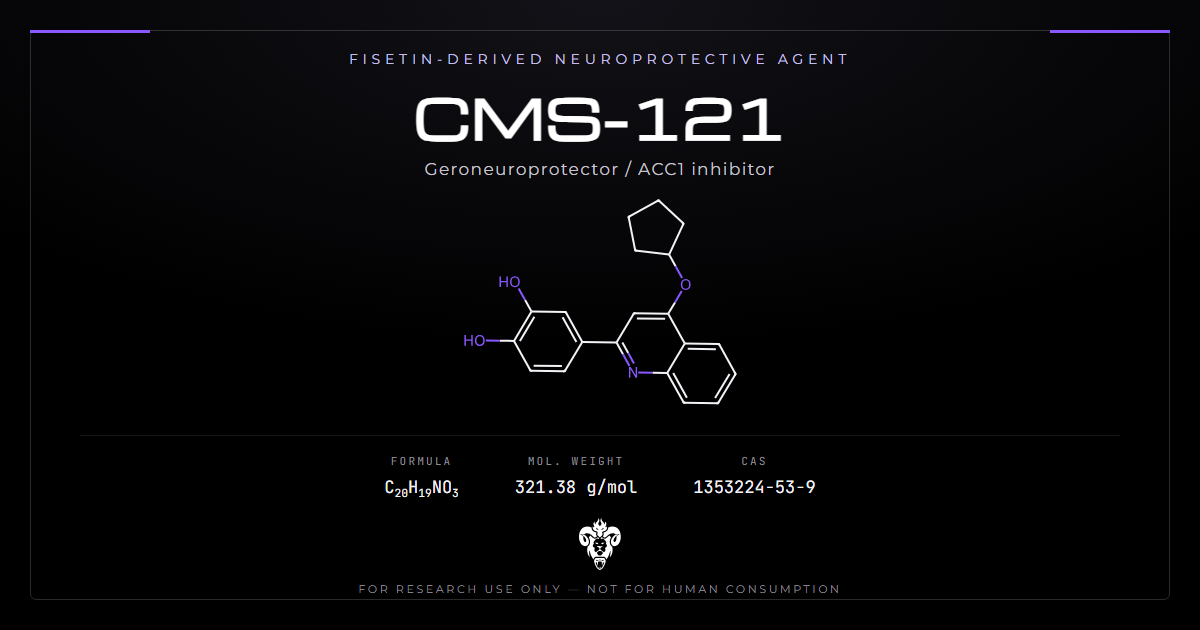
Most compounds in this catalog arrive with a thin paper trail and a plausible mechanism. CMS-121 arrives with the opposite: fifteen years of work at the Salk Institute, a target that was identified after the compound already worked, a dozen peer-reviewed animal studies, and a completed Phase 1 trial in human volunteers. That combination is rare enough in the research compound space to be worth walking through carefully.
It is also a compound that gets described incorrectly almost everywhere it is sold. CMS-121 is called a quinolone when it is a quinoline. It is described as a direct dual inhibitor of two enzymes when only one of those interactions is direct. And the human safety data, which is the single most useful thing anyone has published about it, is usually left out entirely.
Chemical Identity and Physical Profile
CMS-121 is 4-[4-(cyclopentyloxy)quinolin-2-yl]benzene-1,2-diol, CAS 1353224-53-9. The molecular formula is C₂₀H₁₉NO₃ and the molar mass is 321.38 g/mol. The InChIKey is OMHNVUCFPJJLKD-UHFFFAOYSA-N, and the reported UV absorption maxima are 223 and 276 nm.[1]
The structure is worth reading carefully because it explains the entire program. A quinoline core carries a cyclopentyloxy ether at the 4-position and a catechol — a 3,4-dihydroxyphenyl group — at the 2-position. That catechol is the piece inherited from fisetin. Everything else was engineered.
| Property | Value |
|---|---|
| CAS number | 1353224-53-9 |
| Molecular formula | C₂₀H₁₉NO₃ |
| Molar mass | 321.38 g/mol |
| Exact mass | 321.1365 Da |
| InChIKey | OMHNVUCFPJJLKD-UHFFFAOYSA-N |
| Appearance | Crystalline solid |
| Solubility | DMSO ~20 mg/mL; DMF ~30 mg/mL |
| λmax | 223 nm, 276 nm |
| Storage | −20 °C, protected from light |
One naming correction, because it propagates through vendor listings and secondary write-ups: CMS-121 contains a quinoline ring, not a quinolone. A quinolone would require a carbonyl at the ring 2- or 4-position. CMS-121 has an ether oxygen at C4 and an aryl substituent at C2. The distinction matters if you are searching structural databases or interpreting NMR.
From Fisetin to CMS-121: Why the Parent Compound Failed
Fisetin is a flavonol found in strawberries and other plants, and Pamela Maher’s group at Salk documented its neuroprotective activity across cell models, stroke models, and Huntington’s models over roughly a decade. The problem was never activity. The problem was drug-likeness.
Run the numbers side by side and the medicinal chemistry rationale for CMS-121 becomes obvious:
| Fisetin | CMS-121 | J147 | |
|---|---|---|---|
| Formula | C₁₅H₁₀O₆ | C₂₀H₁₉NO₃ | C₁₃H₁₂F₃N₃O₂S |
| Molar mass | 286.24 | 321.38 | 331.32 |
| cLogP | 2.28 | 4.63 | 3.63 |
| TPSA (Ų) | 111.1 | 62.6 | 55.7 |
| H-bond donors | 4 | 2 | 1 |
Fisetin’s topological polar surface area of 111 Ų sits well above the ~90 Ų ceiling generally associated with CNS penetration, and four hydrogen bond donors compound the problem. Chiruta and colleagues replaced the chromone with a quinoline, removed two of the four hydroxyls, and added a lipophilic cyclopentyl ether.[2] The result drops TPSA to 62.6 Ų and halves the donor count while keeping the catechol that carries the redox activity.
That paper generated a large derivative series. Roughly twenty compounds showed substantially enhanced neuroprotective activity, six went into full ADME and pharmacokinetic characterization, and two — CMS-121 and CMS140 — were carried into transgenic Alzheimer’s mice. CMS-121 outperformed CMS140, and the program consolidated around it.[3]
The Screening Philosophy Behind CMS-121
CMS-121 was not designed against a target. It was selected by phenotypic screening — a panel of cell-based assays built to model old-age-associated nerve cell toxicities, with compounds required to perform across all of them before advancing.[4]
Two assays drove the selection. In HT22 hippocampal cells, CMS-121 protects against iodoacetic acid–induced death, an in vitro ischemia mimic, with an EC₅₀ near 7 nM. Against glutamate-induced oxytosis, the EC₅₀ is roughly 200 nM.[1][4] CMS-121 also maintains intracellular glutathione under glutamate challenge, blocks LPS-driven N9 microglial activation by about 82%, and scavenges free radicals in a TEAC assay.[1][2]
The pathway those assays interrogate — oxytosis, now understood as substantially overlapping with ferroptosis — is defined by glutathione depletion, iron-dependent lipid peroxidation, and cell death. That framing is why the eventual target discovery made sense.
Mechanism: FASN Directly, ACC1 Indirectly
This is where most published descriptions of CMS-121 collapse two separate findings into one wrong sentence. They are distinct results from distinct papers, and the difference is mechanistically important.
Fatty acid synthase (FASN) is the direct molecular target. Ates and colleagues identified it in 2020 and demonstrated partial inhibition — CMS-121 does not shut FASN down, it throttles it.[3] FASN protein levels are elevated in human Alzheimer’s brain tissue, which had not previously been considered in an AD drug discovery context.
Acetyl-CoA carboxylase 1 (ACC1) is inhibited too, but not by CMS-121 binding it. Currais and colleagues showed that CMS-121 activates AMPK, and AMPK phosphorylates ACC1 at serine 79, which inactivates it.[5] The controlling experiment is the one that settles it: in AMPK knockout fibroblasts, no basal ACC1 phosphorylation was detectable, and the CMS-121 effect on acetyl-CoA and on protection against oxytosis was lost.
So the accurate statement is that CMS-121 partially inhibits FASN directly and inhibits ACC1 indirectly through AMPK activation. Both arms converge on the same node.
What Happens Downstream
Both FASN inhibition and ACC1 phosphorylation restrict the conversion of acetyl-CoA into malonyl-CoA and onward into long-chain fatty acids. Two consequences follow.
Acetyl-CoA accumulates. In cultured neurons and in SAMP8 mouse brain, CMS-121 raised acetyl-CoA levels and increased acetylation of histone H3 at lysine 9 — a site tied to memory formation.[5] Directly inhibiting or knocking down ACC1 reproduced both the acetyl-CoA rise and the neuroprotection, which is strong evidence the pathway is causal rather than correlative.
Free polyunsaturated fatty acids fall. PUFAs are the substrate for the lipid peroxidation that defines ferroptotic death. Lowering the available pool lowers the peroxidation ceiling. CMS-121 reduced free PUFA in primary neurons, in transgenic AD mouse brain, in SAMP8 cortex and plasma, and in the plasma of treated wild-type mice.[3][5][6]
That is the whole mechanism in one line: CMS-121 turns down de novo lipogenesis, which simultaneously raises a neuroprotective metabolite and removes a ferroptotic substrate.
Preclinical Record: Cognition
The APPswe/PS1ΔE9 study is the flagship. Male transgenic mice were dosed beginning at 9 months of age — deliberately late, when amyloid pathology and cognitive deficits are already established — with 400 ppm CMS-121 in diet, averaging about 34 mg/kg/day, for three months (n = 12 per group).[3] Spatial memory, contextual memory, and the anxiety response were all restored to age-matched wild-type levels by 12 months. Brain lipid peroxidation and neuroinflammatory markers fell.
Note what the study did not chase. Fisetin had previously shown no effect on plaque count or soluble and insoluble amyloid-β in the same model, and the CMS-121 work explicitly set amyloid aside to measure cognition and lipid biology instead.[3]
The SAMP8 senescence-accelerated model provides the aging counterpart. CMS-121 given from 9 to 13 months at 200 ppm (~17 mg/kg/day) reduced cognitive decline and prevented a large fraction of the transcriptomic and metabolomic drift that occurs across that window.[5] Correlation analysis in that paper showed CMS-121 was the more effective of the two compounds tested at preventing transcriptomic aging.
A separate SAMP8 study found CMS-121 at 200 ppm attenuated age-related hearing impairment, measured by auditory brainstem response thresholds and cochlear ribbon synapse counts.[7]
Preclinical Record: Metabolic and Geroprotective
The peripheral data is arguably more interesting than the neuro data, and it is almost never discussed.
In db/db leptin-receptor-deficient mice — an obesity and type 2 diabetes model — six months of dietary CMS-121 improved glucose tolerance and lowered HbA1c and insulin. Blood and liver triglycerides and free fatty acids decreased. Hepatic NF-κB, IL-18, caspase 3, and C-reactive protein fell. Urinary NGAL, clusterin, and albumin all improved, indicating reduced kidney damage.[8]
In wild-type C57BL/6 mice, six months of CMS-121 (200 ppm rising to 400 ppm, roughly 9.4 then 18.8 mg/kg/day) cut body weight gain by 40% relative to controls, with greater lean mass, less fat mass, and higher resting oxygen consumption — without a meaningful change in locomotor activity.[6] Adipose tissue showed increased Nrf1, TFAM, TOM20, and GLUT4. Liver showed reduced FASN and PEPCK. Plasma metabolomics found elevated short-chain acylcarnitines and β-hydroxybutyrate metabolites alongside decreased PUFA — a signature the authors described as resembling a ketogenic diet.
In Drosophila melanogaster, 5 µM CMS-121 extended median male lifespan by 8.46% (p = 0.017).[9] That same paper showed CMS-121 restored more youthful protein profiles in both brain and kidney of aged SAMP8 mice, with tissue-specific mechanisms in each organ.
Human Data: The Completed Phase 1
CMS-121 received FDA Investigational New Drug clearance and entered a Phase 1 trial sponsored by Virogenics, Inc. (NCT05318040), which is now listed as completed.[10] The design ran in four parts: single ascending dose in young adults, multiple ascending dose in young adults, multiple ascending dose in elderly subjects, and an open-label fed/fasted crossover.
The results were posted as a preprint in 2025.[11] Single doses up to 1800 mg and repeat dosing up to 900 mg/day for seven days were generally well tolerated, with most treatment-emergent adverse events mild. No QTcF prolongation signal emerged in the cardiodynamic assessment; a single subject at the 50 mg dose had one isolated post-dose QTcF of 451 ms.
Three metabolites were characterized — CMS121-C1, C2, and C3 — with C2 contributing more molar-equivalent exposure in plasma than the parent compound itself. Urinary excretion of metabolites was minimal, so renal clearance is unlikely to be the primary elimination route. Exposure was meaningfully higher and terminal half-life longer in elderly subjects than in young ones, and systemic exposure ran roughly 50% higher in the fed state than fasted.
What the CMS-121 Data Does Not Establish
An honest read of the record requires stating the gaps as clearly as the findings.
There is no human efficacy data. Phase 1 measured safety, tolerability, and pharmacokinetics in healthy volunteers — not cognition, not any Alzheimer’s endpoint. A Phase 2 trial has been proposed and grant-funded work toward 13-week toxicology and a tablet formulation has been described, but as of this writing no Phase 2 efficacy result exists.[12]
Lifespan extension has been demonstrated in Drosophila only. The mammalian work measures healthspan markers and disease-model endpoints, not survival. Extrapolating an 8.46% fly lifespan effect to mammals is not supported.
The rodent dosing is chronic and dietary. Animals ate CMS-121 continuously in feed across three to six months. That exposure profile is not equivalent to intermittent bolus dosing, and the mg/kg figures should not be scaled naively.
FASN inhibition is partial by design, and systemic FASN inhibition carries known liabilities from oncology programs. Partial inhibition may be exactly why CMS-121 has been tolerated well; it also means the compound is not a clean pharmacological tool for FASN blockade.
Finally, the Phase 1 report is a preprint that had not completed peer review at posting, and the Salk Institute holds the CMS-121 patents with commercial development running through Virogenics. Neither fact invalidates the data. Both belong in the interpretation.
Handling, Solubility, and Experimental Design Notes
CMS-121 is supplied as a crystalline solid and stored at −20 °C. Reported solubility is approximately 20 mg/mL in DMSO and 30 mg/mL in DMF.[1]
The catechol is the handling consideration. Ortho-dihydroxy aromatics oxidize readily to ortho-quinones under alkaline conditions, in the presence of trace transition metals, and on exposure to light and air. Practical consequences for anyone working with CMS-121:
- Prepare stock solutions fresh, protect from light, and aliquot to avoid freeze-thaw cycling.
- Watch for discoloration. Darkening in a stored solution is the visible signature of catechol oxidation.
- Chelate or use high-purity buffers. Trace copper and iron accelerate the reaction substantially.
- Be cautious with alkaline media. Oxidation rate climbs sharply above neutral pH.
For in vitro work, note the two-order-of-magnitude gap between the ischemia-mimic and oxytosis EC₅₀ values. A single concentration will not characterize CMS-121 across both endpoints, and the relevant range spans roughly 5 nM to 5 µM depending on the assay.
Analytical Verification
Identity and purity for a compound like CMS-121 are established by HPLC for purity determination and mass spectrometry for identity confirmation, with the exact mass of 321.1365 Da giving a clean target. The λmax values of 223 and 276 nm inform UV detection wavelength selection.
A supplier-issued certificate is not the same thing as independent confirmation. Every batch in the Kimera catalog is characterized through third-party analysis, and the full COA archive is public and searchable by lot. If you are sourcing CMS-121 or any research compound from anywhere, ask for the batch-specific certificate before you ask about price.
Regulatory and Supply Status
CMS-121 is an investigational compound. It is not approved by the FDA or any other regulatory authority for any indication, in any jurisdiction. It is not a dietary supplement, and it is not scheduled under the Controlled Substances Act.
CMS-121 is supplied for laboratory research use only — not for human consumption, and not for medical, veterinary, or household use. Researchers working the same pathway space may also want the structurally unrelated Salk companion compound J-147, which targets the ATP synthase alpha subunit and appears in most of the same SAMP8 studies, or TND1128 for mitochondrial redox work. Related mechanism coverage is collected under Metabolic Compounds and Nootropics.
Frequently Asked Questions About CMS-121
What is CMS-121?
CMS-121 is a synthetic fisetin derivative developed at the Salk Institute as a candidate for Alzheimer’s disease and age-related cognitive decline. Chemically it is 4-[4-(cyclopentyloxy)quinolin-2-yl]benzene-1,2-diol, CAS 1353224-53-9.
What is the mechanism of CMS-121?
CMS-121 partially inhibits fatty acid synthase directly and inhibits acetyl-CoA carboxylase 1 indirectly by activating AMPK, which phosphorylates ACC1 at serine 79. Both restrict de novo lipogenesis, raising acetyl-CoA and lowering the free PUFA pool that fuels lipid peroxidation.
How does CMS-121 differ from fisetin?
CMS-121 keeps fisetin’s catechol but replaces the chromone core with a quinoline and adds a cyclopentyl ether. Topological polar surface area drops from 111 to 63 Ų and hydrogen bond donors from four to two, which is what converted a poorly bioavailable flavonol into an orally active, brain-penetrant molecule.
Has CMS-121 been tested in humans?
Yes. A four-part Phase 1 trial (NCT05318040) in healthy young and elderly volunteers is listed as completed. Single doses to 1800 mg and seven-day repeat dosing to 900 mg/day were generally well tolerated. No efficacy endpoints were measured.
Is CMS-121 the same as J147?
No. Both came from the same Salk drug discovery program and appear together in several papers, but they are structurally unrelated. J147 is a curcumin derivative targeting the ATP synthase alpha subunit; CMS-121 is a fisetin derivative targeting FASN.
Is CMS-121 legal to purchase?
CMS-121 is not a controlled substance and is available to qualified researchers as a research-use-only material. It is not approved for human use anywhere and carries no therapeutic indication.
References
Primary Literature
- Cayman Chemical. CMS121 (Item No. 27085) product data and technical information. CAS 1353224-53-9. https://www.caymanchem.com/product/27085/cms121
- Chiruta C, Schubert D, Dargusch R, Maher P. Chemical modification of the multi-target neuroprotective compound fisetin. J Med Chem. 2012;55(1):378–389. https://doi.org/10.1021/jm2012563
- Ates G, Goldberg J, Currais A, Maher P. CMS121, a fatty acid synthase inhibitor, protects against excess lipid peroxidation and inflammation and alleviates cognitive loss in a transgenic mouse model of Alzheimer’s disease. Redox Biol. 2020;36:101648. https://doi.org/10.1016/j.redox.2020.101648
- Prior M, Chiruta C, Currais A, Goldberg J, Ramsey J, Dargusch R, Maher PA, Schubert D. Back to the future with phenotypic screening. ACS Chem Neurosci. 2014;5(7):503–513. https://doi.org/10.1021/cn500051h
- Currais A, Huang L, Goldberg J, Petrascheck M, Ates G, Pinto-Duarte A, Shokhirev MN, Schubert D, Maher P. Elevating acetyl-CoA levels reduces aspects of brain aging. eLife. 2019;8:e47866. https://doi.org/10.7554/eLife.47866
- Dafre AL, Zahid S, Probst JJ, Currais A, Yu J, Schubert D, Maher P. CMS121: a novel approach to mitigate aging-related obesity and metabolic dysfunction. Aging (Albany NY). 2024;16(6):4980–4999. https://doi.org/10.18632/aging.205673
- Pham TB, Boussaty EC, Currais A, Maher P, Schubert DR, Manor U, Friedman RA. Attenuation of age-related hearing impairment in senescence-accelerated mouse prone 8 (SAMP8) mice treated with fatty acid synthase inhibitor CMS121. J Mol Neurosci. 2023;73(4–5):307–315. https://doi.org/10.1007/s12031-023-02119-w
- Zahid S, Dafre AL, Currais A, Yu J, Schubert D, Maher P. The geroprotective drug candidate CMS121 alleviates diabetes, liver inflammation, and renal damage in db/db leptin receptor deficient mice. Int J Mol Sci. 2023;24(7):6828. https://doi.org/10.3390/ijms24076828
- Kepchia D, Currais A, Dargusch R, Finley K, Schubert D, Maher P. Geroprotective effects of Alzheimer’s disease drug candidates. Aging (Albany NY). 2021;13(3):3269–3289. https://doi.org/10.18632/aging.202631
Clinical, Regulatory, and Review Sources
- ClinicalTrials.gov. Safety, tolerability and pharmacokinetics of CMS121, a drug candidate for Alzheimer’s disease, in healthy subjects. NCT05318040. Sponsor: Virogenics, Inc. https://clinicaltrials.gov/study/NCT05318040
- Maher P, Christopher R, Evans R, Raschke W. Safety, pharmacokinetics, and cardiodynamics of CMS121, a novel small molecule fisetin derivative with neuroprotective properties, in Phase 1 healthy adult volunteers. medRxiv preprint. 2025. https://doi.org/10.1101/2025.02.28.25323123 (Preprint — not certified by peer review at time of writing.)
- Currais A, Raschke W, Maher P. CMS121, a novel drug candidate for the treatment of Alzheimer’s disease and age-related dementia. J Alzheimers Dis. 2024;101(s1):S179–S192. https://doi.org/10.3233/JAD-231062
CMS-121 is supplied by Kimera Chems for laboratory research use only. It is not for human consumption, nor for medical, veterinary, or household use. Nothing in this article constitutes dosing guidance, a therapeutic claim, or a recommendation for use in humans or animals. All dosing figures cited are from published animal studies and are reported for scientific context only.