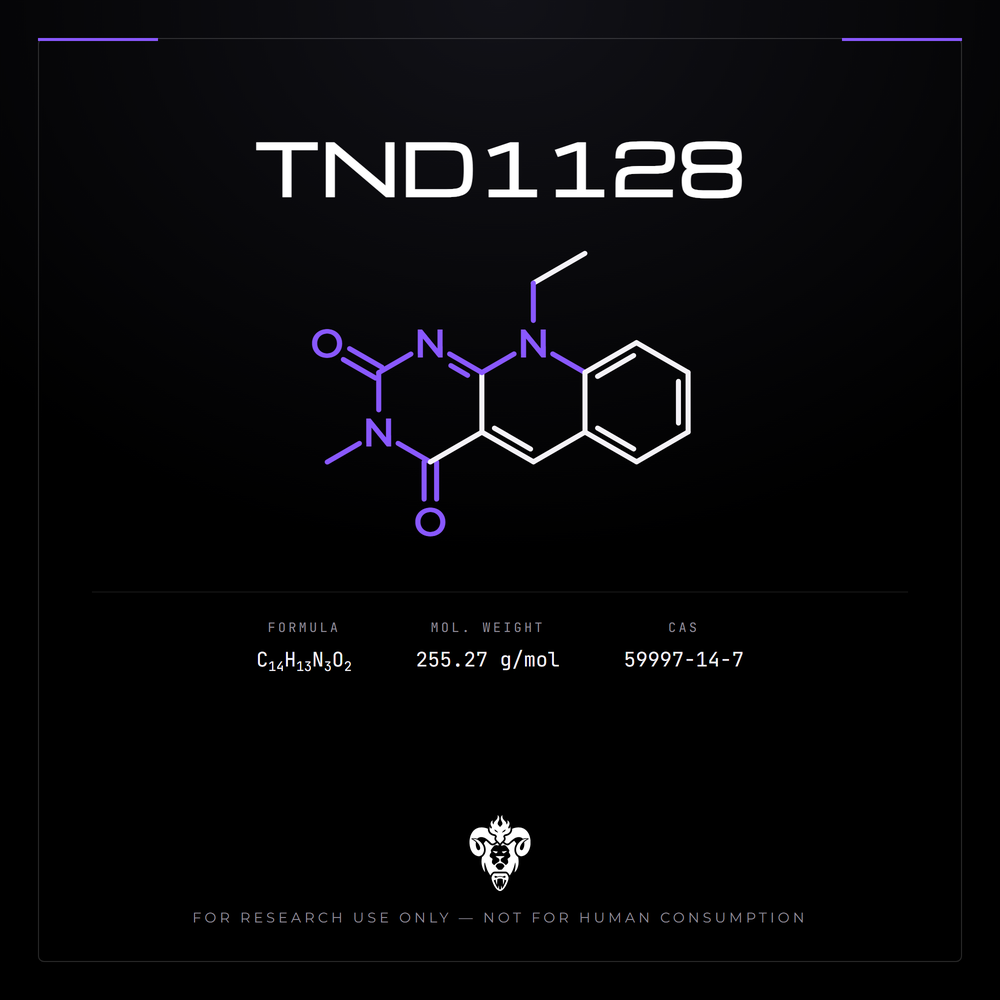

TND1128 (5-Deazaflavin Derivative) Research Standard
TND1128 (CAS 59997-14-7) is 10-ethyl-3-methylpyrimido[4,5-b]quinoline-2,4(3H,10H)-dione, a synthetic 5-deazaflavin supplied as a reference material for early-stage laboratory work on mitochondrial membrane potential, neuronal calcium handling and deazaflavin redox chemistry. It is an early-stage research compound: the entire indexed literature on the molecule consists of three preclinical rodent papers from a single overlapping research group. Everything below distinguishes what has been measured on TND1128 itself from what is known about the broader 5-deazaflavin class.
Mechanism of Action & Research Context
No target engagement, binding or enzymology data exists for TND1128. Its authors describe it as having “self-redox” or “auto-redox” capability, a descriptor that originates with them and has not been independently corroborated by published electrochemical characterisation.
-
Mitochondrial membrane potential and ATP index. In acute mouse brain slices following 24-hour pretreatment at 10 mg/kg i.p., TND1128 raised mitochondrial membrane potential on a JC-1 readout and increased an ATP-synthesis index. The authors propose incorporation into the TCA cycle and electron transport chain as an explanation; they offer this as a hypothesis, and it has not been demonstrated.[3]
-
Calcium handling under depolarising challenge. In ex vivo mouse brain slices, subcutaneous pretreatment across 0.01–1 mg/kg dose-dependently mitigated cytoplasmic and mitochondrial Ca2+ overload under repeated high-K+ challenge, measured by Fura-4F and X-Rhod-1 fluorescence imaging. In the same comparison β-NMN affected cytoplasmic but not mitochondrial Ca2+.[2]
-
Neuronal morphology. In cultured mouse hippocampal neurons, TND1128 increased axonal and dendritic branching and excitatory synapse number.[1]
-
Class-level redox chemistry. 5-Deazaflavins structurally resemble flavins but behave like nicotinamide cofactors: they are obligate two-electron hydride carriers with low redox potential, with hydride transferred from C5 of the reduced species.[5,6,7] The biological deazaflavin cofactor F420 mediates oxidoreductive chemistry in archaeal and bacterial metabolism.[4] Note that no mammalian deazaflavin cofactor system is described in this literature, so class chemistry should not be assumed to transfer to TND1128 in a mammalian context without evidence.
-
Synthetic 5-deazaflavins as a medicinal-chemistry scaffold. The class is an established scaffold subjected to in vitro cell and kinase screening, though the analogues studied are unrelated to TND1128.[8]
What is not established. “Mitochondrial biogenesis” is not supported by these papers: they measured membrane potential, calcium handling and neurite morphology, not mitochondrial mass or biogenesis markers such as PGC-1α or mtDNA copy number. There is no independent replication, no pharmacokinetic data, no toxicology, no target identification, and no published electrochemical characterisation of the molecule. Every biological finding comes from mouse brain slices or mouse primary neuron culture.
Research Applications
Primary fields of in vitro and ex vivo laboratory investigation include:
-
Mitochondrial membrane potential imaging. JC-1 and comparable ratiometric ΔΨm readouts in slice and culture preparations.[3]
-
Dual-compartment calcium imaging. Fura-4F and X-Rhod-1 to resolve cytoplasmic against mitochondrial Ca2+ under depolarising challenge.[2]
-
Primary neuron morphology. Neurite branching and synapse counting in hippocampal culture.[1]
-
Deazaflavin redox chemistry. Hydride-transfer and redox-potential characterisation against the established F420 literature.[4,5,6,7]
-
Independent replication. Given the single-group provenance of the existing findings, this compound is a candidate for confirmatory work rather than a settled tool.
Analytical Documentation
Purity and identity vary by manufacturing lot. Kimera Chems does not publish a single fixed purity figure for this item; refer to the batch-specific Certificate of Analysis (COA) issued for the lot received, which reflects third-party analytical testing for that lot.
References
- Katsurabayashi S, Oyabu K, Kubota K, et al. The novel mitochondria activator, 10-ethyl-3-methylpyrimido[4,5-b]quinoline-2,4(3H,10H)-dione (TND1128), promotes the development of hippocampal neuronal morphology. Biochem Biophys Res Commun. 2021;560:146–151. doi:10.1016/j.bbrc.2021.04.132
- Takahashi N, Akaike N, Nagamatsu T, Uchino H, Kudo Y. Effects of TND1128 (a 5-deazaflavin derivative), with self-redox ability, as a mitochondria activator on the mouse brain slice and its comparison with β-NMN. J Pharmacol Sci. 2022;151(2):93–109. doi:10.1016/j.jphs.2022.11.005
- Takahashi N, Nagamatsu T, Akaike N, Kudo Y. TND1128, a 5-deazaflavin derivative with auto-redox ability, facilitates polarization of mitochondrial membrane potential and on-demand ATP synthesis in mice brain slices. J Pharmacol Sci. 2024;156(4):218–229. doi:10.1016/j.jphs.2024.10.001
- Bashiri G. Cofactor F420, an emerging redox power in biosynthesis of secondary metabolites. Biochem Soc Trans. 2022;50(1):253–267. doi:10.1042/BST20211286
- Mascotti ML, Juri Ayub M, Fraaije MW. On the diversity of F420-dependent oxidoreductases: a sequence- and structure-based classification. Proteins. 2021;89(11):1497–1507. doi:10.1002/prot.26170
- Greening C, Jirapanjawat T, Afroze S, et al. Mycobacterial F420H2-dependent reductases promiscuously reduce diverse compounds through a common mechanism. Front Microbiol. 2017;8:1000. doi:10.3389/fmicb.2017.01000
- Nguyen QT, Trinco G, Binda C, Mattevi A, Fraaije MW. Discovery and characterization of an F420-dependent glucose-6-phosphate dehydrogenase (Rh-FGD1) from Rhodococcus jostii RHA1. Appl Microbiol Biotechnol. 2017;101(7):2831–2842. doi:10.1007/s00253-016-8038-y
- Bedewy WA, Mohamed MS, Abdelhameed AM, et al. Design, synthesis, and antitumor efficacy of novel 5-deazaflavin derivatives backed by kinase screening, docking, and ADME studies. J Enzyme Inhib Med Chem. 2023;38(1):2220570. doi:10.1080/14756366.2023.2220570
Storage & Handling
Store at controlled room temperature. Keep tightly closed.
Storage guidance is a house recommendation. Analytical documentation is per-lot release testing.
Related Research Compounds
Research Use Only Disclaimer: This product is labeled and sold “For Research Use Only – NOT FOR HUMAN CONSUMPTION.” It is not a drug, dietary supplement, food, cosmetic, or medical device, and it is not approved by the FDA or any other regulator for human or veterinary use. It is supplied to approved account holders as a research chemical for laboratory use and must be handled in accordance with applicable law.