
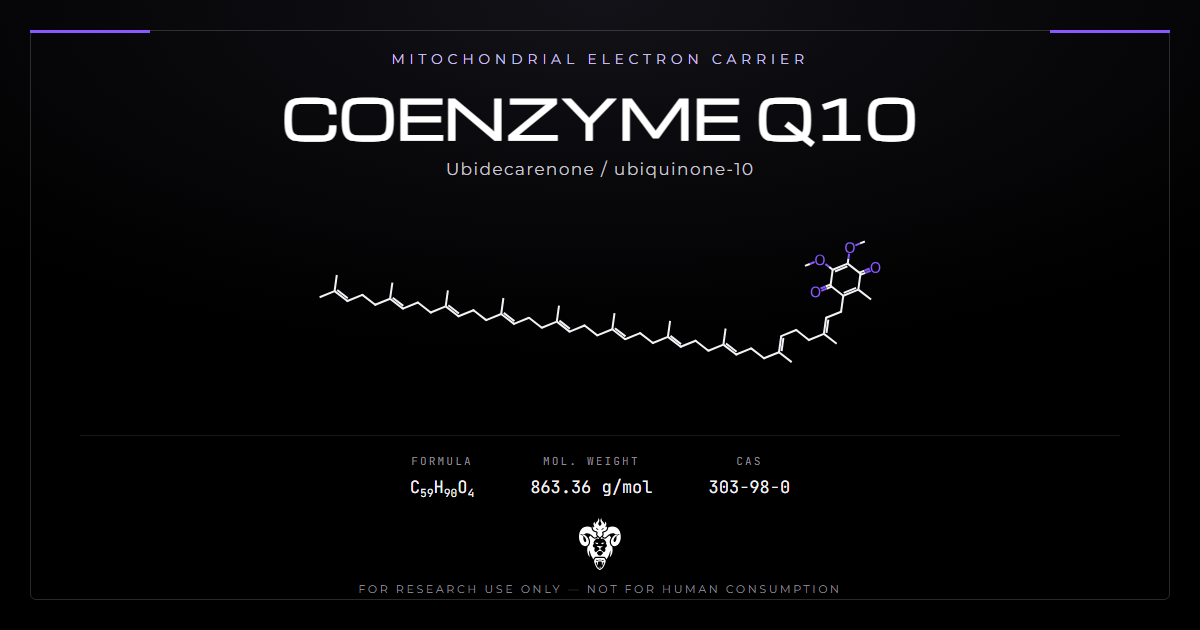
A single number explains most of what follows. Coenzyme Q10 has a calculated logP of 19.4, which places it among the most hydrophobic molecules anyone tries to absorb orally.
Everything downstream is a consequence. Absorption is slow, saturable and dominated by formulation. Plasma concentration rises in a dose-ordered way and then plateaus.
The awkward part is what happens next. Rodents were given the compound for life. Plasma and liver went up several fold, and heart, kidney and brain did not move at all [2]. Statin-treated adults took 400 mg daily for eight weeks. Muscle biopsies showed no change in content and none in mitochondrial function [15].
Chemical identity
A benzoquinone head on a ten-unit isoprenoid tail, which is where the number in the name comes from.
| Property | Value |
|---|---|
| Systematic name | 2,3-dimethoxy-5-methyl-6-decaprenyl-1,4-benzoquinone |
| INN | Ubidecarenone |
| Common names | CoQ10, coenzyme Q10, ubiquinone |
| Molecular formula | C59H90O4 |
| Molecular weight | 863.3 g/mol |
| Monoisotopic mass | 862.6839 Da |
| CAS number | 303-98-0 |
| PubChem CID | 5281915 |
| InChIKey | ACTIUHUUMQJHFO-UPTCCGCDSA-N |
| Calculated logP | 19.4 |
| Isoprene units | 10 |
| Reduced form | Ubiquinol, C59H92O4, 865.4 g/mol |
| Reduced form CID | 9962735 |
Reading the structure
Two halves do two different jobs, and neither one helps the molecule dissolve.
The quinone head carries the redox chemistry. It accepts and donates electrons in two single-electron steps, passing through a semiquinone radical on the way.
The tail is 50 carbons of polyisoprene. It anchors the molecule inside membranes and gives it lateral mobility there. It is also the reason a gram of powder will not go into water.
Ubiquinone and ubiquinol
The oxidised and reduced forms differ by two hydrogen atoms and by two hydroxyl groups replacing two ketones.
Ubiquinone is the quinone. Ubiquinol is the hydroquinone, and it is the form that acts as a lipid-phase antioxidant. Cells interconvert them continuously as part of normal function.
That interconversion matters commercially, because both forms are sold as separate products at different prices. What the absorption data say about that distinction appears below.
What it does in a mitochondrion
The textbook role understates the range, and a 2023 review in Trends in Biochemical Sciences is the current summary [16].
The electron carrier role
Complex I and complex II both hand electrons to the same mobile carrier, which then delivers them to complex III.
That junction is the point of the molecule. It is a conduit through which electrons from many pathways enter the respiratory chain, including fatty acid oxidation, dihydroorotate dehydrogenase and others [16].
Because it is the shared entry point, its concentration in the inner membrane is a plausible rate limit. That plausibility is the entire rationale for supplementation, and it is why tissue concentration rather than plasma concentration is the number that matters.
The antioxidant role
The reduced form is a chain-breaking antioxidant within lipid membranes, and few molecules are positioned to do that job.
Ubiquinol intercepts lipid peroxyl radicals in the membrane phase where water-soluble antioxidants cannot reach. It also regenerates alpha-tocopherol, which links the two systems.
The 2023 review adds more roles [16]. They include cofactor duty in biosynthetic and catabolic reactions, detoxification of damaging lipid species, and involvement in cellular signalling and oxygen sensing. Open questions on biosynthesis and transport remain, and the authors name those gaps as an obstacle to treating deficiency.
The absorption problem
An 863 Da lipid with a logP near 19 is a difficult oral molecule, and the pharmacokinetic literature reflects that.
A saturable, plateauing curve
Bhagavan and Chopra collated plasma responses across formulations and doses (PMID 17482886).
Total plasma concentration and net increase over baseline both rose with dose. Plasma concentration then plateaued at 2,400 mg with one chewable formulation. Absorption efficiency fell as the dose rose [3].
Read that carefully. Doubling the dose does not double the exposure, and above a certain point it adds nothing measurable to plasma at all.
Why formulation dominates
The compound is crystalline at room temperature, and crystals do not absorb.
Mantle and Dybring review the absorption pathway from stomach transit through lymphatic uptake [11]. They place particular weight on crystal dispersion in the original formulation. Their figure is that absence of dispersion reduces bioavailability by 75%.
One caveat belongs with that number. Both authors are employees of a company that manufactures CoQ10 preparations, which the paper discloses. The mechanism is uncontroversial and the specific figure comes from an interested source.
The ubiquinol question
Marketing for the reduced form rests on a claim that one measurement undercuts.
About 95% of circulating CoQ10 already exists as ubiquinol, and that ratio shows no appreciable change after ingesting the compound [3]. Whichever form goes in, the body decides the redox state of what circulates.
The same logic appeared in the methylcobalamin literature, where cells strip and discard the supplemental methyl group before rebuilding their own cofactors. Here the parallel is exact: the redox form is set after absorption, not by the label.
Solubilised formulations of both forms do show better plasma responses than crystalline preparations [3]. So the useful distinction is dispersion, not oxidation state.
Plasma is not tissue
Every supplementation study reports plasma because plasma is easy. Two studies measured what actually matters.
| Study | Model | Dose and duration | Plasma | Target tissue |
|---|---|---|---|---|
| Lönnrot 1998 [2] | Rats and mice, lifelong | 10 mg/kg/day | Up 2.6 to 8.4 fold | Heart, kidney, brain unchanged |
| Dohlmann 2022 [15] | Statin-treated adults | 400 mg/day, 8 weeks | Not the endpoint | Muscle content unchanged |
| Bhagavan 2007 [3] | Human, various | Up to 2,400 mg | Plateaus | Not measured |
| Claxton 2022 [14] | 26 trials pooled | Various | Raised | Not measured |
The lifelong rodent experiment
Lönnrot and colleagues supplemented Sprague-Dawley rats and C57 mice for their entire lives at 10 mg/kg daily [2].
Plasma and liver concentrations ran 2.6 to 8.4 times higher than controls at every age point. Kidney, heart and brain showed no change in either Q10 or the rodent-dominant Q9.
Survival did not change either. Lifelong supplementation neither extended nor shortened lifespan in either species, and histopathology across tissues showed no differences [2].
The human muscle biopsy trial
Dohlmann and colleagues took the same question into people, with biopsies rather than blood draws [15].
Thirty-seven adults on simvastatin, with and without myalgia, took part. They received 400 mg daily or placebo for eight weeks. Muscle CoQ10 content, mitochondrial respiratory capacity, mitochondrial content by citrate synthase activity, and reactive oxygen species production were all measured before and after.
Nothing moved. Muscle content and mitochondrial function were unaltered. Individual changes in muscle concentration did not correlate with changes in myalgia intensity [15].
The statin hypothesis
Statins inhibit HMG-CoA reductase, which sits upstream of both cholesterol and the isoprenoid tail. Lower plasma CoQ10 during statin therapy is well documented. Whether supplementation fixes anything is a separate question, and three meta-analyses have asked it.
Where the depletion figure comes from
Two mechanisms produce the same measurement, and only one of them is a deficiency.
The mevalonate pathway supplies the polyisoprenoid tail, so blocking it can reduce synthesis. Circulating CoQ10 also travels in lipoproteins, so a drug that lowers LDL lowers the carrier and the cargo together.
Distinguishing those requires tissue measurement rather than a plasma number. That distinction is exactly what the muscle biopsy trial supplied [15].
Three meta-analyses, one agreement
The pooled analyses disagree on the subjective endpoint and agree on the objective one.
Banach and colleagues pooled 6 studies with 302 patients. Plasma creatine kinase was unchanged after supplementation [7]. Qu and colleagues pooled 12 trials with 575 patients and reported improvement in muscle pain, weakness, cramp and tiredness. They again found no reduction in creatine kinase [9]. Wei and colleagues pooled 8 studies with 472 patients and found neither creatine kinase nor muscle pain improved [13].
Note what survives across all three. Creatine kinase, the objective marker, moved in none of them. The disagreement lives entirely in self-reported scales, in trials where blinding of a distinctively coloured supplement is difficult.
Individual trials sit on both sides. Derosa and colleagues randomised 60 statin-intolerant patients to a liquid preparation at 100 mg daily and reported lower symptom scores at three months [10].
What the muscle showed
The mechanistic tiebreaker is the biopsy trial, and it removes the proposed mechanism rather than the effect.
If supplementation relieves statin myalgia by restoring muscle CoQ10, then muscle CoQ10 should rise. In 37 patients at 400 mg daily for eight weeks, it did not [15].
A separate check points the same way. The 2022 systematic review ran meta-regression for a treatment interaction with statins in heart failure and found none [14].
Heart failure, the strongest cardiac evidence
Patients with heart failure have lower plasma concentrations, and that is an independent predictor of mortality in the population [8]. Whether correcting the measurement changes outcomes is what the trials tested.
Q-SYMBIO
Mortensen and colleagues randomised 420 patients with moderate to severe heart failure (PMID 25282031). Arms were 100 mg three times daily or placebo, on top of standard therapy.
The short-term result was null. None of the three prespecified 16-week endpoints changed: NYHA class, six-minute walk, and N-terminal pro-B type natriuretic peptide [5].
The long-term result was not. Major adverse cardiovascular events at two years reached 15% on treatment against 26% on placebo. That is a hazard ratio of 0.50 (95% CI 0.32 to 0.80, p = 0.003). Cardiovascular mortality ran 9% against 16%, and all-cause mortality 10% against 18% [5].
A trial null on every short-term endpoint and positive on hard outcomes at two years is an unusual shape. It is the single most cited result in this field [8].
What the systematic review found
A 2022 NIHR health technology assessment pooled the field and reached a more guarded conclusion [14].
Twenty-six trials with 2,250 participants were included. Many were poorly reported and rated at high or unclear risk of bias in at least one domain. Pooled all-cause mortality across seven trials with 1,371 participants gave a relative risk of 0.68, with a confidence interval of 0.45 to 1.03.
That interval crosses one. The assessment described the effect as a possible benefit and judged the compound cost-effective if prescribed. It concluded that a new trial would be valuable [14]. An overview of ten meta-analyses reached a similar place [17]. Ejection fraction rose 1.77 to 3.81 percentage points, with mortality risk ratios between 0.58 and 0.69.
Alehagen and colleagues supply the other positive trial, and it comes with an attribution problem [4]. Their 5-year study in 443 elderly Swedes found cardiovascular mortality of 5.9% against 12.6% on placebo. The intervention combined selenium with the quinone in a selenium-poor population, so neither component can be credited alone.
Where supplementation clearly works
One setting produces unambiguous responses, and it is a genetic disease rather than a deficiency of intake.
Primary CoQ10 deficiency covers mutations in the biosynthetic pathway itself. Berardo and Quinzii review the infantile multisystem forms and the diagnostic gains from exome and genome sequencing [12].
Response depends on the organ. Steroid-resistant nephrotic syndrome caused by the deficiency frequently improves with treatment, while the infantile encephalopathic forms respond poorly [12].
That split is informative for everything above it. The same molecule reaches one target organ and not another, in the disease it was made for. Delivery rather than dose is the binding constraint. The unchanged brain concentrations in lifelong rodent supplementation point at the same barrier [2].
The large negative trial
Preclinical Parkinson models and a phase II signal supported a full trial, and the full trial did not confirm it.
The Parkinson Study Group randomised 600 participants with early Parkinson disease (PMID 24664227). Arms were placebo, 1,200 mg or 2,400 mg daily, with all participants on 1,200 IU of vitamin E.
The study stopped after a prespecified futility criterion was met. Both active groups showed slight adverse trends. Worsening in total UPDRS score ran 6.9 points on placebo, 7.5 on 1,200 mg and 8.0 on 2,400 mg [6].
Treatment was safe and well tolerated at doses far above any supplement label. It showed no evidence of clinical benefit [6], and at 2,400 mg the dose sits at the plasma plateau identified in the absorption work [3].
How to read a CoQ10 study
Four questions separate the papers that mean something from the ones that measure convenience.
Plasma or tissue?
Plasma responds reliably and tissue mostly does not [2][15]. A study reporting a rise in circulating concentration has demonstrated absorption, not delivery.
Which formulation?
Crystalline and solubilised preparations differ severalfold in plasma response [3][11]. Two trials at the same milligram dose are not comparable unless the preparation matches.
Objective or self-reported endpoint?
In the statin literature, creatine kinase is null across every pooled analysis while symptom scales disagree [7][9][13]. Colour and taste make blinding hard, which loads the subjective endpoints.
Who funded and who wrote it?
Several key reviews come from manufacturers, disclosed in the papers themselves [11]. The underlying biochemistry is independent of that, and specific bioavailability multipliers deserve more scrutiny.
Verifying research material
A crystalline, air-sensitive, light-sensitive lipid raises analytical questions that a water-soluble compound does not.
Identity
HPLC with ultraviolet or electrochemical detection is the standard assay, and both forms have distinct signatures. Ubiquinone absorbs strongly near 275 nm and ubiquinol does not, which makes the redox state directly measurable rather than inferred.
Mass spectrometry separates the homologues. CoQ9 differs from CoQ10 by a single isoprene unit and 68 Da, and it is the plausible contaminant in material of fermentation origin.
Colour is a crude but real first check. Oxidised material is a distinctive orange-yellow, and reduced material is close to white, so a preparation sold as ubiquinol that arrives orange has oxidised.
Purity and form
Chromatographic purity and redox composition are separate questions, and a certificate should report both.
The all-trans configuration is the biologically relevant one. Fermentation-derived material is all-trans by construction, while synthetic routes can produce cis isomers, so origin belongs on the certificate alongside purity.
Residual solvents matter more than usual here. Recrystallisation and solubilisation both involve organic solvents, and a compound this lipophilic retains them more readily than a polar solid.
Handling
Store cold, dry and dark, and keep containers sealed against air.
Light degrades the quinone and oxygen converts ubiquinol back to ubiquinone. Amber glass under inert headspace is the sensible default for the reduced form, which will otherwise oxidise during ordinary handling.
Solution preparation is the practical obstacle. The compound will not dissolve in aqueous buffer at useful concentrations. Cell work therefore needs a carrier: ethanol or DMSO stocks with vehicle controls, cyclodextrin complexation, or lipid dispersion. Any of those changes what the cells receive, which is worth recording in the methods rather than in a footnote.
Kimera publishes third-party certificates of analysis for every lot in its COA database. Laboratories source CoQ10 as a mitochondrial electron carrier reference. It appears alongside methylene blue, which acts as an alternative electron carrier by a different route. It also pairs with NAD+ and glutathione where redox chemistry is the shared theme. Related work appears in the redox and cofactors category.
Common questions about CoQ10
Why does the dose have to be so high? Hydrophobicity. With a logP near 19, absorption is poor, saturable, and heavily dependent on formulation [3][11].
Is ubiquinol better than ubiquinone? About 95% of circulating material is already ubiquinol regardless of what was ingested [3]. Dispersion is the variable that changes plasma response.
Does supplementation raise tissue concentration? Mostly no. Lifelong rodent dosing left heart, kidney and brain unchanged [2], and eight weeks at 400 mg left human muscle unchanged [15].
Does it help with statin muscle symptoms? Creatine kinase is unchanged in every pooled analysis [7][9][13], and muscle content did not rise in the one trial that biopsied it [15].
What is the strongest positive trial? Q-SYMBIO, 420 patients, null on all short-term endpoints and reporting major adverse cardiovascular events of 15% against 26% at two years [5].
Does the age-related decline claim hold up? It is traceable. Kalén and colleagues measured ubiquinone across seven human organs and found a peak near age 20 followed by continuous decline [1].
Summary of the evidence
Identity: C59H90O4, 863.3 g/mol, CAS 303-98-0. A benzoquinone head on a ten-unit isoprenoid tail, with a calculated logP of 19.4.
Function: the shared entry point through which electrons from many pathways reach complex III, plus a lipid-phase antioxidant role in its reduced form [16].
Absorption: dose-ordered, saturable, and plateauing near 2,400 mg, with efficiency falling as dose rises [3]. Crystal dispersion dominates the formulation effect [11].
Redox form: roughly 95% of circulating material is ubiquinol whichever form is ingested [3].
Tissue: plasma and liver rose several fold in lifelong rodent supplementation while heart, kidney and brain did not [2]. Human muscle content did not change at 400 mg daily for eight weeks [15].
Statins: creatine kinase unchanged across three pooled analyses [7][9][13], symptom scales disagreeing [9][13], and no statin interaction in heart failure meta-regression [14].
Cardiac: Q-SYMBIO null short-term and positive at two years [5]. Pooled all-cause mortality relative risk 0.68 with an interval crossing one [14].
Negative evidence: 600 patients with early Parkinson disease, up to 2,400 mg daily, terminated for futility with slight adverse trends [6].
Clearest effect: primary genetic deficiency, where the renal phenotype often responds and the encephalopathic one often does not [12].
Status: supplied for laboratory research use only.
References
- Kalén A, Appelkvist EL, Dallner G. Age-related changes in the lipid compositions of rat and human tissues. Lipids. 1989;24(7):579-584. PMID 2779364. DOI
- Lönnrot K, Holm P, Lagerstedt A, Huhtala H, Alho H. The effects of lifelong ubiquinone Q10 supplementation on the Q9 and Q10 tissue concentrations and life span of male rats and mice. Biochem Mol Biol Int. 1998;44(4):727-737. PMID 9584986. DOI
- Bhagavan HN, Chopra RK. Plasma coenzyme Q10 response to oral ingestion of coenzyme Q10 formulations. Mitochondrion. 2007;7 Suppl:S78-S88. PMID 17482886. DOI
- Alehagen U, Johansson P, Björnstedt M, Rosén A, Dahlström U. Cardiovascular mortality and N-terminal-proBNP reduced after combined selenium and coenzyme Q10 supplementation: a 5-year prospective randomized double-blind placebo-controlled trial among elderly Swedish citizens. Int J Cardiol. 2013;167(5):1860-1866. PMID 22626835. DOI
- Mortensen SA, Rosenfeldt F, Kumar A, Dolliner P, Filipiak KJ, Pella D, Alehagen U, Steurer G, Littarru GP. The effect of coenzyme Q10 on morbidity and mortality in chronic heart failure: results from Q-SYMBIO, a randomized double-blind trial. JACC Heart Fail. 2014;2(6):641-649. PMID 25282031. DOI
- Parkinson Study Group QE3 Investigators; Beal MF, Oakes D, Shoulson I, Henchcliffe C, Galpern WR, Haas R, et al. A randomized clinical trial of high-dosage coenzyme Q10 in early Parkinson disease: no evidence of benefit. JAMA Neurol. 2014;71(5):543-552. PMID 24664227. DOI
- Banach M, Serban C, Sahebkar A, Ursoniu S, Rysz J, Muntner P, et al. Effects of coenzyme Q10 on statin-induced myopathy: a meta-analysis of randomized controlled trials. Mayo Clin Proc. 2015;90(1):24-34. PMID 25440725. DOI
- Oleck S, Ventura HO. Coenzyme Q10 and utility in heart failure: just another supplement? Curr Heart Fail Rep. 2016;13(4):190-195. PMID 27333901. DOI
- Qu H, Guo M, Chai H, Wang WT, Gao ZY, Shi DZ. Effects of coenzyme Q10 on statin-induced myopathy: an updated meta-analysis of randomized controlled trials. J Am Heart Assoc. 2018;7(19):e009835. PMID 30371340. DOI
- Derosa G, D’Angelo A, Maffioli P. Coenzyme Q10 liquid supplementation in dyslipidemic subjects with statin-related clinical symptoms: a double-blind, randomized, placebo-controlled study. Drug Des Devel Ther. 2019;13:3647-3655. PMID 31695332. DOI
- Mantle D, Dybring A. Bioavailability of coenzyme Q10: an overview of the absorption process and subsequent metabolism. Antioxidants (Basel). 2020;9(5):386. PMID 32380795. DOI
- Berardo A, Quinzii CM. Redefining infantile-onset multisystem phenotypes of coenzyme Q10-deficiency in the next-generation sequencing era. J Transl Genet Genom. 2020;4:22-35. PMID 33426503. DOI
- Wei H, Xin X, Zhang J, Xie Q, Naveed M, Kaiyan C, Xiao P. Effects of coenzyme Q10 supplementation on statin-induced myopathy: a meta-analysis of randomized controlled trials. Ir J Med Sci. 2022;191(2):719-725. PMID 33999383. DOI
- Claxton L, Simmonds M, Beresford L, Cubbon R, Dayer M, Gottlieb SS, et al. Coenzyme Q10 to manage chronic heart failure with a reduced ejection fraction: a systematic review and economic evaluation. Health Technol Assess. 2022;26(4):1-128. PMID 35076012. DOI
- Dohlmann TL, Kuhlman AB, Morville T, Dahl M, Asping M, Orlando P, et al. Coenzyme Q10 supplementation in statin treated patients: a double-blinded randomized placebo-controlled trial. Antioxidants (Basel). 2022;11(9):1698. PMID 36139772. DOI
- Guerra RM, Pagliarini DJ. Coenzyme Q biochemistry and biosynthesis. Trends Biochem Sci. 2023;48(5):463-476. PMID 36702698. DOI
- Alarcón-Vieco E, Martínez-García I, Sequí-Domínguez I, Rodríguez-Gutiérrez E, Moreno-Herráiz N, Pascual-Morena C. Effect of coenzyme Q10 on cardiac function and survival in heart failure: an overview of systematic reviews and meta-analyses. Food Funct. 2023;14(14):6302-6311. PMID 37350565. DOI
CoQ10 is sold for laboratory research use only. Not for human consumption, nor medical, veterinary, or household uses.
Literature retrieved from PubMed.