Skip to content

Glutathione (GSH)
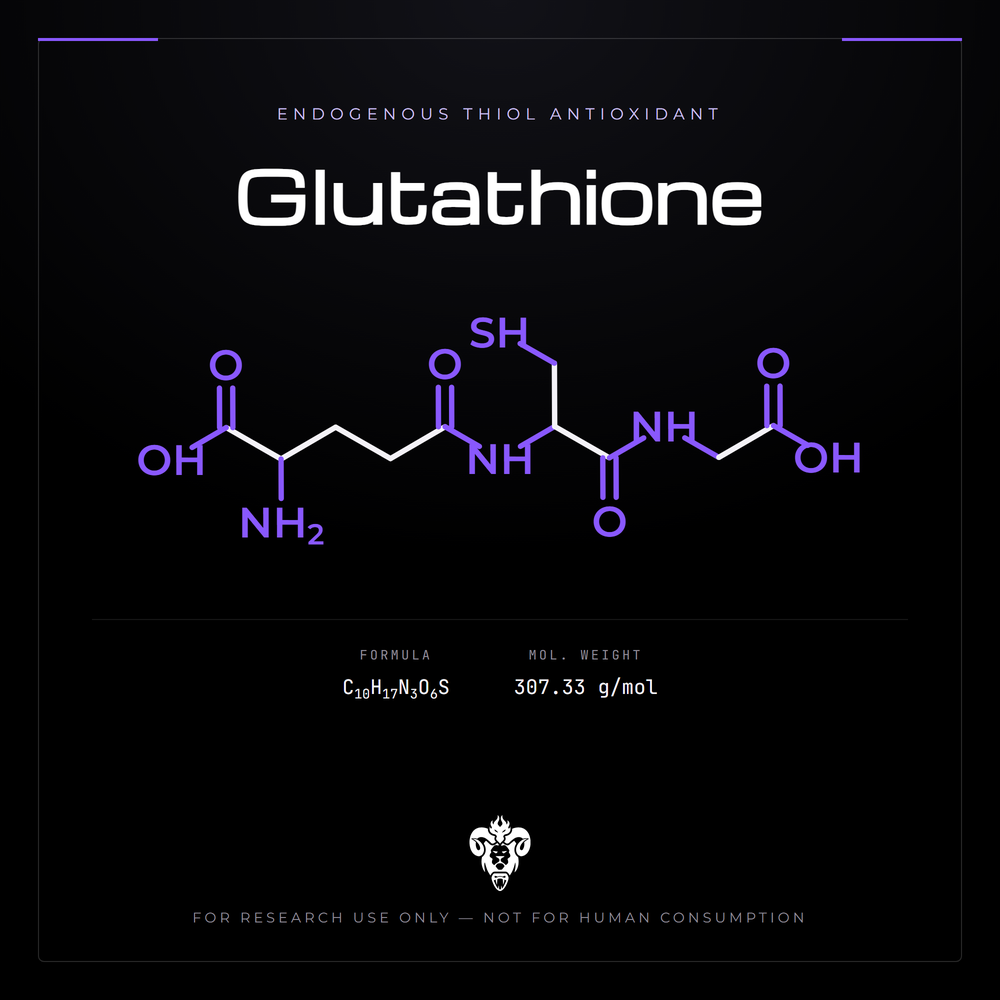
Glutathione (GSH) is a naturally occurring tripeptide composed of glutamic acid, cysteine, and glycine. Widely distributed in living cells, it is a fundamental molecule extensively studied for its central role in cellular redox balance, antioxidant defense, and detoxification mechanisms. The molecule functions as a primary intracellular antioxidant by donating electrons to neutralize reactive oxygen species (ROS) and free radicals. In research models, the thiol group of the cysteine residue is essential for its biochemical activity and reversible redox cycling between its reduced (GSH) and oxidized (GSSG) forms.
Technical Specifications
| Property | Specification |
|---|---|
| Product Name | Glutathione (GSH) |
| Chemical Name | gamma-L-Glutamyl-L-cysteinylglycine |
| Peptide Sequence | Glu-Cys-Gly |
| Molecular Formula | C10H17N3O6S |
| Molecular Weight | 307.32 g/mol |
| CAS Number | 70-18-8 |
| Appearance | Clear Solution |
| Solubility | Soluble in water and buffered aqueous solutions |
Research Applications & Mechanism of Interest
The primary utility of glutathione in laboratory settings involves mapping its role as a core component of cellular protection and metabolic regulation.
Primary fields of in vitro laboratory investigation include:
-
Oxidative Stress & Redox Biology: Assessing how GSH levels modulate cellular responses to oxidative challenges.
-
Enzymatic Antioxidant Defense: Studying enzymatic pathways involving glutathione peroxidase, glutathione reductase, and glutathione S-transferases.
-
Cellular Detoxification: Evaluating the role of GSH in the metabolism and neutralization of xenobiotics.
-
Mitochondrial Function: Investigating how glutathione maintains redox homeostasis to support mitochondrial integrity.
Storage & Handling Guidelines
Storage after receipt: refrigerate at 2-8 °C. Do not freeze. Refrigeration is a post-receipt storage condition, not a transit requirement.
Storage guidance is a house recommendation. Analytical documentation is per-lot release testing.
Related Research Compounds
Analytical Documentation
Purity, identity, and composition vary by manufacturing lot. Kimera Chems does not publish a single fixed purity figure for this item; refer to the batch-specific Certificate of Analysis (COA) issued for the lot received, which reflects third-party analytical testing for that lot. Contact us if a COA for your lot is required.
Research Use Only Disclaimer: This product is developed, synthesized, and distributed strictly as a Research Use Only (RUO) laboratory reference chemical intended exclusively for non-clinical analytical and scientific investigation. It is not an FDA-approved drug formulation, active pharmaceutical ingredient, or dietary supplement, and is strictly prohibited for human or veterinary consumption. Kimera Chems supplies these chemical batches solely to accredited institutional laboratories and qualified scientific investigators.