Skip to content

L-Carnitine
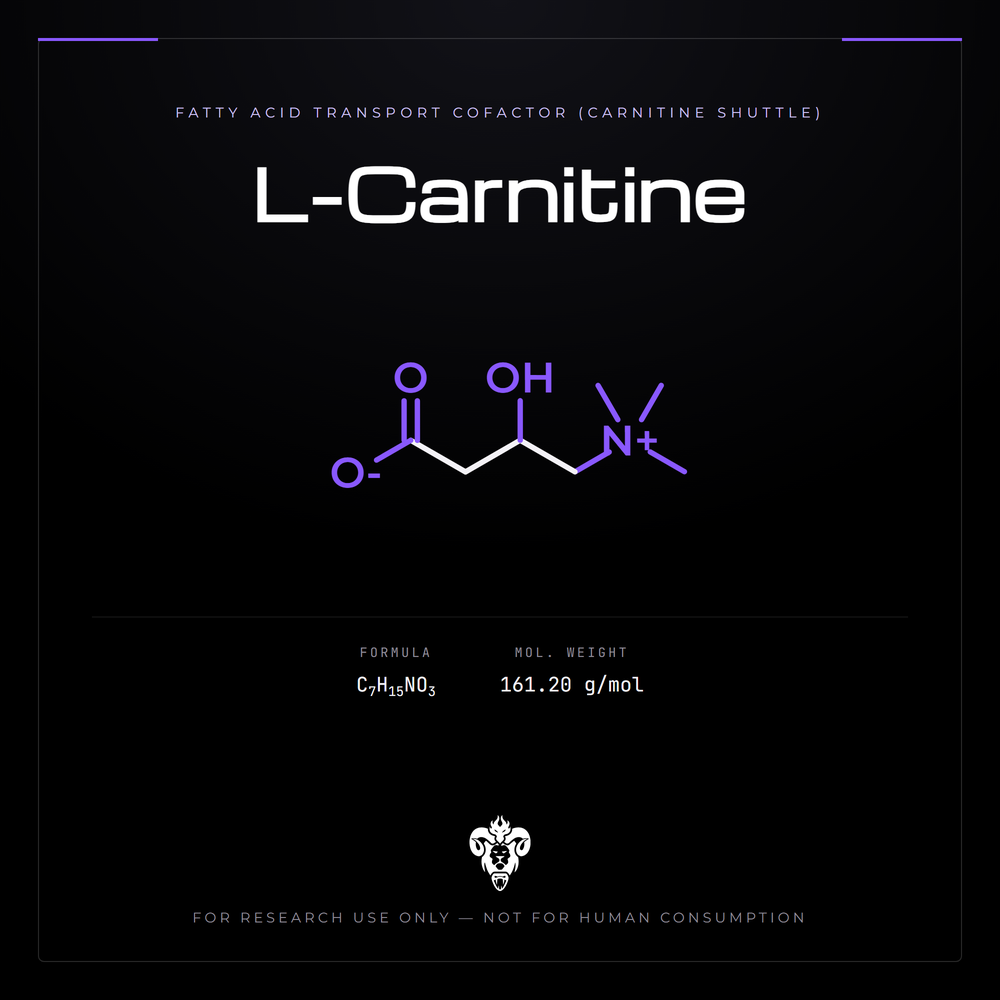
L-Carnitine is a quaternary ammonium compound, 3-hydroxy-4-(trimethylammonio)butanoate, and the obligatory carrier of the carnitine shuttle. Long-chain fatty acyl-CoA esters cannot cross the inner mitochondrial membrane. Carnitine solves that by accepting the acyl group as a carnitine ester, which can cross, then handing it back to coenzyme A on the matrix side. Without it, long-chain fatty acids reach the mitochondrion and stop.
Stereochemistry matters here more than it does for most metabolites. Only the L enantiomer is biologically active; D-carnitine is not merely inert but competes with the L form at the transporter and at the transferases, which is why a racemic preparation is not a weaker version of the same reagent but a different one. Any assay using carnitine as a substrate or supplement needs the enantiomeric identity stated.
Additional Properties
| Property | Specification |
|---|---|
| Biosynthetic Precursor | Gamma-butyrobetaine |
| Appearance | Clear, colorless solution |
| Solubility Profile | Supplied in aqueous solution; freely water-soluble |
| Solution Base | Deionized Water, Benzyl Alcohol |
Research Applications & Mechanism of Action
The shuttle runs in three steps. Carnitine palmitoyltransferase 1, on the outer mitochondrial membrane, transfers the acyl group from CoA to carnitine. A translocase exchanges acylcarnitine inward for free carnitine outward. Carnitine palmitoyltransferase 2, on the matrix side, reverses the first reaction so beta-oxidation can proceed. CPT1 is the rate-limiting step and the regulated one, which makes it the point most experiments target.
A second function follows from the first and is often the more useful readout. Because the shuttle is an exchange, the acylcarnitine pool mirrors the acyl-CoA pool inside the mitochondrion, and acylcarnitines leave the cell where acyl-CoAs do not. Profiling them is therefore an indirect window onto intramitochondrial acyl-CoA composition, and chain-length distribution reports on where in the oxidation pathway a block sits.
Primary fields of in vitro and preclinical laboratory investigation include:
-
Fatty Acid Oxidation Flux: Measuring beta-oxidation rate in isolated mitochondria and permeabilised cells with carnitine as the limiting cofactor.
-
Acylcarnitine Profiling: Using chain-length distribution by tandem mass spectrometry to localise a metabolic block.
-
CPT1 Enzymology: Characterising transferase kinetics and malonyl-CoA sensitivity in mitochondrial preparations.
-
Transporter Studies: Investigating OCTN2-mediated carnitine uptake and competition with structurally related substrates.
-
Analytical Reference Work: A defined enantiopure standard for chromatographic and mass-spectrometric method development.
Selected Research Literature
Peer-reviewed literature indexed on PubMed, provided for scientific context only. Nothing here describes or implies a use for this material.
- Console L, Scalise M, Giangregorio N, Tonazzi A, Barile M, Indiveri C. The link between the mitochondrial fatty acid oxidation derangement and kidney injury. Front Physiol. 2020;11:794. doi:10.3389/fphys.2020.00794
Analytical Documentation
Purity, identity, and composition vary by manufacturing lot. Kimera Chems does not publish a single fixed purity figure for this item; refer to the batch-specific Certificate of Analysis (COA) issued for the lot received, which reflects third-party analytical testing for that lot. Contact us if a COA for your lot is required.
Storage & Handling
Store at controlled room temperature. Do not refrigerate or freeze. Cold storage may cause the solution to cloud or precipitate. If this occurs, return to room temperature and mix until clear.
Storage guidance is a house recommendation. Analytical documentation is per-lot release testing.
Related Research Compounds
Research Use Disclaimer
Research Use Only Disclaimer: This product is labeled and sold “For Research Use Only — NOT FOR HUMAN CONSUMPTION.” It is not a drug, dietary supplement, food, cosmetic, or medical device, and it is not approved by the FDA or any other regulator for human or veterinary use. It is supplied to approved account holders as a research chemical for laboratory use and must be handled in accordance with applicable law.