
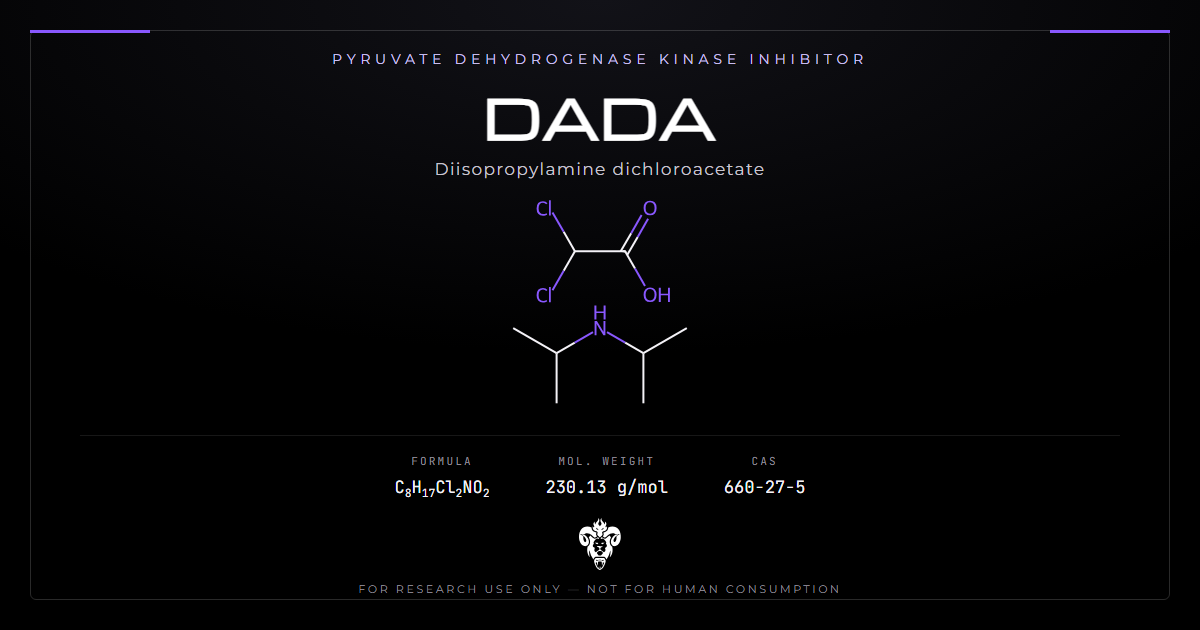
DADA is a salt of two components, and neither of them is inert.
The anion is dichloroacetate, one of the best-characterised inhibitors of pyruvate dehydrogenase kinase. Its mechanistic literature reaches back to 1974 [1]. The cation is diisopropylamine, a simple secondary amine.
Both halves tested positive for mutagenicity in the Ames assay in 1982. The authors of that paper noted that roughly 90 percent of such agents prove carcinogenic [2].
That paper exists for an odd reason. DADA was, and in some markets remains, the active constituent of formulations sold as pangamic acid, or “vitamin B15”. Pangamic acid was never a vitamin.
The compound therefore arrives carrying three separate stories: a serious enzymology literature, a discredited nutritional one, and a genotoxicity finding. This article covers the chemistry and the enzyme target. It then separates what the literature shows for DADA specifically from what it shows for dichloroacetate generally, sets out the safety record on both halves, and describes how to handle the material.
Chemical identity: what you are actually handling
DADA is a two-component salt rather than a single molecule.
| Property | Value |
|---|---|
| IUPAC name | 2,2-dichloroacetic acid;N-propan-2-ylpropan-2-amine |
| Common name | Diisopropylamine dichloroacetate |
| Abbreviation | DADA |
| CAS | 660-27-5 |
| Combined formula | C8H17Cl2NO2 |
| Formula weight | 230.13 g/mol |
| PubChem CID | 12617 |
| InChIKey | ILKBHIBYKSHTKQ-UHFFFAOYSA-N |
| Anion | Dichloroacetate, C2HCl2O2− |
| Cation | Diisopropylammonium, C6H16N+ |
| Stereocentres | None |
Two components, one formula weight
Dichloroacetic acid is 128.94 g/mol. Diisopropylamine is 101.19 g/mol. Together they give 230.13.
Dichloroacetate therefore accounts for roughly 56 percent of the salt by mass, and diisopropylamine for roughly 44 percent. Weighing 100 mg of DADA delivers approximately 56 mg of dichloroacetate.
That correction matters more here than for most salts. The comparison literature dosed sodium dichloroacetate rather than this salt, and the two differ substantially in molar content per gram.
Which half is the active one
The honest answer is that the anion carries the characterised pharmacology, and the cation is not established as inert.
Dichloroacetate has a defined enzyme target and four decades of mechanistic work behind it. Diisopropylamine has no comparable pharmacology. It did test positive for mutagenicity on its own in the Ames assay [2], so describing it as a passive counterion is not supportable either.
Anyone designing an experiment with DADA is therefore working with a compound whose activity needs careful attribution. The design section below gives the control that settles it.
The enzyme target
Understanding dichloroacetate requires understanding a single metabolic switch.
The pyruvate dehydrogenase complex
The pyruvate dehydrogenase complex sits at the junction between glycolysis and the tricarboxylic acid cycle. It catalyses the oxidative decarboxylation of pyruvate to acetyl coenzyme A. That step commits the carbon to oxidative metabolism rather than to lactate.
Reversible phosphorylation regulates the complex. Pyruvate dehydrogenase kinase phosphorylates and thereby inactivates it, and a counterpart phosphatase reverses that. The proportion in the active dephosphorylated form sets how much pyruvate enters oxidative metabolism [1].
Inhibiting the kinase therefore shifts the equilibrium toward the active form, pushing pyruvate into oxidation and away from lactate production.
Four kinase isoforms exist, and they differ in tissue distribution and in what regulates them. That matters for interpretation. A compound inhibiting all four produces a broad metabolic shift, while one preferring a single isoform acts more narrowly. Isoform expression also varies with nutritional state and with disease, so the same compound can produce different effects in the same tissue under different conditions.
Why this became interesting beyond metabolism
Many tumour cells sustain high glycolytic flux and lactate production regardless of oxygen availability. Pyruvate dehydrogenase kinase expression supports that pattern [5].
Reversing it pharmacologically became an obvious question. Several tumour types overexpress kinase isoforms relative to normal tissue [5][9]. Proposals name the enzyme as a target in malignant glioma [5] and cutaneous melanoma [9].
The same axis appears well outside oncology. Kinase induction under hypoxia alters metabolism and inhibits apoptosis in endometriotic stromal cells [12]. Metabolomic work in neovascular age-related macular degeneration identified a kinase and lactate axis. Inhibition reduced lesion formation in a mouse model [13].
What dichloroacetate does
Whitehouse and colleagues established the mechanism in 1974, and the paper remains the reference for it.
They screened halogenated carboxylic acids against pig heart pyruvate dehydrogenase kinase. Monochloroacetate, dichloroacetate, trichloroacetate, difluoroacetate and two chloropropionates all inhibited the enzyme, with roughly 100 µM required for half-maximal inhibition [1]. Inhibition was mainly non-competitive with respect to ATP.
Two negative results in that paper inform as much as the positive ones. Dichloroacetamide, the amide rather than the acid, did not inhibit [1]. And dichloroacetate neither increased the catalytic activity of purified pyruvate dehydrogenase nor affected the activating phosphatase [1]. The effect runs through the kinase specifically.
The consequences followed through tissue and whole animal. Dichloroacetate raised the proportion of active pyruvate dehydrogenase across heart, kidney and fat-cell mitochondria, and in perfused heart, isolated diaphragm and epididymal fat pads [1].
Injection into starved rats activated the complex in heart, muscle, adipose tissue, kidney and liver within 60 minutes. Blood lactate fell within 15 minutes [1].
Later work using hyperpolarised nuclear magnetic resonance confirmed the same effect in a modern setting. In diabetic rat muscle, dichloroacetate rapidly restored depressed pyruvate dehydrogenase activity to control levels. Tricarboxylic acid cycle flux did not change [14].
The selectivity limitation
Dichloroacetate is a small, simple molecule, and its limitations are well recognised in the field.
Wu and colleagues developed a more selective kinase inhibitor for a stated reason. The lack of specificity and side effects of dichloroacetate indicated that a more specific inhibitor was needed [11].
In diet-induced obese mouse hearts, both compounds stimulated flux through the complex. Only dichloroacetate increased lactate production [11].
Cellular responses also vary by kinase isoform expression. Work in colorectal cancer lines found differential regulation of complex phosphorylation between lines. The authors concluded the compound may benefit only a subset of tumour types, depending on isoform profile [8].
Evidence specific to DADA
Most of the literature above concerns dichloroacetate as sodium salt or free acid. Three studies address this particular salt.
A pyruvate dehydrogenase kinase 4 inhibitor
Yamane and colleagues characterised DADA as an inhibitor of the fourth kinase isoform. They tested it in mice with severe influenza [7].
Infection markedly reduced complex activity and ATP levels. It also selectively upregulated that isoform in skeletal muscle, heart, liver and lungs [7].
Oral DADA given at 12-hour intervals for 14 days restored complex activity and ATP levels across those organs. Measures of glucose and lipid metabolism improved alongside [7].
That study is useful for two reasons beyond its disease model. It identifies a specific isoform preference, and it demonstrates oral activity for this salt rather than for dichloroacetate generally.
A direct comparison against dichloroacetate
Su and colleagues ran the comparison that matters most for anyone choosing between the two [10].
In a breast adenocarcinoma cell line, the half-maximal inhibitory concentration of DADA came to 7.1 ± 1.1 mmol/L. Dichloroacetate came to 15.6 ± 2.0 mmol/L [10].
In a mouse xenograft model, 100 mg/kg DADA suppressed tumour growth better than the same mass of dichloroacetate. That mass represents half the molar dose [10].
Both compounds inhibited lactate production and glucose uptake in vitro at 10 mmol/L, DADA the stronger of the two [10].
The authors left the explanation open. The difference might reflect the cation contributing activity, better cellular uptake of the salt, or something else. That question remains open, and it is the most interesting unanswered question about this compound.
A clinical trial
One randomised trial of DADA exists. Lu and colleagues ran a multicentre double-blind dose-comparison study in 127 patients with non-alcoholic fatty liver disease. Dosing ran at 60 or 120 mg daily for eight weeks [3].
Both dose groups improved across symptom scores, transaminase normalisation, serum lipids and ultrasound grading. Neither group differed significantly from the other [3]. Dry mouth occurred in one patient per group, and no severe adverse reactions were reported [3].
Two caveats belong alongside that summary. The trial compared two doses of the same drug rather than drug against placebo. It therefore cannot separate treatment effect from natural history. And eight weeks is short relative to the concerns in the next section.
The pangamic acid problem
DADA reached wide circulation through a route unrelated to enzymology.
Pangamic acid, marketed as “vitamin B15”, was promoted for decades despite never meeting the definition of a vitamin. Formulations sold under that name varied in composition, and DADA was the active constituent of many of them [2].
Gelernt and Herbert tested it. Both diisopropylamine dichloroacetate and diisopropylamine alone showed mutagenicity in the Ames Salmonella assay with mammalian microsomal activation [2].
Their conclusion was direct. Roughly 90 percent of such agents prove carcinogenic, and that possibility deserves consideration in any proposed use of pangamic acid containing either substance [2].
Two points about how to read that finding.
An Ames positive is a genotoxicity signal, not a demonstration of carcinogenicity in animals or humans. The assay measures mutation in bacteria. Its correlation with rodent carcinogenicity is substantial rather than absolute.
The finding nonetheless applies to both components, which is unusual. A mutagenic anion paired with an inert cation would leave options. A salt where both halves score positive does not.
No subsequent carcinogenicity study of DADA appears in the indexed literature to resolve the question either way.
The neuropathy signal
The dichloroacetate safety literature contains one clear adverse finding and one reassuring counterweight, and both deserve stating.
The terminated trial
Kaufmann and colleagues ran a double-blind placebo-controlled randomised crossover trial of dichloroacetate. Dosing was 25 mg/kg/day in 30 patients with a mitochondrial disorder [4].
The outcome was unambiguous. Across the initial 24-month treatment period, 15 of 15 patients on dichloroacetate came off study medication, against 4 of 15 on placebo [4].
Onset or worsening of peripheral neuropathy drove discontinuation in 17 of 19 patients. The trial terminated early for peripheral nerve toxicity [4].
No benefit was detectable. The authors concluded that the neuropathy overshadowed assessment of any potential benefit [4].
The long-term counterweight
A different picture emerges at lower doses in a different population.
Abdelmalak and colleagues followed eight patients with congenital lactic acidosis. Each received oral dichloroacetate at 12.5 mg/kg twice daily, for between 9.7 and 16.5 years [6]. That is half the daily dose of the terminated trial, sustained for well over a decade.
Blood lactate remained normal throughout. Haematological, electrolyte, renal and hepatic status stayed stable. Nerve conduction either held steady or declined modestly, prompting dose reduction or temporary discontinuation in three patients. Symptomatic worsening of peripheral neuropathy did not occur [6].
The two studies together suggest the neuropathy risk is dose-dependent and population-dependent rather than absolute. Neither supports treating the compound as free of neurological effects.
Physicochemical properties and handling
DADA is a hygroscopic crystalline solid, and the hygroscopicity is the practical problem.
Both components favour water. Dichloroacetate is a strong carboxylate, and diisopropylammonium a small charged amine. The salt therefore dissolves readily and draws moisture from air. Weighing it accurately requires a dry environment and reasonable speed.
Chemically it holds up well. Neither component carries an oxidisable centre or a hydrolysable bond of consequence. Dichloroacetic acid is a stable halogenated carboxylic acid rather than a reactive alkylating one.
Two handling notes follow from what it is. Dichloroacetic acid in free form is corrosive, so any procedure liberating the free acid deserves the corresponding precautions. And diisopropylamine is volatile, with a strong amine odour. A preparation smelling strongly of amine may indicate salt dissociation or free amine contamination.
Store the solid sealed, dry and cool. Prepare aqueous solutions fresh and buffer them, since dissolving the salt will shift solution pH.
Analytical characterisation
Four checks cover this material, and the first two reflect its two-component nature.
Stoichiometric ratio, by proton NMR integration. The diisopropyl methyl doublet integrates against the dichloroacetate methine singlet, and the ratio confirms a 1:1 salt directly.
Content of both components, quantified separately. Ion chromatography quantifies dichloroacetate. The amine is quantified by titration or by NMR against an internal standard.
Chloride content and free chloride specifically. Hydrolytic loss of chloride from the dichloroacetate would change the anion identity, and free chloride is the marker.
Water content by Karl Fischer titration, given the hygroscopicity. A material that has absorbed several percent water will assay low on everything else.
What a rigorous certificate should contain
Salt stoichiometry, stated as a ratio rather than assumed.
Chromatographic purity with method conditions.
Water content, quantified.
Identity of both ions, established separately.
Residual solvents from synthesis.
Kimera publishes third-party certificates of analysis for every lot in its COA database. Laboratories source DADA as a pyruvate dehydrogenase kinase inhibitor. It sometimes sits alongside BAM15 or AICAR, which act on mitochondrial and energy-sensing pathways by different routes. Related chemistry appears in the metabolic category.
Common misclassifications
Four errors recur.
The diisopropylamine is described as an inert counterion. It tested positive for mutagenicity on its own in the Ames assay [2].
Sources treat DADA and sodium dichloroacetate as equivalent at matched mass. Molar content differs. A direct comparison found DADA roughly twice as potent in a cell line, and more effective at matched mass in vivo [10].
Summaries omit the vitamin B15 history. The compound entered wide circulation as the active constituent of a substance that was never a vitamin. The mutagenicity work exists because of that history [2].
Copy describes dichloroacetate as well tolerated. A randomised trial at 25 mg/kg/day terminated early for peripheral nerve toxicity [4]. A decade-long study at half that dose did find it generally tolerated [6], which makes the risk dose-dependent rather than absent.
Experimental design considerations
Include a sodium dichloroacetate arm at matched molar anion. This control separates anion activity from any contribution by the cation. No published study appears to have run it cleanly.
Consider a diisopropylamine-only arm as well. Given the Ames result, treating the cation as a null condition is an assumption rather than a control [2].
Correct for salt mass. Multiply by 0.56 to obtain dichloroacetate content from weighed DADA.
Work in the millimolar range for cellular effects. Reported half-maximal concentrations in cell lines run 7.1 mmol/L for DADA and 15.6 mmol/L for dichloroacetate [10]. Both sit far above the concentrations typical for receptor-targeted compounds.
Check kinase isoform expression in the model. Cellular responses differ by isoform profile, and a negative result may reflect the model rather than the compound [8].
Measure lactate as well as the intended endpoint. Lactate reduction is the most direct and immediate consequence of the mechanism [1].
Frequently asked questions
What is DADA? Diisopropylamine dichloroacetate, CAS 660-27-5, a 1:1 salt of dichloroacetic acid with diisopropylamine. Kimera supplies it as a laboratory research material.
What is the molecular target? Pyruvate dehydrogenase kinase, which the dichloroacetate anion inhibits, shifting the pyruvate dehydrogenase complex toward its active form [1].
Is the diisopropylamine just a counterion? Not established as such. It tested positive for mutagenicity on its own [2]. A direct comparison also found the salt more potent than dichloroacetate alone [10].
How much dichloroacetate is in the salt? About 56 percent by mass.
What is the relationship to vitamin B15? DADA was the active constituent of many formulations sold as pangamic acid, a substance that was never a vitamin [2].
What is the main safety finding? Two. Ames mutagenicity for both components [2], and dose-dependent peripheral neuropathy from dichloroacetate, which terminated one randomised trial early [4].
Is it approved anywhere? It has reached market in some jurisdictions for liver conditions. It holds no approval in the European Union or United States. Kimera supplies it for laboratory research use only.
Summary of the evidence
Identity: a 1:1 salt, C8H17Cl2NO2, 230.13 g/mol. Dichloroacetate contributes roughly 56 percent by mass, diisopropylamine roughly 44 percent.
Mechanism: inhibition of pyruvate dehydrogenase kinase. Dichloroacetate acts at around 100 µM against the isolated enzyme, non-competitively with respect to ATP [1].
Downstream effect: a higher proportion of active pyruvate dehydrogenase across multiple tissues. Blood lactate fell within 15 minutes of injection in rats [1], and depressed activity recovered in diabetic rat muscle [14].
DADA-specific findings: inhibition of the fourth kinase isoform, with oral activity in a mouse infection model [7]. Roughly twofold greater potency than dichloroacetate in a breast cancer cell line [10].
Clinical record: one randomised dose-comparison trial in 127 patients with fatty liver disease, without a placebo arm [3].
Genotoxicity: both the salt and the free amine tested positive in the Ames assay. No subsequent carcinogenicity study appears in the literature [2].
Neurotoxicity: dichloroacetate at 25 mg/kg/day terminated a randomised trial early for peripheral nerve toxicity [4]. At 12.5 mg/kg twice daily it proved generally tolerated across more than a decade in a small congenital cohort [6].
Wider target interest: work on pyruvate dehydrogenase kinase spans glioma [5], melanoma [9], colorectal cancer [8], endometriosis [12], macular degeneration [13] and diabetic cardiomyopathy [11].
Status: supplied for laboratory research use only.
References
- Whitehouse S, Cooper RH, Randle PJ. Mechanism of activation of pyruvate dehydrogenase by dichloroacetate and other halogenated carboxylic acids. Biochem J. 1974;141(3):761-774. PMID 4478069. DOI
- Gelernt MD, Herbert V. Mutagenicity of diisopropylamine dichloroacetate, the “active constituent” of vitamin B15 (pangamic acid). Nutr Cancer. 1982;3(3):129-133. PMID 6752894. DOI
- Lu LG, Zeng MD, Mao YM, et al. Diisopropylamine dichloroacetate in the treatment of nonalcoholic fatty liver disease: a multicenter random double-blind controlled trial. Zhonghua Gan Zang Bing Za Zhi. 2005;13(2):92-95. PMID 15727691
- Kaufmann P, Engelstad K, Wei Y, et al. Dichloroacetate causes toxic neuropathy in MELAS: a randomized, controlled clinical trial. Neurology. 2006;66(3):324-330. PMID 16476929. DOI
- Jha MK, Suk K. Pyruvate dehydrogenase kinase as a potential therapeutic target for malignant gliomas. Brain Tumor Res Treat. 2013;1(2):57-63. PMID 24904893. DOI
- Abdelmalak M, Lew A, Ramezani R, et al. Long-term safety of dichloroacetate in congenital lactic acidosis. Mol Genet Metab. 2013;109(2):139-143. PMID 23611579. DOI
- Yamane K, Indalao IL, Chida J, et al. Diisopropylamine dichloroacetate, a novel pyruvate dehydrogenase kinase 4 inhibitor, as a potential therapeutic agent for metabolic disorders and multiorgan failure in severe influenza. PLoS One. 2014;9(5):e98032. PMID 24865588. DOI
- Ho N, Coomber BL. Pyruvate dehydrogenase kinase expression and metabolic changes following dichloroacetate exposure in anoxic human colorectal cancer cells. Exp Cell Res. 2015;331(1):73-81. PMID 25536473. DOI
- Pópulo H, Caldas R, Lopes JM, et al. Overexpression of pyruvate dehydrogenase kinase supports dichloroacetate as a candidate for cutaneous melanoma therapy. Expert Opin Ther Targets. 2015;19(6):733-745. PMID 25976231. DOI
- Su L, Zhang H, Yan C, et al. Superior anti-tumor efficacy of diisopropylamine dichloroacetate compared with dichloroacetate in a subcutaneous transplantation breast tumor model. Oncotarget. 2016;7(40):65721-65731. PMID 27582548. DOI
- Wu CY, Satapati S, Gui W, et al. A novel inhibitor of pyruvate dehydrogenase kinase stimulates myocardial carbohydrate oxidation in diet-induced obesity. J Biol Chem. 2018;293(25):9604-9613. PMID 29739849. DOI
- Lee HC, Lin SC, Wu MH, Tsai SJ. Induction of pyruvate dehydrogenase kinase 1 by hypoxia alters cellular metabolism and inhibits apoptosis in endometriotic stromal cells. Reprod Sci. 2019;26(6):734-744. PMID 30092712. DOI
- Lambert V, Hansen S, Schoumacher M, et al. Pyruvate dehydrogenase kinase/lactate axis: a therapeutic target for neovascular age-related macular degeneration identified by metabolomics. J Mol Med (Berl). 2020;98(12):1737-1751. PMID 33079232. DOI
- Park JM, Josan S, Hurd RE, et al. Hyperpolarized NMR study of the impact of pyruvate dehydrogenase kinase inhibition on the pyruvate dehydrogenase and TCA flux in type 2 diabetic rat muscle. Pflugers Arch. 2021;473(11):1761-1773. PMID 34415396. DOI
DADA is sold for laboratory research use only. Not for human consumption, nor medical, veterinary, or household uses.
Literature retrieved from PubMed.