Skip to content
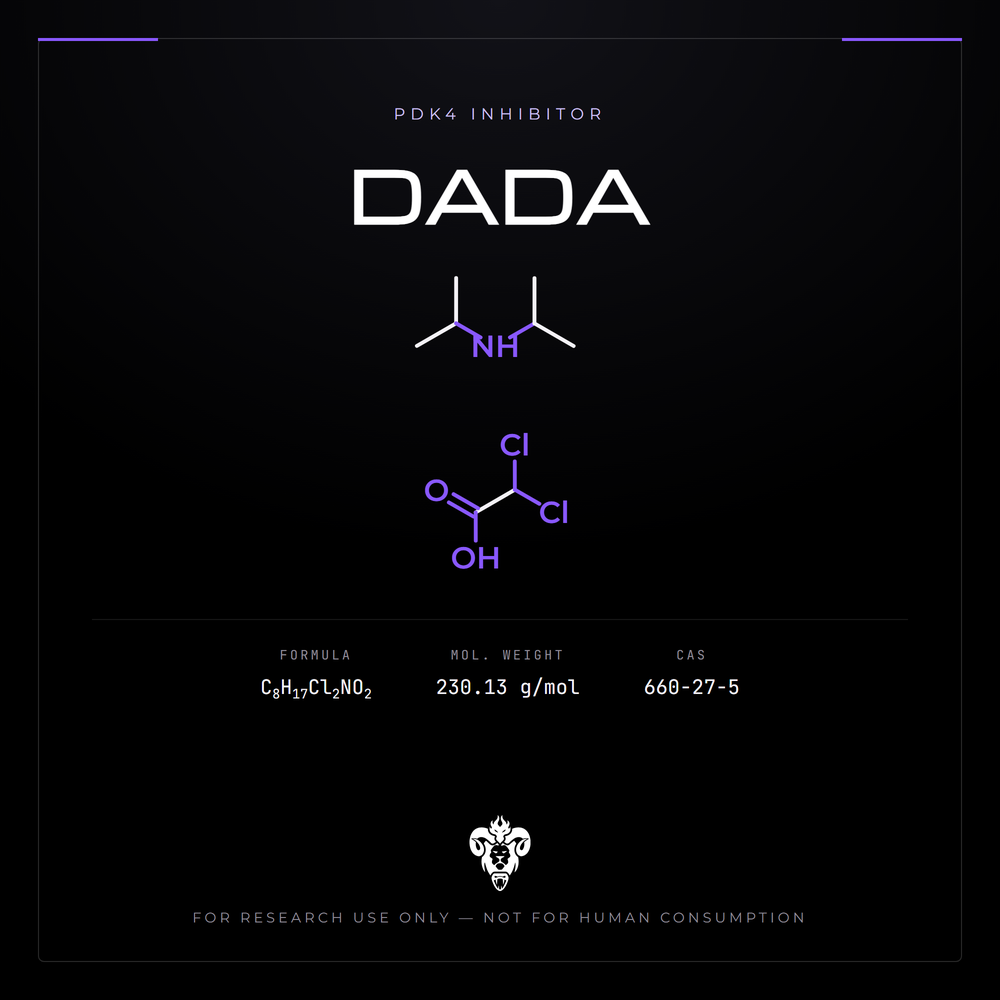

DADA (Diisopropylamine Dichloroacetate)
DADA (Diisopropylamine Dichloroacetate) is a synthetic organic amine salt composed of a cationic diisopropylamine moiety complexed with an anionic dichloroacetate partner. In enzyme and mitochondrial assays, DADA is used as an inhibitor of pyruvate dehydrogenase kinase 4 (PDK4).
By selectively targeting PDK4, DADA blocks the phosphorylation-mediated inactivation of the pyruvate dehydrogenase complex (PDC), which keeps the complex in its active, unphosphorylated form.
Structural Elements to Observe: The diagram above illustrates the active dichloroacetic acid (DCA) core of the salt. In DADA, this chlorinated organic acid is stabilized via an ionic bond to diisopropylamine. This specific salt configuration is extensively evaluated in solution chemistry to observe how the two counter-ions maintain molecular association and alter transport kinetics across varied buffer systems over time.
Physical & Handling Properties
| Property | Specification |
|---|---|
| Physical Format | White crystalline powder |
| Solution Base | Deionized Water, Benzyl Alcohol |
Research Applications & Mechanism of Interest
DADA is used in enzyme and mitochondrial function assays as a PDK4 inhibitor.
Primary fields of preclinical and in vitro laboratory investigation include:
-
PDK4 Enzymatic Inhibition: Investigating how blocking PDK4 restores active, unphosphorylated pyruvate dehydrogenase, thereby accelerating the conversion of pyruvate to acetyl-CoA inside the mitochondrial matrix.
-
Lactate and Acidification Readouts: Measuring lactate production and extracellular acidification in cultured cell lines when PDK4 is inhibited.
-
Ion-Pair Stability & Salt Association: Evaluating the structural behavior of the diisopropylamine-dichloroacetate pair in liquid chromatography and cell-free assay environments. Researchers check structural association over time across various pH gradients and buffer concentrations.
-
Oxygen Consumption: Using oxygen consumption rate (OCR) assays to measure pyruvate oxidation when PDK4 is inhibited.
Storage & Handling Guidelines
Store at controlled room temperature. Keep tightly closed. Liquid formats: do not refrigerate or freeze. Cold storage may cause the solution to cloud or precipitate. If this occurs, return to room temperature and mix until clear.
Storage guidance is a house recommendation. Analytical documentation is per-lot release testing.
Related Research Compounds
Frequently Asked Research Questions
How does DADA differ from sodium dichloroacetate (NaDCA) in experimental models?
While both compounds deliver the active dichloroacetate anion to inhibit PDK, DADA utilizes a diisopropylamine counter-ion rather than a sodium ion. In specific cell-free and tissue assays, the presence of the organic amine counter-ion can significantly alter membrane permeability, ionization characteristics, and localized buffer compatibility compared to inorganic sodium salts.
Why is moisture protection so critical for DADA crystalline powder?
As an organic amine salt, DADA is inherently hygroscopic. If exposed to ambient moisture, the crystalline matrix will absorb water molecules, resulting in physical clumping. This does not necessarily degrade the covalent bonds, but it alters the compound’s moisture weight, compromising the precision of micro-molar solution preparation.
Research Use Only Disclaimer: This product is labeled and sold “For Research Use Only — NOT FOR HUMAN CONSUMPTION.” It is not a drug, dietary supplement, food, cosmetic, or medical device, and it is not approved by the FDA or any other regulator for human or veterinary use. It is supplied to approved account holders as a research chemical for laboratory use and must be handled in accordance with applicable law.