
Most compounds in this catalogue have thin literature. Dihexa has a different problem. Its literature was reasonably developed, and then the paper carrying its mechanism was withdrawn.
In April 2025, the Journal of Pharmacology and Experimental Therapeutics published a retraction notice. It covered the 2014 study that established hepatocyte growth factor and c-Met signalling as the basis of Dihexa’s procognitive activity [3]. That paper was the mechanistic foundation. Almost every subsequent description of how this molecule works traces back to it.
The retraction does not erase the compound, and it does not make the behavioural observations disappear. What it removes is the answer to the question of what Dihexa binds. And that question turns out to have been contested all along, because the receptor it was designed against has two competing identifications in the literature.
This article covers the chemistry, the angiotensin IV system it came from, both candidate targets, what the retraction removes and what survives it, and how to handle the material analytically.
Chemical identity: what you are actually handling
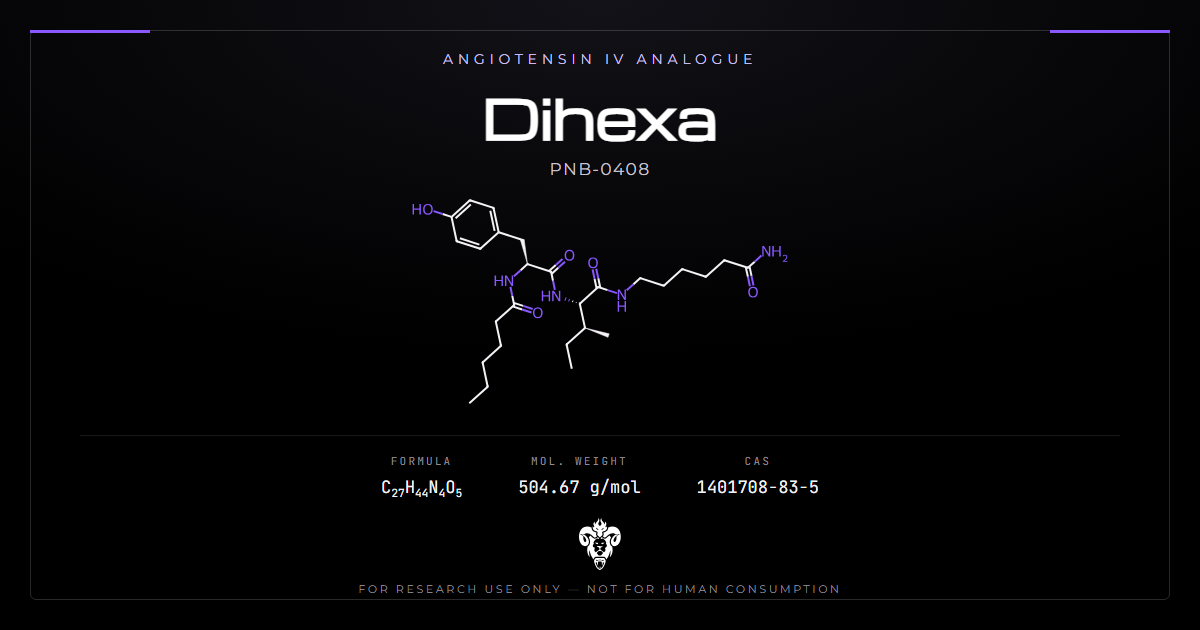
Dihexa is a capped dipeptide rather than a conventional peptide.
| Property | Value |
|---|---|
| Common name | Dihexa |
| Chemical name | N-hexanoic-Tyr-Ile-(6) aminohexanoic amide |
| CAS | 1401708-83-5 |
| Molecular formula | C27H44N4O5 |
| Molecular weight | 504.66 g/mol |
| PubChem CID | 129010512 |
| InChIKey | XEUVNVNAVKZSPT-JTJYXVOQSA-N |
| Amino acid residues | Two, both (S) configuration |
| Parent compound | Nle1-angiotensin IV |
| Originator | Washington State University |
The capping strategy
The core of the molecule is a tyrosine-isoleucine dipeptide. A hexanoyl group caps the amino terminus, and a 6-aminohexanoic amide extends the carboxy terminus.
Both caps are fatty-acid-like chains, and the chemists added them to solve a delivery problem rather than a binding one. Angiotensin IV and its early analogues showed procognitive activity in animal models but failed on two practical counts: they did not cross the blood-brain barrier, and they had no oral activity [1].
Capping a peptide at both ends does two things. It blocks the exopeptidases that would otherwise chew the molecule inward from either terminus. It also raises lipophilicity substantially, which permits passive membrane transit.
Is it a peptide?
Dihexa occupies a boundary. Two amide-linked amino acid residues mean peptide chemistry governs its synthesis and part of its stability behaviour. Yet it remains far too small and too heavily modified to behave like a therapeutic peptide in solution.
Treat it as a small molecule for solubility purposes, and as a peptide for identity confirmation. Its two stereocentres come from the natural residues, and epimerisation at those centres remains the stereochemical risk during synthesis.
The angiotensin IV system
Understanding Dihexa requires understanding the peptide system it was abstracted from, because that system carries an unresolved question at its centre.
The peptide and its effect
Angiotensin IV is a hexapeptide fragment of the renin-angiotensin cascade. Early work dismissed it as an inactive breakdown product of angiotensin II [6].
That view changed three decades ago, when intracerebroventricular injection of the peptide improved learning and memory in rats [8]. Follow-up work found the peptide enhancing learning and memory in normal rodents, and reversing deficits in amnesia models [6].
A systematic review of experimental studies gives a measured summary of that literature’s strength. Of 450 articles screened, 32 met inclusion criteria. Seven of eleven studies in normal animals found angiotensin IV benefited performance on passive or conditioned avoidance and object recognition tasks. In models of cognitive deficit, eight of nine studies found the peptide and its analogues, Dihexa among them, improved spatial working memory and passive avoidance performance [10].
The same review notes an important qualification. These peptides worked best given intracerebroventricularly, close in time to learning acquisition or retention testing [10]. That is a demanding delivery condition, and overcoming it was the stated purpose of the Dihexa programme.
Three axes, not one pathway
The renin-angiotensin system in the brain is not a single cascade, and placing Dihexa correctly means knowing which branch it belongs to.
Three axes operate in parallel. The classical pathway runs from angiotensin-converting enzyme through angiotensin II to the AT1 receptor, and it drives the sympathetic and pressor responses. A second, non-classical axis runs through angiotensin-converting enzyme 2 to angiotensin-(1-7) and the Mas receptor, and it generally opposes the first. A third axis, described as exclusive to the brain, runs from aminopeptidase activity through angiotensin IV to the AT4 site, and it acts on cerebral microvasculature while participating in cognition, memory and learning [7].
That third axis is where Dihexa sits. Its separation from the pressor pathway is the reason a compound derived from an angiotensin fragment is studied for cognition rather than blood pressure. Reviews of the wider system treat the angiotensin IV branch as functionally distinct from the classical one [7][11].
The AT4 receptor question
Binding studies identified a distinct site for angiotensin IV, designated the AT4 receptor, concentrated in brain regions involved in cognition [6].
Naming a receptor is not the same as identifying the protein. Two candidate identifications emerged, and both carry serious support.
The two candidate targets for Dihexa
This is the crux, and it explains why the retraction matters so much.
Insulin-regulated aminopeptidase
Albiston and colleagues identified the AT4 receptor as insulin-regulated aminopeptidase, a transmembrane zinc enzyme also called IRAP or cystinyl aminopeptidase [6]. On this account, angiotensin IV acts as an inhibitor of the enzyme rather than as a classical receptor agonist.
That proposal has held up well. An entire medicinal chemistry literature now surrounds IRAP inhibitor design, moving stepwise from the hexapeptide toward more drug-like peptidomimetics [8]. Crystal structures of IRAP and computational studies have accelerated the structure-activity work. Reviews now catalogue those design efforts with attention to inhibitor selectivity [9].
IRAP is a genuinely multi-functional enzyme. It regulates oxytocin levels in late pregnancy, affects cellular glucose uptake through trafficking of the glucose transporter GLUT4, and participates in antigen cross-presentation by dendritic cells [9]. Reviews of the wider renin-angiotensin system treat the angiotensin IV and IRAP pairing as an established axis [11][12].
Hepatocyte growth factor and c-Met
The Washington State group proposed a different answer. In their account, the brain angiotensin IV system coincides with the hepatocyte growth factor and c-Met receptor system [4].
The appeal of this hypothesis is that c-Met activation drives mitogenesis, motogenesis, morphogenesis, stem cell differentiation and neurogenesis, and offers protection against tissue insult across many cell types including neurons [5]. A compound acting through it would have a plausible route to the synaptic effects reported for Dihexa.
Wright and colleagues were explicit that the identity question remained open. Their 2014 review states directly that controversy persists over the identity of the AT4 receptor protein, acknowledges Albiston’s evidence for IRAP as convincing, and then presents their own case for the growth factor system [4].
The retraction and what it removes
The evidence for the growth factor hypothesis rested principally on one paper.
What the paper claimed
Benoist and colleagues set out to elucidate the mechanism behind Dihexa’s activity. They framed the work around two obstacles that had held the field back. One was the absence of blood-brain-barrier-penetrant analogues, the other the absence of a validated mechanism of action [2].
Their reported findings were specific and mutually reinforcing. Dihexa bound hepatocyte growth factor with high affinity. Both Dihexa and its parent Nle1-angiotensin IV induced c-Met phosphorylation in the presence of subthreshold growth factor concentrations, and augmented growth-factor-dependent cell scattering. Both induced hippocampal spinogenesis and synaptogenesis comparable to the growth factor itself. A growth factor antagonist and a short hairpin RNA against c-Met blocked those actions. And an intracerebroventricular growth factor antagonist blocked the procognitive effect of orally delivered Dihexa in a spatial learning task [2].
That is a well-constructed mechanistic argument, running from binding through cellular signalling to blocked behaviour.
What the notice means
The journal retracted that paper in April 2025 [3]. PubMed now indexes the original as a retracted publication.
A retraction is a stronger action than an expression of concern. It signals that the journal no longer stands behind the findings. Standard practice is to stop citing the retracted work as evidence.
The practical effect for anyone working with Dihexa is direct. That single paper supplied the binding data, the c-Met phosphorylation data, the antagonist blockade and the behavioural blockade. Removing it breaks the chain.
What survives
Several things survive untouched, and stating them precisely matters.
The chemistry stands. Identity, formula, structure and synthesis hold independent of any mechanistic claim.
The broader angiotensin IV behavioural literature stands too. That body of work predates the retracted paper and spans multiple independent groups, as the systematic review documents [10].
The IRAP hypothesis stands, and gains ground by comparison. It rests on a separate literature with its own structural biology and medicinal chemistry [6][8][9].
One claim does not survive: that Dihexa works through hepatocyte growth factor and c-Met. Anyone stating that mechanism today cites a retracted paper, directly or at one remove.
Reading the compound honestly
The defensible position is narrower than most supplier copy suggests.
Dihexa is a metabolically stabilised, brain-penetrant analogue of a peptide family with a reproducible behavioural signature in rodent models [10]. Its molecular target is not settled. The better-supported candidate for the family as a whole is IRAP [6][8][9]. The alternative proposal, specific to this compound, currently lacks a standing primary paper.
That is a legitimate and interesting position for a research tool. A compound whose target is contested is precisely the compound worth running target-engagement experiments on.
One contextual point belongs here, stated plainly because it is disclosed rather than hidden. Several of the papers advancing the growth factor hypothesis, including the retracted one, carry author affiliations with a company formed to commercialise the compound alongside the university affiliations [2][4][5]. Disclosed commercial affiliation is ordinary in translational pharmacology and implies nothing improper on its own.
It does bear on how a reader weighs two competing hypotheses. The IRAP identification came from a separate group and has been developed by medicinal chemists with no stake in this particular molecule [6][8][9]. Where two accounts of a target compete and one has a commercial interest attached, the independent line deserves at least equal weight, and the retraction shifts that balance further.
It does not license describing Dihexa as an established growth factor agonist. The gap between those two framings separates a research material from a marketing claim.
What settling the target would take
A contested target is a research opportunity rather than a dead end, and the experiments that would resolve it are reasonably well defined.
Direct binding measurement comes first. Surface plasmon resonance or isothermal titration calorimetry against purified IRAP, and separately against the growth factor, would establish which interaction occurs and at what affinity. The retracted paper reported high-affinity binding to the growth factor [2], and an independent replication attempt would be informative either way.
Enzyme inhibition provides a second, cleaner readout. IRAP is an aminopeptidase with a measurable catalytic activity, so a compound acting on it should inhibit substrate turnover. That assay is straightforward, well established in the inhibitor design literature [9], and does not depend on any downstream signalling claim.
Genetic controls settle attribution. IRAP knockout or knockdown tissue provides the test that pharmacology alone cannot: an effect surviving loss of the proposed target did not run through it.
Selectivity against related enzymes matters here more than usual. IRAP belongs to the M1 family of zinc aminopeptidases, whose members share considerable active-site similarity, and inhibitor selectivity within that family has been a persistent design challenge [9].
Physicochemical properties and handling
The molecule carries three amide bonds, a phenolic hydroxyl from tyrosine, and two aliphatic chains.
Amide bonds hold under ordinary storage, hydrolysing only under strong acid or base, or enzymatically. The terminal caps block aminopeptidase and carboxypeptidase attack specifically. That is why the molecule survives oral delivery where its parent peptide does not.
The tyrosine phenol is the most reactive site. Phenols oxidise on exposure to air and light. Tyrosine residues also undergo nitration and halogenation under harsh conditions.
Lipophilicity runs high for a molecule containing two amino acids, which is the intended consequence of the capping. Aqueous solubility is correspondingly limited. Dimethyl sulfoxide is the usual stock solvent.
Store the solid sealed, dry, cold and dark. Prepare solutions fresh where possible.
Analytical characterisation
Four checks cover this compound.
Accurate mass confirms C27H44N4O5 at 504.66. Four nitrogens and five oxygens give a distinctive composition for a molecule of this size.
Tandem mass spectrometry confirms the sequence. Amide bonds fragment predictably, and the resulting ion series distinguishes the tyrosine-isoleucine order from a reversed or substituted arrangement.
Proton NMR confirms both caps. The hexanoyl and aminohexanoyl chains produce characteristic aliphatic envelopes, and their integration against the tyrosine aromatic protons confirms both are present rather than only one.
Chiral integrity at the two residue centres requires either chiral chromatography or amino acid analysis after hydrolysis. Epimerisation during coupling is the standard risk in peptide synthesis. A D-residue shares the molecular formula and accurate mass exactly.
What a rigorous certificate should contain
Chromatographic purity with the method stated.
Accurate mass confirming the molecular formula.
Sequence confirmation by tandem mass spectrometry.
Stereochemical purity, since mass methods cannot report it.
Residual solvents and, if solid-phase synthesis was used, residual coupling reagents.
Kimera publishes third-party certificates of analysis for every lot in its COA database. Laboratories source Dihexa for angiotensin IV system work, sometimes alongside Selank or CJC-1295 (no DAC). Related chemistry appears in the peptides category.
Common misclassifications
Four errors recur, and the first is now the most serious.
Suppliers describe Dihexa as an HGF/c-Met agonist or potentiator. The journal retracted the primary paper supporting that mechanism in April 2025 [3].
Summaries call it a nootropic peptide with established mechanism. Its target is contested, and the competing identification points at an aminopeptidase rather than a growth factor receptor [6].
Sources treat it as equivalent to angiotensin IV. It is a heavily modified two-residue analogue, and those modifications exist precisely because the parent peptide behaves differently.
Copy describes its behavioural literature as human. No human clinical trial of Dihexa exists in the literature, and the entire behavioural record is preclinical [10].
Experimental design considerations
Do not assume a target. Run a binding or engagement assay appropriate to whichever hypothesis is being tested, rather than inheriting a mechanism from the literature.
Include an IRAP-directed comparator if the target is the question. The inhibitor literature offers characterised tool compounds for exactly this purpose [9].
Cite the retraction if the growth factor mechanism appears in a rationale. Citing the retracted paper without noting its status is a citation error reviewers increasingly catch.
Control for delivery. The parent peptide literature depended heavily on intracerebroventricular administration close to the learning event [10], and any oral or peripheral design departs from that precedent.
Verify stereochemistry before use. Two centres, a peptide coupling route, and no mass-based way to detect epimerisation.
Frequently asked questions
What is Dihexa? N-hexanoic-Tyr-Ile-(6) aminohexanoic amide, CAS 1401708-83-5, a capped dipeptide derived from Nle1-angiotensin IV. Kimera supplies it as a laboratory research material.
What was retracted? The 2014 paper reporting that the procognitive and synaptogenic effects of angiotensin IV-derived peptides depend on hepatocyte growth factor and c-Met activation. The journal published the retraction notice in April 2025 [2][3].
Does the retraction mean the compound does nothing? No. It removes the mechanistic explanation, not the behavioural observations, which come from a wider literature [10].
What is the alternative target? Insulin-regulated aminopeptidase, identified as the AT4 receptor and supported by an independent structural and medicinal chemistry literature [6][8][9].
Why is it capped at both ends? To block exopeptidase degradation and raise lipophilicity enough for blood-brain barrier transit and oral activity [1].
Has it been tested in humans? No published clinical trial exists.
What analytical check matters most? Stereochemical purity at the two residue centres, which no mass measurement can report.
Should the retracted paper still be cited? Only with its status stated. Reference managers and databases now flag it, and citing it as live evidence is an error a reviewer will catch.
Summary of the evidence
Identity: C27H44N4O5, 504.66 g/mol, a capped tyrosine-isoleucine dipeptide with two stereocentres.
Design rationale: metabolic stabilisation and lipophilicity sufficient for oral delivery and brain penetration, addressing the two failings of earlier angiotensin IV analogues [1].
Behavioural literature: reproducible procognitive effects across the angiotensin IV family in rodent deficit models, documented in a systematic review of 32 qualifying studies [10].
Mechanism, claimed: hepatocyte growth factor binding and c-Met activation [2]. Status: retracted April 2025 [3].
Mechanism, alternative: inhibition of insulin-regulated aminopeptidase, the identification favoured for the AT4 site [6], supported by an independent inhibitor design literature [8][9].
Acknowledged uncertainty: the originating group itself described the receptor identity as controversial [4].
Human data: none published.
Status: preclinical research material, no approval anywhere, mechanism unresolved.
References
- Wright JW, Harding JW. The brain RAS and Alzheimer’s disease. Exp Neurol. 2010;223(2):326-333. PMID 19782074. DOI
- Benoist CC, Kawas LH, Zhu M, et al. The procognitive and synaptogenic effects of angiotensin IV-derived peptides are dependent on activation of the hepatocyte growth factor/c-met system. J Pharmacol Exp Ther. 2014;351(2):390-402. Retracted. PMID 25187433. DOI
- Benoist CC, Kawas LH, Zhu M, et al. Retraction notice to “The procognitive and synaptogenic effects of angiotensin IV-derived peptides are dependent on activation of the hepatocyte growth factor/c-Met system”. J Pharmacol Exp Ther. 2025;392(4):103567. PMID 40312093. DOI
- Wright JW, Kawas LH, Harding JW. The development of small molecule angiotensin IV analogs to treat Alzheimer’s and Parkinson’s diseases. Prog Neurobiol. 2015;125:26-46. PMID 25455861. DOI
- Wright JW, Harding JW. The brain hepatocyte growth factor/c-Met receptor system: a new target for the treatment of Alzheimer’s disease. J Alzheimers Dis. 2015;45(4):985-1000. PMID 25649658. DOI
- Albiston AL, Mustafa T, McDowall SG, et al. AT4 receptor is insulin-regulated membrane aminopeptidase: potential mechanisms of memory enhancement. Trends Endocrinol Metab. 2003;14(2):72-77. PMID 12591177. DOI
- Molina-Van den Bosch M, Jacobs-Cachá C, Vergara A, Serón D, Soler MJ. The renin-angiotensin system and the brain. Hipertens Riesgo Vasc. 2021;38(3):125-132. PMID 33526381. DOI
- Hallberg M, Larhed M. From angiotensin IV to small peptidemimetics inhibiting insulin-regulated aminopeptidase. Front Pharmacol. 2020;11:590855. PMID 33178027. DOI
- Georgiadis D, Ziotopoulou A, Kaloumenou E, Lelis A, Papasava A. The discovery of insulin-regulated aminopeptidase (IRAP) inhibitors: a literature review. Front Pharmacol. 2020;11:585838. PMID 33071797. DOI
- Ho JK, Nation DA. Cognitive benefits of angiotensin IV and angiotensin-(1-7): a systematic review of experimental studies. Neurosci Biobehav Rev. 2018;92:209-225. PMID 29733881. DOI
- Ohishi M, Yamamoto K, Rakugi H. Angiotensin (1-7) and other angiotensin peptides. Curr Pharm Des. 2013;19(17):3060-3064. PMID 23176220. DOI
- Hallberg M. Targeting the insulin-regulated aminopeptidase/AT4 receptor for cognitive disorders. Drug News Perspect. 2009;22(3):133-139. PMID 19440555. DOI
Dihexa is sold for laboratory research use only. Not for human consumption, nor medical, veterinary, or household uses.
Literature retrieved from PubMed.