Skip to content

CJC-1295 No DAC Research Standard
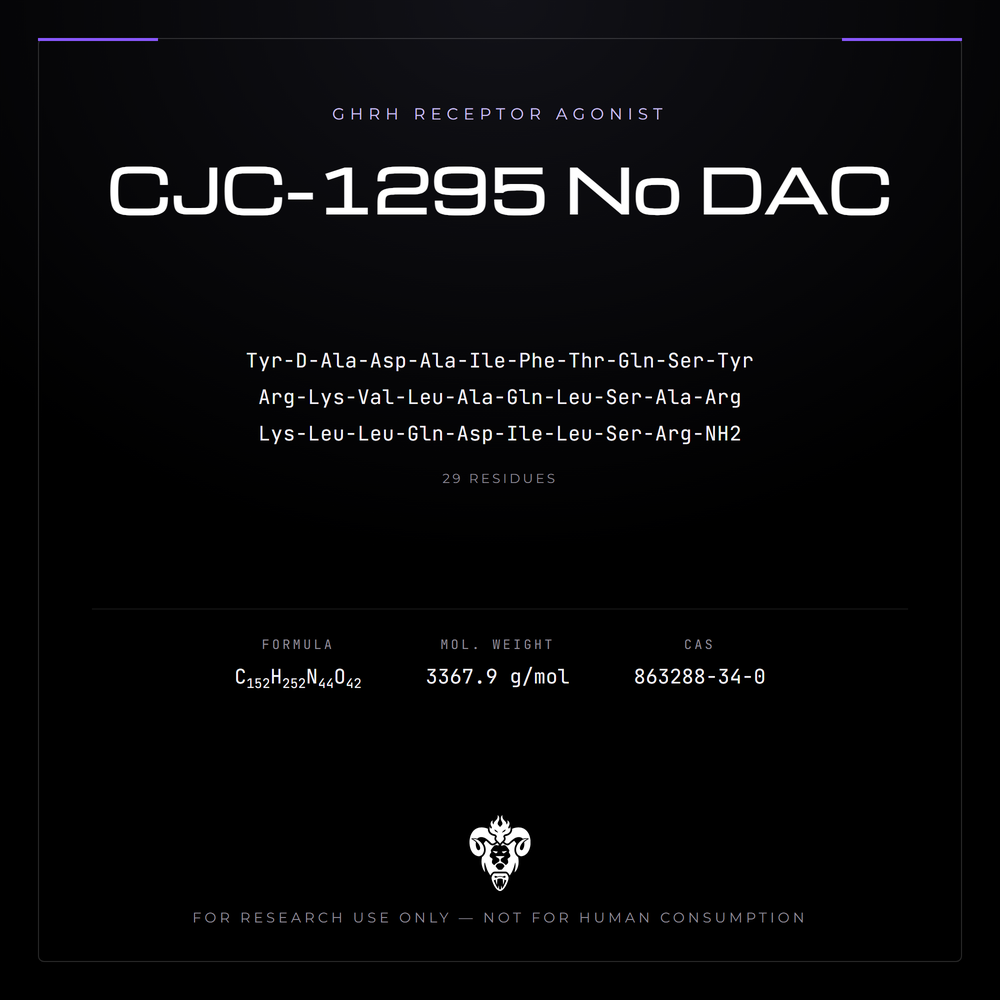
CJC-1295 No DAC (CAS 863288-34-0), also indexed as modified GRF(1-29), is a substituted analogue of GRF(1-29) engineered for resistance to dipeptidyl peptidase IV. The name is worth unpacking, because it describes what the molecule lacks: the Drug Affinity Complex, the maleimide group that lets the full CJC-1295 bind serum albumin. This compound keeps the protease-resistant backbone and drops the albumin carrier.[1,2]
Mechanism of Action & Research Context
The molecular target is the growth hormone-releasing hormone receptor (GHRH-R), a class II GPCR on pituitary somatotrophs — a different receptor from the GHS-R1a targeted by the ghrelin-mimetic secretagogues.
-
The receptor. GHRH-R is a class II G-protein-coupled receptor required for normal growth hormone synthesis and release, and for normal growth and proliferation of pituitary somatotrophs. Mutations in mouse and human are associated with GH deficiency, short stature and pituitary hypoplasia. Alternative mRNA splicing produces variants proposed to act as dominant-negative inhibitors of the wild-type receptor.[3]
-
DPP-IV is the limiting factor. GRF(1-29)NH2 is degraded mainly by dipeptidyl peptidase IV, which clips the N-terminal dipeptide to leave inactive GRF(3-29)NH2. Analogues designed to resist plasma DPP-IV are markedly more stable, and that resistance carries across compartments — a DPP-IV-resistant analogue was far more stable than the parent in intestinal enterocytes as well as plasma.[2]
-
What “No DAC” changes. The tetrasubstituted GRF(1-29) backbone resists DPP-IV, so it survives the cleavage that inactivates sermorelin. But without the maleimide it does not conjugate to albumin, so it does not acquire the multi-day circulating presence that defines the DAC version. Substituting one for the other in an experiment changes the exposure profile substantially, not marginally.[1,2]
-
No sulfur in the formula. C152H252N44O42 contains no sulfur, unlike sermorelin’s, which reflects substitution of the native Met27. That is a quick identity check against a COA.
Research Applications
Primary fields of in vitro and preclinical laboratory investigation include:
-
GH secretion assays in cultured anterior pituitary cells.[1]
-
Comparative protease stability against unmodified GRF(1-29).[2]
-
Exposure-profile comparisons against the albumin-binding DAC analogue.[1]
-
Receptor pharmacology at GHRH-R.[3]
Analytical Documentation
Purity and identity vary by manufacturing lot. Kimera Chems does not publish a single fixed purity figure for this item; refer to the batch-specific Certificate of Analysis (COA) issued for the lot received, which reflects third-party analytical testing for that lot.
References
- Jetté L, Léger R, Thibaudeau K, et al. Human growth hormone-releasing factor (hGRF)1-29-albumin bioconjugates activate the GRF receptor on the anterior pituitary in rats: identification of CJC-1295 as a long-lasting GRF analog. Endocrinology. 2005;146(7):3052–3058. doi:10.1210/en.2004-1286
- Bai JP, Chang LL. The involvement of dipeptidyl peptidase IV in brush-border degradation of GRF(1-29)NH2 by intestinal mucosal cells. J Pharm Pharmacol. 1995;47(8):698–701. doi:10.1111/j.2042-7158.1995.tb05863.x
- Gaylinn BD. Growth hormone releasing hormone receptor. Recept Channels. 2002;8(3–4):155–162. PMID: 12529933.
Storage & Handling
Store at controlled room temperature, sealed and protected from light.
Storage guidance is a house recommendation. Analytical documentation is per-lot release testing.
Related Research Compounds
Research Use Only Disclaimer: This product is labeled and sold “For Research Use Only – NOT FOR HUMAN CONSUMPTION.” It is not a drug, dietary supplement, food, cosmetic, or medical device, and it is not approved by the FDA or any other regulator for human or veterinary use. It is supplied to approved account holders as a research chemical for laboratory use and must be handled in accordance with applicable law.