Skip to content


GHRP-6 Research Standard
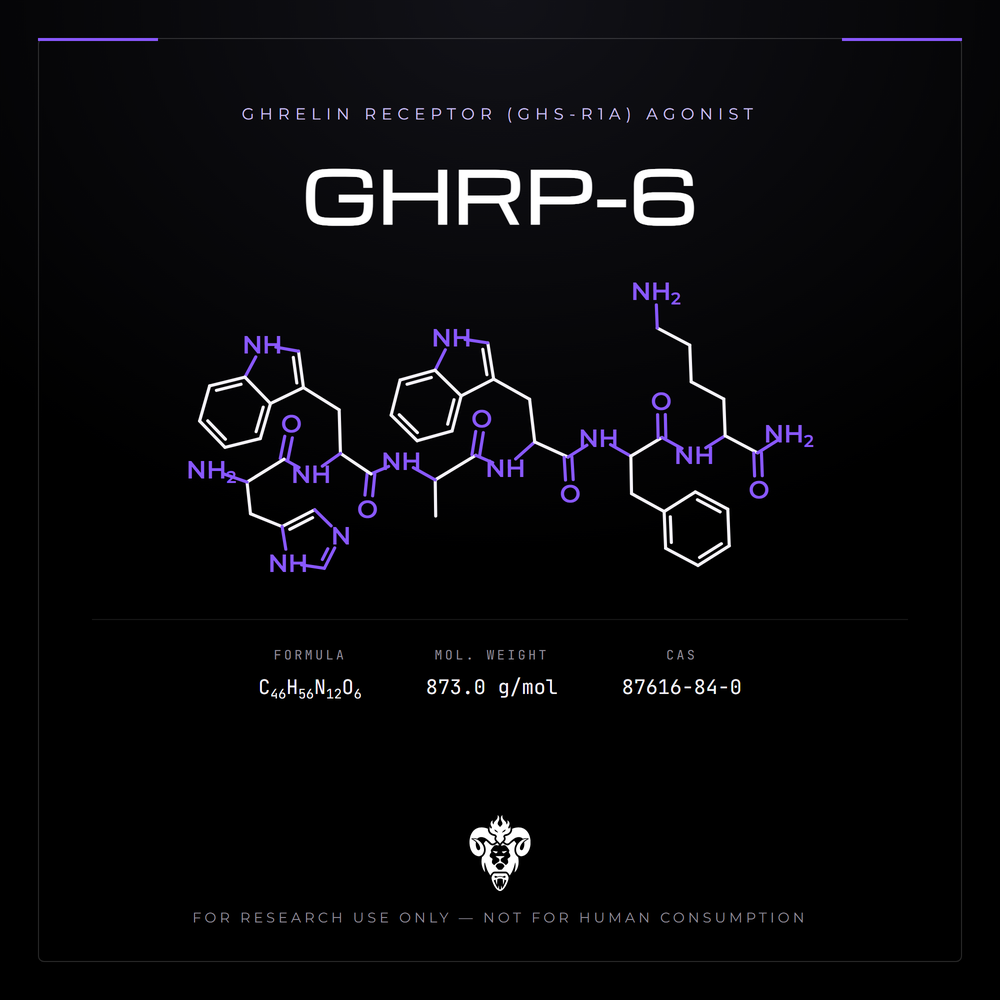
GHRP-6 is a synthetic hexapeptide growth hormone-releasing peptide, supplied as a 5 mg lyophilized powder in a 3 mL vial. It is the comparator the rest of this class is measured against: when a new secretagogue is characterised, GHRP-6 is almost always the reference arm.[1]
Mechanism of Action & Research Context
The molecular target is the growth hormone secretagogue receptor GHS-R1a, a class A G-protein-coupled receptor whose endogenous ligand is ghrelin, a peptide produced predominantly by the stomach.
-
The reference standard for the class. In primary rat pituitary cells GHRP-6 released GH with EC50 = 2.2 ± 0.3 nmol/L, defined as 100% efficacy in that comparison; in anaesthetised rats ED50 = 115 ± 36 nmol/kg.[1]
-
It is not GH-selective. In swine, GHRP-6 raised plasma ACTH and cortisol alongside GH. That corticotropic component is the confound ipamorelin was developed to remove, and it is the reason GHRP-6 and ipamorelin are not interchangeable in study design.[1]
-
Part of the response may be indirect. Radiolabelled GHRPs accumulate in the glandular stomach, the site of ghrelin synthesis. Resecting the gastrointestinal tract attenuated the GH response to GHRP-6 by 60–70% while leaving the GHRH response intact, which points to endogenous ghrelin mediating a substantial share of the effect rather than the peptide acting on the pituitary alone.[3]
-
A shared pharmacophore. The peptidic secretagogues converge on the core Ala-Trp-(D-Phe)-Lys. Radio-competitive assay against radiolabelled ghrelin at GHSR1a has mapped which substitutions at positions 1, 2, 3 and 7 preserve or destroy binding across GHRP-1, GHRP-2, GHRP-6, hexarelin and ipamorelin — and confirmed that active metabolites, not only intact parent, retain receptor binding.[2]
-
An unusually constitutively active receptor. GHS-R1a is notable among GPCRs for high ligand-independent signalling. The interaction between the ligand-binding transmembrane domains and extracellular loop 2 appears partly responsible. That basal activity drives PLC, PKC and CRE signalling, is reversed by the inverse agonist [D-Arg1, D-Phe5, D-Trp7,9, Leu11]-substance P, and the receptor also shows C-terminal-dependent constitutive internalisation. A nonsense mutation (Ala204Glu) that alters only the constitutive activity is associated with familial short stature, which is the strongest evidence that the basal signalling matters rather than being an artefact.[4]
Research Applications
Primary fields of in vitro and preclinical laboratory investigation include:
-
Radio-competitive receptor binding assays against radiolabelled ghrelin at GHSR1a.[2]
-
GH release assays in primary pituitary cell culture, with GHRP and GHRH antagonists to establish which receptor is carrying the response.[1]
-
Constitutive-activity and inverse-agonist work at GHS-R1a.[4]
-
Structure-activity studies across the shared Ala-Trp-(D-Phe)-Lys core.[2]
-
Metabolite and analytical method development, where active metabolites retain receptor binding.[2]
Analytical Documentation
Purity and identity vary by manufacturing lot. Kimera Chems does not publish a single fixed purity figure for this item; refer to the batch-specific Certificate of Analysis (COA) issued for the lot received, which reflects third-party analytical testing for that lot.
References
- Raun K, Hansen BS, Johansen NL, et al. Ipamorelin, the first selective growth hormone secretagogue. Eur J Endocrinol. 1998;139(5):552–561. doi:10.1530/eje.0.1390552
- Ferro P, Krotov G, Zvereva I, Rodchenkov G, Segura J. Structure-activity relationship for peptidic growth hormone secretagogues. Drug Test Anal. 2017;9(1):87–95. doi:10.1002/dta.1947
- Ahnfelt-Rønne I, Nowak J, Olsen UB. Do growth hormone-releasing peptides act as ghrelin secretagogues? Endocrine. 2001;14(1):133–135. doi:10.1385/ENDO:14:1:133
- Mear Y, Enjalbert A, Thirion S. GHS-R1a constitutive activity and its physiological relevance. Front Neurosci. 2013;7:87. doi:10.3389/fnins.2013.00087
- Locatelli V, Bresciani E, Bulgarelli I, et al. Ghrelin in gastroenteric pathophysiology. J Endocrinol Invest. 2005;28(9):843–848. doi:10.1007/BF03347579
Storage & Handling
Store at controlled room temperature, sealed and protected from light.
Storage guidance is a house recommendation. Analytical documentation is per-lot release testing.
Related Research Compounds
Research Use Only Disclaimer: This product is labeled and sold “For Research Use Only – NOT FOR HUMAN CONSUMPTION.” It is not a drug, dietary supplement, food, cosmetic, or medical device, and it is not approved by the FDA or any other regulator for human or veterinary use. It is supplied to approved account holders as a research chemical for laboratory use and must be handled in accordance with applicable law.