Skip to content

ACE-031 (Myostatin Inhibitory Peptide 7)
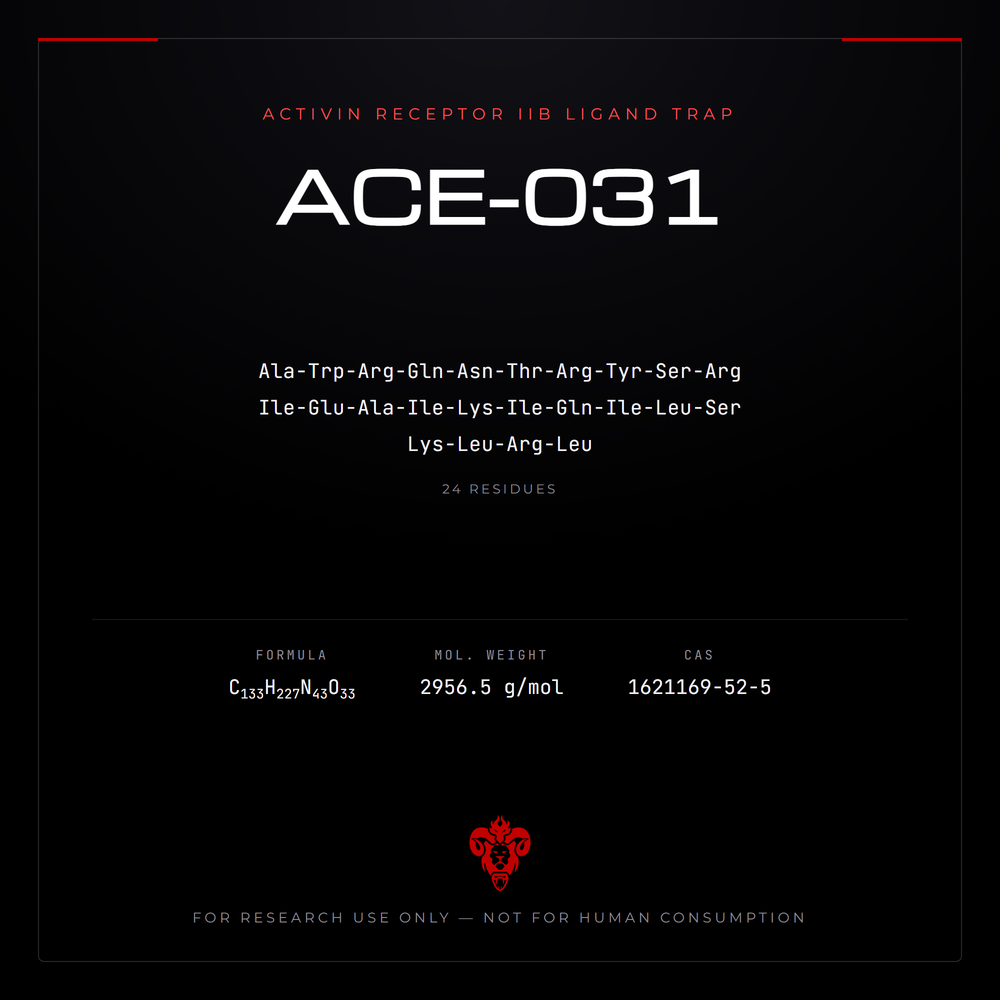
ACE-031 (Myostatin Inhibitory Peptide 7) is a synthetic 24-residue peptide, Ala-Trp-Arg-Gln-Asn-Thr-Arg-Tyr-Ser-Arg-Ile-Glu-Ala-Ile-Lys-Ile-Gln-Ile-Leu-Ser-Lys-Leu-Arg-Leu-NH2 (CAS 1621169-52-5, C133H227N43O33, MW 2956.5). It is a myostatin inhibitory peptide, not the recombinant ActRIIB-Fc fusion protein that shares the ACE-031 name in the literature.
Much of the published ACE-031 literature describes that ActRIIB-Fc decoy, a soluble activin receptor type IIB extracellular domain fused to an immunoglobulin Fc region. It is a ligand trap with a broad capture profile, and the published comparisons are explicit about the consequence: a decoy receptor and a myostatin-selective neutralising antibody do not produce the same result. Both increase muscle mass; only the decoy increases bone mass, and the difference persists in myostatin-deficient animals, which means the extra effect belongs to some other captured ligand. Any experiment using this class needs a selective comparator to say which ligand is responsible.
Additional Properties
| Property | Specification |
|---|---|
| Molecular Targets | Myostatin (GDF-8) |
| Appearance | White to off-white lyophilized powder |
Identity note: the full ActRIIB-Fc fusion described in the primary literature is a glycosylated dimeric protein of roughly 76 kDa. The formula and mass above describe the peptide sequence supplied under this catalogue entry, which is a substantially smaller construct. Confirm which entity an experiment requires against the lot certificate before designing around published fusion-protein data.
Research Applications & Mechanism of Action
Myostatin is a negative regulator of skeletal muscle mass, acting through ActRIIB and the Smad2/3 branch of TGF-beta signalling. Removing that brake, genetically or pharmacologically, increases muscle mass. A myostatin inhibitory peptide targets this pathway with a small synthetic sequence, which distinguishes it from the broad ActRIIB-Fc decoy, from receptor-blocking strategies and from myostatin gene deletion.
Primary fields of in vitro and preclinical laboratory investigation include:
-
Myostatin Selectivity: Comparing a myostatin inhibitory peptide against a broad ligand trap in the same model to establish which effects require ligands other than myostatin.
-
Myoblast Differentiation: Measuring myogenic marker expression and myoblast fusion in culture when myostatin signalling is suppressed.
-
Musculoskeletal Coupling: Examining bone histomorphometry alongside muscle mass, where trabecular thickness, trabecular number and bone formation rate are the readouts.
-
Smad Pathway Analysis: Tracking Smad2/3 phosphorylation as the proximal signalling consequence of myostatin inhibition.
-
Comparative Construct Work: Benchmarking against activin-receptor-derived traps such as the ActRIIB-Fc decoy in the same assay system.
Selected Research Literature
Peer-reviewed preclinical literature indexed on PubMed, provided for scientific context only. These are animal and in-vitro studies; nothing here describes or implies a use for this material.
- Bialek P, Parkington J, Li X, et al. A myostatin and activin decoy receptor enhances bone formation in mice. Bone. 2013;60:162-171. doi:10.1016/j.bone.2013.12.002
- Fakhfakh R, Lee SJ, Tremblay JP. Administration of a soluble activin type IIB receptor promotes the transplantation of human myoblasts in dystrophic mice. Cell Transplant. 2012;21(7):1419-1430. doi:10.3727/096368911X627480
Assay note. Bialek et al. tested the decoy in myostatin-deficient animals and still saw a bone effect, then ruled out BMP3 as the responsible ligand by repeating the experiment in BMP3-deficient animals. The captured ligand behind that effect remains unidentified, so attributing any decoy-receptor result specifically to myostatin requires the selective comparator arm.
Analytical Documentation
Purity, identity, and composition vary by manufacturing lot. Kimera Chems does not publish a single fixed purity figure for this item; refer to the batch-specific Certificate of Analysis (COA) issued for the lot received, which reflects third-party analytical testing for that lot. Contact us if a COA for your lot is required.
Storage & Handling
Store at controlled room temperature, sealed and protected from light.
Storage guidance is a house recommendation. Analytical documentation is per-lot release testing.
Related Research Compounds
Research Use Disclaimer
Research Use Only Disclaimer: This product is labeled and sold “For Research Use Only — NOT FOR HUMAN CONSUMPTION.” It is not a drug, dietary supplement, food, cosmetic, or medical device, and it is not approved by the FDA or any other regulator for human or veterinary use. It is supplied to approved account holders as a research chemical for laboratory use and must be handled in accordance with applicable law.