Skip to content

IGF-1 LR3 Research Standard
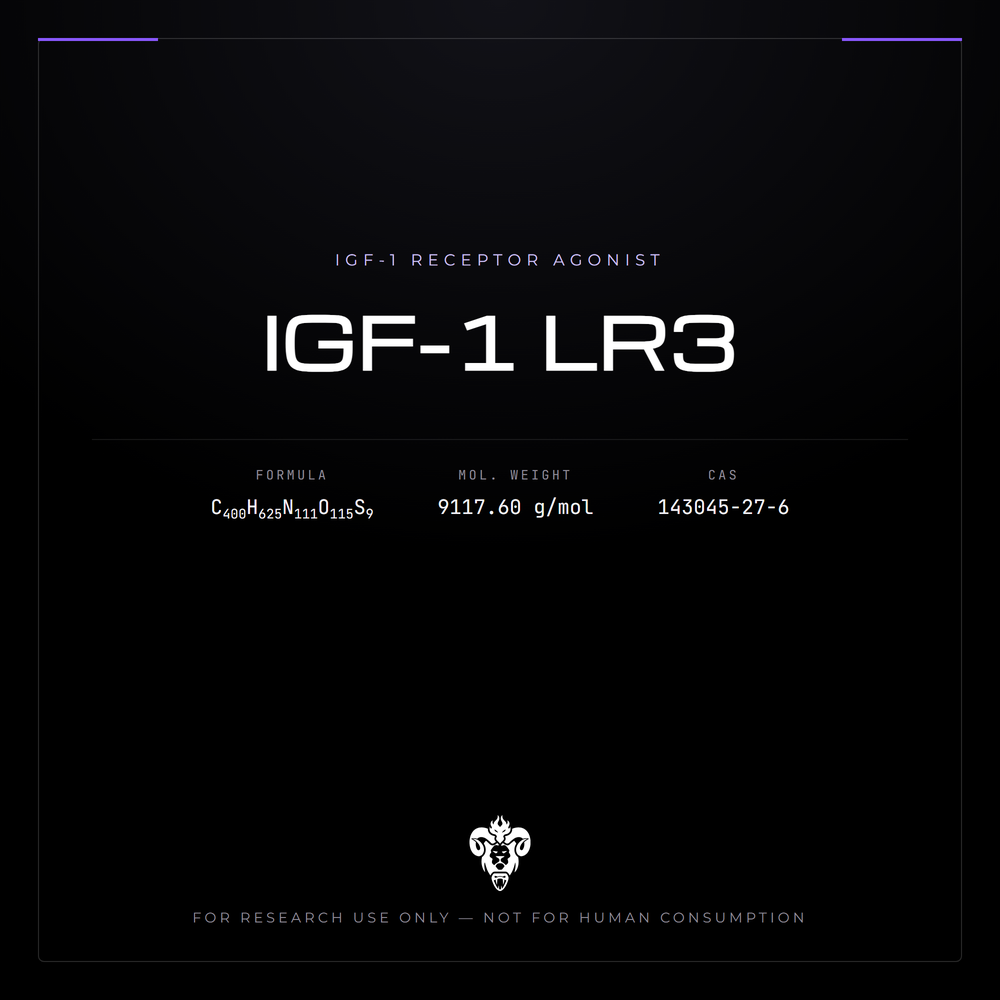
IGF-1 LR3 (CAS 143045-27-6), also indexed as Long R3 IGF-1, is a recombinant 83-residue analogue of insulin-like growth factor I, supplied as a 1 mg lyophilized powder in a 3 mL vial. It exists to solve one specific problem in IGF research: native IGF-1 is largely sequestered by binding proteins, and this analogue is engineered to escape them.[1,2]
Mechanism of Action & Research Context
The molecular target is the type 1 IGF receptor. What distinguishes this analogue is not its receptor behaviour but its binding-protein behaviour.
-
High receptor affinity, low IGFBP affinity. Long R3 IGF-I is characterised as an IGF-I analogue with high receptor affinity and much reduced affinity for the IGF binding proteins. Since IGF effects in tissue are mediated by the interaction of both receptors and IGFBPs, an analogue that sidesteps one arm isolates the other.[1,2]
-
Tissue-selective effects without whole-body growth. The most instructive result, and one that resists the obvious summary: in guinea pigs infused for 7 days, Long R3 IGF-I significantly increased the fractional weight of adrenals, gut, kidneys and spleen — while overall growth was not stimulated. Body weight gain, feed intake, feed conversion efficiency and carcass composition were all unaffected.[1]
-
It lowers circulating IGF and IGFBP concentrations. Infusion reduced plasma IGF-I, IGF-II and IGF binding protein levels. So the analogue perturbs the endogenous system it is being used to probe, which needs accounting for in any design measuring circulating IGF as an endpoint.[1]
-
Efficacy at the tissue level. In artificially reared newborn rat pups, dietary Long R3 IGF-I increased intestinal villus height and cell counts above both formula-fed and mother-fed controls, confirming activity on gut epithelium.[2]
Research Applications
Primary fields of in vitro and preclinical laboratory investigation include:
-
IGFBP-independent receptor studies, using reduced binding-protein affinity to separate receptor-mediated from IGFBP-mediated effects.[1,2]
-
Organ-specific growth measurement, reported as fractional weight rather than whole-body mass.[1]
-
Intestinal epithelium models, including villus morphometry and IGF receptor distribution.[2]
-
Circulating IGF and IGFBP quantification as a control for system-level perturbation.[1]
-
Comparative pharmacology against native IGF-I and IGF-II.[1]
Analytical Documentation
Purity and identity vary by manufacturing lot. Kimera Chems does not publish a single fixed purity figure for this item; refer to the batch-specific Certificate of Analysis (COA) issued for the lot received, which reflects third-party analytical testing for that lot.
References
- Conlon MA, Tomas FM, Owens PC, Wallace JC, Howarth GS, Ballard FJ. Long R3 insulin-like growth factor-I (IGF-I) infusion stimulates organ growth but reduces plasma IGF-I, IGF-II and IGF binding protein concentrations in the guinea pig. J Endocrinol. 1995;146(2):247–253. doi:10.1677/joe.0.1460247
- Staley MD, Gibson CA, Herbein JF, Grosvenor CE, Baumrucker CR. Rat milk and dietary long arginine3 insulin-like growth factor I promote intestinal growth of newborn rat pups. Pediatr Res. 1998;44(4):512–518. doi:10.1203/00006450-199810000-00008
Storage & Handling
Storage after receipt: refrigerate at 2-8 °C. Do not freeze. Refrigeration is a post-receipt storage condition, not a transit requirement.
Storage guidance is a house recommendation. Analytical documentation is per-lot release testing.
Related Research Compounds
Research Use Only Disclaimer: This product is labeled and sold “For Research Use Only – NOT FOR HUMAN CONSUMPTION.” It is not a drug, dietary supplement, food, cosmetic, or medical device, and it is not approved by the FDA or any other regulator for human or veterinary use. It is supplied to approved account holders as a research chemical for laboratory use and must be handled in accordance with applicable law.