Skip to content
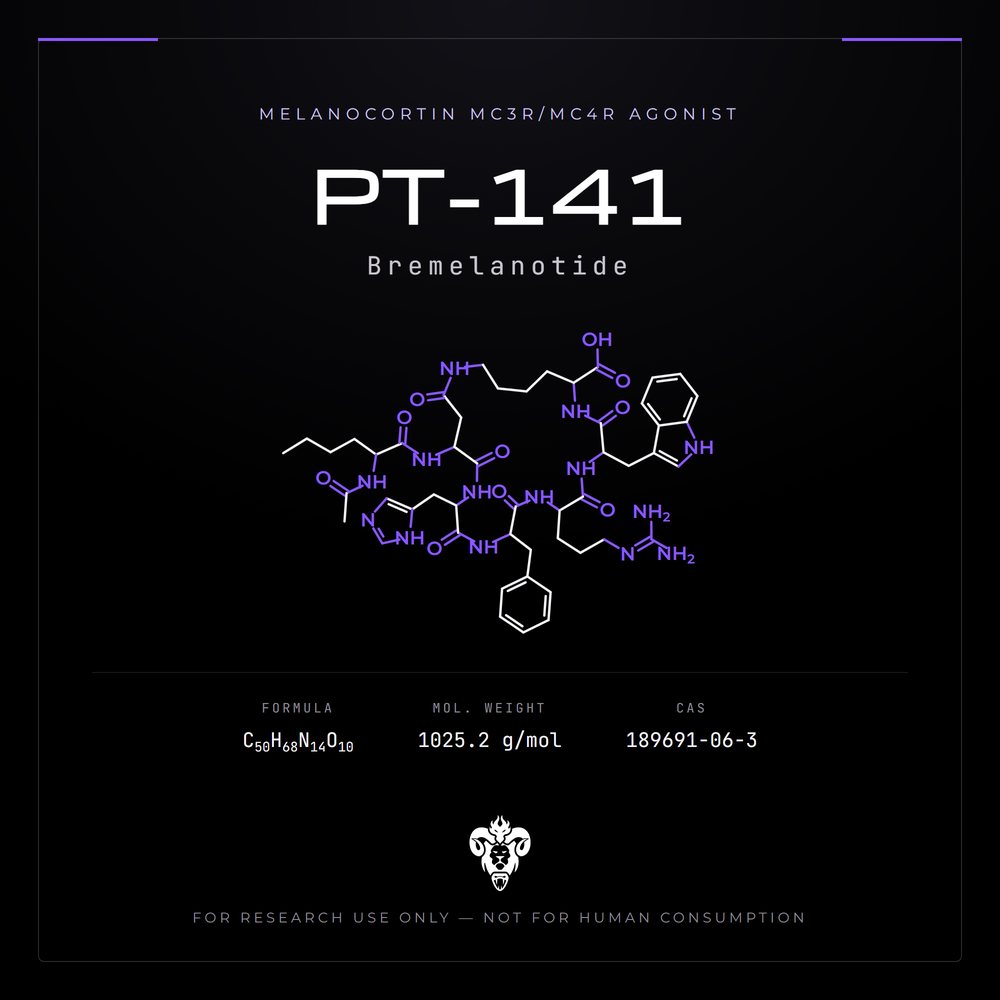

PT-141 (Bremelanotide) Research Standard
PT-141, known generically as bremelanotide (CAS 189691-06-3), is a synthetic cyclic heptapeptide analogue of the endogenous neuropeptide α-melanocyte-stimulating hormone (α-MSH). Supplied as a 10 mg lyophilized powder in a 3 mL vial, it is used in the laboratory as a reference agonist at the melanocortin receptors — five class A G-protein-coupled receptors (MC1R–MC5R) that couple to Gs, adenylyl cyclase and cyclic AMP. Its side-chain lactam bridge closes the peptide into a macrocycle that holds the conserved His-Phe-Arg-Trp message sequence in a fixed orientation, which is what makes it a stable comparator in receptor binding and second-messenger work.
Mechanism of Action & Research Context
Bremelanotide is a non-selective melanocortin agonist: it binds across several receptor subtypes rather than discriminating sharply between them. That breadth is precisely why it is useful as a reference point in subtype-comparison panels.
The His-Phe-Arg-Trp message sequence. All melanocortin agonists share this tetrapeptide core. Systematic truncation of NDP-α-MSH established that the motif does not engage every subtype in the same way, overturning the earlier assumption of a common binding mode and setting the basis for subtype-selective design.[1]
Macrocyclisation and conformational constraint. The message sequence is flexible in linear peptides. Closing it into a ring pre-organises the bioactive conformation, and constrained cyclic α-MSH analogues have reached greater than 5000-fold selectivity for a single subtype with low-nanomolar IC50 and EC50 values in CHO cells expressing human receptors.[4] Comparative work on cyclised MC4R agonists shows ring constraint shifting selectivity by two to three orders of magnitude without sacrificing agonist potency.[5]
Gs–adenylyl cyclase–cAMP coupling. Melanocortin receptors raise intracellular cAMP on agonist binding, and cAMP accumulation is the standard functional readout for the family. Luminescent real-time cAMP reporters in MC4R-expressing HEK293 lines are an established platform for quantifying it.[6]
Residue chemistry drives selectivity. In α-MSH/γ-MSH hybrid series, increasing hydrophobicity and substituting bulkier aromatic residues at positions 6 and 8 is what separates MC1R- from MC3R-preferring analogues — a direct handle for structure-activity work on the cyclic scaffold.[3]
Assay format changes the number. EC50 values for melanocortin agonists differ measurably between cAMP accumulation and transcriptional reporter formats, so the assay has to be reported alongside the potency figure. This is a documented pitfall in MC4R agonist screening.[5]
Research Applications
Primary fields of in vitro laboratory investigation include:
Receptor binding panels. Determining affinity (Ki, IC50) across MC1R–MC5R in transiently or stably transfected cell lines, with a non-selective agonist as the anchor point.[2]
cAMP functional assays. Benchmarking Gs-coupled second-messenger output against a characterised agonist standard.[6]
Structure-activity relationship (SAR) studies. Testing how ring size, bridge chemistry and residue substitution alter potency and subtype preference within the cyclic melanocortin scaffold.[3,4,5]
Molecular docking and structural modelling. Supplying experimental affinity data to validate computational models of the melanocortin binding pocket.
Comparative pharmacology. Profiling synthetic analogues against endogenous ligands such as α-MSH and ACTH, and against the endogenous antagonist AgRP.[2]
Analytical Documentation
Purity and identity vary by manufacturing lot. Kimera Chems does not publish a single fixed purity figure for this item; refer to the batch-specific Certificate of Analysis (COA) issued for the lot received, which reflects third-party analytical testing for that lot.
References
- Haskell-Luevano C, Hendrata S, North C, et al. Discovery of prototype peptidomimetic agonists at the human melanocortin receptors MC1R and MC4R. J Med Chem. 1997;40(14):2133–2139. doi:10.1021/jm960840h
- Schiöth HB, Muceniece R, Wikberg JE. Characterization of the binding of MSH-B, HB-228, GHRP-6 and 153N-6 to the human melanocortin receptor subtypes. Neuropeptides. 1997;31(6):565–571. doi:10.1016/s0143-4179(97)90002-0
- Cai M, Mayorov AV, Cabello C, et al. Novel 3D pharmacophore of alpha-MSH/gamma-MSH hybrids leads to selective human MC1R and MC3R analogues. J Med Chem. 2005;48(6):1839–1848. doi:10.1021/jm049579s
- Bednarek MA, MacNeil T, Tang R, et al. Potent and selective agonists of human melanocortin receptor 5: cyclic analogues of alpha-melanocyte-stimulating hormone. J Med Chem. 2007;50(10):2520–2526. doi:10.1021/jm0614275
- Palmer D, Gonçalves JPL, Hansen LV, et al. Click-chemistry-mediated synthesis of selective melanocortin receptor 4 agonists. J Med Chem. 2017;60(21):8716–8730. doi:10.1021/acs.jmedchem.7b00353
- Pantel J, Williams SY, Mi D, et al. Development of a high throughput screen for allosteric modulators of melanocortin-4 receptor signaling using a real time cAMP assay. Eur J Pharmacol. 2011;660(1):139–147. doi:10.1016/j.ejphar.2011.01.031
Storage & Handling
Store at controlled room temperature, sealed and protected from light.
Storage guidance is a house recommendation. Analytical documentation is per-lot release testing.